
BuddhistCatholicContemplativeEvangelicalGeneral ChristianHinduJewishLatter-day SaintMuslimNew VisionsProgressive Christian
Beliefs
- Buddhist
- Catholic
- Contemplative
- Evangelical
- General Christian
- Hindu
- Jewish
- Latter-day Saint
- More Voices
- Muslim
- New Visions
- Pagan
- Progressive Christian
Topics
- Religion News
- Food and Religion
- Sports and Religion
- Religious Art
- Religious Music and Entertainment
- Religious Events
- History and Religion
- Style and Religion
- Politics and Religion
- Women in Religion
- Recreation Outdoors and Religion
- Business Finance and Religion
- Careers Workplace and Religion
- Education and Religion
- Family Parenting and Religion
- Health Fitness and Religion
- Home and Religion
- Relationships and Religion
- Technology and Religion
- Travel and Religion
Columnists
- Buddhist Columnists
- Business Finance and Religion Columnists
- Careers Workplace and Religion Columnists
- Catholic Columnists
- Contemplative Columnists
- Education and Religion Columnists
- Evangelists Columnists
- Family Parenting and Religion Columnists
- General Christian Columnists
- Health Fitness and Religion Columnists
- Hindu Columnists
- History and Religion Columnists
- Home and Religion Columnists
- Jewish Columnists
- More Voices Columnists
- Latter Day Columnists
- Muslim Columnists
- New Visions Columnists
- Nonreligious Columnists
- Pagan Columnists
- Politics and Religion Columnists
- Progressive Columnists
- Recreation Outdoors and Religion Columnists
- Relationships and Religion Columnists
- Religion News Columnists
- Religious Art Columnists
- Religious Events Columnists
- Religious Music and Entertainment Columnists
- Sports and Religion Columnists
- Style and Religion Columnists
- Technology and Religion Columnists
- Travel and Religion Columnists
- Women in Religion Columnists
Resource Library
- 2026 Calendar
- Library of World Religions
- The 100 Most Holy Places on Earth
- Patheos Answers
- Podcasts
- Videos
- Faith Leaders Database
- Anglican Episcopalian
- Bahai
- Baptist
- Buddhism
- Christianity
- Confucianism
- Eastern Orthodoxy
- Hinduism
- Holiness and Pentecostal
- ISKCON
- Islam
- Judaism
- Lutheran
- Methodist
- The Church of Jesus Christ of Latter-day Saints
- New Age
- Paganism
- Presbytarian and Reformed
- Protestantism
- Religion Behind the Scenes
- Roman Catholic
- Scientology
- Shia Islam
- Sikhism
- Sufism
- Sunni Islam
- Taoism
- Zen
- See all religions
Research Tools
 Ad-Free & Subscriber Log-In Subscription Support
Ad-Free & Subscriber Log-In Subscription Support
Follow Patheos 

- Trending:
- Forgiveness
- |
- Marriage
- |
- Consciousness
- |
- Death Penalty
- |
- Election
- |
- Halloween

- Home
- Jewish
- Religion News
- Hanukkah Celebrations Have Changed Dramatically − But The Same Is True Of Christmas
Hanukkah Celebrations Have Changed Dramatically − But The Same Is True Of Christmas
Last updated on: December 7, 2023 at 12:00 am by The Conversation
Hanukkah Celebrations Have Changed Dramatically − But The Same Is True Of Christmas 2023-12-07T00:00:42-04:00 The Conversation
Patheos Explore the world's faith through different perspectives on religion and spirituality! Patheos has the views of the prevalent religions and spiritualities of the world.
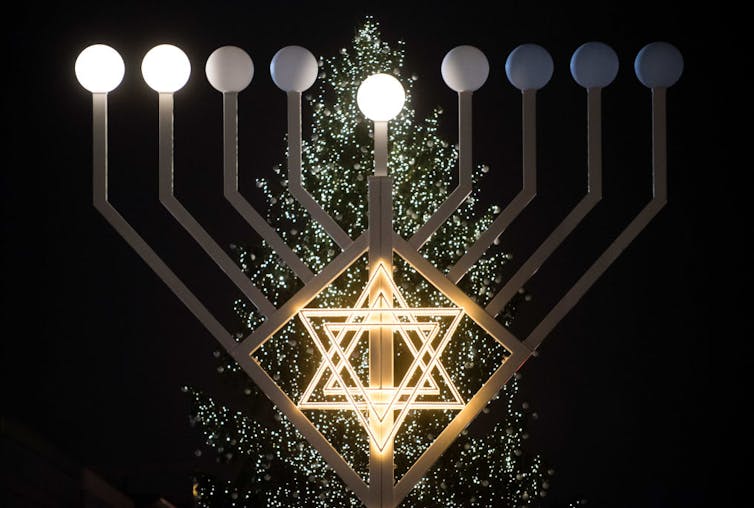
Candles on a large Hanukkah menorah shine in front of a Christmas tree at the Brandenburg Gate in Berlin, Germany, in 2015.
Gregor Fischer/picture alliance via Getty Images
By Samira Mehta of University of Colorado Boulder
Hanukkah is not the Jewish Christmas. Articles and op-eds in newspapers remind readers of that fact every year, lamenting that the Jewish Festival of Lights has almost become an imitation of the Christian holiday.
These pieces exist for a reason. Hanukkah is a minor festival in the Jewish liturgical year, whose major holidays come in the fall and spring – the High Holidays and Passover, respectively. Because of its proximity to Christmas, however, Hanukkah has been culturally elevated into a major celebration.
American shops and schools nod to diversity by putting up menorahs next to Christmas trees or including the dreidel song in the “holiday concert” alongside Santa, Rudolph or the Christ child. Even Chabad, an Orthodox Jewish movement, holds public menorah lightings that look remarkably like public Christmas tree lightings.
Store windows, doctors’ offices and college dining halls display Christmas trees and menorahs side by side, though the latter is a ritual object, not merely a decoration. A menorah, or “hanukkiah,” is lit in a specific way, on specific days, with accompanying prayers – more akin to a Christian Advent wreath than to the holly decking the halls.
Much of my Jewish studies and gender research focuses on interfaith families, for whom these issues can be especially tricky. I empathize with Jewish Americans worried about Hanukkah growing too similar to Christmas – but the history of both holidays is more complicated than these comparisons let on.

The four sons of a Jewish family in Brookline, Mass., light the first candle of their menorah during Hanukkah in 1971.
Spencer Grant/Getty Images
Ancient revolt
There’s a deep irony, of course, in seeing Hanukkah as a prime example of assimilation: The festival itself celebrates a victory against assimilation.
In 168 B.C.E., Antiochus IV Epiphanes, king of the Seleucid Empire, sent his army to conquer Jerusalem. He outlawed Jewish holidays, Shabbat observance and practices such as circumcision. His troops set up altars to the Greek gods in the Jewish temple, dedicating it to Zeus.
The Maccabees, a Jewish resistance movement led by a priestly family, opposed both Antiochus and Jews who assimilated to the conquering Greek culture. Hanukkah celebrates the rebels’ victory over the Seleucid army.
In the temple, the Jews kept an eternal flame burning – as synagogues do today. When the Maccabees reclaimed the temple, however, there was enough oil to last for only a day. Miraculously, the story says it lasted for a week: enough time to bring in more oil.
Traditional holiday celebrations, therefore, include lighting the menorah each night for eight days and eating food cooked in oil. Spinning dreidel games are also traditional, as are songs like “Maoz Tzur.”
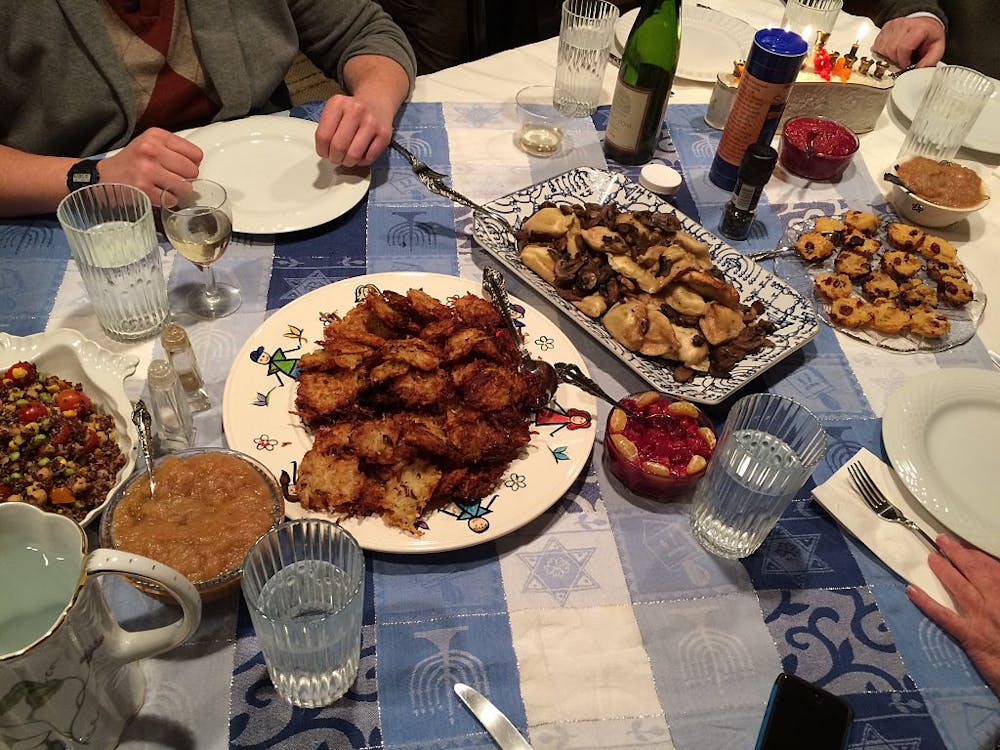
Latkes – fried potato pancakes – are one of the most popular Hanukkah foods in the U.S., usually served with applesauce or sour cream.
Lisa J Goodman/Moment Mobile via Getty Images
“Hanukkah bushes” topped with a Star of David, extravagant presents, community menorah lightings in the park, blue and white lights on houses and Hanukkah Advent calendars? Not traditional, if “traditional” means things that have happened for hundreds of years.
Carols and carousing
Assimilation to the United States’ Christian-majority culture has played a role in Hanukkah’s modern transformation. That said, the story of how Hanukkah came to have the commercial, kids-and-gifts focus that it has in the U.S. today is a bit more complicated.
When people worry that Hanukkah is simply a Jewish adaptation to the Christmas gift season, I think they are imagining that Christmas itself has always been as most Americans today know it – with the presents, the tree and the family togetherness. But, in fact, both contemporary Christmas and contemporary Hanukkah grew up together in response to the Industrial Revolution.
Before the Industrial Revolution, both Europe and North America were primarily agrarian societies. When the harvest was completed, the entire Advent season took on an air of revelry – there was caroling in the streets and a certain amount of drunken carousing. For the more wealthy, it was a season of parties and balls. Sometimes, there would be class-based conflict – like vandalism or other crimes – between the wealthy partygoers and the working-class street parties.
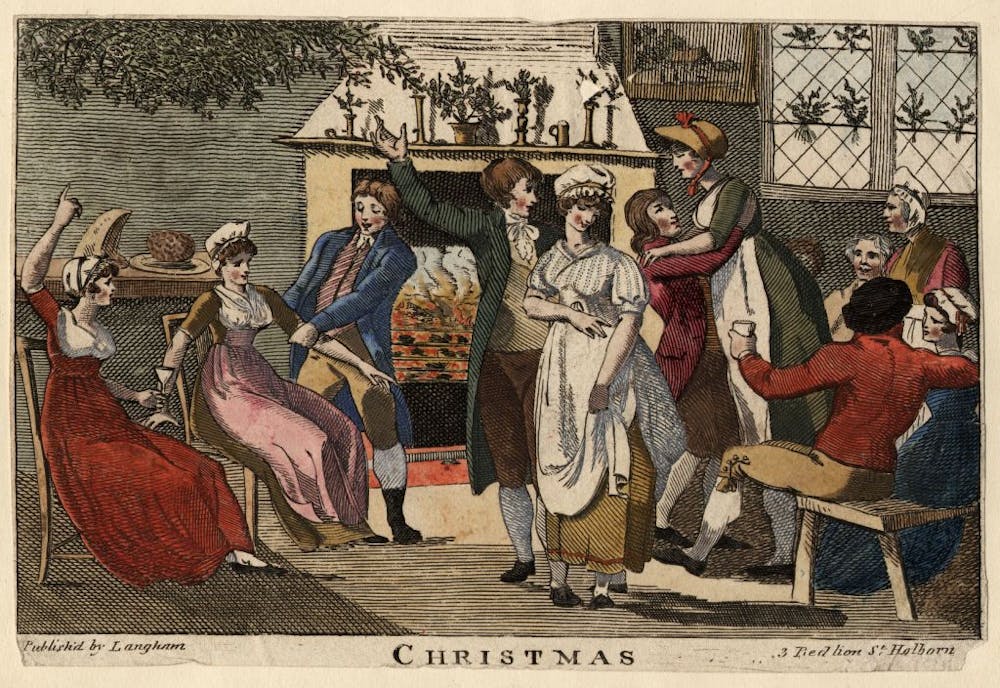
A 19th century Christmas celebrations in London – not exactly puritanical.
Hulton Archive/Getty Images
The highlight of the season was New Year’s rather than Christmas. Gifts, if any, were small and usually handmade. The wealthy gave end-of-the-year bonuses to servants and tradespeople. All in all, the season was as much about friends as family, and celebrated in public as much or more than in private.
For a variety of reasons, social campaigners in the early 19th century looked to make Christmas into the domestic celebration of consumption that we have today. The shift from seasonal farm work to round-the-clock factory work made the evenings of carousing problematic, for example – hungover workers are not good workers – and moving the celebration to a single day solved that problem. Meanwhile, religious voices tried to emphasize Christmas as a celebration of Christ in Christian homes.
But more to the point, the Industrial Revolution created a huge market of relatively affordable goods that needed a market. Christmas provided an abundant market. And so did Hanukkah.
New needs, new traditions
Jews received the same advertisements for gifts and festive foods as their Christian neighbors, and it was hard to resist the pull of the celebratory season. However, the late American studies scholar Dianne Ashton’s book “Hanukkah in America: A History” suggests that Hanukkah did not take its current form only because American Jews were imitating Christmas in some sort of religious version of keeping up with the Joneses.
Hanukkah, which is celebrated mostly in the home, gave Jewish women a place to shine – much like a domestic Christmas gave such opportunities to Christian women. It allowed Jews to focus on the family bonds, which often felt fragile and precious in the shadow of immigration and relatives left behind.
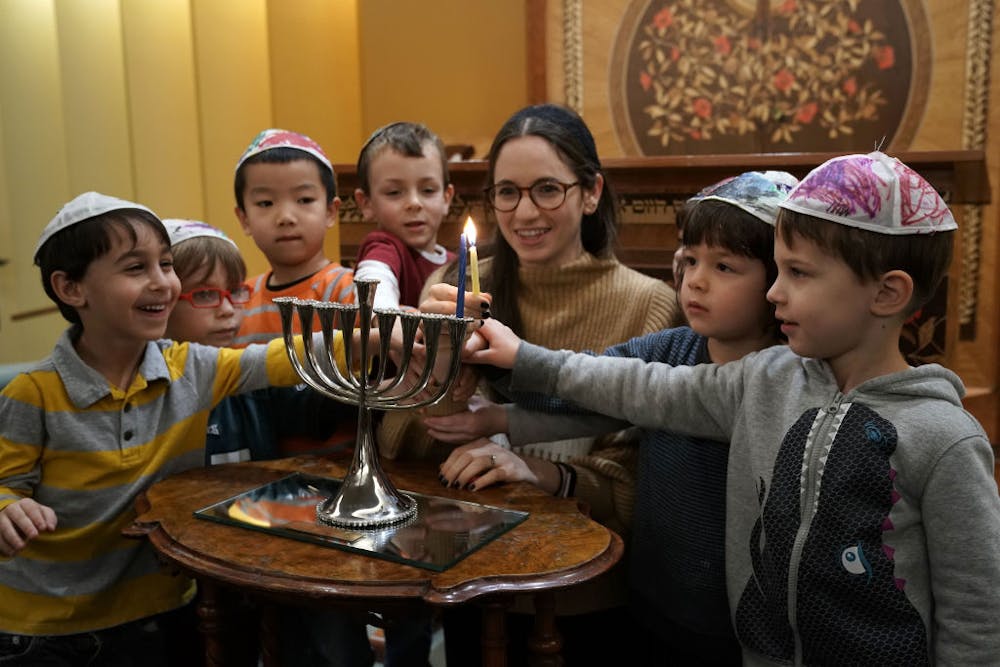
A rabbi teaches preschoolers how to light a Hanukkah menorah in November 2018 in Washington, D.C.
Alex Wong/Getty Images
And focusing on children, such as by having them light the candles – a job traditionally done by adult men – offered a way to engage the next generation in a time and place where being Jewish felt like a choice.
In America, Jews were full citizens, free from the laws that had previously kept their communities isolated in many parts of Europe. That freedom also made it easier for each individual to choose how much to engage with Jewish community, if at all. In America, you could leave your Judaism behind without converting to Christianity – and many Jews did. Hanukkah was a fun way to build attachments to the holiday.
American Jews adapted Hanukkah to their own needs, emphasizing aspects of the religion that made it work in this new environment. One can see that as assimilation, sure, but it was also adaptation for survival. Joining in the “holiday season” did mitigate the feeling of being an outsider, and a minority, at the holidays. But it also allowed for the creation of a new way of engaging Judaism in a new space and time.
This article is republished from The Conversation, a nonprofit, independent news organization dedicated to unlocking the knowledge of experts for the public good.
Jewish
General Christian
Religious Events

About Samira Mehta
Samira Mehta is an Associate Professor of Women and Gender Studies & Jewish Studies at the University of Colorado Boulder. You can read more about the author here.
Next Post

December 13, 2023 Mike Johnson represented a creationist museum in court
Browse Our Archives
Select a Category Buddhism Christianity Hinduism Islam Judaism Religion and society Uncategorized
Select a Month July 2024 March 2024 February 2024 January 2024 December 2023 November 2023 October 2023 September 2023 August 2023 July 2023 January 2023 August 2022 July 2022 April 2022 February 2022 January 2022 October 2021 July 2021 June 2021 May 2021 April 2021 March 2021 February 2021 January 2021 December 2020 November 2020 October 2020 September 2020 August 2020 July 2020 June 2020 May 2020
Follow Us!
TAKE THE
Religious Wisdom Quiz
How long did it take to rebuild Jerusalem's walls under Nehemiah?
Select your answer to see how you score.
40 days 52 days 7 years 12 months
Related posts from The Conversation


Electing A Virtuous President Would Make Immunity Irrelevant

Why The Olympic Games Are A ‘Civil Religious’...

The Catholic Church Is Using The Olympics To...
TRENDING AT PATHEOS Religion News

Catholic Integralists believe that religious values – specifically Christian ones – should...

Electing A Virtuous President Would Make Immunity Irrelevant
Presidential immunity can bring with it many risks. So how can we...

Why The Olympic Games Are A ‘Civil Religious’...
Sporting events form a vital space where Americans display their 'civil religious...

After more than a decade of news, research updates, and insights on...

Q: Why do Southern Baptists and like-minded Protestants...
THE RELIGION GUY’S ANSWER: Why? Simple. Because they believe that’s what the...

THE QUESTION: Is gambling evil? THE RELIGION GUY’S ANSWER: Analysts anticipate a...
view all Religion News blogs
Ad-Free & Subscriber Log-In Subscription Support
- About Us
- 2026 Calendar
- Videos
- Podcasts
- Library of World Religions
- Faith In Media Tracker
- Advertise With Us
- Write for Us
- Privacy Policy
- Terms of Service
- Do Not Sell My Data
- Contact Us
- Radiant Digital
- Manage Newsletter Subscriptions
- Unsubscribe From Notifications
- Sitemap
Copyright 2008-2026, Patheos. All rights reserved.
Subscription Support Ad-Free & Subscriber Log-In
Follow Patheos