
BuddhistCatholicContemplativeEvangelicalGeneral ChristianHinduJewishLatter-day SaintMuslimNew VisionsProgressive Christian
Beliefs
- Buddhist
- Catholic
- Contemplative
- Evangelical
- General Christian
- Hindu
- Jewish
- Latter-day Saint
- More Voices
- Muslim
- New Visions
- Pagan
- Progressive Christian
Topics
- Religion News
- Food and Religion
- Sports and Religion
- Religious Art
- Religious Music and Entertainment
- Religious Events
- History and Religion
- Style and Religion
- Politics and Religion
- Women in Religion
- Recreation Outdoors and Religion
- Business Finance and Religion
- Careers Workplace and Religion
- Education and Religion
- Family Parenting and Religion
- Health Fitness and Religion
- Home and Religion
- Relationships and Religion
- Technology and Religion
- Travel and Religion
Columnists
- Buddhist Columnists
- Business Finance and Religion Columnists
- Careers Workplace and Religion Columnists
- Catholic Columnists
- Contemplative Columnists
- Education and Religion Columnists
- Evangelists Columnists
- Family Parenting and Religion Columnists
- General Christian Columnists
- Health Fitness and Religion Columnists
- Hindu Columnists
- History and Religion Columnists
- Home and Religion Columnists
- Jewish Columnists
- More Voices Columnists
- Latter Day Columnists
- Muslim Columnists
- New Visions Columnists
- Nonreligious Columnists
- Pagan Columnists
- Politics and Religion Columnists
- Progressive Columnists
- Recreation Outdoors and Religion Columnists
- Relationships and Religion Columnists
- Religion News Columnists
- Religious Art Columnists
- Religious Events Columnists
- Religious Music and Entertainment Columnists
- Sports and Religion Columnists
- Style and Religion Columnists
- Technology and Religion Columnists
- Travel and Religion Columnists
- Women in Religion Columnists
Resource Library
- 2026 Calendar
- Library of World Religions
- The 100 Most Holy Places on Earth
- Patheos Answers
- Podcasts
- Videos
- Faith Leaders Database
- Anglican Episcopalian
- Bahai
- Baptist
- Buddhism
- Christianity
- Confucianism
- Eastern Orthodoxy
- Hinduism
- Holiness and Pentecostal
- ISKCON
- Islam
- Judaism
- Lutheran
- Methodist
- The Church of Jesus Christ of Latter-day Saints
- New Age
- Paganism
- Presbytarian and Reformed
- Protestantism
- Religion Behind the Scenes
- Roman Catholic
- Scientology
- Shia Islam
- Sikhism
- Sufism
- Sunni Islam
- Taoism
- Zen
- See all religions
Research Tools
 Ad-Free & Subscriber Log-In Subscription Support
Ad-Free & Subscriber Log-In Subscription Support
Follow Patheos 

- Trending:
- Forgiveness
- |
- Marriage
- |
- Consciousness
- |
- Death Penalty
- |
- Election
- |
- Halloween

- Home
- Religion News
- Latter-day Saints lawsuits raise questions over Mormon tithing – can churches just invest funds members believe are for charity?
Latter-day Saints lawsuits raise questions over Mormon tithing – can churches just invest funds members believe are for charity?
Last updated on: November 28, 2023 at 12:11 pm by The Conversation
Latter-day Saints lawsuits raise questions over Mormon tithing – can churches just invest funds members believe are for charity? 2023-11-28T12:11:59-04:00 The Conversation
Patheos Explore the world's faith through different perspectives on religion and spirituality! Patheos has the views of the prevalent religions and spiritualities of the world.
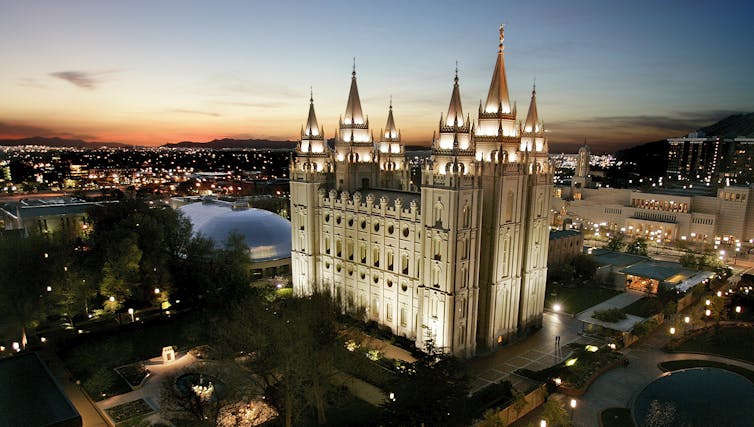
The Mormon Temple is the centerpiece of Temple Square in Salt Lake City.
AP Photo/Douglas C. Pizac
By Samuel Brunson of Loyola University Chicago
Three men have filed a lawsuit against the Church of Jesus Christ of Latter-day Saints – also known as the LDS or Mormon church – and its investment arm, Ensign Peak Advisors, Inc. The men, at least one of whom remains an active member of the church, according to the lawsuit, into making donations.
LDS church doctrine requires its members to tithe – that is, give 10% of their income to the church. Otherwise, members cannot attend or participate in worship in the church’s temples.
As a law professor who studies the financial practices of churches and other tax-exempt organizations, I have seen that it is hard for donors to win a lawsuit against their church – or any other charity – when they demand a refund for their donations.
3 kinds of relief
The lawsuit against the LDS church and Ensign Peak, filed on Oct. 31, 2023, is based on the premise that the church has violated its members’ trust by amassing massive investments in stocks, bonds, real estate and agriculture that don’t support charitable activities.
The men are seeking three forms of relief.
First, they want the court to certify their suit as a class action – meaning that these plaintiffs could pursue the suit on behalf of everybody who had allegedly been defrauded into making donations to the LDS church – which says it has about 6.8 million U.S. members.
Second, they’re asking the court to order the LDS church to stop its allegedly deceptive practices, including its purported failure to give the money it has collected and reserved for charitable purposes to charity. The lawsuit also calls on the LDS church to make more of its financial practices known to the public and to appoint an independent special master to oversee the church’s collection and use of its revenue.
Third, they ask the court to order the church to refund the donations they have made over the last 10 years, an amount they say totals for the three of them around US$350,000. They’re also requesting other monetary relief, including that the LDS church pay their legal fees.
The church doesn’t disclose details about its finances. It has denied the allegations that it committed fraud with its “sacred funds” or dipped directly into tithed funds or other pools of money received for charitable purposes to make investments.
This financial opacity has hurt the LDS church before. In February 2023, the U.S. Securities and Exchange Commission found that Ensign Peak, the church’s investment arm, had failed to make required disclosures of its securities portfolio. The SEC fined the church and Ensign Peak a total of $5 million.
Estimates vary regarding the size of the church’s portfolio. By a whistleblower’s estimate, it may be as high as $100 billion.
Donors generally have no say
Charitable donations, generally of money or property, are often deductible for tax purposes because churches qualify as exempt under section 501(c)(3) of the Internal Revenue Code. Just as when you give money to a friend or relative, you no longer own or control those dollars after the transaction is completed.
Unless a donation is a restricted gift, making it contingent on the charity using it in a particular way, its use is out of the hands of the donor.
While donors cannot get their money back when they are disappointed by a charity, they will probably stop making donations.
Most donations to religious institutions are unrestricted. That means that even if church members who tithe do not like how their church spends money, unless their church acted illegally in soliciting their donation – by, for example, lying about how they would use the donation – a member’s only option is to stop giving.
Fiduciary duty – for the institution
The men who are suing the LDS church and its investment arm don’t just say they disapprove of how the church is spending their tithed funds. They argue that the church breached its fiduciary duties to its members – all of whom are also its donors.
Fiduciary duties encompass a special duty to act in the best interests of someone or something, based on certain legal relationships. Churches generally do not owe fiduciary duties to their members.
Allegations of fraud
While donors generally have no say regarding how their charitable donations are used, there is an exception when the charity fraudulently induces the donor to make the donation.
And these plaintiffs allege that this is what the LDS church did: that it claimed donated funds would be used for charitable purposes, but that they were not.
James Huntsman, brother of former Utah Gov. Jon Huntsman Jr., is also accusing the Mormon church of lying in a separate lawsuit he filed on his own against the Church of the Latter-day Saints in March 2021. That case is still pending.
A Utah state law prohibits charities from lying to their donors and allows donors to sue to get their money back from charities that violate this statute. And yet fraud is hard to prove. In Utah, in particular, there’s a nine-part test for this purpose.
This is all moot, at least for the lawsuit filed on Halloween in 2023, if the statute of limitations has run its course. In Utah, plaintiffs must file fraud suits within three years of when they discover or should have discovered fraudulent behavior.
And the Ensign Peak allegations first surfaced in 2019 – four years before the plaintiffs filed this lawsuit. Their lawyers argue that the statute of limitations does not bar the case, because the LDS church hid how it used the money and plaintiffs could not have discovered the alleged fraud until recently.
Seeking relief
If the three men were to win this new court case, they would be entitled to monetary damages, likely including at least the return of the $350,000 they have said they donated to the LDS church over the past decade. But they are also asking for the court to order the LDS church to make periodic financial disclosures and to appoint an independent authority outside the church to oversee the church’s finances.
These orders would go above what Utah law requires of nonprofits incorporated in the state. But beyond that, I believe they would likely violate the church’s First Amendment rights to religious freedom.
The Supreme Court has held that courts cannot interfere with churches’ internal affairs.
A church’s internal affairs include not only disputes over doctrine and clergy, but also disputes over church administration. Appointing somebody to oversee how the LDS church raises and spends its money would violate this doctrine.
This article is republished from The Conversation, a nonprofit, independent news organization dedicated to unlocking the knowledge of experts for the public good. .

About Samuel Brunson
Samuel Brunson is a Professor of Law at Loyola University Chicago. You can read more about the author here.


Browse Our Archives
Select a Category Buddhism Christianity Hinduism Islam Judaism Religion and society Uncategorized
Select a Month July 2024 March 2024 February 2024 January 2024 December 2023 November 2023 October 2023 September 2023 August 2023 July 2023 January 2023 August 2022 July 2022 April 2022 February 2022 January 2022 October 2021 July 2021 June 2021 May 2021 April 2021 March 2021 February 2021 January 2021 December 2020 November 2020 October 2020 September 2020 August 2020 July 2020 June 2020 May 2020
Follow Us!
TAKE THE
Religious Wisdom Quiz
What does "Golgotha" mean?
Select your answer to see how you score.
House of Bread Place of the Skull Mountain of God Valley of Death
Related posts from The Conversation


Electing A Virtuous President Would Make Immunity Irrelevant

Why The Olympic Games Are A ‘Civil Religious’...

The Catholic Church Is Using The Olympics To...
TRENDING AT PATHEOS Religion News

Catholic Integralists believe that religious values – specifically Christian ones – should...

Electing A Virtuous President Would Make Immunity Irrelevant
Presidential immunity can bring with it many risks. So how can we...

Why The Olympic Games Are A ‘Civil Religious’...
Sporting events form a vital space where Americans display their 'civil religious...

After more than a decade of news, research updates, and insights on...

Q: Why do Southern Baptists and like-minded Protestants...
THE RELIGION GUY’S ANSWER: Why? Simple. Because they believe that’s what the...

THE QUESTION: Is gambling evil? THE RELIGION GUY’S ANSWER: Analysts anticipate a...
view all Religion News blogs
Ad-Free & Subscriber Log-In Subscription Support
- About Us
- 2026 Calendar
- Videos
- Podcasts
- Library of World Religions
- Faith In Media Tracker
- Advertise With Us
- Write for Us
- Privacy Policy
- Terms of Service
- Do Not Sell My Data
- Contact Us
- Radiant Digital
- Manage Newsletter Subscriptions
- Unsubscribe From Notifications
- Sitemap
Copyright 2008-2026, Patheos. All rights reserved.
Subscription Support Ad-Free & Subscriber Log-In
Follow Patheos