
BuddhistCatholicContemplativeEvangelicalGeneral ChristianHinduJewishLatter-day SaintMuslimNew VisionsProgressive Christian
Beliefs
- Buddhist
- Catholic
- Contemplative
- Evangelical
- General Christian
- Hindu
- Jewish
- Latter-day Saint
- More Voices
- Muslim
- New Visions
- Pagan
- Progressive Christian
Topics
- Religion News
- Food and Religion
- Sports and Religion
- Religious Art
- Religious Music and Entertainment
- Religious Events
- History and Religion
- Style and Religion
- Politics and Religion
- Women in Religion
- Recreation Outdoors and Religion
- Business Finance and Religion
- Careers Workplace and Religion
- Education and Religion
- Family Parenting and Religion
- Health Fitness and Religion
- Home and Religion
- Relationships and Religion
- Technology and Religion
- Travel and Religion
Columnists
- Buddhist Columnists
- Business Finance and Religion Columnists
- Careers Workplace and Religion Columnists
- Catholic Columnists
- Contemplative Columnists
- Education and Religion Columnists
- Evangelists Columnists
- Family Parenting and Religion Columnists
- General Christian Columnists
- Health Fitness and Religion Columnists
- Hindu Columnists
- History and Religion Columnists
- Home and Religion Columnists
- Jewish Columnists
- More Voices Columnists
- Latter Day Columnists
- Muslim Columnists
- New Visions Columnists
- Nonreligious Columnists
- Pagan Columnists
- Politics and Religion Columnists
- Progressive Columnists
- Recreation Outdoors and Religion Columnists
- Relationships and Religion Columnists
- Religion News Columnists
- Religious Art Columnists
- Religious Events Columnists
- Religious Music and Entertainment Columnists
- Sports and Religion Columnists
- Style and Religion Columnists
- Technology and Religion Columnists
- Travel and Religion Columnists
- Women in Religion Columnists
Resource Library
- 2026 Calendar
- Library of World Religions
- The 100 Most Holy Places on Earth
- Patheos Answers
- Podcasts
- Videos
- Faith Leaders Database
- Anglican Episcopalian
- Bahai
- Baptist
- Buddhism
- Christianity
- Confucianism
- Eastern Orthodoxy
- Hinduism
- Holiness and Pentecostal
- ISKCON
- Islam
- Judaism
- Lutheran
- Methodist
- The Church of Jesus Christ of Latter-day Saints
- New Age
- Paganism
- Presbytarian and Reformed
- Protestantism
- Religion Behind the Scenes
- Roman Catholic
- Scientology
- Shia Islam
- Sikhism
- Sufism
- Sunni Islam
- Taoism
- Zen
- See all religions
Research Tools
 Ad-Free & Subscriber Log-In Subscription Support
Ad-Free & Subscriber Log-In Subscription Support
Follow Patheos 

- Trending:
- Forgiveness
- |
- Marriage
- |
- Consciousness
- |
- Death Penalty
- |
- Election
- |
- Halloween

- Home
- General Christian
- Religion News
- The History of the Cross and Its Many Meanings Over The Centuries
The History of the Cross and Its Many Meanings Over The Centuries
Last updated on: September 15, 2023 at 9:19 am by The Conversation
The History of the Cross and Its Many Meanings Over The Centuries 2023-09-15T09:19:45-04:00 The Conversation
Patheos Explore the world's faith through different perspectives on religion and spirituality! Patheos has the views of the prevalent religions and spiritualities of the world.
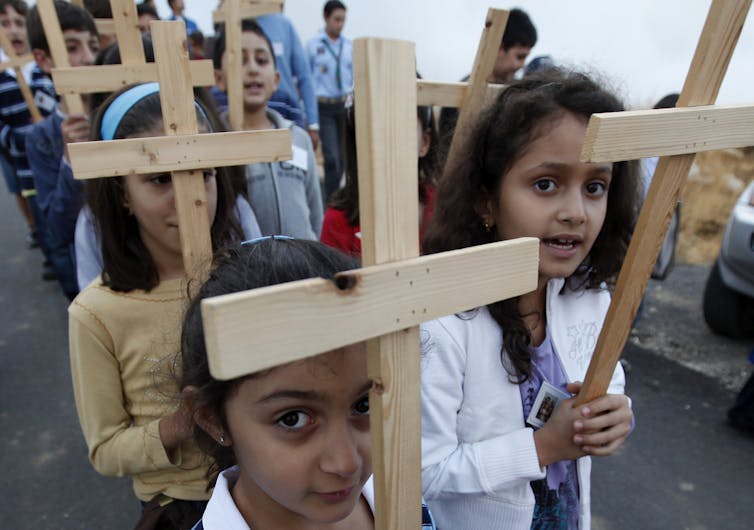
A procession of Christian girls, venerating the Cross, in the village of Qanat Bekish, Lebanon.
AP Photo/Hussein Malla
By Joanne M. Pierce of College of the Holy Cross
In the fall, Catholics and some other Christian churches celebrate the Feast of the Holy Cross. With the feast, Christians commemorate Jesus Christ’s life, especially his salvific death on the cross and his later Resurrection, believing this offers them the promise of forgiveness and eternal life.
The feast has its roots in late antiquity, a time when the cross became an important part of Christian art and worship. The cross, once a shameful form of execution for criminals, has became a predominant symbol of Christ and Christianity.
However, the cross at times has also taken on darker meanings as a symbol of persecution, violence and even racism.
The early cross
As a scholar of medieval Christian history and worship, I have studied this complicated history.
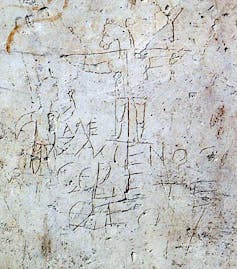
Second century pagan graffito depicting a man worshipping a crucified donkey-headed figure.
A famous piece of early-third century Roman wall art, the “Alexamenos graffito,” depicts two human figures, with the head of a donkey, arms stretched out in a T-shaped cross, with the caption “Alexamenos worships his god.”
Christianity was outlawed at the time in the Roman Empire and criticized by some as a religion for fools. The caricature of “Alexamenos,” offering prayers to this crucified figure was a way of depicting Christ with a donkey’s head and ridiculing his god.
But for Christians, the cross had deep meaning. They understood Christ’s death on the cross to be “completed” by God’s raising him from the dead three days later. This Resurrection was a sign of Christ’s “victory” over sin and death.
Believers could share in this victory by being baptized, forgiven of past sin and “reborn” into a new life in the Christian community, the church. Christians, then, frequently referred to the Christ’s cross both as the “wood of life” and as a “victorious Cross.”
The true cross?
In the early fourth century, Emperor Constantine legalized Christianity. He authorized excavation of some of the holy sites of Christ’s life in what came to be called the “Holy Land.” At the time, it was part of the Roman province of Syria Palestina, bracketed by the Jordan River to the east, the Mediterranean Sea to the west and Syria to the north.
By the fifth century, the legend arose that pieces of crosses were uncovered by Constantine’s mother, Helena, during these excavations. Believers said a miraculous healing took place when a sick woman was touched with one piece, proof that it was a section of the actual cross of Christ.
Constantine built a large church, the Martyrium, over what was assumed to be the location of Jesus’ tomb. The September date of that church’s dedication came to be celebrated as the feast of the “Exaltation of the Cross.”
Helena’s supposed “finding” of the cross itself was given its own feast day in May: the “Invention of the Cross.” Both feasts were celebrated in Rome by the seventh century.
One section of what was believed to be the true cross was kept and venerated on Good Friday in Jerusalem from the mid-fourth century until its conquest by a Muslim caliph in the seventh century.
Later representations
Numerous Christian churches were constructed in the Roman Empire during the fourth and fifth centuries. With imperial financial support, these large buildings were decorated with intricate mosaics depicting figures from the scriptures, especially of Christ and the apostles.
The cross that appears in mosaic is a golden cross adorned with round or square precious gems, a visual representation of the victory over sin and death achieved by Christ’s death. It was called a “crux gemmata,” or “gemmed cross.”
From the sixth century through the early Middle Ages, artistic representations of the Crucifixion became more common. Sometimes Christ was depicted on the cross alone, perhaps between the other two criminals crucified with him. More often, Christ on the cross is surrounded on either side by the figures of Mary and the apostle, Saint John.
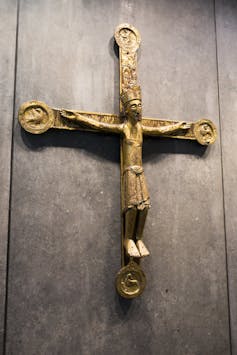
Early medieval representation of Christ on the cross.
Thomas Quine, CC BY
Public veneration of the cross on Good Friday became increasingly common outside of the Holy Land, and this ritual was observed in Rome in the eighth century.
During the medieval period, the crucified Christ was commonly portrayed as a serene figure. The representation tended to change over the centuries, to Christ as a tortured, twisted victim.
Different meanings
During the Reformation, Protestant churches rejected the use of the crucifix. In their view, it was a human “invention,” not in frequent use in the primitive church. They claimed the crucifix had become the object of idolatrous Catholic veneration, and used other versions of a plain cross instead.
Differing depictions of the cross expressed deeper conflicts within Western Christianity.
But even before that, the cross was used in a divisive way. During the High Middle Ages, the cross became connected with a series of religious wars waged from Christian Europe to liberate the Holy Land from the grasp of Muslim rulers.
Those who chose to go and fight would wear a special garment, marked with a cross, over their daily clothes. They had “taken the cross” and came to be called “Crusaders.”
Of all the Crusades, only the first one in the late 11th century really accomplished its objective. These Crusaders conquered Jerusalem in a bloody battle that did not spare women and children in the effort to rid the city of “infidels.” The Crusades also sparked waves of active hostility toward European Jews, resulting in outbreaks of violence against Jewish communities for centuries.
By the 19th century, the term “crusade” came to refer more generally to any kind of struggle for a “righteous” reason, whether religious or secular. In the United States at that time, the term was used to describe a number of religious-social activists. For example, abolitionist newspaper editor William Lloyd Garrison was called a “Crusader” in his political struggle to end the evil of slavery.
Symbol of pro-white agenda
Later the cross was also literally taken up by activists demonstrating against social advances. For example, the Ku Klux Klan, as part of their terror campaign, would often burn plain wooden crosses at meetings or on the lawns of African Americans, Jews or Catholics.
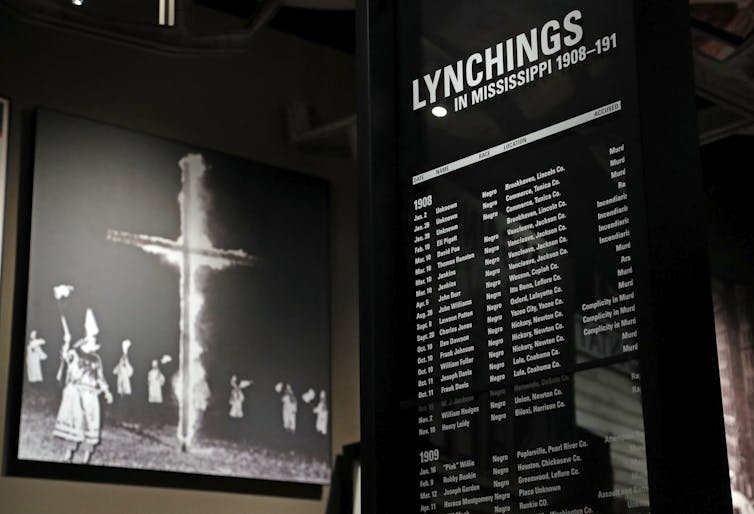
A monolith listing the names, dates and rationale for the lynching of African Americans stands in front of a photograph of a burning Ku Klux Klan cross on display in the Mississippi Civil Rights Museum in Jackson, Miss.
AP Photo/Rogelio V. Solis
A few decades later, Adolf Hitler’s quest for German expansionism and persecution of Jews, based on his belief in the superiority of the “Aryan race,” came to be crystallized in the sign of the swastika. Originally a religious symbol from India, it had for centuries been used in Christian iconography as one of many artistic expressions of the cross.
Even today, the newspaper of the KKK is entitled The Crusader, and various white supremacy groups use forms of the cross as a symbol of their own pro-white agenda on flags, tattoos and clothing.
The Feast of the Holy Cross focuses on the meaning of the cross as a powerful sign of divine love and salvation for early Christians. It is tragic that the cross has also been twisted into a vivid sign of hatred and intolerance.
This article is republished from The Conversation, a nonprofit, independent news organization dedicated to unlocking the knowledge of experts for the public good.
General Christian
Catholic
History and Religion

About Joanne M. Pierce
Joanne M. Pierce is a Professor of Religious Studies at the College of the Holy Cross. You can read more about the author here.



Browse Our Archives
Select a Category Buddhism Christianity Hinduism Islam Judaism Religion and society Uncategorized
Select a Month July 2024 March 2024 February 2024 January 2024 December 2023 November 2023 October 2023 September 2023 August 2023 July 2023 January 2023 August 2022 July 2022 April 2022 February 2022 January 2022 October 2021 July 2021 June 2021 May 2021 April 2021 March 2021 February 2021 January 2021 December 2020 November 2020 October 2020 September 2020 August 2020 July 2020 June 2020 May 2020
Follow Us!
TAKE THE
Religious Wisdom Quiz
Who interpreted dreams for a Pharaoh and a baker?
Select your answer to see how you score.
Joseph Moses Aaron Daniel
Related posts from The Conversation


Electing A Virtuous President Would Make Immunity Irrelevant

Why The Olympic Games Are A ‘Civil Religious’...

The Catholic Church Is Using The Olympics To...
TRENDING AT PATHEOS Religion News

Catholic Integralists believe that religious values – specifically Christian ones – should...

Electing A Virtuous President Would Make Immunity Irrelevant
Presidential immunity can bring with it many risks. So how can we...

Why The Olympic Games Are A ‘Civil Religious’...
Sporting events form a vital space where Americans display their 'civil religious...

After more than a decade of news, research updates, and insights on...

Q: Why do Southern Baptists and like-minded Protestants...
THE RELIGION GUY’S ANSWER: Why? Simple. Because they believe that’s what the...

THE QUESTION: Is gambling evil? THE RELIGION GUY’S ANSWER: Analysts anticipate a...
view all Religion News blogs
Ad-Free & Subscriber Log-In Subscription Support
- About Us
- 2026 Calendar
- Videos
- Podcasts
- Library of World Religions
- Faith In Media Tracker
- Advertise With Us
- Write for Us
- Privacy Policy
- Terms of Service
- Do Not Sell My Data
- Contact Us
- Radiant Digital
- Manage Newsletter Subscriptions
- Unsubscribe From Notifications
- Sitemap
Copyright 2008-2026, Patheos. All rights reserved.
Subscription Support Ad-Free & Subscriber Log-In
Follow Patheos