
BuddhistCatholicContemplativeEvangelicalGeneral ChristianHinduJewishLatter-day SaintMuslimNew VisionsProgressive Christian
Beliefs
- Buddhist
- Catholic
- Contemplative
- Evangelical
- General Christian
- Hindu
- Jewish
- Latter-day Saint
- More Voices
- Muslim
- New Visions
- Pagan
- Progressive Christian
Topics
- Religion News
- Food and Religion
- Sports and Religion
- Religious Art
- Religious Music and Entertainment
- Religious Events
- History and Religion
- Style and Religion
- Politics and Religion
- Women in Religion
- Recreation Outdoors and Religion
- Business Finance and Religion
- Careers Workplace and Religion
- Education and Religion
- Family Parenting and Religion
- Health Fitness and Religion
- Home and Religion
- Relationships and Religion
- Technology and Religion
- Travel and Religion
Columnists
- Buddhist Columnists
- Business Finance and Religion Columnists
- Careers Workplace and Religion Columnists
- Catholic Columnists
- Contemplative Columnists
- Education and Religion Columnists
- Evangelists Columnists
- Family Parenting and Religion Columnists
- General Christian Columnists
- Health Fitness and Religion Columnists
- Hindu Columnists
- History and Religion Columnists
- Home and Religion Columnists
- Jewish Columnists
- More Voices Columnists
- Latter Day Columnists
- Muslim Columnists
- New Visions Columnists
- Nonreligious Columnists
- Pagan Columnists
- Politics and Religion Columnists
- Progressive Columnists
- Recreation Outdoors and Religion Columnists
- Relationships and Religion Columnists
- Religion News Columnists
- Religious Art Columnists
- Religious Events Columnists
- Religious Music and Entertainment Columnists
- Sports and Religion Columnists
- Style and Religion Columnists
- Technology and Religion Columnists
- Travel and Religion Columnists
- Women in Religion Columnists
Resource Library
- 2026 Calendar
- Library of World Religions
- The 100 Most Holy Places on Earth
- Patheos Answers
- Podcasts
- Videos
- Faith Leaders Database
- Anglican Episcopalian
- Bahai
- Baptist
- Buddhism
- Christianity
- Confucianism
- Eastern Orthodoxy
- Hinduism
- Holiness and Pentecostal
- ISKCON
- Islam
- Judaism
- Lutheran
- Methodist
- The Church of Jesus Christ of Latter-day Saints
- New Age
- Paganism
- Presbytarian and Reformed
- Protestantism
- Religion Behind the Scenes
- Roman Catholic
- Scientology
- Shia Islam
- Sikhism
- Sufism
- Sunni Islam
- Taoism
- Zen
- See all religions
Research Tools
 Ad-Free & Subscriber Log-In Subscription Support
Ad-Free & Subscriber Log-In Subscription Support
Follow Patheos 

- Trending:
- Forgiveness
- |
- Marriage
- |
- Consciousness
- |
- Death Penalty
- |
- Election
- |
- Halloween

- Home
- Jewish
- Religion News
- Rosh Hashana and Yom Kippur Are Times For Soul-Searching, But Not On Your Own – Community Has Always Been at the Heart of the Jewish High Holidays
Rosh Hashana and Yom Kippur Are Times For Soul-Searching, But Not On Your Own – Community Has Always Been at the Heart of the Jewish High Holidays
Last updated on: September 15, 2023 at 9:28 am by The Conversation
Rosh Hashana and Yom Kippur Are Times For Soul-Searching, But Not On Your Own – Community Has Always Been at the Heart of the Jewish High Holidays 2023-09-15T09:28:15-04:00 The Conversation
Patheos Explore the world's faith through different perspectives on religion and spirituality! Patheos has the views of the prevalent religions and spiritualities of the world.
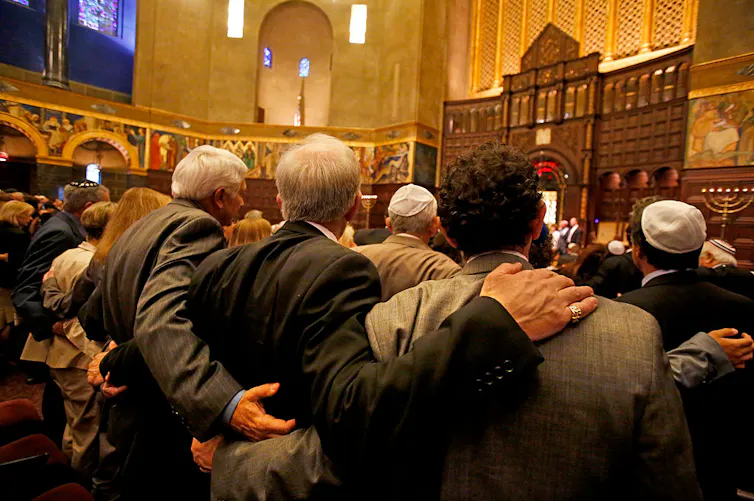
Members of the congregation sing during a Rosh Hashana service at the Wilshire Boulevard Temple in Los Angeles in 2013.
Anne Cusack/Los Angeles Times via Getty Images
By David L. Graizbord of University of Arizona
Starting the evening of Sept. 15, 2023, and again the evening of Sept. 24, Jews around the world will be filing into synagogues to mark their “Days of Awe” – the High Holidays of Rosh Hashana and Yom Kippur.
For many who observe these holidays in the United States, the Days of Awe will be the only time that they visit a synagogue this year. Only 1 in 5 American Jews attend services once a month or more.
What is more, Yom Kippur is among the most somber and punishing holidays of the Jewish calendar. Why, then, do so many individuals who rarely pray in a synagogue choose to do it during the dour Days of Awe, rather than on many of the joyful, celebratory feasts that the Jewish calendar has to offer?
The answer lies partly in the nature of Jewish civilization itself. While today observers perceive Judaism as a religion, Jewish culture is not focused on individual belief and worship so much as on an entire community and its collective relationship with God and its history.
As a scholar of Judaic studies, I believe these are core, galvanizing elements of Jewish civilization that the Days of Awe bring into relief, making the High Holy Days a focus of congregants’ cultural lives as Jews. While the High Holidays may seem like days of individual soul-searching and repentance alone, their focus is actually communal, taking stock of an entire people’s identity and traditions.
Rosh Hashana: The Jewish New Year
According to rabbinic interpretations, Rosh Hashana commemorates God’s creation of humanity. Tradition has it that Rosh Hashana is a time when God judges humans, and especially “his people,” Israel. Meanwhile, they affirm their acceptance of God’s sovereignty over everything and everybody.
That is largely why Jews exchange New Year’s greetings along the lines of, “May you be inscribed [in the Book of Life]” – folkloric shorthand for wishing someone a good fate for the year ahead.
Whether they occur in traditionalist or modernist settings, Jewish New Year ceremonies are mostly held in synagogues. The services begin with attendees’ recitation of an ancient liturgy that underscores God’s kingship over the universe. Yet the centerpiece is the loud blowing of a shofar, a ram’s horn, whose powerful blasts the biblical book of Joshua describes as bringing down the walls of the city of Jericho. During the High Holidays, the sound “opens the gates of heaven” so that congregants’ acknowledgment of divine sovereignty can enter God’s abode and inform his judgment.
Notably, Jewish law has it that individuals should not mark the High Holidays alone. Ideally, the services require a “minyan,” or quorum of 10 adults – as do many Jewish rituals.
Before 70 C.E., when Roman legions destroyed the Jerusalem Temple, sacrifices at its altar were an important component of Jewish social, political and ritual life. Afterward, rabbinic law radically democratized the Israelites’ rituals, mostly as liturgical services. These took the place of activities that the priests of the temple had performed. Thus the people, along with their history as a political community, remained the protagonists of a comprehensive cultural system – not the relatively narrow, private sense of “faith” that the word “religion” can suggest.
Confession – as a community – on Yom Kippur
After Rosh Hashana, the mood darkens as Yom Kippur approaches: the Day of Atonement.
On the eve of Yom Kippur, before its onset at sundown, Jews return to their synagogues. As a prelude to the first Yom Kippur service, a cantor or another skilled congregant sings the famed Kol Nidre: the Renunciation of All Vows. This poem asks God to preemptively annul any oaths Jews will make to God unknowingly or involuntarily, or ones they cannot fulfill. Notably, Kol Nidre plaintively asks, “May all the people of Israel be forgiven, including all the strangers who live in their midst, for all the people are at fault.”
Cantor Azi Schwartz performs the Kol Nidre at Park Avenue Synagogue in New York.
One of the Yom Kippur liturgy’s distinctive elements is a section called the Viddui – the “confession.” That word may summon images of a one-on-one encounter with a priest in the privacy of a small, partitioned booth. “Confession” may also suggest a creed: “I believe in X, Y, Z – and that my belief will save my soul.”
Yet Jewish “confession” is neither an affirmation of faith nor a purely individual mea culpa. Instead, the Viddui affirms a long list of wrongdoings for which all congregants repent: Among other things, “We and our fathers have sinned. We have trespassed. We have betrayed; We have stolen. We have slandered.”
The focus of the services, in other words, is not exclusively on personal sin and salvation. The language of the liturgy uses “we,” not just “I.” It does not matter whether individuals reciting the liturgy have erred in the specific ways the confession mentions. What matters is that they take responsibility for the entire Jewish people – past, present and future – in relation to their fellow humans, and in relation to the God of Israel: One for all, and all for one.
As the Talmud puts it, “All Israel [is] mutually responsible.” The biblical Book of Deuteronomy, too, is packed with laws for the entire people of Israel as they are about to enter their promised land, so that they “may prolong your days upon the land.” Commandments about theft, mercy and caring for the stranger and the orphan, for example, are explicit blueprints for a functioning, socially just state – not just guides to individual or universal morality.
The books of the Hebrew Bible enshrine a story of the Jewish people, a collective story at the root of these awe-filled days. Indeed, the High Holidays affirm a sense of belonging that keeps even some of the least traditional Jews returning to ceremonies every year, affirming the ideal of a kinship-based society rooted in collective justice.
This article is republished from The Conversation, a nonprofit, independent news organization dedicated to unlocking the knowledge of experts for the public good. .
Jewish

About David L. Graizbord
David L. Graizbord is the Director of the Arizona Center for Judaic Studies at the University of Arizona. You can read more about the author here.
Previous Post
September 13, 2023
The History of the Cross and Its Many Meanings Over The Centuries
Browse Our Archives
Select a Category Buddhism Christianity Hinduism Islam Judaism Religion and society Uncategorized
Select a Month July 2024 March 2024 February 2024 January 2024 December 2023 November 2023 October 2023 September 2023 August 2023 July 2023 January 2023 August 2022 July 2022 April 2022 February 2022 January 2022 October 2021 July 2021 June 2021 May 2021 April 2021 March 2021 February 2021 January 2021 December 2020 November 2020 October 2020 September 2020 August 2020 July 2020 June 2020 May 2020
Follow Us!
TAKE THE
Religious Wisdom Quiz
What does Proverbs compare wisdom to?
Select your answer to see how you score.
A woman A mountain A river A city
Related posts from The Conversation
Hanukkah Celebrations Have Changed Dramatically − But The...

This Passover, as in the past, will be...

How New York's 19th-century Jews turned Purim into...

How to fight Holocaust denial in social media...
TRENDING AT PATHEOS Religion News

Catholic Integralists believe that religious values – specifically Christian ones – should...

Electing A Virtuous President Would Make Immunity Irrelevant
Presidential immunity can bring with it many risks. So how can we...

Why The Olympic Games Are A ‘Civil Religious’...
Sporting events form a vital space where Americans display their 'civil religious...

After more than a decade of news, research updates, and insights on...

Q: Why do Southern Baptists and like-minded Protestants...
THE RELIGION GUY’S ANSWER: Why? Simple. Because they believe that’s what the...

THE QUESTION: Is gambling evil? THE RELIGION GUY’S ANSWER: Analysts anticipate a...
view all Religion News blogs
Ad-Free & Subscriber Log-In Subscription Support
- About Us
- 2026 Calendar
- Videos
- Podcasts
- Library of World Religions
- Faith In Media Tracker
- Advertise With Us
- Write for Us
- Privacy Policy
- Terms of Service
- Do Not Sell My Data
- Contact Us
- Radiant Digital
- Manage Newsletter Subscriptions
- Unsubscribe From Notifications
- Sitemap
Copyright 2008-2026, Patheos. All rights reserved.
Subscription Support Ad-Free & Subscriber Log-In
Follow Patheos