
BuddhistCatholicContemplativeEvangelicalGeneral ChristianHinduJewishLatter-day SaintMuslimNew VisionsProgressive Christian
Beliefs
- Buddhist
- Catholic
- Contemplative
- Evangelical
- General Christian
- Hindu
- Jewish
- Latter-day Saint
- More Voices
- Muslim
- New Visions
- Pagan
- Progressive Christian
Topics
- Religion News
- Food and Religion
- Sports and Religion
- Religious Art
- Religious Music and Entertainment
- Religious Events
- History and Religion
- Style and Religion
- Politics and Religion
- Women in Religion
- Recreation Outdoors and Religion
- Business Finance and Religion
- Careers Workplace and Religion
- Education and Religion
- Family Parenting and Religion
- Health Fitness and Religion
- Home and Religion
- Relationships and Religion
- Technology and Religion
- Travel and Religion
Columnists
- Buddhist Columnists
- Business Finance and Religion Columnists
- Careers Workplace and Religion Columnists
- Catholic Columnists
- Contemplative Columnists
- Education and Religion Columnists
- Evangelists Columnists
- Family Parenting and Religion Columnists
- General Christian Columnists
- Health Fitness and Religion Columnists
- Hindu Columnists
- History and Religion Columnists
- Home and Religion Columnists
- Jewish Columnists
- More Voices Columnists
- Latter Day Columnists
- Muslim Columnists
- New Visions Columnists
- Nonreligious Columnists
- Pagan Columnists
- Politics and Religion Columnists
- Progressive Columnists
- Recreation Outdoors and Religion Columnists
- Relationships and Religion Columnists
- Religion News Columnists
- Religious Art Columnists
- Religious Events Columnists
- Religious Music and Entertainment Columnists
- Sports and Religion Columnists
- Style and Religion Columnists
- Technology and Religion Columnists
- Travel and Religion Columnists
- Women in Religion Columnists
Resource Library
- 2026 Calendar
- Library of World Religions
- The 100 Most Holy Places on Earth
- Patheos Answers
- Podcasts
- Videos
- Faith Leaders Database
- Anglican Episcopalian
- Bahai
- Baptist
- Buddhism
- Christianity
- Confucianism
- Eastern Orthodoxy
- Hinduism
- Holiness and Pentecostal
- ISKCON
- Islam
- Judaism
- Lutheran
- Methodist
- The Church of Jesus Christ of Latter-day Saints
- New Age
- Paganism
- Presbytarian and Reformed
- Protestantism
- Religion Behind the Scenes
- Roman Catholic
- Scientology
- Shia Islam
- Sikhism
- Sufism
- Sunni Islam
- Taoism
- Zen
- See all religions
Research Tools
 Ad-Free & Subscriber Log-In Subscription Support
Ad-Free & Subscriber Log-In Subscription Support
Follow Patheos 

- Trending:
- Forgiveness
- |
- Marriage
- |
- Consciousness
- |
- Death Penalty
- |
- Election
- |
- Halloween

- Home
- More Voices
- Religion News
- Religious Leaders Without Religion: How Humanist, Atheist and Spiritual-But-Not-Religious Chaplains Tend To Patients’ Needs
Religious Leaders Without Religion: How Humanist, Atheist and Spiritual-But-Not-Religious Chaplains Tend To Patients’ Needs
Last updated on: September 15, 2023 at 9:25 am by The Conversation
Religious Leaders Without Religion: How Humanist, Atheist and Spiritual-But-Not-Religious Chaplains Tend To Patients’ Needs 2023-09-15T09:25:52-04:00 The Conversation
Patheos Explore the world's faith through different perspectives on religion and spirituality! Patheos has the views of the prevalent religions and spiritualities of the world.

Chaplains talk with anyone, regardless of whether or not the patient has a religious affiliation – and some chaplains themselves are not religious.
Jacob Wackerhausen/iStock via Getty Images Plus
By Amy Lawton of Brandeis University
In times of loss, change or other challenges, chaplains can listen, provide comfort and discuss spiritual needs. These spiritual caregivers can be found working in hospitals, universities, prisons and many other secular settings, serving people of all faiths and those with no faith tradition at all.
Yet a common assumption is that chaplains themselves must be grounded in a religious tradition. After all, how can you be a religious leader without religion?
In reality, a growing number of chaplains are nonreligious: people who identify as atheist, agnostic, humanist or “spiritual but not religious.” I am a sociologist and research manager at Brandeis University’s Chaplaincy Innovation Lab, where our team researches and supports chaplains of all faiths, including those from nonreligious backgrounds. Our current research has focused on learning from 21 nonreligious chaplains about their experiences.
A changing society
Thirty percent of Americans are religiously unaffiliated. Research suggests that people who are atheists or otherwise nonreligious sometimes reject a chaplain out of wariness, or shut down a conversation if they feel judged for their beliefs. But this research has not accounted for a new, increasingly likely situation – that the chaplain might also be nonreligious.
No national survey has been done, so the number of nonreligious chaplains is unknown. But there is plenty of reason to think that as more Americans choose not to affiliate with any particular religion, so too do more chaplains.
Nonreligious chaplains have been a part of hospital systems and universities for years, but they came into the national spotlight in August 2021 when Harvard University’s organization of chaplains unanimously elected humanist and atheist Greg Epstein as president. Humanists believe in the potential and goodness of human beings without reference to the supernatural.
Other recent reporting on humanist chaplains has also focused on school campuses, but nonreligious chaplains are not limited to colleges and universities. Eighteen of the 21 nonreligious chaplains we spoke with in our study work in health care, including hospice. The Federal Bureau of Prisons allows nonreligious chaplains, but we were unable to find any of them to participate in the current study.

Humanist chaplain Bart Campolo, center, and his wife, Marty, right, mingle with students at the University of Southern California in 2015.
AP Photo/Jae C. Hong
Not all settings allow nonreligious chaplains, however, including the U.S. military.
Authentic calling
The idea of a “call” from God is central to many religious vocations: a strong impulse toward religious leadership, which many people attribute to the divine.
Chaplains who are atheists, agnostics, humanists or who consider themselves spiritual but not religious also can feel called. But they do not believe that their calls come from a deity.
Joe, for example, an atheist and a humanist whom we interviewed, has worked as a chaplain in hospitals and hospices. He says that his “light bulb moment” came after a history professor told him that beliefs are the source of a community’s power. While atheists do not believe in God or gods, many do have strong beliefs about ethics and morality, and American atheists are more likely than American Christians to say they often feel a sense of wonder about the universe. Joe’s call was not “from a divine source,” but nonetheless, he says this experience “kind of filled me with a sense of control, and confidence, and presence” in his life that grounded his sense of a calling.
Sunil, another chaplain our team interviewed, was inspired by his college chaplain, whom he calls “a really influential presence.” The chaplain helped Sunil answer questions about identity and values without “necessarily having any religious or spiritual leanings to it,” and encouraged him to go to divinity school.
Today, Sunil tries to help others answer those same questions in his work as a health care chaplain – and to offer deeply thoughtful, meaningful spiritual care to people who aren’t religious.
Education and training
Most chaplaincy jobs require a theological degree. Along with coursework in sacred scriptures and religious leadership, chaplaincy training usually involves clinical pastoral education, where students learn about hands-on, care-oriented aspects of their profession. This involves learning to provide care to everyone, regardless of their religious background.
Although coursework is broadly the same for all students, religious or nonreligious, the actual experience of earning a degree is very different for nonreligious students. In the United States, Christian students are easily able to enroll in a seminary or divinity school that shares their faith identity and spend their years of study learning about their own tradition.
Chaplaincy programs that focus on non-Christian traditions are available, but scarcer, and our team does not know of an overtly nonreligious chaplaincy program. In recent years, more seminaries have welcomed nonreligious students, but nonetheless, nonreligious students often find themselves focusing their study on traditions to which they have no personal connection.
Yet there is a surprising bright side.
‘I am here to support you’
Being deeply immersed in traditions that are not one’s own is one of the reasons that nonreligious chaplains can be so effective.
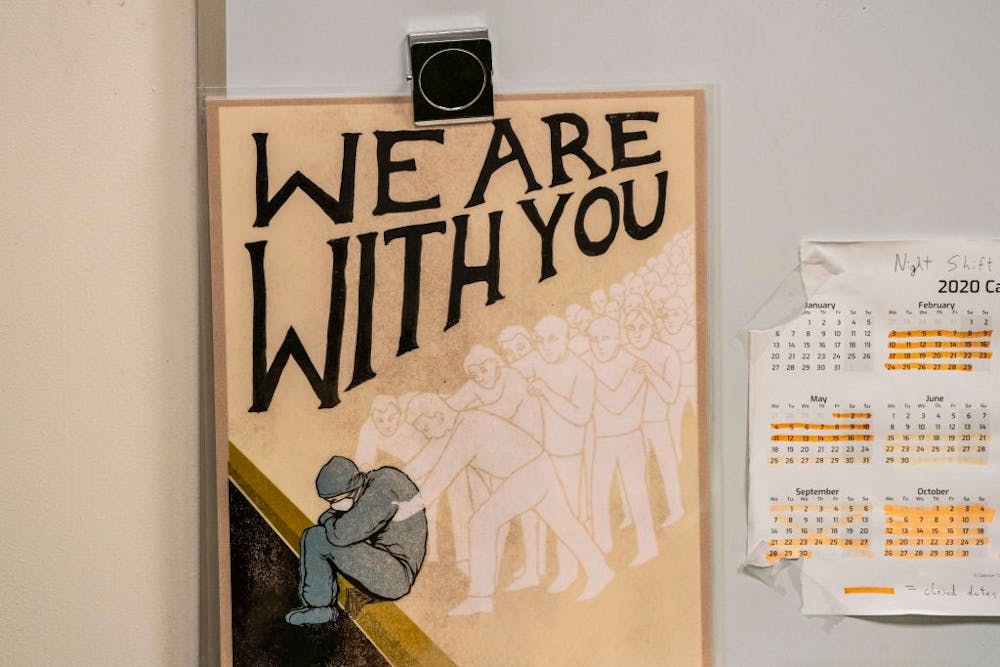
Artwork posted by a chaplain in a break room in the trauma surgery ICU at Harborview Medical Center in Seattle.
David Ryder/Getty Images
For example, our team asked Kathy, a health care chaplain, how she approaches prayer with religious and nonreligious patients. “My goal is to try to meet that person where they are and pray in a way that’s helpful and comforting for them, or meets whatever the need is that’s arisen during the conversation that we’ve had,” she said. Like all chaplains, Kathy is there to accompany, not proselytize. While she herself prays to the “great mystery,” she is comfortable facilitating whatever prayer is needed.
Claire, a chaplaincy student, agreed with Kathy and described her own first experience meeting an evangelical Christian patient. It was easy, she said, because “you’re not trying to fix anything. You’re just trying to meet them where they are. So that’s it.”
Nonreligious chaplains are used to thinking outside the box. Having learned about major world religions, many of them can find overlapping values and beliefs with their patients, such as finding beauty and meaning in the natural world or finding strength in their conviction that human beings are inherently good.
Cynthia works in the palliative care department in a hospital and tells her patients, “I am here to support you in whatever is meaningful to you right now and whatever is most important in your life in this moment.” She asks patients: “What are you struggling with right now? What are your goals? What do you hope for? What are you afraid of?” – trying to “unpack that with a spiritual lens rather than a medical lens.”
Cynthia is an example of why spiritual care by nonreligious chaplains may be surprising, but is likely here to stay. Based on our research, nonreligious chaplains are as capable as religious chaplains of meeting a person in their darkest hour and taking them by the hand.
This article is republished from The Conversation, a nonprofit, independent news organization dedicated to unlocking the knowledge of experts for the public good.
More Voices

About Amy Lawton
Amy Lawton is a Research Manager of the Chaplaincy Innovation Lab at Brandeis University. You can read more about the author here.

Next Post
September 13, 2023 The History of the Cross and Its Many Meanings Over The Centuries
Browse Our Archives
Select a Category Buddhism Christianity Hinduism Islam Judaism Religion and society Uncategorized
Select a Month July 2024 March 2024 February 2024 January 2024 December 2023 November 2023 October 2023 September 2023 August 2023 July 2023 January 2023 August 2022 July 2022 April 2022 February 2022 January 2022 October 2021 July 2021 June 2021 May 2021 April 2021 March 2021 February 2021 January 2021 December 2020 November 2020 October 2020 September 2020 August 2020 July 2020 June 2020 May 2020
Follow Us!
TAKE THE
Religious Wisdom Quiz
Who said, "I am not worthy to untie the strap of his sandals"?
Select your answer to see how you score.
Peter Paul John the Baptist Thomas
Related posts from The Conversation


Electing A Virtuous President Would Make Immunity Irrelevant

Why The Olympic Games Are A ‘Civil Religious’...

The Catholic Church Is Using The Olympics To...
TRENDING AT PATHEOS Religion News

Catholic Integralists believe that religious values – specifically Christian ones – should...

Electing A Virtuous President Would Make Immunity Irrelevant
Presidential immunity can bring with it many risks. So how can we...

Why The Olympic Games Are A ‘Civil Religious’...
Sporting events form a vital space where Americans display their 'civil religious...

After more than a decade of news, research updates, and insights on...

Q: Why do Southern Baptists and like-minded Protestants...
THE RELIGION GUY’S ANSWER: Why? Simple. Because they believe that’s what the...

THE QUESTION: Is gambling evil? THE RELIGION GUY’S ANSWER: Analysts anticipate a...
view all Religion News blogs
Ad-Free & Subscriber Log-In Subscription Support
- About Us
- 2026 Calendar
- Videos
- Podcasts
- Library of World Religions
- Faith In Media Tracker
- Advertise With Us
- Write for Us
- Privacy Policy
- Terms of Service
- Do Not Sell My Data
- Contact Us
- Radiant Digital
- Manage Newsletter Subscriptions
- Unsubscribe From Notifications
- Sitemap
Copyright 2008-2026, Patheos. All rights reserved.
Subscription Support Ad-Free & Subscriber Log-In
Follow Patheos