
BuddhistCatholicContemplativeEvangelicalGeneral ChristianHinduJewishLatter-day SaintMuslimNew VisionsProgressive Christian
Beliefs
- Buddhist
- Catholic
- Contemplative
- Evangelical
- General Christian
- Hindu
- Jewish
- Latter-day Saint
- More Voices
- Muslim
- New Visions
- Pagan
- Progressive Christian
Topics
- Religion News
- Food and Religion
- Sports and Religion
- Religious Art
- Religious Music and Entertainment
- Religious Events
- History and Religion
- Style and Religion
- Politics and Religion
- Women in Religion
- Recreation Outdoors and Religion
- Business Finance and Religion
- Careers Workplace and Religion
- Education and Religion
- Family Parenting and Religion
- Health Fitness and Religion
- Home and Religion
- Relationships and Religion
- Technology and Religion
- Travel and Religion
Columnists
- Buddhist Columnists
- Business Finance and Religion Columnists
- Careers Workplace and Religion Columnists
- Catholic Columnists
- Contemplative Columnists
- Education and Religion Columnists
- Evangelists Columnists
- Family Parenting and Religion Columnists
- General Christian Columnists
- Health Fitness and Religion Columnists
- Hindu Columnists
- History and Religion Columnists
- Home and Religion Columnists
- Jewish Columnists
- More Voices Columnists
- Latter Day Columnists
- Muslim Columnists
- New Visions Columnists
- Nonreligious Columnists
- Pagan Columnists
- Politics and Religion Columnists
- Progressive Columnists
- Recreation Outdoors and Religion Columnists
- Relationships and Religion Columnists
- Religion News Columnists
- Religious Art Columnists
- Religious Events Columnists
- Religious Music and Entertainment Columnists
- Sports and Religion Columnists
- Style and Religion Columnists
- Technology and Religion Columnists
- Travel and Religion Columnists
- Women in Religion Columnists
Resource Library
- 2026 Calendar
- Library of World Religions
- The 100 Most Holy Places on Earth
- Patheos Answers
- Podcasts
- Videos
- Faith Leaders Database
- Anglican Episcopalian
- Bahai
- Baptist
- Buddhism
- Christianity
- Confucianism
- Eastern Orthodoxy
- Hinduism
- Holiness and Pentecostal
- ISKCON
- Islam
- Judaism
- Lutheran
- Methodist
- The Church of Jesus Christ of Latter-day Saints
- New Age
- Paganism
- Presbytarian and Reformed
- Protestantism
- Religion Behind the Scenes
- Roman Catholic
- Scientology
- Shia Islam
- Sikhism
- Sufism
- Sunni Islam
- Taoism
- Zen
- See all religions
Research Tools
 Ad-Free & Subscriber Log-In Subscription Support
Follow Patheos 

- Trending:
- Advent
- |
- Forgiveness
- |
- Thanksgiving
- |
- Election
- |
- Seasonal Holidays
- |
- Marriage

- Home
- Religion News
- Tourists search for Mount Sinai in Saudi Arabia – but does a geographical location for pivotal Bible event even exist?
Tourists search for Mount Sinai in Saudi Arabia – but does a geographical location for pivotal Bible event even exist?
Last updated on: August 7, 2023 at 11:05 am by The Conversation
Tourists search for Mount Sinai in Saudi Arabia – but does a geographical location for pivotal Bible event even exist? 2023-08-07T11:05:23-04:00 The Conversation
Patheos Explore the world's faith through different perspectives on religion and spirituality! Patheos has the views of the prevalent religions and spiritualities of the world.
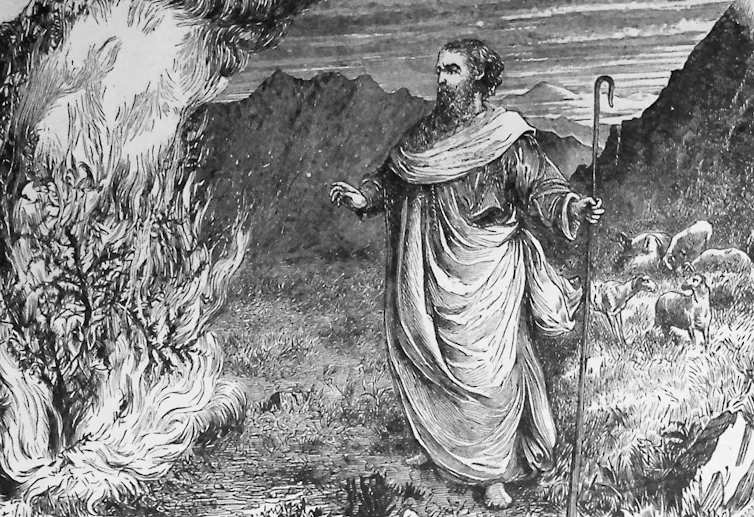
Mount Sinai is mentioned in the second book of the Bible, Exodus, as the site where Moses received his first instruction from God.
Pictures From History/Universal Images Group via Getty Images
By Jacob F. Love, of University of Tennessee
Since Saudi Arabia relaxed rules and expanded visas for tourists in 2019, Christians have been increasingly visiting the country, drawn by word of mouth and promotional YouTube videos, in search of Mount Sinai, where the Bible recounts God revealing the Ten Commandments to Moses.
For many centuries people have believed the location to be in Egypt’s Sinai Peninsula, near the site of a monastery built around 550 C.E. and named after St. Catherine.
But this was entirely based on the word of local tribes living some 2,000 years after the event. Most scholars believe that the location of Mount Sinai is unknowable from the available textual evidence. As a scholar of the Hebrew Bible and language, I agree with them.

The Greek Orthodox Monastery of St. Catherine on the Sinai Peninsula, some 240 miles from Cairo, Egypt.
AP Photo/Enric Marti, File
The existence of Mount Sinai is likely a legendary myth that is part of the stories of many cultures. There is no corroborating evidence, archaeological or otherwise, to support any particular location.
What’s in a name?
The first biblical mention of the holy mountain occurs in Exodus, the second book of the Bible and the primary source for the story of Moses leading the Israelites out of Egypt.
In Exodus 3:1, a mountain is referred to as Horeb and called the “mountain of God.” Horeb is mentioned twice more in Exodus but then disappears without mention in the third and fourth books – Leviticus and Numbers – until it reappears in the last book of the first section of the Bible, or the Pentateuch – Deuteronomy.
Deuteronomy retells the history of Israel as the Israelites were poised to enter the Holy Land. Throughout Deuteronomy, there are over a dozen references to Horeb as the place where Moses received the commandments.
Horeb is also found in biblical books after the Pentateuch. For example, the prophet Malachi says in the book that bears his name, “Remember the statutes of Moses … whom I commanded at Horeb.”
Horeb is a common name for the mountain in the Bible and yet is far less known than Sinai. The name Sinai is used throughout Exodus and occurs in Leviticus and Numbers, although Horeb is absent from those works.
But in Deuteronomy, Sinai all but disappears – it is used just once in a poem quoted by the author of Deuteronomy (33:2). The poem is cast as Moses’ final benediction of the people and begins, “This is the blessing with which Moses the man of God blessed the children of Israel before his death. He said, ‘The Lord came from Sinai, and dawned from Se′ir upon us; he shone forth from Mount Paran,
he came from the ten thousands of holy ones, with flaming fire at his right hand.’”
Horeb or Sinai?
It is not simply a matter of two different names for the same place. That could be explained as easily as noting that Jerusalem is also called the City of David. And it would be logical if the various books scattered these names as if they were interchangeable. But I would argue that the distribution is anything but random.
The references to Sinai are concentrated in Exodus, Leviticus and Numbers, while Deuteronomy refers almost exclusively to Horeb. In other words, the author or authors of Exodus, Leviticus and Numbers strongly preferred the word Sinai while the author of Deuteronomy used only Horeb.
For over 200 years biblical scholars have been analyzing the Pentateuch to discern its editorial history. The result of this search for the authors of the Pentateuch has led to the conclusions that the first four books were written by at least three authors and redacted by editors to combine their stories.
There is evidence to show that the last book, Deuteronomy, was written by a single author. However, scholars argue, an editor probably changed and added material. It is likely that the one poem that mentions Sinai in Deuteronomy, when every other mention of that mountain is in Horeb, is a result of the editorial changes.
A second possibility is that they are two different locations, each of which had sacred status to a particular group of Israelites. The third possibility, favored by most biblical scholars, is that the ancient stories cataloged among the Israelites came from different sources and were ultimately reconciled by editors.
The second and third possibilities are not necessarily mutually exclusive – in other words, even if the stories were written by different authors, those different authors could have the same place in mind.
Perhaps the key fact to keep in mind is that scholars know very little about the location of Mount Sinai and whether or not it is the same place as Horeb.
A strange absence
Many of the books recounting the early history of biblical times, especially the prophets, however, have practically no reference to Sinai or Horeb. Among the 150 Psalms there is but one reference to Sinai.
How can it be that such a critical source of the religion of Israel was of little interest to these prophets? The commandments that Moses is believed to have received from God framed the lives of all Israelites and established the priestly offerings, the courts, and the rules for marriage, divorce and inheritance. Yet, none of the prophets felt a need to call upon Israel to follow the laws of Moses given at Sinai or Horeb. Is it not more reasonable to imagine that they simply knew little of those events or did not attach much importance to them?
Some people might conclude that the belief about Moses at Sinai is just invention. After all, there is so much historical and archaeological evidence for the history of places such as Jerusalem and Lachish. But in the case of Horeb or Sinai, the geographical hints found in the Bible are insufficient to make any sort of determination.
In other words, there isn’t sufficient data to decide whether the biblical account of Sinai or Horeb happened somewhere, or whether it is perhaps a foundation legend created for some purpose such as uniting the disparate Hebrew-speaking tribes of Israel.
When some Christians, such as the ones now looking for Sinai in Saudi Arabia, examine these sources, they often try to stitch together texts written over centuries after the events supposedly happened. It is not surprising that various people have assigned the location of Sinai to locations hundreds of miles apart.
Based on all the evidence – or lack thereof – I argue that Sinai is located not in any specific place but rather in the hearts and minds of those who treasure the meaning of the Hebrew Bible.

This article is republished from The Conversation, a nonprofit, independent news organization dedicated to unlocking the knowledge of experts for the public good. .

About Jacob F. Love
Jacob F. Love is a Lecturer in Religious Studies at the University of Tennessee. You can read more about the author here.

Browse Our Archives
Select a Category Buddhism Christianity Hinduism Islam Judaism Religion and society Uncategorized
Select a Month July 2024 March 2024 February 2024 January 2024 December 2023 November 2023 October 2023 September 2023 August 2023 July 2023 January 2023 August 2022 July 2022 April 2022 February 2022 January 2022 October 2021 July 2021 June 2021 May 2021 April 2021 March 2021 February 2021 January 2021 December 2020 November 2020 October 2020 September 2020 August 2020 July 2020 June 2020 May 2020
Follow Us!
TAKE THE
Religious Wisdom Quiz
Which king asked Elijah for help against the armies of Moab and Edom?
Select your answer to see how you score.
Jehoram Joash Jehoshaphat Joram
Related posts from The Conversation


Electing A Virtuous President Would Make Immunity Irrelevant

Why The Olympic Games Are A ‘Civil Religious’...

The Catholic Church Is Using The Olympics To...
TRENDING AT PATHEOS Religion News

Catholic Integralists believe that religious values – specifically Christian ones – should...

Electing A Virtuous President Would Make Immunity Irrelevant
Presidential immunity can bring with it many risks. So how can we...

Why The Olympic Games Are A ‘Civil Religious’...
Sporting events form a vital space where Americans display their 'civil religious...

After more than a decade of news, research updates, and insights on...

Q: Why do Southern Baptists and like-minded Protestants...
THE RELIGION GUY’S ANSWER: Why? Simple. Because they believe that’s what the...

THE QUESTION: Is gambling evil? THE RELIGION GUY’S ANSWER: Analysts anticipate a...
view all Religion News blogs
Ad-Free & Subscriber Log-In Subscription Support
- About Us
- 2026 Calendar
- Videos
- Podcasts
- Library of World Religions
- Faith In Media Tracker
- Advertise With Us
- Write for Us
- Privacy Policy
- Terms of Service
- Do Not Sell My Data
- Contact Us
- Radiant Digital
- Manage Newsletter Subscriptions
- Unsubscribe From Notifications
- Sitemap
Copyright 2008-2026, Patheos. All rights reserved.
Subscription Support Ad-Free & Subscriber Log-In
Follow Patheos