
BuddhistCatholicContemplativeEvangelicalGeneral ChristianHinduJewishLatter-day SaintMuslimNew VisionsProgressive Christian
Beliefs
- Buddhist
- Catholic
- Contemplative
- Evangelical
- General Christian
- Hindu
- Jewish
- Latter-day Saint
- More Voices
- Muslim
- New Visions
- Pagan
- Progressive Christian
Topics
- Religion News
- Food and Religion
- Sports and Religion
- Religious Art
- Religious Music and Entertainment
- Religious Events
- History and Religion
- Style and Religion
- Politics and Religion
- Women in Religion
- Recreation Outdoors and Religion
- Business Finance and Religion
- Careers Workplace and Religion
- Education and Religion
- Family Parenting and Religion
- Health Fitness and Religion
- Home and Religion
- Relationships and Religion
- Technology and Religion
- Travel and Religion
Columnists
- Buddhist Columnists
- Business Finance and Religion Columnists
- Careers Workplace and Religion Columnists
- Catholic Columnists
- Contemplative Columnists
- Education and Religion Columnists
- Evangelists Columnists
- Family Parenting and Religion Columnists
- General Christian Columnists
- Health Fitness and Religion Columnists
- Hindu Columnists
- History and Religion Columnists
- Home and Religion Columnists
- Jewish Columnists
- More Voices Columnists
- Latter Day Columnists
- Muslim Columnists
- New Visions Columnists
- Nonreligious Columnists
- Pagan Columnists
- Politics and Religion Columnists
- Progressive Columnists
- Recreation Outdoors and Religion Columnists
- Relationships and Religion Columnists
- Religion News Columnists
- Religious Art Columnists
- Religious Events Columnists
- Religious Music and Entertainment Columnists
- Sports and Religion Columnists
- Style and Religion Columnists
- Technology and Religion Columnists
- Travel and Religion Columnists
- Women in Religion Columnists
Resource Library
- 2026 Calendar
- Library of World Religions
- The 100 Most Holy Places on Earth
- Patheos Answers
- Podcasts
- Videos
- Faith Leaders Database
- Anglican Episcopalian
- Bahai
- Baptist
- Buddhism
- Christianity
- Confucianism
- Eastern Orthodoxy
- Hinduism
- Holiness and Pentecostal
- ISKCON
- Islam
- Judaism
- Lutheran
- Methodist
- The Church of Jesus Christ of Latter-day Saints
- New Age
- Paganism
- Presbytarian and Reformed
- Protestantism
- Religion Behind the Scenes
- Roman Catholic
- Scientology
- Shia Islam
- Sikhism
- Sufism
- Sunni Islam
- Taoism
- Zen
- See all religions
Research Tools
 Ad-Free & Subscriber Log-In Subscription Support
Ad-Free & Subscriber Log-In Subscription Support
Follow Patheos 

- Trending:
- Forgiveness
- |
- Marriage
- |
- Consciousness
- |
- Death Penalty
- |
- Election
- |
- Halloween

- Home
- Religion News
- Quran Burning in Sweden Prompts Debate on the Fine Line Between Freedom of Expression and Incitement of Hatred
Quran Burning in Sweden Prompts Debate on the Fine Line Between Freedom of Expression and Incitement of Hatred
Last updated on: September 15, 2023 at 9:27 am by The Conversation
Quran Burning in Sweden Prompts Debate on the Fine Line Between Freedom of Expression and Incitement of Hatred 2023-09-15T09:27:15-04:00 The Conversation
Patheos Explore the world's faith through different perspectives on religion and spirituality! Patheos has the views of the prevalent religions and spiritualities of the world.

Iraqis raise copies of the Quran during a protest in Baghdad, Iraq, on July 22, 2023, following reports of the burning of the holy book in Copenhagen.
AP Photo/Hadi Mizban
By Armin Langer of University of Florida
The Swedish government is concerned about national security following several incidents involving the burning of the Quran that have provoked demonstrations and outrage from Muslim-majority countries.
The spate of Quran-burning incidents followed an act of desecration by far-right activist Rasmus Paludan on Jan. 21, 2023, in front of the Turkish embassy in Stockholm. On Aug. 25, Denmark’s government said it would “criminalize” desecration of religious objects and moved a bill banning the burning of scriptures.
While freedom of expression is a fundamental human right in liberal democracies, the right to express one’s opinion can become complex when expressing one’s views clashes with the religious and cultural beliefs of others and when this rhetoric veers into hate speech.
As a scholar of European studies, I’m interested in how modern European societies are trying to navigate the fine line between freedom of expression and the need to prevent incitement of hatred; a few are introducing laws specifically addressing hate speech.
Death penalty for insulting God and church
Since medieval times, because of the dominant role of Christianity in political and cultural life, blasphemy against Christian beliefs in European countries was severely punished.
For instance, the Danish Code from 1683 punished people by cutting off their tongue, head or hands. Similarly, in Britain, both on the main island and in its overseas colonies, blasphemy was punished with executions. In 1636, English Puritan settlers in Massachusetts instituted the penalty of death for blasphemy.
For centuries, blasphemy laws were viewed by religious and civil leaders as safeguards for keeping society orderly and strengthening religious rules and influence. These laws showed how much power and influence religious groups wielded back then.
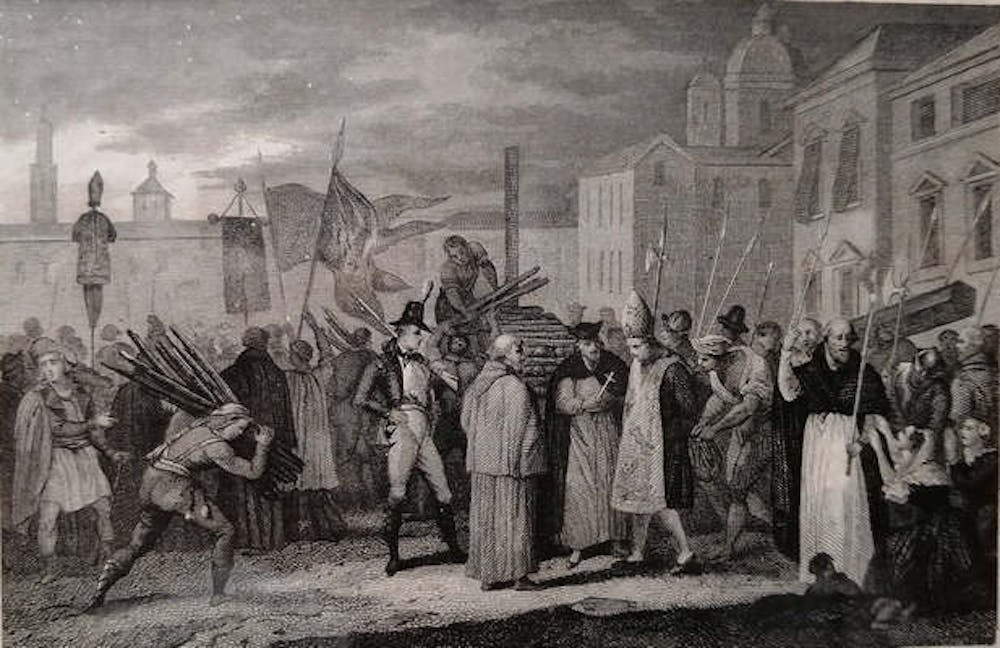
A painting showing a man being executed for heresy in July 1826.
(E)manccipa-Ment via Wikimedia Commons, CC BY-SA
During the Enlightenment, from the 1600s to the 1700s, religious institutions began losing power. Advocating for a strict separation of church and state, France became the first country to repeal its blasphemy law in 1881. Seven other European countries repealed their laws between the 1900s and 2000s, including Sweden and, more recently, Denmark.
European landscape of blasphemy laws
Several countries in Europe retain blasphemy laws, but their approaches are highly varied. Often the laws may not prevent present-day acts like dishonoring of religious texts.
In Russia, legislators introduced a federal law in 2013 criminalizing public insults of religious beliefs. This followed some provocative performances by the Moscow-based feminist protest art group Pussy Riot. One such protest, a “punk prayer,” in a Moscow cathedral in 2012 criticized the close ties between the Russian Orthodox Church and the Putin regime.
Since 1969, the German penal code has forbidden the public slander of religions and worldviews. While Germany rarely enforces this law, in 2006 an anti-Islam activist got a one-year suspended prison sentence for distributing toilet paper with the words “Quran, the Holy Quran” printed on it.
Austria and Switzerland have laws quite similar to Germany’s in this regard. In 2011, a person in Vienna was fined for calling the Islamic prophet Muhammad a pedophile. This case later went up to the European Court of Human Rights, which supported the Viennese court’s decision. The court said that the person wasn’t trying to have a useful discussion but instead just wanted to show that the prophet Muhammad shouldn’t be respected.
Spain, too, takes a strong stance against religious disrespect. Its penal code makes it a crime to publicly belittle religious beliefs, practices or ceremonies in a way that could hurt the feelings of followers. While Spain introduced this law to safeguard Catholic interests, it also covers religious minorities.
Italy, another Catholic-majority country, punishes acts deemed to be disrespectful to religions. Its penal code has been used to punish actions that insult Christianity. For example, in 2017 authorities charged an artist for depicting Jesus with an erect penis.
Contemporary debate
The Quran burnings in Sweden and Denmark, aren’t random – they’re part of a broader agenda of targeting Muslims that’s being pushed by far-right groups across Europe.
In many European countries, lawmakers and others are asking whether these book burnings should be seen as exercises of free expression or more as incitement based on religion.
A few countries are introducing new legislation to curb hate speech against religious communities. For example, in 2006 England got rid of the blasphemy law and introduced The Racial and Religious Hatred Act, which makes it an offense to stir up religious hatred. After repealing its blasphemy law in 2020, Ireland has been discussing the introduction of a hate speech law, which will criminalize any communication or behavior that is likely to incite violence or hatred.
Sweden passed a hate speech law in 1970 protecting racial, ethnic, religious and sexual minorities. Swedish authorities pointed to this legislation when they took action against a Quran-burning incident that occurred in front of a mosque in June 2023.
The police argued that the Quran burning wasn’t just about religion but specifically targeted the Muslim community. This was evident, according to the authorities, as the incident took place in front of a mosque during the Islamic holiday of Eid, setting it apart from other burnings that took place outside of the Swedish Royal Palace, the Turkish and Iraqi embassies and other public spaces. Because of the existing hate speech law focusing on incitement against minorities rather than religions, the activist received a fine from the police.
In recent weeks, some have called for a stricter application of the hate speech law and have demanded a ban on all Quran-burning events for implicitly inciting hatred against Muslims.
A global challenge
This discussion isn’t limited to Europe alone. Even in the U.S., there’s an ongoing debate about the boundaries of free speech. The First Amendment of the Constitution allows free speech, which some can interpret as the right to burn holy books.
Terry Jones, for instance, is a controversial Christian pastor from Florida. He organized Quran-burning events in Gainesville in 2011 and 2012. His only legal consequence was a US$271 fine from Gainesville Fire Rescue for not following fire safety rules.
Following Jones’ announcement that he was going to burn the Quran, President Barack Obama said that the pastor violated U.S. principles of religious tolerance. Legal scholar Jack Balkin recommended using free speech in promoting pluralist values to counter Jones’ hatred. Scholar of law and religion Jane Wise suggested that the U.S. could follow the English example by banning hate speech.
As societies change, I believe it has become important to recognize when freedom of speech has turned into promoting hatred. Figuring out where this boundary lies, understanding the standards applied and uncovering potential biases can spark important conversations. While a solution that applies to every single country may not exist, it’s essential to engage in this dialogue, recognizing its complexity and the varying perspectives across societies.
This article is republished from The Conversation, a nonprofit, independent news organization dedicated to unlocking the knowledge of experts for the public good. .

About Armin Langer
Armin Langer is an Assistant Professor of European Studies at the University of Florida. You can read more about the author here.



Browse Our Archives
Select a Category Buddhism Christianity Hinduism Islam Judaism Religion and society Uncategorized
Select a Month July 2024 March 2024 February 2024 January 2024 December 2023 November 2023 October 2023 September 2023 August 2023 July 2023 January 2023 August 2022 July 2022 April 2022 February 2022 January 2022 October 2021 July 2021 June 2021 May 2021 April 2021 March 2021 February 2021 January 2021 December 2020 November 2020 October 2020 September 2020 August 2020 July 2020 June 2020 May 2020
Follow Us!
TAKE THE
Religious Wisdom Quiz
How long did it take to rebuild Jerusalem's walls under Nehemiah?
Select your answer to see how you score.
40 days 52 days 7 years 12 months
Related posts from The Conversation

Saudi Reforms Are Softening Islam’s Role, But Critics...
Islam’s call to prayer is ringing out in...

There is no one Islamic interpretation on ethics...
The problem with India's 'love jihad' laws
TRENDING AT PATHEOS Religion News

Catholic Integralists believe that religious values – specifically Christian ones – should...

Electing A Virtuous President Would Make Immunity Irrelevant
Presidential immunity can bring with it many risks. So how can we...

Why The Olympic Games Are A ‘Civil Religious’...
Sporting events form a vital space where Americans display their 'civil religious...

After more than a decade of news, research updates, and insights on...

Q: Why do Southern Baptists and like-minded Protestants...
THE RELIGION GUY’S ANSWER: Why? Simple. Because they believe that’s what the...

THE QUESTION: Is gambling evil? THE RELIGION GUY’S ANSWER: Analysts anticipate a...
view all Religion News blogs
Ad-Free & Subscriber Log-In Subscription Support
- About Us
- 2026 Calendar
- Videos
- Podcasts
- Library of World Religions
- Faith In Media Tracker
- Advertise With Us
- Write for Us
- Privacy Policy
- Terms of Service
- Do Not Sell My Data
- Contact Us
- Radiant Digital
- Manage Newsletter Subscriptions
- Unsubscribe From Notifications
- Sitemap
Copyright 2008-2026, Patheos. All rights reserved.
Subscription Support Ad-Free & Subscriber Log-In
Follow Patheos