
BuddhistCatholicContemplativeEvangelicalGeneral ChristianHinduJewishLatter-day SaintMuslimNew VisionsProgressive Christian
Beliefs
- Buddhist
- Catholic
- Contemplative
- Evangelical
- General Christian
- Hindu
- Jewish
- Latter-day Saint
- More Voices
- Muslim
- New Visions
- Pagan
- Progressive Christian
Topics
- Religion News
- Food and Religion
- Sports and Religion
- Religious Art
- Religious Music and Entertainment
- Religious Events
- History and Religion
- Style and Religion
- Politics and Religion
- Women in Religion
- Recreation Outdoors and Religion
- Business Finance and Religion
- Careers Workplace and Religion
- Education and Religion
- Family Parenting and Religion
- Health Fitness and Religion
- Home and Religion
- Relationships and Religion
- Technology and Religion
- Travel and Religion
Columnists
- Buddhist Columnists
- Business Finance and Religion Columnists
- Careers Workplace and Religion Columnists
- Catholic Columnists
- Contemplative Columnists
- Education and Religion Columnists
- Evangelists Columnists
- Family Parenting and Religion Columnists
- General Christian Columnists
- Health Fitness and Religion Columnists
- Hindu Columnists
- History and Religion Columnists
- Home and Religion Columnists
- Jewish Columnists
- More Voices Columnists
- Latter Day Columnists
- Muslim Columnists
- New Visions Columnists
- Nonreligious Columnists
- Pagan Columnists
- Politics and Religion Columnists
- Progressive Columnists
- Recreation Outdoors and Religion Columnists
- Relationships and Religion Columnists
- Religion News Columnists
- Religious Art Columnists
- Religious Events Columnists
- Religious Music and Entertainment Columnists
- Sports and Religion Columnists
- Style and Religion Columnists
- Technology and Religion Columnists
- Travel and Religion Columnists
- Women in Religion Columnists
Resource Library
- 2026 Calendar
- Library of World Religions
- The 100 Most Holy Places on Earth
- Patheos Answers
- Podcasts
- Videos
- Faith Leaders Database
- Anglican Episcopalian
- Bahai
- Baptist
- Buddhism
- Christianity
- Confucianism
- Eastern Orthodoxy
- Hinduism
- Holiness and Pentecostal
- ISKCON
- Islam
- Judaism
- Lutheran
- Methodist
- The Church of Jesus Christ of Latter-day Saints
- New Age
- Paganism
- Presbytarian and Reformed
- Protestantism
- Religion Behind the Scenes
- Roman Catholic
- Scientology
- Shia Islam
- Sikhism
- Sufism
- Sunni Islam
- Taoism
- Zen
- See all religions
Research Tools
 Ad-Free & Subscriber Log-In Subscription Support
Follow Patheos 

- Trending:
- Advent
- |
- Forgiveness
- |
- Thanksgiving
- |
- Election
- |
- Seasonal Holidays
- |
- Marriage

- Home
- Religion News
- Islam’s call to prayer is ringing out in more US cities – affirming a long and growing presence of Muslims in America
Islam’s call to prayer is ringing out in more US cities – affirming a long and growing presence of Muslims in America
Last updated on: August 17, 2023 at 6:25 am by The Conversation
Islam’s call to prayer is ringing out in more US cities – affirming a long and growing presence of Muslims in America 2023-08-16T21:09:01-04:00 The Conversation
Patheos Explore the world's faith through different perspectives on religion and spirituality! Patheos has the views of the prevalent religions and spiritualities of the world.
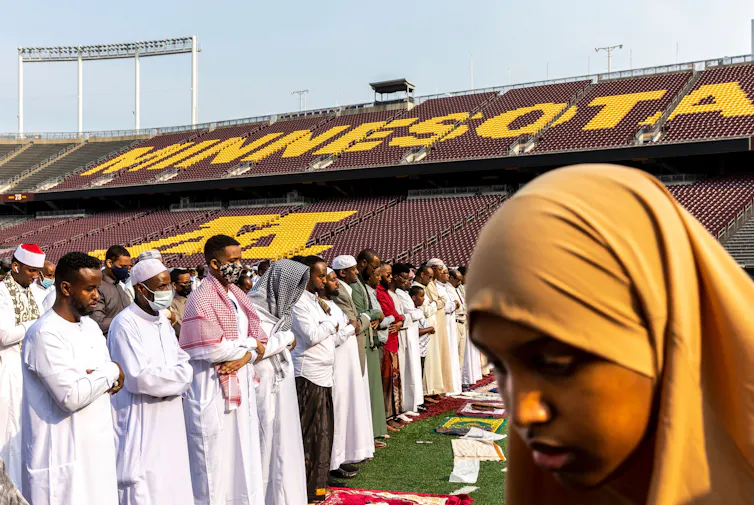
Minneapolis allows call to prayer to be publicly broadcast five times per day.
Kerem Yucel/AFP via Getty Images
By Leila Tarakji of Michigan State University
Minneapolis recently became the first major U.S. city to allow the “adhan,” or Muslim call to prayer, to be broadcast from mosques five times a day.
In April 2023, the Minneapolis City Council unanimously approved a change to the city’s sound ordinance, effectively eliminating time constraints that previously prevented the pre-dawn and evening prayer calls from being broadcast.
For the citizens of Minneapolis and for many Muslims across the United States, this represents a historic moment. Jaylani Hussein, executive director of the Minnesota chapter of the Council on American-Islamic Relations, described this as a victory for religious freedom and for the U.S. Constitution. The resolution demonstrates that Muslims are not only “welcome here, but they’re also here – that they are part of the fabric of the diversity of this city and our state,” he said in a statement.
As a scholar of Islam and Muslims in America, I am particularly interested in how Muslim Americans express themselves as a faith community at the local, national and global levels. The practice of calling worshippers to prayer is an important aspect of daily Muslim life, one that has a long history on American soil.
Adhan: Tradition and meanings
Adhan literally means “announcement” in Arabic and refers to the Islamic call to prayer that takes place five times a day. The five daily prayers signify one of the five pillars of Islam that are traditionally considered obligatory for every Muslim. The prayers are performed in the direction of Mecca throughout the day.
The practice of calling the adhan dates to the time of Prophet Muhammad, when it became the standard way to mark the beginning of each prayer’s time and to call Muslims to prayer. In his text “Approaching the Qur’an: The Early Revelations,” scholar Michael Sells notes that “the call to prayer punctuates daily life five times, drawing people out of their everyday preoccupation to matters of ultimate concern.”
Recited in Arabic, the adhan translates as: God is most great, God is most great; I testify that there is no god but God; I testify that Muhammad is the messenger of God; Come (alive) to the prayer; Come (alive) to flourishing; God is most great, God is most great; There is no god but God.
The adhan.
In Muslim-majority countries, the distinctive sound of the adhan loudly called from every mosque’s minaret is one of the most memorable sounds for visitors.
The significance of the adhan is such that Islamic tradition recommends that it be one of the first sounds that a newborn baby hears. Often, the father will gently recite the adhan in the baby’s right ear. The words mark the beginning of a person’s life on the “right path,” with the remembrance of God.
In America, where the adhan is not commonly heard in public settings, many Muslims make do with a prayer app, on their cellphones or other devices, that lists the various prayer times and calls the adhan at the appropriate time.
Influence on popular music and culture
The earliest practice of the adhan on American soil dates back to the hundreds of thousands of enslaved African Muslims who, to varying extents, brought their Islamic practices with them. In the process, the adhan has left a deep influence on American music and culture.
Historian Sylviane A. Diouf attributes the roots of blues music to West African Muslims who were enslaved and forcibly taken to the Americas between the 1600s and mid-1800s.
Diouf specifically makes a comparison between the adhan and “Levee Camp Holler,” a song that was written and sung by former slaves. Holler songs were precursors to the blues. “It features the same ornamented notes, elongated syllables sung with wavy intonations, melismas, and pauses. When both pieces are juxtaposed, it is hard to distinguish when the call to prayer ends and the holler starts,” Diouf writes.
More recently, Muslim rapper Lupe Fiasco released an album called “Muhammad Walks” that clearly includes sound bites from the adhan along with various references to Islamic traditions.
Adhan broadcast during the month of Ramadan from a mosque in Virginia.
History of the Muslim prayer call in the US
Generally speaking, mosques in the U.S. make the call to prayer inside the prayer space, where it is audible only to those present. The earliest documented public broadcasting of the Muslim call to prayer took place during the World’s Columbian Exposition, a world’s fair that was held in Chicago in 1893.
The fair featured “Cairo Street,” a popular attraction that sought to recreate a small cross section of Cairene life. Among the 26 different structures that were specifically built for this project was a mosque where tourists could hear the muezzin – one who makes the call to prayer – call the adhan from the minaret and then watch Muslim worshippers perform their daily prayers.
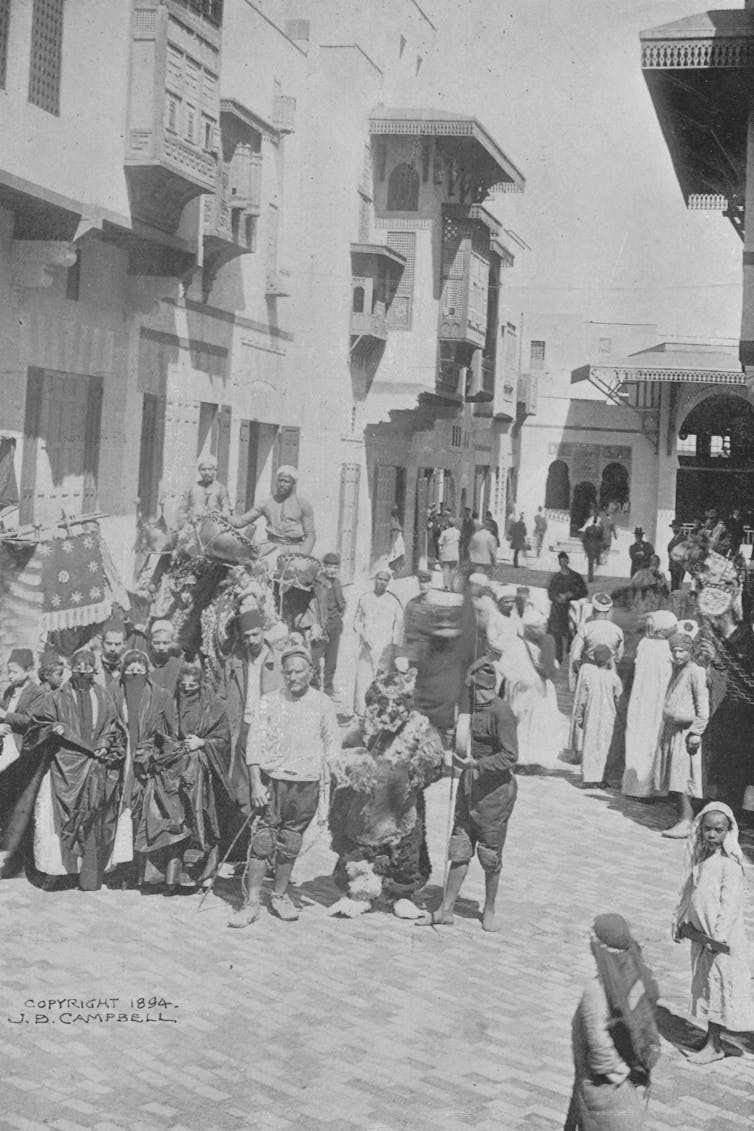
A scene from the Cairo-themed area of World’s Columbian Exposition in Chicago, 1893.
Museum of Science and Industry, Chicago/Getty Images
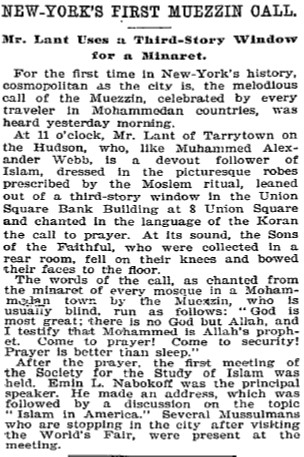
Later the same year, the prayer call was broadcast from a third-story window of the Union Square Bank building in New York City. After John Lant, a convert to Islam and co-founder of First Society for the Study of Islam in America, made the adhan, a congregational prayer was held before the group proceeded with the society’s first meeting.
This moment was documented by The New York Times: “For the first time in New-York’s history, cosmopolitan as the city is, the melodious call of the Muezzin, celebrated by every traveler in Mohammedan countries, was heard yesterday morning.”
Recent broadcasts
Since the 1970s the adhan has been broadcast from mosques in the U.S., such as the American Moslem Society, which was established in Dearborn, Michigan, in 1938 and is arguably the first U.S. mosque to be granted the legal right to transmit all five prayer calls through loudspeakers.
In nearby Hamtramck, considered to be America’s first majority-Muslim city, the adhan was legalized by local government in 2004, when a noise ordinance change was put to a citywide vote. At the time, this stirred notable tensions between Hamtramck’s different faith communities.
In 2020, the city council of Paterson, New Jersey, also authorized the call to prayer between certain hours of the day. In 2023, several mosques in Astoria, New York, received permits to broadcast the five calls to prayer specifically for the duration of the holy month of Ramadan.
Similarly, a small mosque in Occoquan, Virginia, was invited by the local mayor to broadcast the adhan on two separate occasions to mark the month of Ramadan.
The call to prayer in Queens, New York.
Indeed, the public broadcasting of the adhan is part of a larger narrative of American plurality. It is a natural manifestation of Muslim American presence and communal expression.
The fact that the adhan can be heard in the streets of Minneapolis, Hamtramck and Astoria – alongside church bells and other sounds of worship – signifies that Muslim beliefs are not deemed less worthy, nor must they be confined to a private space. It is a sign that Muslims are at home and welcome here.
This article is republished from The Conversation, a nonprofit, independent news organization dedicated to unlocking the knowledge of experts for the public good. .

About Leila Tarakji
Leila Tarakji is an Assistant Professor of Religious Studies at Michigan State University. You can read more about the author here.


Browse Our Archives
Select a Category Buddhism Christianity Hinduism Islam Judaism Religion and society Uncategorized
Select a Month July 2024 March 2024 February 2024 January 2024 December 2023 November 2023 October 2023 September 2023 August 2023 July 2023 January 2023 August 2022 July 2022 April 2022 February 2022 January 2022 October 2021 July 2021 June 2021 May 2021 April 2021 March 2021 February 2021 January 2021 December 2020 November 2020 October 2020 September 2020 August 2020 July 2020 June 2020 May 2020
Follow Us!
TAKE THE
Religious Wisdom Quiz
What does James say we should be quick to do and slow to do?
Select your answer to see how you score.
Quick to forgive, slow to judge Quick to obey, slow to question Quick to pray, slow to doubt Quick to listen, slow to speak and slow to become angry
Related posts from The Conversation

Saudi Reforms Are Softening Islam’s Role, But Critics...
Quran Burning in Sweden Prompts Debate on the...

There is no one Islamic interpretation on ethics...
Pope's upcoming visit brings attention to the dwindling...
TRENDING AT PATHEOS Religion News

Catholic Integralists believe that religious values – specifically Christian ones – should...

Electing A Virtuous President Would Make Immunity Irrelevant
Presidential immunity can bring with it many risks. So how can we...

Why The Olympic Games Are A ‘Civil Religious’...
Sporting events form a vital space where Americans display their 'civil religious...

After more than a decade of news, research updates, and insights on...

Q: Why do Southern Baptists and like-minded Protestants...
THE RELIGION GUY’S ANSWER: Why? Simple. Because they believe that’s what the...

THE QUESTION: Is gambling evil? THE RELIGION GUY’S ANSWER: Analysts anticipate a...
view all Religion News blogs
Ad-Free & Subscriber Log-In Subscription Support
- About Us
- 2026 Calendar
- Videos
- Podcasts
- Library of World Religions
- Faith In Media Tracker
- Advertise With Us
- Write for Us
- Privacy Policy
- Terms of Service
- Do Not Sell My Data
- Contact Us
- Radiant Digital
- Manage Newsletter Subscriptions
- Unsubscribe From Notifications
- Sitemap
Copyright 2008-2026, Patheos. All rights reserved.
Subscription Support Ad-Free & Subscriber Log-In
Follow Patheos