
BuddhistCatholicContemplativeEvangelicalGeneral ChristianHinduJewishLatter-day SaintMuslimNew VisionsProgressive Christian
Beliefs
- Buddhist
- Catholic
- Contemplative
- Evangelical
- General Christian
- Hindu
- Jewish
- Latter-day Saint
- More Voices
- Muslim
- New Visions
- Pagan
- Progressive Christian
Topics
- Religion News
- Food and Religion
- Sports and Religion
- Religious Art
- Religious Music and Entertainment
- Religious Events
- History and Religion
- Style and Religion
- Politics and Religion
- Women in Religion
- Recreation Outdoors and Religion
- Business Finance and Religion
- Careers Workplace and Religion
- Education and Religion
- Family Parenting and Religion
- Health Fitness and Religion
- Home and Religion
- Relationships and Religion
- Technology and Religion
- Travel and Religion
Columnists
- Buddhist Columnists
- Business Finance and Religion Columnists
- Careers Workplace and Religion Columnists
- Catholic Columnists
- Contemplative Columnists
- Education and Religion Columnists
- Evangelists Columnists
- Family Parenting and Religion Columnists
- General Christian Columnists
- Health Fitness and Religion Columnists
- Hindu Columnists
- History and Religion Columnists
- Home and Religion Columnists
- Jewish Columnists
- More Voices Columnists
- Latter Day Columnists
- Muslim Columnists
- New Visions Columnists
- Nonreligious Columnists
- Pagan Columnists
- Politics and Religion Columnists
- Progressive Columnists
- Recreation Outdoors and Religion Columnists
- Relationships and Religion Columnists
- Religion News Columnists
- Religious Art Columnists
- Religious Events Columnists
- Religious Music and Entertainment Columnists
- Sports and Religion Columnists
- Style and Religion Columnists
- Technology and Religion Columnists
- Travel and Religion Columnists
- Women in Religion Columnists
Resource Library
- 2026 Calendar
- Library of World Religions
- The 100 Most Holy Places on Earth
- Patheos Answers
- Podcasts
- Videos
- Faith Leaders Database
- Anglican Episcopalian
- Bahai
- Baptist
- Buddhism
- Christianity
- Confucianism
- Eastern Orthodoxy
- Hinduism
- Holiness and Pentecostal
- ISKCON
- Islam
- Judaism
- Lutheran
- Methodist
- The Church of Jesus Christ of Latter-day Saints
- New Age
- Paganism
- Presbytarian and Reformed
- Protestantism
- Religion Behind the Scenes
- Roman Catholic
- Scientology
- Shia Islam
- Sikhism
- Sufism
- Sunni Islam
- Taoism
- Zen
- See all religions
Research Tools
 Ad-Free & Subscriber Log-In Subscription Support
Follow Patheos 

- Trending:
- Advent
- |
- Forgiveness
- |
- Thanksgiving
- |
- Election
- |
- Seasonal Holidays
- |
- Marriage

- Home
- Religion News
- A chatbot willing to take on questions of all kinds – from the serious to the comical – is the latest representation of Jesus for the AI age
A chatbot willing to take on questions of all kinds – from the serious to the comical – is the latest representation of Jesus for the AI age
Last updated on: August 2, 2023 at 11:28 am by The Conversation
A chatbot willing to take on questions of all kinds – from the serious to the comical – is the latest representation of Jesus for the AI age 2023-08-02T11:28:47-04:00 The Conversation
Patheos Explore the world's faith through different perspectives on religion and spirituality! Patheos has the views of the prevalent religions and spiritualities of the world.
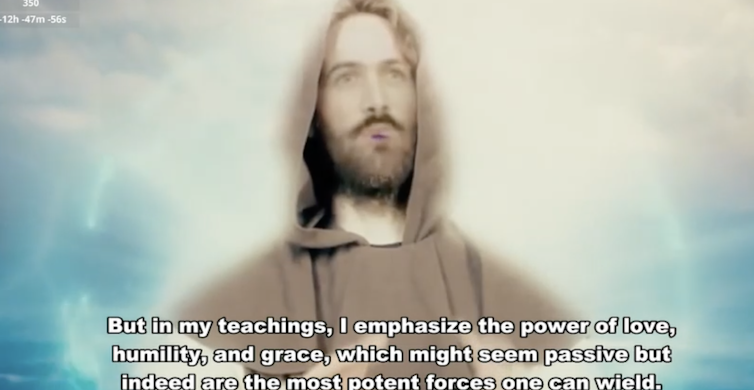
On AI Jesus’ Twitch channel, chatbot Jesus answers questions on personal and spiritual matters.
Twitch user ask_jesus
By Joseph L. Kimmel of Boston College
Jesus has been portrayed in many different ways: from a prophet who alerts his audience to the world’s imminent end to a philosopher who reflects on the nature of life.
But no one has called Jesus an internet guru – that is, until now.
In his latest role as an “AI Jesus,” Jesus stands, rather awkwardly, as a white man, dressed in a hooded brown-and-white robe, available 24/7 to answer any and all questions on his Twitch channel, “ask_jesus.”
Questions posed to this chatbot Jesus can range from the serious – such as asking him about life’s meaning – to requesting a good joke.
While many of these individual questions may be interesting in their own right, as a scholar of early Christianity and comparative religion, I argue that the very presentation of Jesus as “AI Jesus” reveals a fascinating refashioning of this spiritual figure for our AI era.
Reinterpreting Jesus
Numerous scholars have described how Jesus has been reinterpreted over the centuries.
For example, religion scholar Stephen Prothero has shown how, in 19th-century America, Jesus was depicted as brave and tough, reflecting white masculine expectations of the period. Prothero argues that a primarily peaceful Jesus was perceived to conflict with these gender norms, and so Jesus’ physical prowess was emphasized.
By contrast, according to scholar R.S. Sugirtharajah, around the same time in India, Jesus was represented as a Hindu mystic or guru by Indian theologians like Ponnambalam Ramanathan in order to make Jesus more relatable for Indian Christians and to show how his spiritual teachings could be usefully adopted by faithful Hindus.
A third presentation of Jesus is reflected in theologian James Cone’s work. Cone depicts Jesus as Black to highlight the oppression he endured as a victim of political violence. He also shows how the “Black Christ” offers hope for liberation, equality and justice to oppressed people today.
The point is not that one of these representations is necessarily more accurate than the others, but instead that Jesus has been consistently reinterpreted to fit the norms and needs of each new context.
The AI Jesus who engages individuals online in the form of a chatbot is the latest in this ongoing pattern of reinterpretation, geared to making Jesus suited to the current times. On AI Jesus’ Twitch channel, users consistently treat this chatbot Jesus as an authority in both personal and spiritual matters. For example, one recent user asked AI Jesus for advice about how best to stay motivated while exercising, while another person wanted to know why God allows war.
AI Jesus at work
AI Jesus represents one of the newest examples in the growing field of AI spirituality. Researchers in AI spirituality study how human spirituality is being shaped by the rising influence of artificial intelligence, as well as how AI can help people understand how humans form beliefs in the first place.
For example, in a 2021 article on AI and religious belief, scholars Andrea Vestrucci, Sara Lumbreras and Lluis Oviedo explain how AI systems can be designed to generate statements of religious belief, such as – hypothetically – “it is highly likely that the Catholic God does not support the death penalty.”
Over time, such systems can revise and recalibrate these statements based on new information. For example, if the AI system is exposed to new data challenging its beliefs, it will automatically nuance future statements in light of that fresh information.
AI Jesus functions very similarly to this kind of artificial intelligence system and answers religious questions, among others.
For example, in addition to fielding questions referring to war and suffering, AI Jesus has responded to questions about why sensing God’s presence can be difficult, whether an action that causes harm yet was done with good intentions is considered a sin, and how to interpret difficult verses from the Bible.
This AI Jesus also adjusts his responses as the chatbot learns from user input over time. For instance, as part of the running stream of questions from some weeks ago, AI Jesus referenced past interactions with users and nuanced his responses accordingly, saying: “I have received this question about the Bible’s meaning before. … But in light of the question you have just posed, I want to add that … .”
AI spirituality beyond AI Jesus
This chatbot guru is facing increasing competition from other sources of AI spirituality.

Visitors and attendees during the AI-created worship service in St. Paul Church, Bavaria, Germany.
Daniel Vogl/picture alliance via Getty Images
For example, a recent ChatGPT church service in Germany included a sermon preached by a chatbot represented as a bearded Black man, while other avatars led prayers and worship songs.
Other faith traditions are also providing spiritual lessons through AI. For example, in Thailand a Buddhist chatbot named Phra Maha AI has his own Facebook page on which he shares spiritual lessons, such as about the impermanence of life. Like AI Jesus, he is represented as a human being who freely shares his spiritual wisdom and can be messaged on Facebook anytime, anywhere – provided one has an internet connection.
In Japan, another Buddhist chatbot, known as “Buddhabot,” is in the end stages of development. Created by researchers at Kyoto University, Buddhabot has learned Buddhist sutras from which it will be able to quote when asked religious questions, once it is made publicly available.
In this increasing array of easily accessible online options for seeking spiritual guidance or general advice, it is hard to tell which religious chatbot will prove to be most spiritually satisfying.
In any case, the millennia-old trend of refashioning spiritual leaders to meet contemporary needs is likely to continue well after AI Jesus has become a religious presence of the distant past.
This article is republished from The Conversation, a nonprofit, independent news organization dedicated to unlocking the knowledge of experts for the public good. .

About Joseph L. Kimmel
Joseph L. Kimmel is a faculty member in the Theology Department at Boston College. You can read more about the author here.


Browse Our Archives
Select a Category Buddhism Christianity Hinduism Islam Judaism Religion and society Uncategorized
Select a Month July 2024 March 2024 February 2024 January 2024 December 2023 November 2023 October 2023 September 2023 August 2023 July 2023 January 2023 August 2022 July 2022 April 2022 February 2022 January 2022 October 2021 July 2021 June 2021 May 2021 April 2021 March 2021 February 2021 January 2021 December 2020 November 2020 October 2020 September 2020 August 2020 July 2020 June 2020 May 2020
Follow Us!
TAKE THE
Religious Wisdom Quiz
What does James say we should be quick to do and slow to do?
Select your answer to see how you score.
Quick to forgive, slow to judge Quick to obey, slow to question Quick to pray, slow to doubt Quick to listen, slow to speak and slow to become angry
Related posts from The Conversation


Electing A Virtuous President Would Make Immunity Irrelevant

Why The Olympic Games Are A ‘Civil Religious’...

The Catholic Church Is Using The Olympics To...
TRENDING AT PATHEOS Religion News

Catholic Integralists believe that religious values – specifically Christian ones – should...

Electing A Virtuous President Would Make Immunity Irrelevant
Presidential immunity can bring with it many risks. So how can we...

Why The Olympic Games Are A ‘Civil Religious’...
Sporting events form a vital space where Americans display their 'civil religious...

After more than a decade of news, research updates, and insights on...

Q: Why do Southern Baptists and like-minded Protestants...
THE RELIGION GUY’S ANSWER: Why? Simple. Because they believe that’s what the...

THE QUESTION: Is gambling evil? THE RELIGION GUY’S ANSWER: Analysts anticipate a...
view all Religion News blogs
Ad-Free & Subscriber Log-In Subscription Support
- About Us
- 2026 Calendar
- Videos
- Podcasts
- Library of World Religions
- Faith In Media Tracker
- Advertise With Us
- Write for Us
- Privacy Policy
- Terms of Service
- Do Not Sell My Data
- Contact Us
- Radiant Digital
- Manage Newsletter Subscriptions
- Unsubscribe From Notifications
- Sitemap
Copyright 2008-2026, Patheos. All rights reserved.
Subscription Support Ad-Free & Subscriber Log-In
Follow Patheos