
BuddhistCatholicContemplativeEvangelicalGeneral ChristianHinduJewishLatter-day SaintMuslimNew VisionsProgressive Christian
Beliefs
- Buddhist
- Catholic
- Contemplative
- Evangelical
- General Christian
- Hindu
- Jewish
- Latter-day Saint
- More Voices
- Muslim
- New Visions
- Pagan
- Progressive Christian
Topics
- Religion News
- Food and Religion
- Sports and Religion
- Religious Art
- Religious Music and Entertainment
- Religious Events
- History and Religion
- Style and Religion
- Politics and Religion
- Women in Religion
- Recreation Outdoors and Religion
- Business Finance and Religion
- Careers Workplace and Religion
- Education and Religion
- Family Parenting and Religion
- Health Fitness and Religion
- Home and Religion
- Relationships and Religion
- Technology and Religion
- Travel and Religion
Columnists
- Buddhist Columnists
- Business Finance and Religion Columnists
- Careers Workplace and Religion Columnists
- Catholic Columnists
- Contemplative Columnists
- Education and Religion Columnists
- Evangelists Columnists
- Family Parenting and Religion Columnists
- General Christian Columnists
- Health Fitness and Religion Columnists
- Hindu Columnists
- History and Religion Columnists
- Home and Religion Columnists
- Jewish Columnists
- More Voices Columnists
- Latter Day Columnists
- Muslim Columnists
- New Visions Columnists
- Nonreligious Columnists
- Pagan Columnists
- Politics and Religion Columnists
- Progressive Columnists
- Recreation Outdoors and Religion Columnists
- Relationships and Religion Columnists
- Religion News Columnists
- Religious Art Columnists
- Religious Events Columnists
- Religious Music and Entertainment Columnists
- Sports and Religion Columnists
- Style and Religion Columnists
- Technology and Religion Columnists
- Travel and Religion Columnists
- Women in Religion Columnists
Resource Library
- 2026 Calendar
- Library of World Religions
- The 100 Most Holy Places on Earth
- Patheos Answers
- Podcasts
- Videos
- Faith Leaders Database
- Anglican Episcopalian
- Bahai
- Baptist
- Buddhism
- Christianity
- Confucianism
- Eastern Orthodoxy
- Hinduism
- Holiness and Pentecostal
- ISKCON
- Islam
- Judaism
- Lutheran
- Methodist
- The Church of Jesus Christ of Latter-day Saints
- New Age
- Paganism
- Presbytarian and Reformed
- Protestantism
- Religion Behind the Scenes
- Roman Catholic
- Scientology
- Shia Islam
- Sikhism
- Sufism
- Sunni Islam
- Taoism
- Zen
- See all religions
Research Tools
 Ad-Free & Subscriber Log-In Subscription Support
Ad-Free & Subscriber Log-In Subscription Support
Follow Patheos 

- Trending:
- Forgiveness
- |
- Marriage
- |
- Consciousness
- |
- Death Penalty
- |
- Election
- |
- Halloween

- Home
- Religion News
- On New Year’s Day, Buddhist god Hotei brings gifts and good fortune in Japan
On New Year’s Day, Buddhist god Hotei brings gifts and good fortune in Japan
Last updated on: January 4, 2023 at 8:16 pm by The Conversation
On New Year’s Day, Buddhist god Hotei brings gifts and good fortune in Japan 2023-01-04T20:16:35-04:00 The Conversation
Patheos Explore the world's faith through different perspectives on religion and spirituality! Patheos has the views of the prevalent religions and spiritualities of the world.
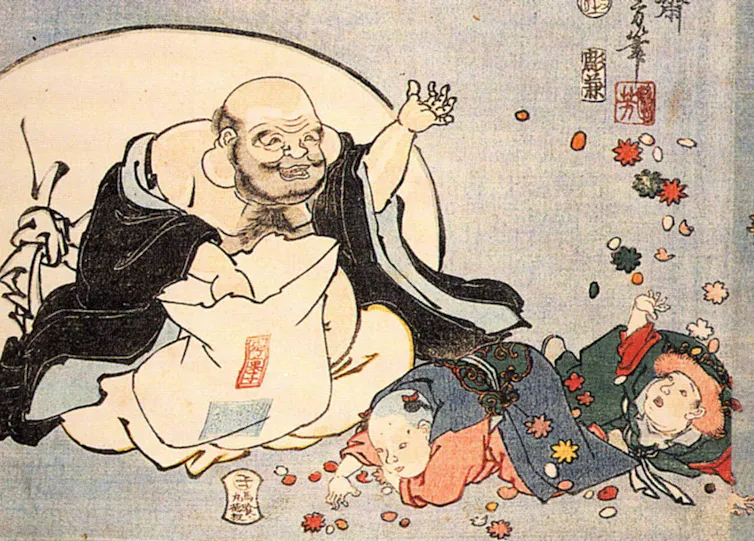
Hotei hands out gifts to children.
Detail of print by Kuniyoshi Utagawa, 1798-1861, via Wikimedia Commons
By Megan Bryson of University of Tennessee
The new year brings a fresh start, symbolized in some cultures by the cherubic baby New Year who replaces the old year that has come to a close. In Japan, the roly-poly god Hotei, who is often identified with Santa Claus, ushers in the new year along with six other gods of good fortune; together, they form the Seven Lucky Gods, or shichi fukujin in Japanese.
As a scholar of East Asian religions who studies deities’ transformations over time, I often explain to my students that cross-cultural encounters produce new understandings and images of gods.
New Year celebrations in Japan bring together many different cultural traditions. Unlike most East Asian countries, which celebrate the Lunar New Year, Japan follows the solar calendar in celebrating the new year on Jan. 1. Japanese New Year traditions combine Shinto and Buddhist elements. For example, Buddhist temples ring their bells to welcome the new year, and people hang Shinto straw ropes – shimenawa in Japanese – around their homes to keep good fortune in and bad luck out.
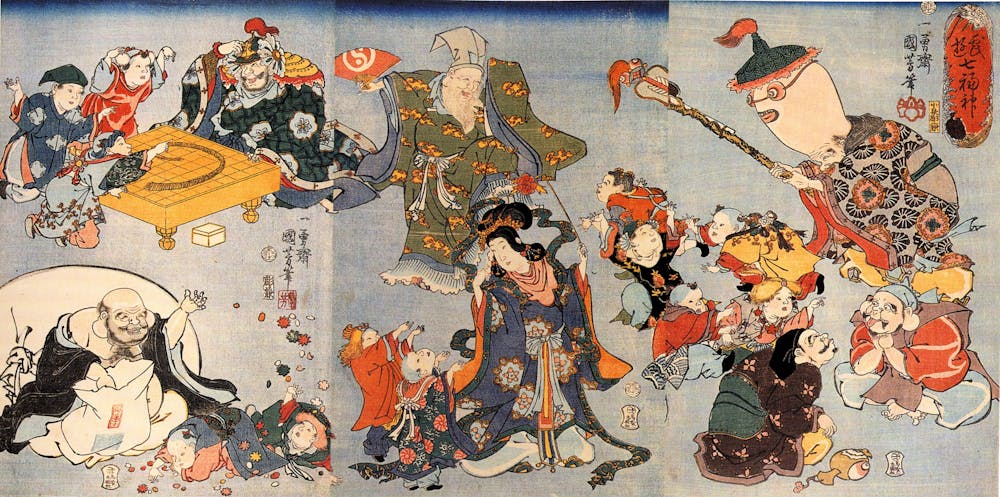
The Seven Lucky Gods at play. Clockwise from top left, the gods are Bishamonten, Jurōjin, Fukurokuju, Ebisu, Daikokuten, Benzaiten and Hotei.
Print made by Kuniyoshi Utagawa, 1798-1861, via Wikimedia Commons
The Seven Lucky Gods also reflect the diverse cultural traditions of Japanese New Year. Along with Hotei, this set includes other Buddhist gods such as Daikokuten, Bishamonten and Benzaiten, along with Chinese gods of longevity and prosperity and the Shinto god Ebisu.
Of these seven gods, Hotei plays the most prominent role in Japanese culture because he is not just a lucky god, but also a buddha.
Origins of Hotei
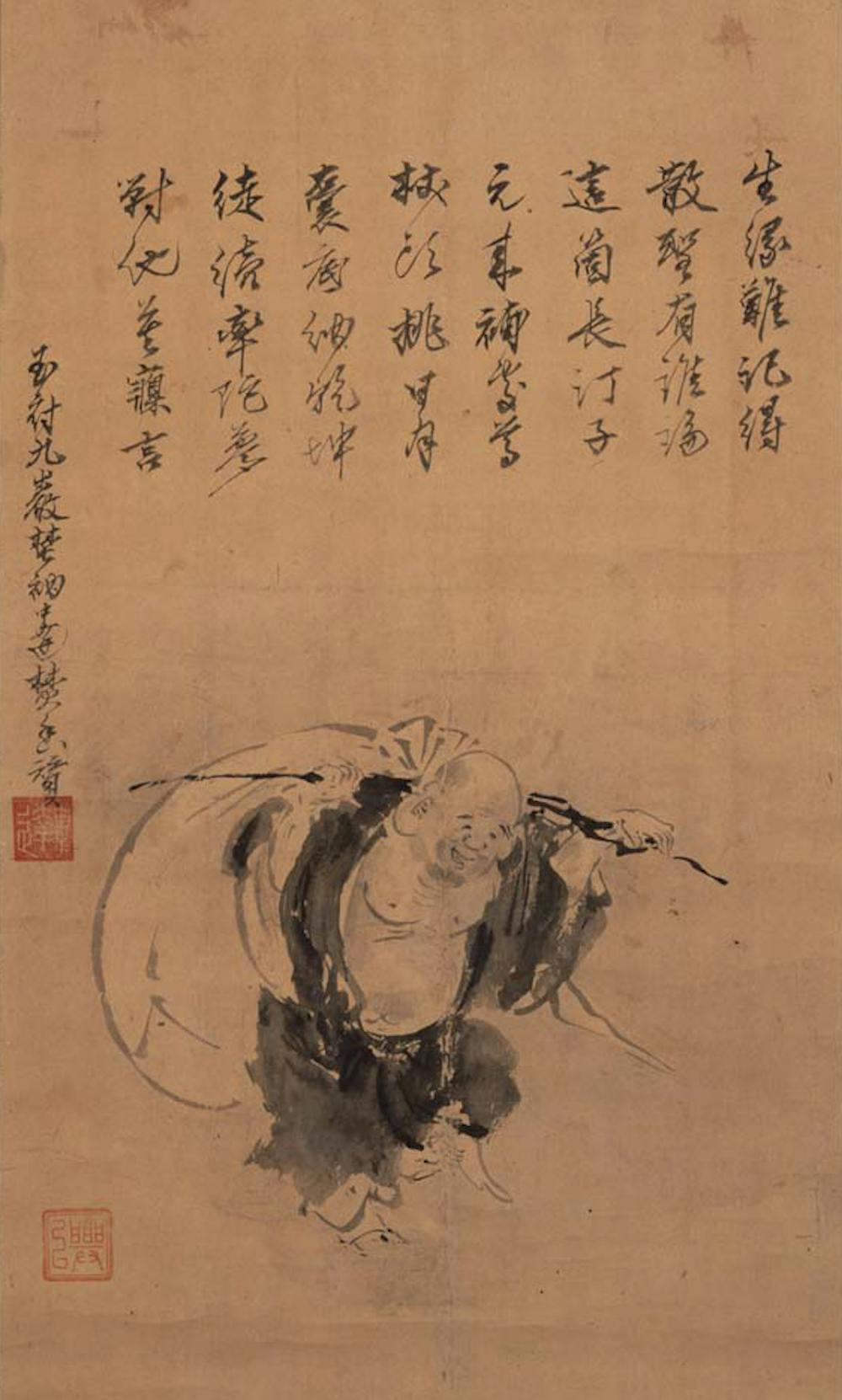
Hotei carrying his bag of treasures.
Painting by Kanō Kōi, d. 1636, via Wikimedia Commons
The name Hotei is the Japanese pronunciation of the Chinese “budai,” which means “cloth bag.” In Japan, Hotei is also known as Hotei oshō, or “monk Hotei,” which refers to his origin as a 10th-century Chinese monk.
Hotei belongs to the Zen school of Buddhism, which celebrates simplicity and rejects the desire for fame and fortune. Zen texts portray Hotei as a wandering monk who is content to live a humble, simple life. He carries a large sack full of odds and ends and shares his “treasures” with children.
Some texts even identify Hotei as a buddha. Buddhism teaches that there were multiple buddhas in the past, and there will be more buddhas to come in the future. The most recent buddha – the buddha most Westerners think of when they hear the word – was called Siddhārtha Gautama or Shakyamuni, who lived about 2,500 years ago. The next buddha will be Maitreya, or Miroku in Japanese.

Hotei opening his bag, which is full of children and jewels.
Print by Kita Busei, 1776-1856, via Metropolitan Museum of Art
The Seven Lucky Gods
Hotei’s well-fed appearance and bag of treasures represented abundance in China and Japan. It was this association with good fortune that led Hotei to be included in the set of Seven Lucky Gods, which developed in Japan by the 17th century.
Each god is associated with a magical object and a specific virtue. Hotei’s object is his bag that magically remains full, and his virtue is generosity. As one of these lucky gods, Hotei is known for being fond of food and drink, and even serves as the patron deity of bars and restaurants.
Other members of the Seven Lucky Gods share Hotei’s multicultural background. Three of the gods started out as Indian deities in both the Hindu and Buddhist pantheons: Daikokuten is Mahākāla, a form of the Hindu god Shiva; Benzaiten is Sarasvatī, the goddess of knowledge and music; and Bishamonten is Vaiśravaṇa, the guardian god of the north. Like Hotei, Daikokuten underwent significant transformations in Japan, from a wrathful protector to a jolly god of wealth.
The Chinese god of prosperity, known as Fukurokuju in Japanese, and the Chinese god of longevity, Jurōjin in Japanese, both come from Daoist backgrounds. The Shinto god Ebisu is the only one of the Seven Lucky Gods that originated in Japan. Ebisu is sometimes identified as the offspring of the primordial gods Izanagi and Izanami, who gave birth to the Japanese islands. As the god of the sea, Ebisu is particularly worshipped by fishermen.
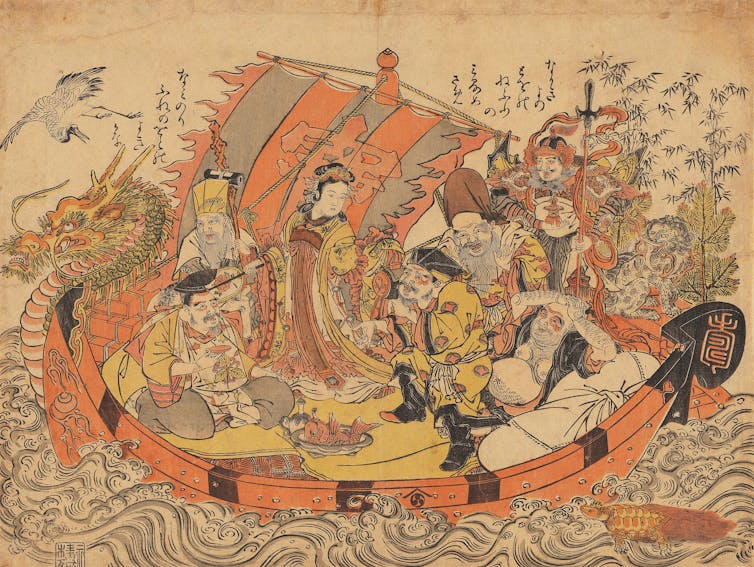
In Japanese mythology, the Seven Lucky Gods are believed to steer their treasure ship from the heavens to Earth on New Year’s Day.
Print made by Kitao Shigemasa, Tokyo, 1772/1780 via Wikimedia Commons
In the first few days of the new year, the Seven Lucky Gods steer their treasure ship, Takarabune, from the heavens to Earth. On the first night of the new year, children place under their pillows a picture of the seven gods on their ship. This is supposed to bring a good dream, a sign of good luck for the year ahead.
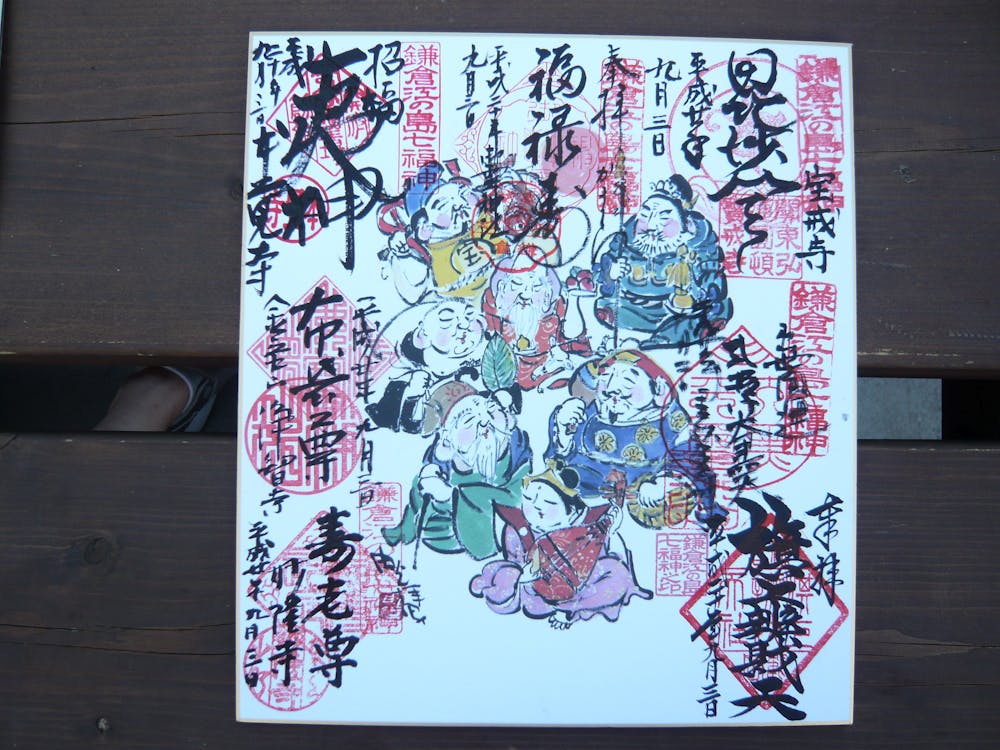
Pilgrims collect stamps for each of the Seven Lucky Gods to bring luck in the new year.
Ryosuke Yagi, 2008, via Flickr.com, CC BY
Another New Year’s custom is making a pilgrimage to temples associated with each of the Seven Lucky Gods. Pilgrims start out with a card that includes the names and images of the Seven Lucky Gods, and they collect a stamp for each god at the god’s temple. Completing the pilgrimage brings good luck for the following year.
Hotei’s bag of treasures and rotund physique mean that people in both Japan and the West have identified him as a Japanese Santa Claus. Some temples even dress up Hotei statues in a Santa hat and beard. However, in Japanese tradition, Hotei’s visit still falls a week later for the new year. His bag of treasures offers the gift of renewal and good fortune for the year to come.
This is an updated version of a piece first published on Dec. 12, 2022.
This article is republished from The Conversation under a Creative Commons license.

About Megan Bryson
Megan Bryson is an Associate Professor of Religious Studies at the University of Tennessee. You can read more about the author here.




Browse Our Archives
Select a Category Buddhism Christianity Hinduism Islam Judaism Religion and society Uncategorized
Select a Month July 2024 March 2024 February 2024 January 2024 December 2023 November 2023 October 2023 September 2023 August 2023 July 2023 January 2023 August 2022 July 2022 April 2022 February 2022 January 2022 October 2021 July 2021 June 2021 May 2021 April 2021 March 2021 February 2021 January 2021 December 2020 November 2020 October 2020 September 2020 August 2020 July 2020 June 2020 May 2020
Follow Us!
TAKE THE
Religious Wisdom Quiz
A shepherd leads his flock beside still waters and through the valley of death's shadow. What is this shepherd's identity?
Select your answer to see how you score.
The Apostles The Prophet David The Lord
Related posts from The Conversation

Why The Olympic Games Are A ‘Civil Religious’...
Cherry Blossoms Show Appreciation Of Impermanence And Spring

AI Won’t Be Replacing Your Priest, Minister, Rabbi...
‘Journey to the West’: Why the Classic Chinese...
TRENDING AT PATHEOS Religion News

Catholic Integralists believe that religious values – specifically Christian ones – should...

Electing A Virtuous President Would Make Immunity Irrelevant
Presidential immunity can bring with it many risks. So how can we...

Why The Olympic Games Are A ‘Civil Religious’...
Sporting events form a vital space where Americans display their 'civil religious...

After more than a decade of news, research updates, and insights on...

Q: Why do Southern Baptists and like-minded Protestants...
THE RELIGION GUY’S ANSWER: Why? Simple. Because they believe that’s what the...

THE QUESTION: Is gambling evil? THE RELIGION GUY’S ANSWER: Analysts anticipate a...
view all Religion News blogs
Ad-Free & Subscriber Log-In Subscription Support
- About Us
- 2026 Calendar
- Videos
- Podcasts
- Library of World Religions
- Faith In Media Tracker
- Advertise With Us
- Write for Us
- Privacy Policy
- Terms of Service
- Do Not Sell My Data
- Contact Us
- Radiant Digital
- Manage Newsletter Subscriptions
- Unsubscribe From Notifications
- Sitemap
Copyright 2008-2026, Patheos. All rights reserved.
Subscription Support Ad-Free & Subscriber Log-In
Follow Patheos