
BuddhistCatholicContemplativeEvangelicalGeneral ChristianHinduJewishLatter-day SaintMuslimNew VisionsProgressive Christian
Beliefs
- Buddhist
- Catholic
- Contemplative
- Evangelical
- General Christian
- Hindu
- Jewish
- Latter-day Saint
- More Voices
- Muslim
- New Visions
- Pagan
- Progressive Christian
Topics
- Religion News
- Food and Religion
- Sports and Religion
- Religious Art
- Religious Music and Entertainment
- Religious Events
- History and Religion
- Style and Religion
- Politics and Religion
- Women in Religion
- Recreation Outdoors and Religion
- Business Finance and Religion
- Careers Workplace and Religion
- Education and Religion
- Family Parenting and Religion
- Health Fitness and Religion
- Home and Religion
- Relationships and Religion
- Technology and Religion
- Travel and Religion
Columnists
- Buddhist Columnists
- Business Finance and Religion Columnists
- Careers Workplace and Religion Columnists
- Catholic Columnists
- Contemplative Columnists
- Education and Religion Columnists
- Evangelists Columnists
- Family Parenting and Religion Columnists
- General Christian Columnists
- Health Fitness and Religion Columnists
- Hindu Columnists
- History and Religion Columnists
- Home and Religion Columnists
- Jewish Columnists
- More Voices Columnists
- Latter Day Columnists
- Muslim Columnists
- New Visions Columnists
- Nonreligious Columnists
- Pagan Columnists
- Politics and Religion Columnists
- Progressive Columnists
- Recreation Outdoors and Religion Columnists
- Relationships and Religion Columnists
- Religion News Columnists
- Religious Art Columnists
- Religious Events Columnists
- Religious Music and Entertainment Columnists
- Sports and Religion Columnists
- Style and Religion Columnists
- Technology and Religion Columnists
- Travel and Religion Columnists
- Women in Religion Columnists
Resource Library
- 2026 Calendar
- Library of World Religions
- The 100 Most Holy Places on Earth
- Patheos Answers
- Podcasts
- Videos
- Faith Leaders Database
- Anglican Episcopalian
- Bahai
- Baptist
- Buddhism
- Christianity
- Confucianism
- Eastern Orthodoxy
- Hinduism
- Holiness and Pentecostal
- ISKCON
- Islam
- Judaism
- Lutheran
- Methodist
- The Church of Jesus Christ of Latter-day Saints
- New Age
- Paganism
- Presbytarian and Reformed
- Protestantism
- Religion Behind the Scenes
- Roman Catholic
- Scientology
- Shia Islam
- Sikhism
- Sufism
- Sunni Islam
- Taoism
- Zen
- See all religions
Research Tools
 Ad-Free & Subscriber Log-In Subscription Support
Ad-Free & Subscriber Log-In Subscription Support
Follow Patheos 

- Trending:
- Forgiveness
- |
- Marriage
- |
- Consciousness
- |
- Death Penalty
- |
- Election
- |
- Halloween

- Home
- Religion News
- We praise people as ‘Good Samaritans,’ but there’s a complex history behind the phrase
We praise people as ‘Good Samaritans,’ but there’s a complex history behind the phrase
Last updated on: August 29, 2022 at 9:17 am by The Conversation
We praise people as ‘Good Samaritans,’ but there’s a complex history behind the phrase 2022-08-28T09:28:52-04:00 The Conversation
Patheos Explore the world's faith through different perspectives on religion and spirituality! Patheos has the views of the prevalent religions and spiritualities of the world.
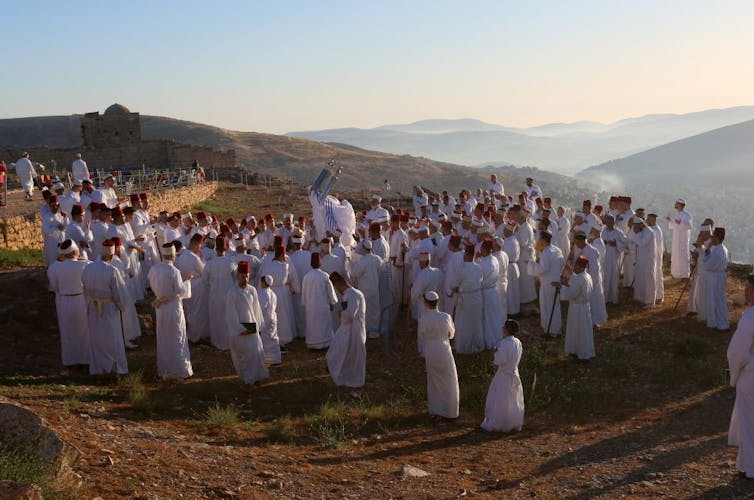
Samaritans celebrate Shavuot atop Mount Gerizim, near the West Bank.
Nidal Eshtayeh/Xinhua via Getty Images
By Terry Giles of Gannon University
“Good Samaritan” is a label often used to describe someone acting selflessly to benefit others, even if a total stranger.
Some may recognize that the phrase has its origin in a biblical story, one of Jesus’ parables recounted in the Book of Luke, Chapter 10. In this story, a traveler from the Samaritan community, a Middle Eastern ethnic and religious group, happens upon a man who had been robbed and beaten by the side of the road.
The injured man was ignored by two men passing by, both of whom belonged to groups who were religiously respected in Jesus’ Jewish community: a priest and a Levite, a tribe with special religious responsibilities. In contrast, the Samaritan gives first aid to the victim, places him upon his donkey, and transports him to an inn where the beaten man is housed, cared for and fed – with all his expenses paid by the Samaritan traveler.
As a professor of biblical studies who has written about Samaritans, I’ve learned that while most of my students have heard of the “good Samaritan,” fewer are aware of the social and historical realities reflected in the story – much less that the Samaritan community still exists today.
Hidden lesson
Samaritanism and Judaism share a common origin in ancient Israel, but the rift between the two communities had already been growing for centuries before Jesus’ birth.
The group’s sacred text is its own version of the first five books of the Hebrew Bible: what Christians know as the Pentateuch, and Jews call the Torah. The Samaritan center of worship is on Mount Gerizim in the present-day West Bank, instead of Jerusalem, where the Jewish temple stood. The faith has its own priesthood, religious calendar and theology. According to Samaritan belief, a messianic figure called the Taheb will usher in an era of Divine Favor, during which the ark of the covenant will be revealed, and Mount Gerizim will be restored as the only recognized center for worship.
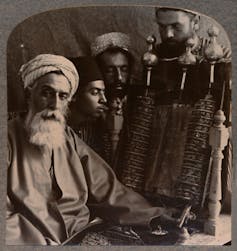
The Samaritan high priest sits in front of Samaritan religious scrolls around 1900.
Print Collector/Hulton Archive via Getty Images
Throughout the group’s history – particularly during the first century, the backdrop for the story in the Book of Luke – the Samaritans have often been marginalized and discriminated against by their neighbors. The relationship between ancient Jews and their Samaritan neighbors was hostile, so people listening to the story would have been shocked that the hero was a Samaritan.
Effectively, the parable turns social reality on its head. Those expected to act righteously and model behavior for others to imitate failed where the Samaritan succeeded. The parable challenged social norms and prejudice based simply on ethnic origin, religious affiliation and where people made their home.
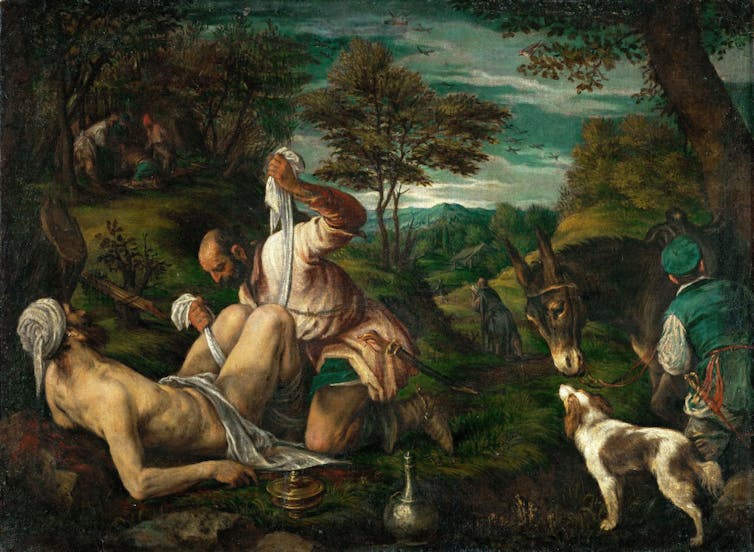
‘The Parable of the Good Samaritan,’ painted around 1575, from the Art History Museum in Vienna.
Fine Art Images/Heritage Images/Hulton Archive via Getty Images
Biblical mentions
The story of the Good Samaritan is not the only time the Samaritan community makes its presence felt in the New Testament literature.
Just one chapter earlier, Luke 9, describes an unwelcome reception Jesus’ disciples receive as they are about to enter a Samaritan village. Jesus and his party are making their way to Jerusalem: an offense to the Samaritans’ belief that Mount Gerizim is the proper place for worship, an issue that often functioned as shorthand for all that separated the two communities.
The villagers therefore choose not to help the travelers on their way. In response, the disciples are ready to call down divine retribution as punishment from heaven. Jesus will have none of it, and rebukes the disciples while leaving the villagers in peace.
The Gospel of John depicts an especially significant conversation between Jesus and a Samaritan. Worn out by a recent journey, he asks a woman to draw water for him at a well. She is rather taken aback, for as the editor of the the chapter explains, Jews don’t mingle with Samaritans. Nevertheless, she does as he requests. Their ensuing conversation mentions major tenets of belief where Samaritanism and Judaism differ, despite their many similarities: their contrasting ideas about prophets, “Messiahs” and where to worship. According to the story, she and many people from the nearby vicinity become followers of Jesus.
Early converts
In fact, it is quite likely the Samaritans were among the first followers of Jesus’ movement.
In the Book of Matthew, Jesus directs his disciples to preach only to the house of Israel, and not to Samaritans or non-Jews, seeming to display an anti-Samaritan bias. The Gospel of John paints quite a different picture, however, first with the account of the Samaritan women at the well.
Later in John, when detractors accuse Jesus of having a demon and being a Samaritan, he only denies the first – seemingly refusing to distance himself from the Samaritans.
The Book of Acts, which describes the start of the Christian church, includes the story of Stephen, who is described as the first martyr among Jesus’ followers. Acts 7 depicts Stephen trying to defend himself against charges of blasphemy, using a text that is at least influenced by Samaritan tradition, if not a version of what will become the Samaritan Pentateuch itself.
The Book of Hebrews in the New Testament also shows Samaritan tendencies, such as referencing heroes from Samaritan tradition.
Despite this important role in the beginning of the Jesus movement, the relationship between Christianity and Samaritanism has not always been positive. The group has often been required to navigate between much larger and more powerful groups, whether they be Jewish, Christian or Muslim. Violence, displacement and conversions – both voluntary and forced – have dramatically diminished the Samaritan community over the centuries.
21st century Samaritans
Today, the Samaritans number somewhere around 1,000 people. Most are in communities outside Tel Aviv and near the West Bank city of Nablus, where they find themselves situated between Israeli and Palestinian cultures and institutions. Most Samaritans hold Israeli citizenship and have Israeli health insurance, but many also attend Palestinian schools, speak Arabic and have both Hebrew and Arabic names.
The small size of the modern Samaritan community makes them easy to overlook. But for those who are willing to listen, the message of the Good Samaritan – a message of kindness, not blinded by nationalistic, religious or ethnic prejudice – resonates as loudly as it ever has.
This article is republished from The Conversation, a nonprofit, independent news organization dedicated to unlocking the knowledge of experts for the public good. .

About Terry Giles
Terry Giles is a Professor of Theology at Gannon University. You can read more about the author here.


Browse Our Archives
Select a Category Buddhism Christianity Hinduism Islam Judaism Religion and society Uncategorized
Select a Month July 2024 March 2024 February 2024 January 2024 December 2023 November 2023 October 2023 September 2023 August 2023 July 2023 January 2023 August 2022 July 2022 April 2022 February 2022 January 2022 October 2021 July 2021 June 2021 May 2021 April 2021 March 2021 February 2021 January 2021 December 2020 November 2020 October 2020 September 2020 August 2020 July 2020 June 2020 May 2020
Follow Us!
TAKE THE
Religious Wisdom Quiz
I cleansed the temple in sixteen days and celebrated Passover so joyfully that we extended it another seven days. Who am I?
Select your answer to see how you score.
Asa Hezekiah Jehoshaphat Josiah
Related posts from The Conversation


Electing A Virtuous President Would Make Immunity Irrelevant

Why The Olympic Games Are A ‘Civil Religious’...

The Catholic Church Is Using The Olympics To...
TRENDING AT PATHEOS Religion News

Catholic Integralists believe that religious values – specifically Christian ones – should...

Electing A Virtuous President Would Make Immunity Irrelevant
Presidential immunity can bring with it many risks. So how can we...

Why The Olympic Games Are A ‘Civil Religious’...
Sporting events form a vital space where Americans display their 'civil religious...

After more than a decade of news, research updates, and insights on...

Q: Why do Southern Baptists and like-minded Protestants...
THE RELIGION GUY’S ANSWER: Why? Simple. Because they believe that’s what the...

THE QUESTION: Is gambling evil? THE RELIGION GUY’S ANSWER: Analysts anticipate a...
view all Religion News blogs
Ad-Free & Subscriber Log-In Subscription Support
- About Us
- 2026 Calendar
- Videos
- Podcasts
- Library of World Religions
- Faith In Media Tracker
- Advertise With Us
- Write for Us
- Privacy Policy
- Terms of Service
- Do Not Sell My Data
- Contact Us
- Radiant Digital
- Manage Newsletter Subscriptions
- Unsubscribe From Notifications
- Sitemap
Copyright 2008-2026, Patheos. All rights reserved.
Subscription Support Ad-Free & Subscriber Log-In
Follow Patheos