
BuddhistCatholicContemplativeEvangelicalGeneral ChristianHinduJewishLatter-day SaintMuslimNew VisionsProgressive Christian
Beliefs
- Buddhist
- Catholic
- Contemplative
- Evangelical
- General Christian
- Hindu
- Jewish
- Latter-day Saint
- More Voices
- Muslim
- New Visions
- Pagan
- Progressive Christian
Topics
- Religion News
- Food and Religion
- Sports and Religion
- Religious Art
- Religious Music and Entertainment
- Religious Events
- History and Religion
- Style and Religion
- Politics and Religion
- Women in Religion
- Recreation Outdoors and Religion
- Business Finance and Religion
- Careers Workplace and Religion
- Education and Religion
- Family Parenting and Religion
- Health Fitness and Religion
- Home and Religion
- Relationships and Religion
- Technology and Religion
- Travel and Religion
Columnists
- Buddhist Columnists
- Business Finance and Religion Columnists
- Careers Workplace and Religion Columnists
- Catholic Columnists
- Contemplative Columnists
- Education and Religion Columnists
- Evangelists Columnists
- Family Parenting and Religion Columnists
- General Christian Columnists
- Health Fitness and Religion Columnists
- Hindu Columnists
- History and Religion Columnists
- Home and Religion Columnists
- Jewish Columnists
- More Voices Columnists
- Latter Day Columnists
- Muslim Columnists
- New Visions Columnists
- Nonreligious Columnists
- Pagan Columnists
- Politics and Religion Columnists
- Progressive Columnists
- Recreation Outdoors and Religion Columnists
- Relationships and Religion Columnists
- Religion News Columnists
- Religious Art Columnists
- Religious Events Columnists
- Religious Music and Entertainment Columnists
- Sports and Religion Columnists
- Style and Religion Columnists
- Technology and Religion Columnists
- Travel and Religion Columnists
- Women in Religion Columnists
Resource Library
- 2026 Calendar
- Library of World Religions
- The 100 Most Holy Places on Earth
- Patheos Answers
- Podcasts
- Videos
- Faith Leaders Database
- Anglican Episcopalian
- Bahai
- Baptist
- Buddhism
- Christianity
- Confucianism
- Eastern Orthodoxy
- Hinduism
- Holiness and Pentecostal
- ISKCON
- Islam
- Judaism
- Lutheran
- Methodist
- The Church of Jesus Christ of Latter-day Saints
- New Age
- Paganism
- Presbytarian and Reformed
- Protestantism
- Religion Behind the Scenes
- Roman Catholic
- Scientology
- Shia Islam
- Sikhism
- Sufism
- Sunni Islam
- Taoism
- Zen
- See all religions
Research Tools
 Ad-Free & Subscriber Log-In Subscription Support
Ad-Free & Subscriber Log-In Subscription Support
Follow Patheos 

- Trending:
- Forgiveness
- |
- Marriage
- |
- Consciousness
- |
- Death Penalty
- |
- Election
- |
- Halloween

- Home
- Religion News
- Terrifying dragons have long been a part of many religions, and there is a reason for their appeal
Terrifying dragons have long been a part of many religions, and there is a reason for their appeal
Last updated on: August 28, 2022 at 9:17 am by The Conversation
Terrifying dragons have long been a part of many religions, and there is a reason for their appeal 2022-08-28T09:17:06-04:00 The Conversation
Patheos Explore the world's faith through different perspectives on religion and spirituality! Patheos has the views of the prevalent religions and spiritualities of the world.

Fire-breathing, fearsome dragons may represent chaos and the human impulse to conquer that threat.
The Image Bank via Getty Images
By Emily Zarka of Arizona State University
The premiere of HBO’s prequel to “Game of Thrones,” “House of the Dragon” will undoubtedly bring more attention to the ferocious dragon. Two-legged or four, fire-breathing or shape-shifting, scaled or feathered, dragons fascinate people across the world with their legendary power. This shouldn’t be surprising.
Long before “Harry Potter,” “Shang-Chi and the Legend of the Ten Rings” and other modern interpretations increased the dragon’s notoriety in the 21st century, artifacts from ancient civilizations indicated their importance in many religions across the world.
As a scholar of monsters, I’ve found dragons to be a nearly universal symbol for many civilizations. Scientists have tried to come up with explanations for the myth of dragons, but their enduring existence is testimony to their narrative power and mystery.

Dragons can symbolize the chaos of the natural world.
Photo by Rock Vincent Guitard for Unsplash., CC BY-SA
Ancient dragons, ancient stories
Religions and cultures across the globe are rife with dragon lore. In fact, across the vast majority of religions, there is mythic trope some scholars call Chaoskampf, a German word that translates as struggle against chaos. This term, used by mythologists, refers to a pervasive motif involving a heroic character who slays a primordial chaos “monster,” often with serpentine or dragonlike characteristics and a massive size that dwarfs humans.
One ancient example is found in the “Enūma Eliš,” a Babylonian creation text from around 2,000 to 1,000 years B.C..
In the text, Tiamat, the female primordial deity of salt water and matriarch of the gods, births 11 kinds of monsters, including the dragon. While Tiamat herself is never described as a “dragon,” some of her children, or “monsters,” include several different kinds of dragons with explicit references to her dragon children. Iconography later evolved so that her appearance began to take on serpentine features, linking her image to another famous clawed mythological predator, the dragon.

The dragon, lord of the scaly animals, represents one of four animals in Chinese mythology corresponding to directions and seasons.
Photo by Raimond Klavins for Unsplash
Dragons in Chinese and other cultures
The presence of the dragon in China, where it is called Long is also ancient and integral to various cultural, spiritual and social traditions.
Dragons are members of the Chinese zodiac, one of the sacred guardian creatures that make up the Four Benevolent Animals and
provide justification for imperial dynasties. Different kinds of these aquatic, intelligent, semidivine beings form a hierarchy in ancient Chinese cosmology and appear in creation myths of various indigenous traditions.
When Jesuit missionaries reintroduced Christianity in China in the 16th century, the dragon’s existence was not contested. Instead, they became associated with a more Westernized explanation – the Devil.
Today, dragons are celebrated and revered in Buddhist, Taoist and Confucianism traditions as symbols of strength and enlightenment.
Dragons also appear in Anatolian religions, Sumerian myths, Germanic sagas, Shinto beliefs and in Abrahamic scriptures. The creature’s repeated and important presence across global religions and cultures raises an interesting question: Why did dragons appear at all?
Symbolic power
A long-proposed theory is that there are natural explanations for dragons. That’s not to say the beasts of myth existed in real life but rather that fossils, living animals and geological features existing in the natural world inspired their creation.
Pulitzer Prize-winning author and scientist Carl Sagan wrote a book on the subject, arguing that dragons evolved from a human need to merge science with myth, the rational with the irrational, as part of an evolutionary response to real predators. His thoughts are an expansion of proposed ideas beginning in the 19th century or earlier as newly discovered fossils were linked to representations of dragons across the globe.
Full or partial remains of numerous extinct species may explain the physical attributes of dragons. In 2020, two scholars, DorothyBelle Poli and Lisa Stoneman, even proposed that the fossilized remains of Lepidodendron, a plant with a scalelike resemblance, may be behind the global presence of dragons.

The fossilized scalelike bark of Lepidodendron could inform dragon mythology.
Print by De Agostini Editorial via Getty Images
Human encounters with flying lizards, oarfish, crocodiles, Saharan horned vipers, large snakes and certain species of lizards and birds have also been proposed as possible explanations for dragon lore, given their physical resemblance to different dragons.
Scholars have also cited natural geologic processes as explanations for dragon lore – particularly when they are associated with natural disasters. Fire-breathing dragons, for instance, might be an explanation for mysterious fires that observers attempted to rationalize as a dragon’s flame. Natural gas vents, methane produced from decaying matter and other sources of underground gas deposits can produce a blaze if accidentally lit. Before the mechanics of combustion were understood fully, such events were deemed indicators of a dragon’s presence, providing a cause for the seemingly implausible.
Eternal dragons
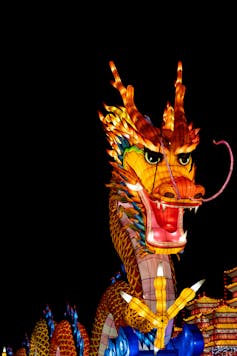
Ancient dragon mythology continues to inspire art and drama.
Photo by Thomas Despeyroux for Unsplash., CC BY-SA
One enduring reason dragons continue to appear in our world could be because they represent the power of nature. Stories about people taming dragons can be seen as stories about the ability of humans to dominate forces that cannot always be controlled.
To gain control over a dragon underscores the problematic idea that humans are superior to all other animals in nature. Dragons challenge the concept of human biological supremacy, raising questions about what it means if humans were forced to reposition themselves as lesser members of the food chain.
More importantly, I believe, the beauty, terror and power of the dragon evokes mystery and suggests that not all phenomena are easily explained or understood.
This article is republished from The Conversation, a nonprofit, independent news organization dedicated to unlocking the knowledge of experts for the public good. .
History and Religion

About Emily Zarka
Emily Zarka is an Instructor in English at Arizona State University. You can read more about the author here.


Browse Our Archives
Select a Category Buddhism Christianity Hinduism Islam Judaism Religion and society Uncategorized
Select a Month July 2024 March 2024 February 2024 January 2024 December 2023 November 2023 October 2023 September 2023 August 2023 July 2023 January 2023 August 2022 July 2022 April 2022 February 2022 January 2022 October 2021 July 2021 June 2021 May 2021 April 2021 March 2021 February 2021 January 2021 December 2020 November 2020 October 2020 September 2020 August 2020 July 2020 June 2020 May 2020
Follow Us!
TAKE THE
Religious Wisdom Quiz
What gift did the wise men NOT bring?
Select your answer to see how you score.
Silver Myrrh Frankincense Gold
Related posts from The Conversation


Electing A Virtuous President Would Make Immunity Irrelevant

Why The Olympic Games Are A ‘Civil Religious’...

The Catholic Church Is Using The Olympics To...
TRENDING AT PATHEOS Religion News

Catholic Integralists believe that religious values – specifically Christian ones – should...

Electing A Virtuous President Would Make Immunity Irrelevant
Presidential immunity can bring with it many risks. So how can we...

Why The Olympic Games Are A ‘Civil Religious’...
Sporting events form a vital space where Americans display their 'civil religious...

After more than a decade of news, research updates, and insights on...

Q: Why do Southern Baptists and like-minded Protestants...
THE RELIGION GUY’S ANSWER: Why? Simple. Because they believe that’s what the...

THE QUESTION: Is gambling evil? THE RELIGION GUY’S ANSWER: Analysts anticipate a...
view all Religion News blogs
Ad-Free & Subscriber Log-In Subscription Support
- About Us
- 2026 Calendar
- Videos
- Podcasts
- Library of World Religions
- Faith In Media Tracker
- Advertise With Us
- Write for Us
- Privacy Policy
- Terms of Service
- Do Not Sell My Data
- Contact Us
- Radiant Digital
- Manage Newsletter Subscriptions
- Unsubscribe From Notifications
- Sitemap
Copyright 2008-2026, Patheos. All rights reserved.
Subscription Support Ad-Free & Subscriber Log-In
Follow Patheos