
BuddhistCatholicContemplativeEvangelicalGeneral ChristianHinduJewishLatter-day SaintMuslimNew VisionsProgressive Christian
Beliefs
- Buddhist
- Catholic
- Contemplative
- Evangelical
- General Christian
- Hindu
- Jewish
- Latter-day Saint
- More Voices
- Muslim
- New Visions
- Pagan
- Progressive Christian
Topics
- Religion News
- Food and Religion
- Sports and Religion
- Religious Art
- Religious Music and Entertainment
- Religious Events
- History and Religion
- Style and Religion
- Politics and Religion
- Women in Religion
- Recreation Outdoors and Religion
- Business Finance and Religion
- Careers Workplace and Religion
- Education and Religion
- Family Parenting and Religion
- Health Fitness and Religion
- Home and Religion
- Relationships and Religion
- Technology and Religion
- Travel and Religion
Columnists
- Buddhist Columnists
- Business Finance and Religion Columnists
- Careers Workplace and Religion Columnists
- Catholic Columnists
- Contemplative Columnists
- Education and Religion Columnists
- Evangelists Columnists
- Family Parenting and Religion Columnists
- General Christian Columnists
- Health Fitness and Religion Columnists
- Hindu Columnists
- History and Religion Columnists
- Home and Religion Columnists
- Jewish Columnists
- More Voices Columnists
- Latter Day Columnists
- Muslim Columnists
- New Visions Columnists
- Nonreligious Columnists
- Pagan Columnists
- Politics and Religion Columnists
- Progressive Columnists
- Recreation Outdoors and Religion Columnists
- Relationships and Religion Columnists
- Religion News Columnists
- Religious Art Columnists
- Religious Events Columnists
- Religious Music and Entertainment Columnists
- Sports and Religion Columnists
- Style and Religion Columnists
- Technology and Religion Columnists
- Travel and Religion Columnists
- Women in Religion Columnists
Resource Library
- 2026 Calendar
- Library of World Religions
- The 100 Most Holy Places on Earth
- Patheos Answers
- Podcasts
- Videos
- Faith Leaders Database
- Anglican Episcopalian
- Bahai
- Baptist
- Buddhism
- Christianity
- Confucianism
- Eastern Orthodoxy
- Hinduism
- Holiness and Pentecostal
- ISKCON
- Islam
- Judaism
- Lutheran
- Methodist
- The Church of Jesus Christ of Latter-day Saints
- New Age
- Paganism
- Presbytarian and Reformed
- Protestantism
- Religion Behind the Scenes
- Roman Catholic
- Scientology
- Shia Islam
- Sikhism
- Sufism
- Sunni Islam
- Taoism
- Zen
- See all religions
Research Tools
 Ad-Free & Subscriber Log-In Subscription Support
Ad-Free & Subscriber Log-In Subscription Support
Follow Patheos 

- Trending:
- Forgiveness
- |
- Marriage
- |
- Consciousness
- |
- Death Penalty
- |
- Election
- |
- Halloween

- Home
- Religion News
- What the Bible actually says about abortion may surprise you
What the Bible actually says about abortion may surprise you
Last updated on: July 21, 2022 at 6:58 pm by The Conversation
What the Bible actually says about abortion may surprise you 2022-07-21T18:58:21-04:00 The Conversation
Patheos Explore the world's faith through different perspectives on religion and spirituality! Patheos has the views of the prevalent religions and spiritualities of the world.
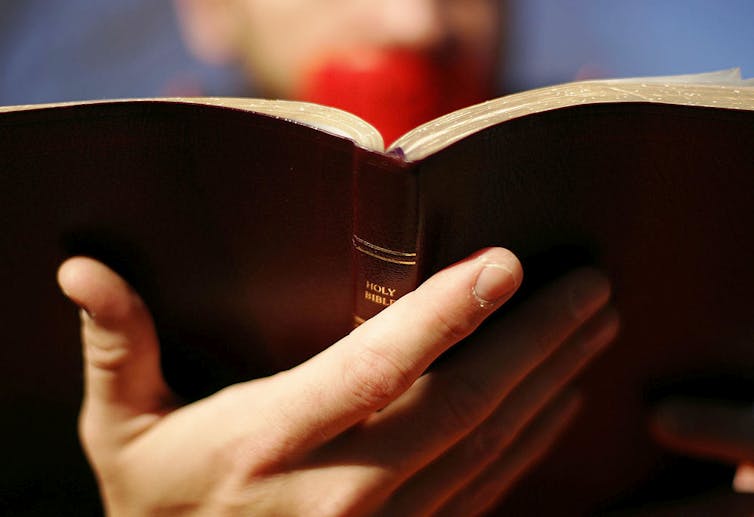
Activist Jason Hershey reads from a Bible as he protests in front of the U.S. Supreme Court with the anti-abortion group Bound for Life in 2005 in Washington, D.C.
Win McNamee via Getty Images
By Melanie A. Howard of Fresno Pacific University
In the days since the Supreme Court overturned Roe v. Wade, which had established the constitutional right to an abortion, some Christians have cited the Bible to argue why this decision should either be celebrated or lamented. But here’s the problem: This 2,000-year-old text says nothing about abortion.
As a university professor of biblical studies, I am familiar with faith-based arguments Christians use to back up views of abortion, whether for or against. Many people seem to assume the Bible discusses the topic head-on, which is not the case.
Ancient context
Abortions were known and practiced in biblical times, although the methods differed significantly from modern ones. The second-century Greek physician Soranus, for example, recommended fasting, bloodletting, vigorous jumping and carrying heavy loads as ways to end a pregnancy.
Soranus’ treatise on gynecology acknowledged different schools of thought on the topic. Some medical practitioners forbade the use of any abortive methods. Others permitted them, but not in cases in which they were intended to cover up an adulterous liaison or simply to preserve the mother’s good looks.
In other words, the Bible was written in a world in which abortion was practiced and viewed with nuance. Yet the Hebrew and Greek equivalents of the word “abortion” do not appear in either the Old or New Testament of the Bible. That is, the topic simply is not directly mentioned.
What the Bible says
The absence of an explicit reference to abortion, however, has not stopped its opponents or proponents from looking to the Bible for support of their positions.
Abortion opponents turn to several biblical texts that, taken together, seem to suggest that human life has value before birth. For example, the Bible opens by describing the creation of humans “in the image of God”: a way to explain the value of human life, presumably even before people are born. Likewise, the Bible describes several important figures, including the prophets Jeremiah and Isaiah and the Christian Apostle Paul, as having being called to their sacred tasks since their time in the womb. Psalm 139 asserts that God “knit me together in my mother’s womb.”
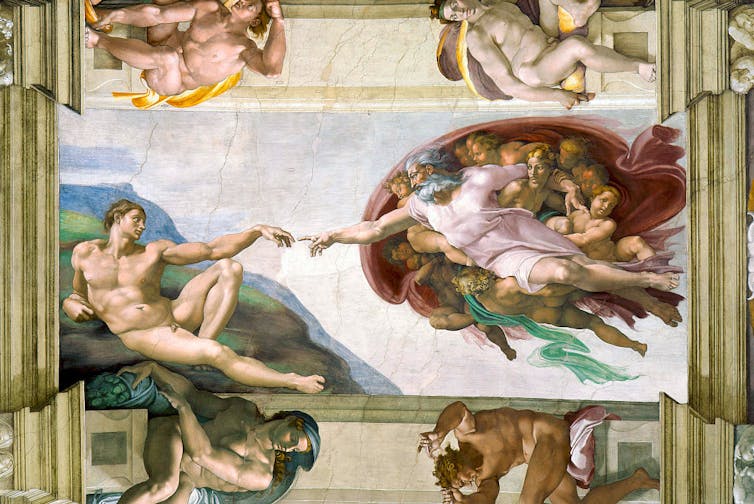
‘The Creation of Adam’ from the Sistine Chapel ceiling in the Vatican, painted by Michelangelo.
GraphicaArtis/Getty Images
However, abortion opponents are not the only ones who can appeal to the Bible for support. Supporters can point to other biblical texts that would seem to count as evidence in their favor.
Exodus 21, for example, suggests that a pregnant woman’s life is more valuable than the fetus’s. This text describes a scenario in which men who are fighting strike a pregnant woman and cause her to miscarry. A monetary fine is imposed if the woman suffers no other harm beyond the miscarriage. However, if the woman suffers additional harm, the perpetrator’s punishment is to suffer reciprocal harm, up to life for life.
There are other biblical texts that seem to celebrate the choices that women make for their bodies, even in contexts in which such choices would have been socially shunned. The fifth chapter of the Gospel of Mark, for example, describes a woman with a gynecological ailment that has made her bleed continuously taking a great risk: She reaches out to touch Jesus’ cloak in hopes that it will heal her, even though the touch of a menstruating woman was believed to cause ritual contamination. However, Jesus commends her choice and praises her faith.
Similarly, in the Gospel of John, Jesus’ follower Mary seemingly wastes resources by pouring an entire container of costly ointment on his feet and using her own hair to wipe them – but he defends her decision to break the social taboo around touching an unrelated man so intimately.
Beyond the Bible
In the response to the Supreme Court’s decision, Christians on both sides of the partisan divide have appealed to any number of texts to assert that their particular brand of politics is biblically backed. However, if they claim the Bible specifically condemns or approves of abortion, they are skewing the textual evidence to fit their position.
Of course, Christians can develop their own faith-based arguments about modern political issues, whether or not the Bible speaks directly to them. But it is important to recognize that although the Bible was written at a time when abortion was practiced, it never directly addresses the issue.
This article is republished from The Conversation, a nonprofit, independent news organization dedicated to unlocking the knowledge of experts for the public good.

About Melanie A. Howard
Melanie A. Howard is an Associate Professor of Biblical & Theological Studies at Fresno Pacific University. You can read more about the author here.
Previous Post
April 21, 2022
Why the future of the world’s largest religion is female – and African
Browse Our Archives
Select a Category Buddhism Christianity Hinduism Islam Judaism Religion and society Uncategorized
Select a Month July 2024 March 2024 February 2024 January 2024 December 2023 November 2023 October 2023 September 2023 August 2023 July 2023 January 2023 August 2022 July 2022 April 2022 February 2022 January 2022 October 2021 July 2021 June 2021 May 2021 April 2021 March 2021 February 2021 January 2021 December 2020 November 2020 October 2020 September 2020 August 2020 July 2020 June 2020 May 2020
Follow Us!
TAKE THE
Religious Wisdom Quiz
Which letter contains a section on taming the tongue?
Select your answer to see how you score.
James Titus Galatians Romans
Related posts from The Conversation


How Christians Hold Differing Views On The Resurrection

Pope Francis called surrogacy ‘deplorable’
How religion and politics will mix in 2024
TRENDING AT PATHEOS Religion News

Catholic Integralists believe that religious values – specifically Christian ones – should...

Electing A Virtuous President Would Make Immunity Irrelevant
Presidential immunity can bring with it many risks. So how can we...

Why The Olympic Games Are A ‘Civil Religious’...
Sporting events form a vital space where Americans display their 'civil religious...

After more than a decade of news, research updates, and insights on...

Q: Why do Southern Baptists and like-minded Protestants...
THE RELIGION GUY’S ANSWER: Why? Simple. Because they believe that’s what the...

THE QUESTION: Is gambling evil? THE RELIGION GUY’S ANSWER: Analysts anticipate a...
view all Religion News blogs
Ad-Free & Subscriber Log-In Subscription Support
- About Us
- 2026 Calendar
- Videos
- Podcasts
- Library of World Religions
- Faith In Media Tracker
- Advertise With Us
- Write for Us
- Privacy Policy
- Terms of Service
- Do Not Sell My Data
- Contact Us
- Radiant Digital
- Manage Newsletter Subscriptions
- Unsubscribe From Notifications
- Sitemap
Copyright 2008-2026, Patheos. All rights reserved.
Subscription Support Ad-Free & Subscriber Log-In
Follow Patheos