
BuddhistCatholicContemplativeEvangelicalGeneral ChristianHinduJewishLatter-day SaintMuslimNew VisionsProgressive Christian
Beliefs
- Buddhist
- Catholic
- Contemplative
- Evangelical
- General Christian
- Hindu
- Jewish
- Latter-day Saint
- More Voices
- Muslim
- New Visions
- Pagan
- Progressive Christian
Topics
- Religion News
- Food and Religion
- Sports and Religion
- Religious Art
- Religious Music and Entertainment
- Religious Events
- History and Religion
- Style and Religion
- Politics and Religion
- Women in Religion
- Recreation Outdoors and Religion
- Business Finance and Religion
- Careers Workplace and Religion
- Education and Religion
- Family Parenting and Religion
- Health Fitness and Religion
- Home and Religion
- Relationships and Religion
- Technology and Religion
- Travel and Religion
Columnists
- Buddhist Columnists
- Business Finance and Religion Columnists
- Careers Workplace and Religion Columnists
- Catholic Columnists
- Contemplative Columnists
- Education and Religion Columnists
- Evangelists Columnists
- Family Parenting and Religion Columnists
- General Christian Columnists
- Health Fitness and Religion Columnists
- Hindu Columnists
- History and Religion Columnists
- Home and Religion Columnists
- Jewish Columnists
- More Voices Columnists
- Latter Day Columnists
- Muslim Columnists
- New Visions Columnists
- Nonreligious Columnists
- Pagan Columnists
- Politics and Religion Columnists
- Progressive Columnists
- Recreation Outdoors and Religion Columnists
- Relationships and Religion Columnists
- Religion News Columnists
- Religious Art Columnists
- Religious Events Columnists
- Religious Music and Entertainment Columnists
- Sports and Religion Columnists
- Style and Religion Columnists
- Technology and Religion Columnists
- Travel and Religion Columnists
- Women in Religion Columnists
Resource Library
- 2026 Calendar
- Library of World Religions
- The 100 Most Holy Places on Earth
- Patheos Answers
- Podcasts
- Videos
- Faith Leaders Database
- Anglican Episcopalian
- Bahai
- Baptist
- Buddhism
- Christianity
- Confucianism
- Eastern Orthodoxy
- Hinduism
- Holiness and Pentecostal
- ISKCON
- Islam
- Judaism
- Lutheran
- Methodist
- The Church of Jesus Christ of Latter-day Saints
- New Age
- Paganism
- Presbytarian and Reformed
- Protestantism
- Religion Behind the Scenes
- Roman Catholic
- Scientology
- Shia Islam
- Sikhism
- Sufism
- Sunni Islam
- Taoism
- Zen
- See all religions
Research Tools
 Ad-Free & Subscriber Log-In Subscription Support
Ad-Free & Subscriber Log-In Subscription Support
Follow Patheos 

- Trending:
- Forgiveness
- |
- Marriage
- |
- Consciousness
- |
- Death Penalty
- |
- Election
- |
- Halloween

- Home
- Religion News
- The patriotic Virgin: How Mary’s been marshaled for religious nationalism and military campaigns
The patriotic Virgin: How Mary’s been marshaled for religious nationalism and military campaigns
Last updated on: July 24, 2022 at 3:00 pm by The Conversation
The patriotic Virgin: How Mary’s been marshaled for religious nationalism and military campaigns 2022-07-21T18:59:59-04:00 The Conversation
Patheos Explore the world's faith through different perspectives on religion and spirituality! Patheos has the views of the prevalent religions and spiritualities of the world.

A mural in Kyiv depicts the Virgin Mary cradling a U.S.-made anti-tank weapon, a Javelin, which is considered a symbol of Ukraine’s defense against Russia.
AP Photo/Efrem Lukatsky
By Dorian Llywelyn of USC Dornsife College of Letters, Arts and Sciences
Ever since Russia began its invasion of Ukraine on Feb. 24, 2022, analysts picking apart Vladimir Putin’s motives and messaging about the war have looked to religion for some of the answers. Putin’s nationalist vision paints Russia as a defender of traditional Christian values against a liberal, secular West.
Putin’s Russia, however, is only the latest in a centurieslong lineup of nations using religion to bolster their political ambitions. As a Jesuit priest and scholar of Catholicism, I’ve seen in my research on nationalism and religion how patriotic loyalties and religious faith easily borrow one another’s language, symbols and emotions.
Western Christianity, including Catholicism, has often been enlisted to stir up patriotic fervor in support of nationalism. Historically, one typical aspect of the Catholic approach is linking devotion to the Virgin Mary with the interests of the state and military.
The birth of a belief
An Egyptian papyrus fragment from the fourth century is the first clear evidence of Christians’ praying to the Virgin Mary. The brief prayer, which seeks Mary’s protection in times of trouble, is written in the first person plural – using language like “our” and “we” – which suggests a belief that Mary would respond to groups of people as well as individuals.
That conviction appeared to grow in the following centuries. After the Roman Emperor Constantine converted to Christianity in A.D. 312, the new faith developed a close relationship with his empire, including a belief that Mary looked with particular favor on the capital city of Constantinople.
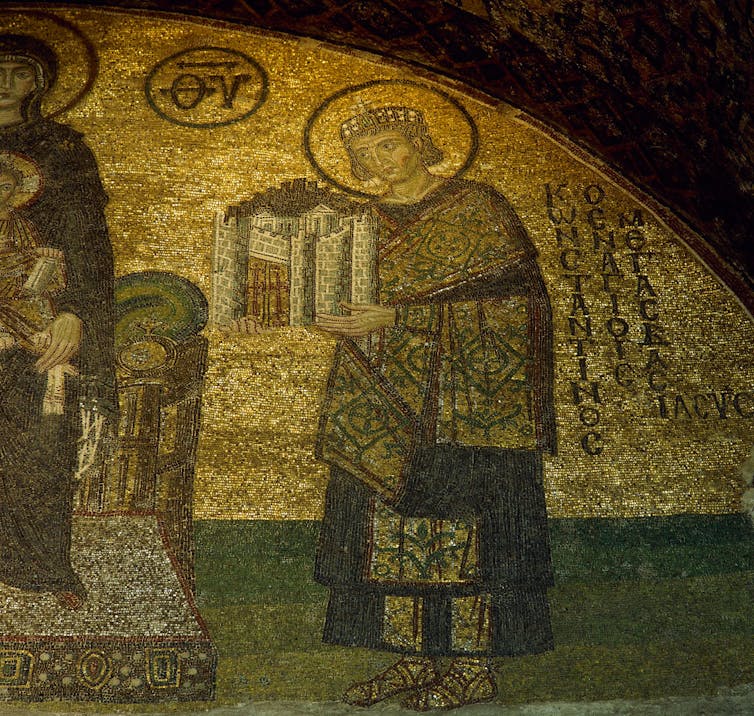
A 10th-century Byzantine mosaic of Constantine the Great offering Constantinople to the Virgin Mary, at the Hagia Sophia in Istanbul.
Photo by PHAS/Universal Images Group via Getty Images
Political and religious leaders asked the Virgin for victory in battle and shelter from plagues. In A.D. 626, Constantinople was besieged by a Persian navy. Christians believed that their prayers to the Virgin destroyed the invading fleet, saving the city and its inhabitants. The Akathist hymn, which has been prayed in both the Orthodox and Eastern Catholic churches ever since, gives Mary the military title “Champion General” in thanks for that victory.
In the Catholic West, military successes such as European victories over the Ottoman Empire were attributed to Mary’s intervention. Her blessing has been sought on imperialist endeavors, including Spain’s conquest of the Americas.
Even today, Mary holds the title of general in the armies of Argentina and Chile, where she is considered a national patroness. The same association between Marian devotion and patriotism can be found in many Latin American countries.
National symbol
Off the battlefield, many Catholic cultures have historically felt they had a special relationship with Mary. In 1638, King Louis XIII formally dedicated France to the Virgin Mary. Popular belief interpreted the subsequent birth of the future Louis XIV as Mary’s miraculous reward, after 23 years of waiting for a male heir.
About two decades later, Polish King Jan II Kazimierz consecrated his country to Mary amid a war. Both acts reflected church and political leaders’ beliefs that their countries had a sacred mission and divine approval for their political ambitions.
When these kinds of beliefs become widespread in a society, many scholars would label them religious nationalism – though there is a long-standing debate about when affection for one’s country becomes “nationalism.” There is widespread consensus, though, that religion is one of the most common elements of nationalism, and many nationalist projects have invoked Mary’s blessing.
Polish territory, for example, was divided between Russia, Prussia and Austria for more than a century. But Polish Catholics continued to address Mary as “Queen of Poland.” Her title asserted the existence of the Polish people as a nation. And it implied that efforts to reestablish Poland as a sovereign country had a heavenly helper.
Similarly, in the 19th century, both Queen Victoria and the Virgin Mary were referred to in different contexts as “Queen of Ireland,” expressing two rival visions of Ireland: part of the Protestant United Kingdom, or a separate and essentially Catholic country.
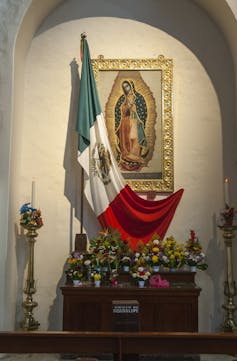
An illustration of the Virgin de Guadalupe in the Cathedral San Ildefonso in Mexico.
John Elk III/The Image Bank via Getty Images
Many different movements have used the figure of the Virgin to support their agendas. In colonial Mexico, the figure of Our Lady of Guadalupe, one title for Mary, was originally interpreted as being a champion of the “criollos,” native-born inhabitants of Spanish descent. During the 1810-21 War of Mexican Independence, “la Guadalupana” figured on the banners of the “independista” forces. The Spanish army, meanwhile, adopted the “Virgin of Los Remedios,” another title for Mary, as their own patroness. She would later be invoked in support of Indigenous people and mestizos, people with both Indigenous and Spanish ancestry.
Mary is invoked not only by nationalist causes. Sometimes she is inspiration for countercultural or protest movements, from the pro-life cause to Latina feminists. Labor leader Cesar Chavez placed the image of Guadalupe on banners as his organization marched for farmworkers’ rights.
Mary’s future
All these uses draw on the ancient belief in Mary’s power to intervene in times of trouble. However, ideological, political and especially military ambitions and religious sentiment are a volatile mix. As the current war in Ukraine shows, allegiance to one’s nation, especially when it claims Christian inspiration, can inspire both imperialist expansionism and heroic resistance to it.
This makes a better understanding of religious nationalism urgently important, especially for the church. Twentieth- and 21st-century popes have condemned aggressive nationalism but have not defined it clearly.
In cultures that are largely secularized, appeals for Mary’s protection or claims that she has a special relationship with any one nation are now likely to seem archaic, outlandish or sectarian. But what I know of both Marian devotion and national identity has convinced me that ancient patterns often survive and reassert themselves in new times and places.
Even where the practice of Catholicism is in decline, Mary’s cultural significance remains strong. And religion continues to be a regular element of many nationalist agendas.
My guess is that we have not seen the last of the warrior Virgin.
This article is republished from The Conversation, a nonprofit, independent news organization dedicated to unlocking the knowledge of experts for the public good.

About Dorian Llywelyn
Dorian Llywelyn is President of the Institute for Advanced Catholic Studies at USC Dornsife College of Letters, Arts and Sciences. You can read more about the author here.


Browse Our Archives
Select a Category Buddhism Christianity Hinduism Islam Judaism Religion and society Uncategorized
Select a Month July 2024 March 2024 February 2024 January 2024 December 2023 November 2023 October 2023 September 2023 August 2023 July 2023 January 2023 August 2022 July 2022 April 2022 February 2022 January 2022 October 2021 July 2021 June 2021 May 2021 April 2021 March 2021 February 2021 January 2021 December 2020 November 2020 October 2020 September 2020 August 2020 July 2020 June 2020 May 2020
Follow Us!
TAKE THE
Religious Wisdom Quiz
"______ is the same yesterday and today and forever."
Select your answer to see how you score.
The Universe Jesus Christ God's Plan Our Calling
Related posts from The Conversation


Electing A Virtuous President Would Make Immunity Irrelevant

Why The Olympic Games Are A ‘Civil Religious’...

The Catholic Church Is Using The Olympics To...
TRENDING AT PATHEOS Religion News

Catholic Integralists believe that religious values – specifically Christian ones – should...

Electing A Virtuous President Would Make Immunity Irrelevant
Presidential immunity can bring with it many risks. So how can we...

Why The Olympic Games Are A ‘Civil Religious’...
Sporting events form a vital space where Americans display their 'civil religious...

After more than a decade of news, research updates, and insights on...

Q: Why do Southern Baptists and like-minded Protestants...
THE RELIGION GUY’S ANSWER: Why? Simple. Because they believe that’s what the...

THE QUESTION: Is gambling evil? THE RELIGION GUY’S ANSWER: Analysts anticipate a...
view all Religion News blogs
Ad-Free & Subscriber Log-In Subscription Support
- About Us
- 2026 Calendar
- Videos
- Podcasts
- Library of World Religions
- Faith In Media Tracker
- Advertise With Us
- Write for Us
- Privacy Policy
- Terms of Service
- Do Not Sell My Data
- Contact Us
- Radiant Digital
- Manage Newsletter Subscriptions
- Unsubscribe From Notifications
- Sitemap
Copyright 2008-2026, Patheos. All rights reserved.
Subscription Support Ad-Free & Subscriber Log-In
Follow Patheos