
BuddhistCatholicContemplativeEvangelicalGeneral ChristianHinduJewishLatter-day SaintMuslimNew VisionsProgressive Christian
Beliefs
- Buddhist
- Catholic
- Contemplative
- Evangelical
- General Christian
- Hindu
- Jewish
- Latter-day Saint
- More Voices
- Muslim
- New Visions
- Pagan
- Progressive Christian
Topics
- Religion News
- Food and Religion
- Sports and Religion
- Religious Art
- Religious Music and Entertainment
- Religious Events
- History and Religion
- Style and Religion
- Politics and Religion
- Women in Religion
- Recreation Outdoors and Religion
- Business Finance and Religion
- Careers Workplace and Religion
- Education and Religion
- Family Parenting and Religion
- Health Fitness and Religion
- Home and Religion
- Relationships and Religion
- Technology and Religion
- Travel and Religion
Columnists
- Buddhist Columnists
- Business Finance and Religion Columnists
- Careers Workplace and Religion Columnists
- Catholic Columnists
- Contemplative Columnists
- Education and Religion Columnists
- Evangelists Columnists
- Family Parenting and Religion Columnists
- General Christian Columnists
- Health Fitness and Religion Columnists
- Hindu Columnists
- History and Religion Columnists
- Home and Religion Columnists
- Jewish Columnists
- More Voices Columnists
- Latter Day Columnists
- Muslim Columnists
- New Visions Columnists
- Nonreligious Columnists
- Pagan Columnists
- Politics and Religion Columnists
- Progressive Columnists
- Recreation Outdoors and Religion Columnists
- Relationships and Religion Columnists
- Religion News Columnists
- Religious Art Columnists
- Religious Events Columnists
- Religious Music and Entertainment Columnists
- Sports and Religion Columnists
- Style and Religion Columnists
- Technology and Religion Columnists
- Travel and Religion Columnists
- Women in Religion Columnists
Resource Library
- 2026 Calendar
- Library of World Religions
- The 100 Most Holy Places on Earth
- Patheos Answers
- Podcasts
- Videos
- Faith Leaders Database
- Anglican Episcopalian
- Bahai
- Baptist
- Buddhism
- Christianity
- Confucianism
- Eastern Orthodoxy
- Hinduism
- Holiness and Pentecostal
- ISKCON
- Islam
- Judaism
- Lutheran
- Methodist
- The Church of Jesus Christ of Latter-day Saints
- New Age
- Paganism
- Presbytarian and Reformed
- Protestantism
- Religion Behind the Scenes
- Roman Catholic
- Scientology
- Shia Islam
- Sikhism
- Sufism
- Sunni Islam
- Taoism
- Zen
- See all religions
Research Tools
 Ad-Free & Subscriber Log-In Subscription Support
Ad-Free & Subscriber Log-In Subscription Support
Follow Patheos 

- Trending:
- Forgiveness
- |
- Marriage
- |
- Consciousness
- |
- Death Penalty
- |
- Election
- |
- Halloween

- Home
- Religion News
- Why the future of the world’s largest religion is female – and African
Why the future of the world’s largest religion is female – and African
Last updated on: April 21, 2022 at 9:00 am by The Conversation
Why the future of the world’s largest religion is female – and African 2022-04-16T11:57:17-04:00 The Conversation
Patheos Explore the world's faith through different perspectives on religion and spirituality! Patheos has the views of the prevalent religions and spiritualities of the world.
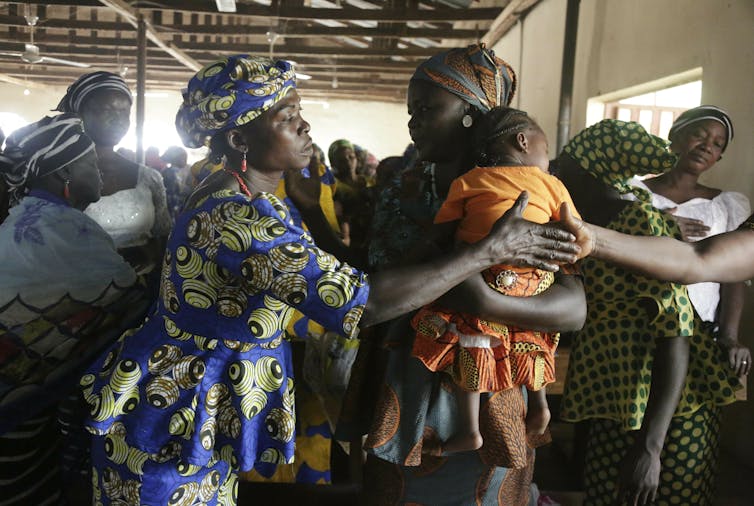
Nigerian women greet each other at St. Charles Catholic Church in Ngurore, Nigeria, on Feb. 17, 2019.
AP Photo/Sunday Alamba
By Gina Zurlo of Gordon-Conwell Theological Seminary
At the start of 2019, Bill and Melinda Gates released a list of facts that had surprised them the previous year. Number four on their list: “Data can be sexist.”
“There are huge gaps in the global data about women and girls,” they explained.
My interest was piqued – not only as a demographer, but as a woman and mother of girls.
I research women in global Christianity and am frequently asked what percentage of the religion is female. The short answer is 52%. But the long answer is more complicated – women make up a much more substantial part of Christianity than that number makes it seem.
The goal of my research is to put the spotlight on Christian women’s contributions to church and society and fill in gaps in our data. Headlines about religion may be focused on the words and actions of Western male leaders, but the reality of the worldwide church is quite different. More and more Christians live outside Europe and North America, especially in Africa – and women are central to that story.
Measuring faith
Social scientists have shown for decades that women are more religious than men by a variety of measures – everything from frequency of private prayer to worship service attendance. Christianity, the world’s largest religion, is no exception. Data from the Pew Research Center show that, compared to Christian men, Christian women are more likely to attend weekly church services (53% versus 46%), pray daily (61% versus 51%), and say religion is important in their lives (68% versus 61%).
It’s not a new trend. In the Gospels, women were the last at the foot of Jesus’s cross, the first at his tomb. Research has shown they were critical to the growth of the early church, being more likely to convert to Christianity than men, and most of the early Christian communities were majority female. Throughout history, women were exemplars of the faith as mystics and martyrs, royal women converting their husbands and supporting convents, and founders of denominations and churches that are now all over the world. Women make up the majority of Christians today.
What researchers don’t have is comprehensive data on women’s activities in churches, their influence, their leadership or their service. Nor are there comprehensive analyses of Christians’ attitudes around the world about women’s and men’s roles in churches.
“Women, according to an old saying in the Black church, are the backbone of the church,” notes religion and gender scholar Ann Braude. “The double meaning of this saying is that while the churches would collapse without women, their place is in the background,” behind male leaders.
But there’s not much actual data, and without good data, it’s harder to make good decisions.
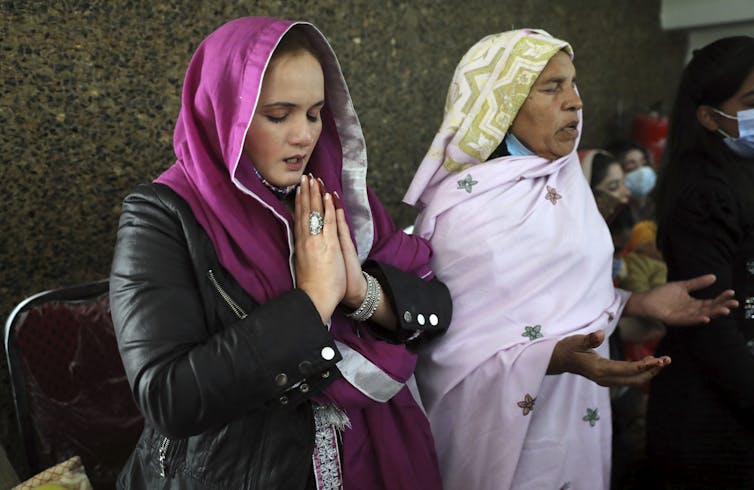
Christian women pray during a Christmas Mass in Our Lady of Fatima Church in Islamabad, Pakistan, in 2021.
AP Photo/Rahmat Gul
At the center of the story
My current research is illustrating that women are the majority of the church nearly everywhere in the world, and that its future is poised to be shaped by African women, in particular.
Christianity continues its demographic shift to the global south. In 1900, 18% of the world’s Christians lived in Asia, Africa, Latin America and Oceania, according to my research. Today that figure is 67%, and by 2050, it is projected to be 77%. Africa is home to 27% of the world’s Christians, the largest share in the world, and by 2050, that figure will likely be 39%. For comparison, the United States and Canada were home to just 11% of all Christians in the world in 2020 and will likely drop to 8% by 2050. Furthermore, the median age of Christians in sub-Saharan Africa is just 19.
One of the most common refrains about the church in Africa is that it is majority female. “The church in Africa has a feminine face and owes much of its tremendous growth to the agency of women,” writes Kenyan theologian Philomena Mwaura.
Or as a Nigerian Anglican bishop recently told me, “If anyone tells you a church in Nigeria is majority male, he’s lying.”
It’s clear that women have been a crucial part of Christianity’s seismic shift south. For example, consider Catholic sisters, who outnumber priests and religious brothers in Africa – and on every continent, in fact. Mothers’ Union, an Anglican nonprofit that aims to support marriages and families, has 30 branches in Africa, including at least 60,000 members in Nigeria alone. In Congo, women have advocated for peacebuilding, including through groups like the National Federation of Protestant Women. Next door, in the Republic of the Congo, Catholic sisters were at the forefront of providing shelter, education and aid in postwar recovery efforts.
Yet here, too, more precise data about African women’s contributions and religious identities is lacking. And beyond quantitative data, African women’s narratives have often been ignored, to the detriment of public understanding. As African theologians Mercy Amba Oduyoye and Rachel Angogo Kanyoro have stated, “African women theologians have come to realize that as long as men and foreign researchers remain the authorities on culture, rituals, and religion, African women will continue to be spoken of as if they were dead.”
Far from dead, African women live at the center of the story – and will continue to do so as healers, evangelists, mothers and the heartbeat of their churches.

This article is republished from The Conversation, a nonprofit, independent news organization dedicated to unlocking the knowledge of experts for the public good.

About Gina Zurlo
Gina Zurlo is Co-Director of the Center for the Study of Global Christianity at Gordon-Conwell Theological Seminary. You can read more about the author here.
Previous Post

April 20, 2022
Who are the Jesuits?
Next Post

July 21, 2022 What the Bible actually says about abortion may surprise you
Browse Our Archives
Select a Category Buddhism Christianity Hinduism Islam Judaism Religion and society Uncategorized
Select a Month July 2024 March 2024 February 2024 January 2024 December 2023 November 2023 October 2023 September 2023 August 2023 July 2023 January 2023 August 2022 July 2022 April 2022 February 2022 January 2022 October 2021 July 2021 June 2021 May 2021 April 2021 March 2021 February 2021 January 2021 December 2020 November 2020 October 2020 September 2020 August 2020 July 2020 June 2020 May 2020
Follow Us!
TAKE THE
Religious Wisdom Quiz
Who compared himself to a gentle lamb led to the slaughter?
Select your answer to see how you score.
Ezekiel Isaiah Jeremiah Job
Related posts from The Conversation


Why The Olympic Games Are A ‘Civil Religious’...

How Christians Hold Differing Views On The Resurrection
Tattooing Dates Back To The Crucifixion
TRENDING AT PATHEOS Religion News

Catholic Integralists believe that religious values – specifically Christian ones – should...

Electing A Virtuous President Would Make Immunity Irrelevant
Presidential immunity can bring with it many risks. So how can we...

Why The Olympic Games Are A ‘Civil Religious’...
Sporting events form a vital space where Americans display their 'civil religious...

After more than a decade of news, research updates, and insights on...

Q: Why do Southern Baptists and like-minded Protestants...
THE RELIGION GUY’S ANSWER: Why? Simple. Because they believe that’s what the...

THE QUESTION: Is gambling evil? THE RELIGION GUY’S ANSWER: Analysts anticipate a...
view all Religion News blogs
Ad-Free & Subscriber Log-In Subscription Support
- About Us
- 2026 Calendar
- Videos
- Podcasts
- Library of World Religions
- Faith In Media Tracker
- Advertise With Us
- Write for Us
- Privacy Policy
- Terms of Service
- Do Not Sell My Data
- Contact Us
- Radiant Digital
- Manage Newsletter Subscriptions
- Unsubscribe From Notifications
- Sitemap
Copyright 2008-2026, Patheos. All rights reserved.
Subscription Support Ad-Free & Subscriber Log-In
Follow Patheos