
BuddhistCatholicContemplativeEvangelicalGeneral ChristianHinduJewishLatter-day SaintMuslimNew VisionsProgressive Christian
Beliefs
- Buddhist
- Catholic
- Contemplative
- Evangelical
- General Christian
- Hindu
- Jewish
- Latter-day Saint
- More Voices
- Muslim
- New Visions
- Pagan
- Progressive Christian
Topics
- Religion News
- Food and Religion
- Sports and Religion
- Religious Art
- Religious Music and Entertainment
- Religious Events
- History and Religion
- Style and Religion
- Politics and Religion
- Women in Religion
- Recreation Outdoors and Religion
- Business Finance and Religion
- Careers Workplace and Religion
- Education and Religion
- Family Parenting and Religion
- Health Fitness and Religion
- Home and Religion
- Relationships and Religion
- Technology and Religion
- Travel and Religion
Columnists
- Buddhist Columnists
- Business Finance and Religion Columnists
- Careers Workplace and Religion Columnists
- Catholic Columnists
- Contemplative Columnists
- Education and Religion Columnists
- Evangelists Columnists
- Family Parenting and Religion Columnists
- General Christian Columnists
- Health Fitness and Religion Columnists
- Hindu Columnists
- History and Religion Columnists
- Home and Religion Columnists
- Jewish Columnists
- More Voices Columnists
- Latter Day Columnists
- Muslim Columnists
- New Visions Columnists
- Nonreligious Columnists
- Pagan Columnists
- Politics and Religion Columnists
- Progressive Columnists
- Recreation Outdoors and Religion Columnists
- Relationships and Religion Columnists
- Religion News Columnists
- Religious Art Columnists
- Religious Events Columnists
- Religious Music and Entertainment Columnists
- Sports and Religion Columnists
- Style and Religion Columnists
- Technology and Religion Columnists
- Travel and Religion Columnists
- Women in Religion Columnists
Resource Library
- 2026 Calendar
- Library of World Religions
- The 100 Most Holy Places on Earth
- Patheos Answers
- Podcasts
- Videos
- Faith Leaders Database
- Anglican Episcopalian
- Bahai
- Baptist
- Buddhism
- Christianity
- Confucianism
- Eastern Orthodoxy
- Hinduism
- Holiness and Pentecostal
- ISKCON
- Islam
- Judaism
- Lutheran
- Methodist
- The Church of Jesus Christ of Latter-day Saints
- New Age
- Paganism
- Presbytarian and Reformed
- Protestantism
- Religion Behind the Scenes
- Roman Catholic
- Scientology
- Shia Islam
- Sikhism
- Sufism
- Sunni Islam
- Taoism
- Zen
- See all religions
Research Tools
 Ad-Free & Subscriber Log-In Subscription Support
Ad-Free & Subscriber Log-In Subscription Support
Follow Patheos 

- Trending:
- Forgiveness
- |
- Marriage
- |
- Consciousness
- |
- Death Penalty
- |
- Election
- |
- Halloween

- Home
- Religion News
- Who are the Jesuits?
Who are the Jesuits?
Last updated on: April 20, 2022 at 9:00 am by The Conversation
Who are the Jesuits? 2022-04-10T21:13:14-04:00 The Conversation
Patheos Explore the world's faith through different perspectives on religion and spirituality! Patheos has the views of the prevalent religions and spiritualities of the world.

Venezuelan priest Arturo Sosa Abascal, second from right, receives congratulations after being chosen as new superior general of the Jesuits in 2016.
Franco Origlia/Getty Images News via Getty Images
By Dorian Llywelyn of USC Dornsife College of Letters, Arts and Sciences
For centuries, the Jesuits have worn many hats: missionaries, educators and preachers; writers and scientists; priests with the poor and confessors to the royal courts of Europe.
I am a scholar of Catholicism and a priest who belongs to the Society of Jesus (more commonly known as the Jesuits) – often considered one of the Catholic Church’s most influential religious orders.
But the Jesuits are also among the church’s more controversial groups: They have sometimes run afoul of Catholic groups holding different opinions or church authorities, and they also have been accused of conniving in politics. For example, fearful that the order would interfere in American politics, Founding Father John Adams wrote to Thomas Jefferson in 1816 that the order deserved “eternal Perdition on Earth and in Hell.”
So who are the Jesuits? And what makes them distinctive?
Soldier to saint
In 1521, the Basque nobleman Iñigo López – known to history as St. Ignatius of Loyola – was seriously wounded in a battle against the French in Pamplona, Spain. Intense prayer over months of painful recuperation prompted a personal transformation that would lead him to found the Society of Jesus in 1534.
Ignatius compiled his spiritual insights into a prayer manual called the “Spiritual Exercises.” This book was intended to help people “seek and find the will of God” and guide them through a monthlong silent retreat.

St. Ignatius, the Basque nobleman who would become founder of the Jesuits.
Photo by Christophel Fine Art/Universal Images Group via Getty Images
While studying at the University of Paris, Ignatius gathered a small group of like-minded men whom he led through the “Spiritual Exercises.” They became the first Jesuits, soon electing Ignatius as their leader, the first superior general. By the time Ignatius died in 1556 there were some 1,000 Jesuits spread across Europe, India and Brazil.
One mission, many ways
Catholic religious orders generally require their members to take three lifelong vows: poverty, chastity and obedience. The additional Jesuit “fourth vow” is a commitment to being available to be sent to work wherever the needs of the church and the world are most pressing. Often, this means undertaking ministries in remote corners of the globe or in emerging fields of study.
Also built into the order is the desire to “seek God and find God’s will in all things.” This conviction has historically drawn Jesuits to many different areas of study, including mathematics and the sciences, and has sent them to far-flung places. Jesuit explorers mapped the Amazon River and discovered the source of the Blue Nile. Sixteen asteroids and some 34 Moon craters are named for Jesuit astronomers.
At a time when public education was scarce, they responded to that need and built a network of schools across Europe, Latin America and Asia. Their schools developed an innovative curriculum that incorporated rhetoric, the classics, the arts and science.
Education continues to be one of the order’s major emphases, with nearly 200 Jesuit-founded universities, and hundreds more high schools and educational projects across the world.
Lightning rods for controversy
Jesuits’ work has sometimes immersed them in controversies and criticism.
Among the best-known was the “Chinese rites” debate in the 17th century. Convinced that Christianity would spread more quickly if it adapted to local cultures, Jesuit missionaries in China incorporated elements of Confucian ancestor veneration into Catholic rituals. This move was bitterly opposed by Franciscan and Dominican missionaries, and Pope Clement XI banned the strategy in 1704.
The Jesuits’ close association with royal courts and the papacy made the order influential, but also vulnerable to opposition. Beginning with the territories of the Portuguese Empire, Jesuits were gradually expelled from all the Bourbon territories – areas that today form parts of Spain, Italy and France and their former empires – and the Habsburg lands of Central Europe. Bowing to political pressure, the Vatican formally abolished the Jesuits, and they had no official existence from 1773 until 1814.
Adapting to change, embracing justice
In 1965, Father Pedro Arrupe, a Basque who had spent much of his life in Japan, was elected as the Jesuits’ 28th superior general. At the time, the Catholic Church was implementing the teachings of the Second Vatican Council, adapting many practices to be more relevant to a changing world experiencing decolonialization, Cold War politics and the shift in Catholic population to the Southern Hemisphere.
Under Arrupe’s leadership, the Jesuits formally declared that a commitment to justice was essential to their order’s work. This development brought many Jesuits to take progressive stances in religion and politics alike. Jesuits in Latin America, for example, adopted aspects of liberation theology, which emphasized concern for the poor and oppressed: providing for people not only spiritually, but materially. Today, in the minds of many, Jesuits continue to be associated with more progressive and liberal viewpoints.
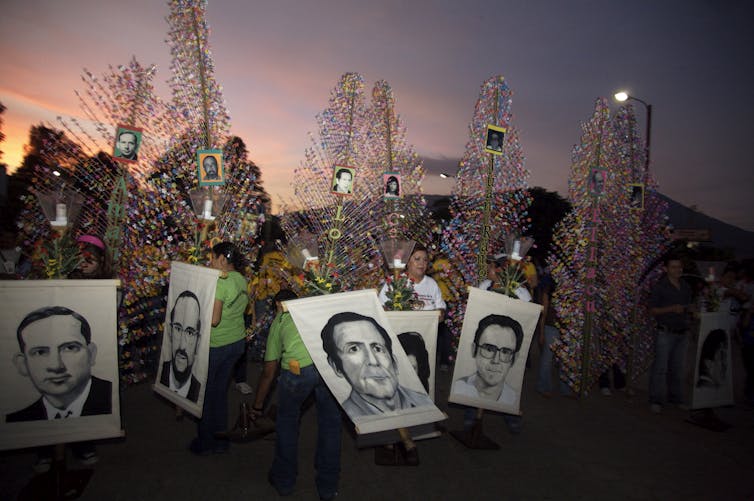
Banners depicting six Jesuit priests massacred in 1989 in El Salvador are displayed during a 2008 memorial to mark the anniversary of their deaths.
AP Photo/Edgar Romero
Like those in other Catholic orders, Jesuit priests around the world have been accused of sex abuse. A recent church report in Spain, for example, identified 96 abusers, most of whom had already died.
Meanwhile, more historical research is coming to light on Jesuits’ involvement with slavery. In 2021, the order pledged US$100 million for descendants of people enslaved by Georgetown University in the 19th century and for racial justice initiatives.
Pope Francis and the future of the Jesuits
The prospect of a Jesuit pope was once considered unlikely, given tensions at times between other church leaders and the order. Therefore, the 2013 election of Jesuit Jorge Bergoglio as Pope Francis surprised many, and his papacy has continued in that vein.
Pope Francis has been alternately hailed as a modernizer welcoming of LGBT Catholics and criticized for insufficient responsiveness to the clerical sexual abuse crisis.
Vatican observers note some characteristic Ignatian emphases in Pope Francis’ priorities, language and management style, including more attention to the poor. He has stressed the need for considering all sides of an argument when making church decisions and has shown a pragmatic willingness to consider new approaches.
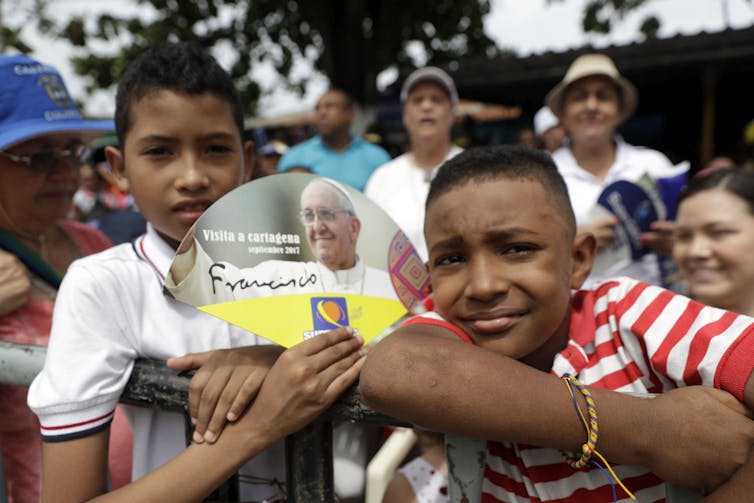
Two boys wait for the arrival of Pope Francis in Cartagena, Colombia, in 2017. Francis visited to honor St. Peter Claver, a 17th-century Jesuit who ministered to African slaves who arrived in the port.
AP Photo/Ricardo Mazalan
Future Jesuit emphases will continue to evolve as the order adapts to new circumstances. But it is the “Spiritual Exercises” that remain the heart of the identity and mission of today’s 17,000 Jesuits.
This article is republished from The Conversation, a nonprofit, independent news organization dedicated to unlocking the knowledge of experts for the public good.

About Dorian Llywelyn
Dorian Llywelyn is the President of Institute for Advanced Catholic Studies at USC Dornsife College of Letters, Arts and Sciences. You can read more about the author here.
Next Post

April 21, 2022 Why the future of the world’s largest religion is female – and African
Browse Our Archives
Select a Category Buddhism Christianity Hinduism Islam Judaism Religion and society Uncategorized
Select a Month July 2024 March 2024 February 2024 January 2024 December 2023 November 2023 October 2023 September 2023 August 2023 July 2023 January 2023 August 2022 July 2022 April 2022 February 2022 January 2022 October 2021 July 2021 June 2021 May 2021 April 2021 March 2021 February 2021 January 2021 December 2020 November 2020 October 2020 September 2020 August 2020 July 2020 June 2020 May 2020
Follow Us!
TAKE THE
Religious Wisdom Quiz
Which Christian group is known for following a strict dress code and pacifism?
Select your answer to see how you score.
Baptists Amish Pentecostals Lutherans
Related posts from The Conversation


The Catholic Church Is Using The Olympics To...

How Christians Hold Differing Views On The Resurrection
Latin America’s colonial period was less Catholic
TRENDING AT PATHEOS Religion News

Catholic Integralists believe that religious values – specifically Christian ones – should...

Electing A Virtuous President Would Make Immunity Irrelevant
Presidential immunity can bring with it many risks. So how can we...

Why The Olympic Games Are A ‘Civil Religious’...
Sporting events form a vital space where Americans display their 'civil religious...

After more than a decade of news, research updates, and insights on...

Q: Why do Southern Baptists and like-minded Protestants...
THE RELIGION GUY’S ANSWER: Why? Simple. Because they believe that’s what the...

THE QUESTION: Is gambling evil? THE RELIGION GUY’S ANSWER: Analysts anticipate a...
view all Religion News blogs
Ad-Free & Subscriber Log-In Subscription Support
- About Us
- 2026 Calendar
- Videos
- Podcasts
- Library of World Religions
- Faith In Media Tracker
- Advertise With Us
- Write for Us
- Privacy Policy
- Terms of Service
- Do Not Sell My Data
- Contact Us
- Radiant Digital
- Manage Newsletter Subscriptions
- Unsubscribe From Notifications
- Sitemap
Copyright 2008-2026, Patheos. All rights reserved.
Subscription Support Ad-Free & Subscriber Log-In
Follow Patheos