
BuddhistCatholicContemplativeEvangelicalGeneral ChristianHinduJewishLatter-day SaintMuslimNew VisionsProgressive Christian
Beliefs
- Buddhist
- Catholic
- Contemplative
- Evangelical
- General Christian
- Hindu
- Jewish
- Latter-day Saint
- More Voices
- Muslim
- New Visions
- Pagan
- Progressive Christian
Topics
- Religion News
- Food and Religion
- Sports and Religion
- Religious Art
- Religious Music and Entertainment
- Religious Events
- History and Religion
- Style and Religion
- Politics and Religion
- Women in Religion
- Recreation Outdoors and Religion
- Business Finance and Religion
- Careers Workplace and Religion
- Education and Religion
- Family Parenting and Religion
- Health Fitness and Religion
- Home and Religion
- Relationships and Religion
- Technology and Religion
- Travel and Religion
Columnists
- Buddhist Columnists
- Business Finance and Religion Columnists
- Careers Workplace and Religion Columnists
- Catholic Columnists
- Contemplative Columnists
- Education and Religion Columnists
- Evangelists Columnists
- Family Parenting and Religion Columnists
- General Christian Columnists
- Health Fitness and Religion Columnists
- Hindu Columnists
- History and Religion Columnists
- Home and Religion Columnists
- Jewish Columnists
- More Voices Columnists
- Latter Day Columnists
- Muslim Columnists
- New Visions Columnists
- Nonreligious Columnists
- Pagan Columnists
- Politics and Religion Columnists
- Progressive Columnists
- Recreation Outdoors and Religion Columnists
- Relationships and Religion Columnists
- Religion News Columnists
- Religious Art Columnists
- Religious Events Columnists
- Religious Music and Entertainment Columnists
- Sports and Religion Columnists
- Style and Religion Columnists
- Technology and Religion Columnists
- Travel and Religion Columnists
- Women in Religion Columnists
Resource Library
- 2026 Calendar
- Library of World Religions
- The 100 Most Holy Places on Earth
- Patheos Answers
- Podcasts
- Videos
- Faith Leaders Database
- Anglican Episcopalian
- Bahai
- Baptist
- Buddhism
- Christianity
- Confucianism
- Eastern Orthodoxy
- Hinduism
- Holiness and Pentecostal
- ISKCON
- Islam
- Judaism
- Lutheran
- Methodist
- The Church of Jesus Christ of Latter-day Saints
- New Age
- Paganism
- Presbytarian and Reformed
- Protestantism
- Religion Behind the Scenes
- Roman Catholic
- Scientology
- Shia Islam
- Sikhism
- Sufism
- Sunni Islam
- Taoism
- Zen
- See all religions
Research Tools
 Ad-Free & Subscriber Log-In Subscription Support
Ad-Free & Subscriber Log-In Subscription Support
Follow Patheos 

- Trending:
- Forgiveness
- |
- Marriage
- |
- Consciousness
- |
- Death Penalty
- |
- Election
- |
- Halloween

- Home
- Religion News
- When Putin says Russia and Ukraine share one faith, he’s leaving out a lot of the story
When Putin says Russia and Ukraine share one faith, he’s leaving out a lot of the story
Last updated on: April 12, 2022 at 9:00 am by The Conversation
When Putin says Russia and Ukraine share one faith, he’s leaving out a lot of the story 2022-04-10T21:16:11-04:00 The Conversation
Patheos Explore the world's faith through different perspectives on religion and spirituality! Patheos has the views of the prevalent religions and spiritualities of the world.
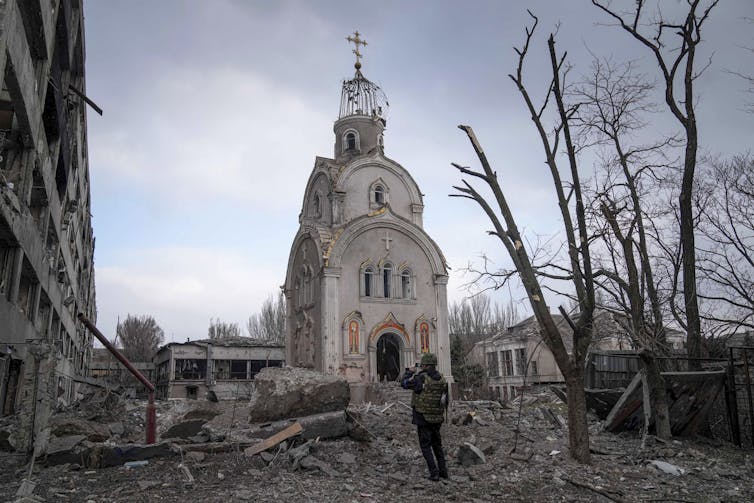
A Ukrainian service member takes a photograph of a damaged church after shelling in a residential district in Mariupol, Ukraine, March 10, 2022.
AP Photo/Evgeniy Maloletka
By Kathryn David of Vanderbilt University
Russian President Vladimir Putin has often asserted that Russians and Ukrainians are “one people.” He points to a few factors: the Russian language spoken widely in both countries, their similar cultures, and the two countries’ political connections, which date back to medieval times. But there is one more factor that ties all these together: religion.
Grand Prince Volodymyr, leader of the kingdom of Kyiv, converted to Christianity in the 10th century and forced his subjects to do the same. As Putin sees it, Orthodox Christianity established a religious and cultural foundation that outlasted the kingdom itself, creating a shared heritage among the people who live in present-day Russia, Ukraine and Belarus.
As a historian of religion and nationalism in Ukraine and Russia, I see Russia’s invasion as, in part, an attempt to restore this imagined “Russian World.” More than 7 in 10 Ukrainians identify as Orthodox Christians, similar to the percentage in Russia.
But what Putin’s claims ignore is a uniquely Ukrainian religious heritage that transcends church institutions and has long nourished Ukrainians’ sense of nationhood. Many Ukrainians throughout history have seen religion as something that asserts their separateness from Russia, not their commonality.
Kyiv vs. Moscow
Under imperial Russia, the Russian Orthodox Church was often a tool of assimilation, with officials eager to use the power of the church to make newly conquered peoples Russian subjects.
Beginning in 1654, when Ukrainian lands were being absorbed into imperial Russia, clergy from Moscow had to decide how to accommodate distinct religious texts, practices and ideas from Kyiv that differed from Moscow’s in subtle yet significant ways. Believing some of the Kyivan practices to be more closely aligned with the Byzantine roots of the Orthodox Church, Russian clergy decided to integrate Ukrainian rituals and priests into the Russian Orthodox Church.
Later, some members of the clergy helped promote the idea of Russian and Ukrainian unity, rooted in Orthodox faith. Yet 19th-century Ukrainian activists took a different view of this history. They saw the Russian Orthodox Church as a tool of empire. In these activists’ view, the church had adopted Ukrainian traditions in the name of spiritual unity while actually denying Ukrainians’ distinct identity.
These nationalist activists did not abandon Orthodox Christianity, however. As they pushed for an autonomous Ukraine, they asserted there was a difference between the politics of the church institution and the everyday religion that foregrounded Ukrainian life.
In the shadow of empire
Not all Ukrainians lived in the spiritual realm of Moscow. A Ukrainian national movement also grew in the west, in former Kyivan lands that ended up in the Austro-Hungarian Empire. Here many in the population were members of a hybrid religious institution, the Greek Catholic Church, which practiced Orthodox rituals but followed the pope.
Local parishes in the Greek Catholic Church became important in the national movement as religious institutions that distinguished Ukrainians from not only Russian neighbors to the east, but also from the local Polish population in Austria-Hungary. But Ukrainian activists grappled with how to build a nation that was split between these two main faiths: the Russian Orthodox Church and the Greek Catholic Church.
When imperial Russia collapsed in 1917, one of the first acts of the new Ukrainian government formed in Kyiv was declaring its own Orthodox Church, separate from Moscow: the Ukrainian Autocephalous Church. The church was intended to use the Ukrainian language and to empower local parishes more than the Russian Orthodox Church had allowed.
As the Austro-Hungarian Empire collapsed, the leader of the Ukrainian Greek Catholic Church, Andrei Sheptytsky, put forward a plan for a unified Ukrainian Church under the Vatican but grounded in Orthodox ritual. He hoped such a church could bring Ukrainians together.
But these plans never materialized. The independent government in Kyiv was defeated by the Bolsheviks by 1921, and the Ukrainian Orthodox Church based in Kyiv was banned by the Soviet Union.
Crackdown on ‘nationalist’ prayers
In the first decades of the Soviet Union, the Bolsheviks mounted a campaign against religious institutions, especially the Russian Orthodox Church. They viewed Russian Orthodoxy, in particular, as an instrument of the old regime and a potential source of opposition.
During World War II, however, the Soviet Union revived the Russian Orthodox Church, hoping to use it as a tool to promote Russian nationalism at home and abroad.
In western Ukraine, which the Soviet Union annexed from Poland in 1939, this meant forcibly converting 3 million Ukrainian Greek Catholics to Russian Orthodoxy.
Many Ukrainians proved resilient in adapting religious life to these circumstances. Some formed an underground Greek Catholic Church, while others found ways to maintain their traditions despite participating in the Soviet-sanctioned Russian Orthodox Church.
In Soviet secret police records, officers documented what they called “nationalist” practices at church: believers remaining silent when the Moscow patriarch’s name was to be commemorated, for example, or using prayer books that predated Soviet rule.
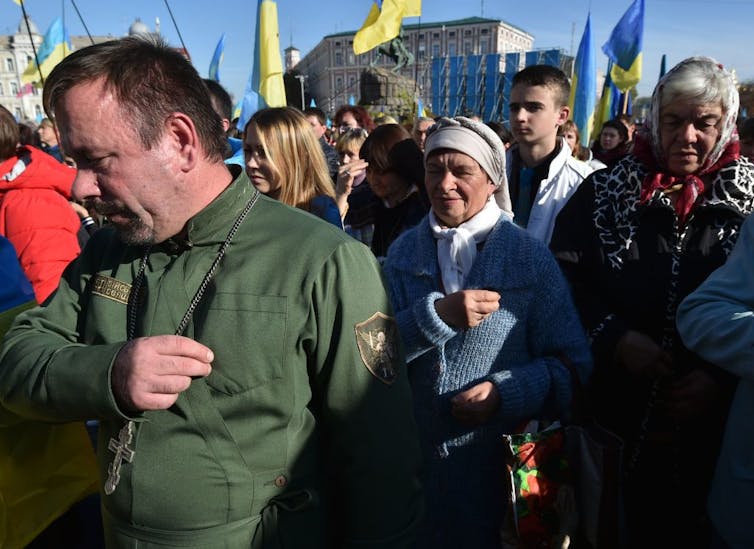
Thousands of people attend a mass prayer in front of St. Sophia Cathedral in Kyiv on Oct. 14, 2018, to give thanks after the Orthodox Church in Ukraine gained autocephaly.
GENYA SAVILOV/AFP via Getty Images
Hopes for change
When the Soviet Union collapsed, Ukraine found itself in a position to redefine the religious landscape. Some Christians became part of the Greek Catholic Church after it was relegalized. Other Christians saw this moment as a time to declare an “autocephalous” Ukrainian church, meaning they would still be in communion with other Orthodox churches around the world, but not under Moscow’s control. Still others wanted to remain part of the Russian Orthodox Church based in Moscow.
In 2019, a Ukrainian Orthodox church was recognized as autocephalous by Ecumenical Patriarch Bartholomew, the spiritual head of Orthodoxy worldwide, forming the Orthodox Church of Ukraine.
In Ukraine today, only 3% of people say they are affiliated with the Orthodox Church based in Moscow, while 24% follow the Orthodox Church based in Ukraine, and a similar percentage call themselves “simply Orthodox.”
Some Ukrainians have treated the Moscow-based church with suspicion, recognizing its close ties to Putin’s government. Yet it would be a mistake to assume that all who attend this church agree with its politics.
Putin and other leaders in Moscow have their own ideas about Orthodoxy. But in Ukraine, sacred spaces have long been where many Ukrainians fought for, and won, their right to self-determination.

This article is republished from The Conversation, a nonprofit, independent news organization dedicated to unlocking the knowledge of experts for the public good.

About Kathryn David
Kathryn David is a Mellon Assistant Professor of Russian and East European Studies at Vanderbilt University. You can read more about the author here.
Browse Our Archives
Select a Category Buddhism Christianity Hinduism Islam Judaism Religion and society Uncategorized
Select a Month July 2024 March 2024 February 2024 January 2024 December 2023 November 2023 October 2023 September 2023 August 2023 July 2023 January 2023 August 2022 July 2022 April 2022 February 2022 January 2022 October 2021 July 2021 June 2021 May 2021 April 2021 March 2021 February 2021 January 2021 December 2020 November 2020 October 2020 September 2020 August 2020 July 2020 June 2020 May 2020
Follow Us!
TAKE THE
Religious Wisdom Quiz
What type of wood was Noah’s Ark made from?
Select your answer to see how you score.
Cedar Gopher wood Oak Olive wood
Related posts from The Conversation


Electing A Virtuous President Would Make Immunity Irrelevant

Why The Olympic Games Are A ‘Civil Religious’...

The Catholic Church Is Using The Olympics To...
TRENDING AT PATHEOS Religion News

Catholic Integralists believe that religious values – specifically Christian ones – should...

Electing A Virtuous President Would Make Immunity Irrelevant
Presidential immunity can bring with it many risks. So how can we...

Why The Olympic Games Are A ‘Civil Religious’...
Sporting events form a vital space where Americans display their 'civil religious...

After more than a decade of news, research updates, and insights on...

Q: Why do Southern Baptists and like-minded Protestants...
THE RELIGION GUY’S ANSWER: Why? Simple. Because they believe that’s what the...

THE QUESTION: Is gambling evil? THE RELIGION GUY’S ANSWER: Analysts anticipate a...
view all Religion News blogs
Ad-Free & Subscriber Log-In Subscription Support
- About Us
- 2026 Calendar
- Videos
- Podcasts
- Library of World Religions
- Faith In Media Tracker
- Advertise With Us
- Write for Us
- Privacy Policy
- Terms of Service
- Do Not Sell My Data
- Contact Us
- Radiant Digital
- Manage Newsletter Subscriptions
- Unsubscribe From Notifications
- Sitemap
Copyright 2008-2026, Patheos. All rights reserved.
Subscription Support Ad-Free & Subscriber Log-In
Follow Patheos