
BuddhistCatholicContemplativeEvangelicalGeneral ChristianHinduJewishLatter-day SaintMuslimNew VisionsProgressive Christian
Beliefs
- Buddhist
- Catholic
- Contemplative
- Evangelical
- General Christian
- Hindu
- Jewish
- Latter-day Saint
- More Voices
- Muslim
- New Visions
- Pagan
- Progressive Christian
Topics
- Religion News
- Food and Religion
- Sports and Religion
- Religious Art
- Religious Music and Entertainment
- Religious Events
- History and Religion
- Style and Religion
- Politics and Religion
- Women in Religion
- Recreation Outdoors and Religion
- Business Finance and Religion
- Careers Workplace and Religion
- Education and Religion
- Family Parenting and Religion
- Health Fitness and Religion
- Home and Religion
- Relationships and Religion
- Technology and Religion
- Travel and Religion
Columnists
- Buddhist Columnists
- Business Finance and Religion Columnists
- Careers Workplace and Religion Columnists
- Catholic Columnists
- Contemplative Columnists
- Education and Religion Columnists
- Evangelists Columnists
- Family Parenting and Religion Columnists
- General Christian Columnists
- Health Fitness and Religion Columnists
- Hindu Columnists
- History and Religion Columnists
- Home and Religion Columnists
- Jewish Columnists
- More Voices Columnists
- Latter Day Columnists
- Muslim Columnists
- New Visions Columnists
- Nonreligious Columnists
- Pagan Columnists
- Politics and Religion Columnists
- Progressive Columnists
- Recreation Outdoors and Religion Columnists
- Relationships and Religion Columnists
- Religion News Columnists
- Religious Art Columnists
- Religious Events Columnists
- Religious Music and Entertainment Columnists
- Sports and Religion Columnists
- Style and Religion Columnists
- Technology and Religion Columnists
- Travel and Religion Columnists
- Women in Religion Columnists
Resource Library
- 2026 Calendar
- Library of World Religions
- The 100 Most Holy Places on Earth
- Patheos Answers
- Podcasts
- Videos
- Faith Leaders Database
- Anglican Episcopalian
- Bahai
- Baptist
- Buddhism
- Christianity
- Confucianism
- Eastern Orthodoxy
- Hinduism
- Holiness and Pentecostal
- ISKCON
- Islam
- Judaism
- Lutheran
- Methodist
- The Church of Jesus Christ of Latter-day Saints
- New Age
- Paganism
- Presbytarian and Reformed
- Protestantism
- Religion Behind the Scenes
- Roman Catholic
- Scientology
- Shia Islam
- Sikhism
- Sufism
- Sunni Islam
- Taoism
- Zen
- See all religions
Research Tools
 Ad-Free & Subscriber Log-In Subscription Support
Ad-Free & Subscriber Log-In Subscription Support
Follow Patheos 

- Trending:
- Forgiveness
- |
- Marriage
- |
- Consciousness
- |
- Death Penalty
- |
- Election
- |
- Halloween

- Home
- Religion News
- Pope Francis apologized for the harm done to First Nations peoples, but what does a pope’s apology mean?
Pope Francis apologized for the harm done to First Nations peoples, but what does a pope’s apology mean?
Last updated on: April 11, 2022 at 9:00 am by The Conversation
Pope Francis apologized for the harm done to First Nations peoples, but what does a pope’s apology mean? 2022-04-10T21:15:20-04:00 The Conversation
Patheos Explore the world's faith through different perspectives on religion and spirituality! Patheos has the views of the prevalent religions and spiritualities of the world.
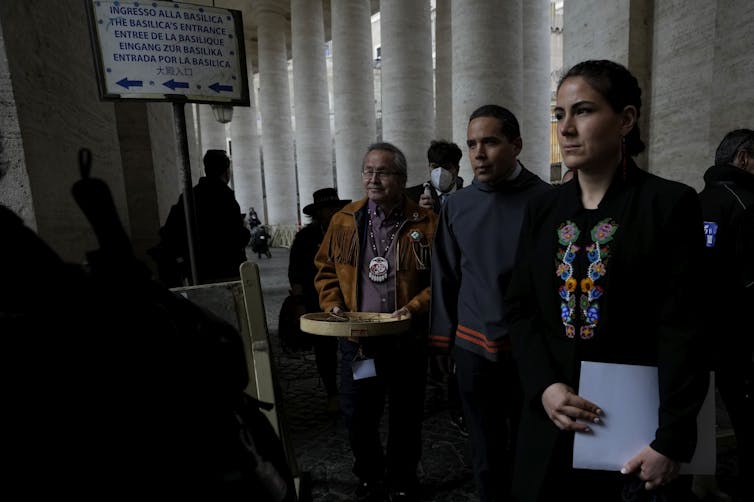
Representatives from the First Nations Inuit and Metis communities, in St. Peter’s Square at the Vatican, after their meeting with Pope Francis, on April 1, 2022.
AP Photo/Alessandra Tarantino
By Annie Selak of Georgetown University
Pope Francis apologized on April 1, 2022, to First Nations, Inuit and Métis delegations, acknowledging the harm done by residential schools in Canada and marking a crucial step in the church admitting its role in the abuse of Indigenous communities and children. Yet this apology, as important as it is, raises questions about what it means when a pope apologizes.
As a Catholic theologian who studies church authority, I’ve observed how previous papal apologies can speak for the entire church and either deny or claim responsibility.
Developments in papal apologies
It was once unthinkable for a pope to apologize, for admitting guilt would imply that the church was sinful. However, the Second Vatican Council, a gathering of bishops, cardinals, heads of religious orders and theologians that met from 1962 to 1965 and modernized the church, shifted the church’s perspective on change and instituted major reforms. It also opened the door to admitting fault.
Pope John Paul II apologized for many past errors of the church by marking March 12, 2000 as a “Day of Pardon.” In the document announcing the Day of Pardon, John Paul II said “the Church today, through the Successor of Peter, names, declares and confesses the errors of Christians in every age.”
This sent out a signal that papal apologies speak for the entire church, beyond a current pope’s personal responsibility. Just one year before, the International Theological Commission had stated that “in the entire history of the Church there are no precedents for papal apologies for ‘past wrongs.’” So, this set a significant new precedent. Christian theologian Jeremy M. Bergen calls the Day of Pardon “the most widely received instance of ecclesial repentance to date.”
Papal apologies are based on an understanding that the pope is the leader of the one, holy, Catholic and apostolic church, connected by tradition throughout time. As a result, it is possible for the pope to apologize for an event in the past when he was not pope, or perhaps not even born yet, because the church of a thousand years ago is connected to today.
When a pope apologizes, the apology often addresses the feelings of the victims, yet fails to implicate the church as responsible. Pope Benedict XVI acknowledged the pain of sexual abuse victims when he said in 2008, “I am deeply sorry for the pain and suffering the victims have endured, and I assure them that, as their pastor, I too share in their suffering.” Yet, Benedict XVI often stopped short of apologizing for the church’s cover-up.
By not admitting the church’s wrongdoing and cover-up, these apologies straddle a line of expressing regret without taking ownership and accountability. It is similar to a friend saying “I am sorry you felt that way” without claiming responsibility.
Pope Francis and apologies
Francis more often admits the church’s fault for its actions. In a 2015 speech in Bolivia, Pope Francis spoke of the “grave sins” of colonization in the Americas and said, “I humbly ask forgiveness, not only for the offense of the church herself, but also for crimes committed against the native peoples during the so-called conquest of America.”

Pope Francis in Bolivia in 2015.
AP Photo/Eduardo Verdugo
In this apology, Francis spoke for the entire church, even though the acts of colonialism began several centuries earlier. This apology affirmed the universal nature of the church, as well as Bolivians’ unique suffering, by Francis apologizing on Bolivian soil. Evo Morales, Bolivia’s former president, responded to the apology, saying, “For the first time, I feel like I have a pope: Pope Francis.”
From my perspective, Francis’ apology regarding residential schools walks a line between prior broad and specific apologies. He stated, “For the deplorable conduct of these members of the Catholic Church, I ask for God’s forgiveness, and I want to say to you with all my heart: I am very sorry.” In saying so, he placed a distance between himself and those “members of the Catholic Church” responsible for the abuse.
Apologies are actions
To be sure, there are those who say that actions are more important than words and that papal apologies are hollow without corresponding actions. While there are certainly actions that are necessary to repair and restore justice, I argue that it is also important to recognize that apologizing is itself an action.
The actions of a world leader such as the pope matter. Apologies are known to be one step in restorative justice. For example, the Truth and Reconciliation Commission of Canada’s “Calls to Action” document includes a call for an apology from the church.
Papal apologies may not say everything, but they do say something important. As the head of the Roman Catholic Church and a world leader, the pope apologizes both to the church and on behalf of the church to the world. These apologies are necessary starting points on the path to forgiveness and healing.
This article is republished from The Conversation, a nonprofit, independent news organization dedicated to unlocking the knowledge of experts for the public good.

About Annie Selak
Annie Selak is the Associate Director of the Women's Center at Georgetown University. You can read more about the author here.
Previous Post

February 22, 2022
How Lourdes became a byword for hope
Browse Our Archives
Select a Category Buddhism Christianity Hinduism Islam Judaism Religion and society Uncategorized
Select a Month July 2024 March 2024 February 2024 January 2024 December 2023 November 2023 October 2023 September 2023 August 2023 July 2023 January 2023 August 2022 July 2022 April 2022 February 2022 January 2022 October 2021 July 2021 June 2021 May 2021 April 2021 March 2021 February 2021 January 2021 December 2020 November 2020 October 2020 September 2020 August 2020 July 2020 June 2020 May 2020
Follow Us!
TAKE THE
Religious Wisdom Quiz
What does "Jericho" mean in Hebrew?
Select your answer to see how you score.
Place of salt Place of fragrance Mount of olives Dry ground
Related posts from The Conversation


The Catholic Church Is Using The Olympics To...

How Christians Hold Differing Views On The Resurrection
Tattooing Dates Back To The Crucifixion
TRENDING AT PATHEOS Religion News

Catholic Integralists believe that religious values – specifically Christian ones – should...

Electing A Virtuous President Would Make Immunity Irrelevant
Presidential immunity can bring with it many risks. So how can we...

Why The Olympic Games Are A ‘Civil Religious’...
Sporting events form a vital space where Americans display their 'civil religious...

After more than a decade of news, research updates, and insights on...

Q: Why do Southern Baptists and like-minded Protestants...
THE RELIGION GUY’S ANSWER: Why? Simple. Because they believe that’s what the...

THE QUESTION: Is gambling evil? THE RELIGION GUY’S ANSWER: Analysts anticipate a...
view all Religion News blogs
Ad-Free & Subscriber Log-In Subscription Support
- About Us
- 2026 Calendar
- Videos
- Podcasts
- Library of World Religions
- Faith In Media Tracker
- Advertise With Us
- Write for Us
- Privacy Policy
- Terms of Service
- Do Not Sell My Data
- Contact Us
- Radiant Digital
- Manage Newsletter Subscriptions
- Unsubscribe From Notifications
- Sitemap
Copyright 2008-2026, Patheos. All rights reserved.
Subscription Support Ad-Free & Subscriber Log-In
Follow Patheos