
BuddhistCatholicContemplativeEvangelicalGeneral ChristianHinduJewishLatter-day SaintMuslimNew VisionsProgressive Christian
Beliefs
- Buddhist
- Catholic
- Contemplative
- Evangelical
- General Christian
- Hindu
- Jewish
- Latter-day Saint
- More Voices
- Muslim
- New Visions
- Pagan
- Progressive Christian
Topics
- Religion News
- Food and Religion
- Sports and Religion
- Religious Art
- Religious Music and Entertainment
- Religious Events
- History and Religion
- Style and Religion
- Politics and Religion
- Women in Religion
- Recreation Outdoors and Religion
- Business Finance and Religion
- Careers Workplace and Religion
- Education and Religion
- Family Parenting and Religion
- Health Fitness and Religion
- Home and Religion
- Relationships and Religion
- Technology and Religion
- Travel and Religion
Columnists
- Buddhist Columnists
- Business Finance and Religion Columnists
- Careers Workplace and Religion Columnists
- Catholic Columnists
- Contemplative Columnists
- Education and Religion Columnists
- Evangelists Columnists
- Family Parenting and Religion Columnists
- General Christian Columnists
- Health Fitness and Religion Columnists
- Hindu Columnists
- History and Religion Columnists
- Home and Religion Columnists
- Jewish Columnists
- More Voices Columnists
- Latter Day Columnists
- Muslim Columnists
- New Visions Columnists
- Nonreligious Columnists
- Pagan Columnists
- Politics and Religion Columnists
- Progressive Columnists
- Recreation Outdoors and Religion Columnists
- Relationships and Religion Columnists
- Religion News Columnists
- Religious Art Columnists
- Religious Events Columnists
- Religious Music and Entertainment Columnists
- Sports and Religion Columnists
- Style and Religion Columnists
- Technology and Religion Columnists
- Travel and Religion Columnists
- Women in Religion Columnists
Resource Library
- 2026 Calendar
- Library of World Religions
- The 100 Most Holy Places on Earth
- Patheos Answers
- Podcasts
- Videos
- Faith Leaders Database
- Anglican Episcopalian
- Bahai
- Baptist
- Buddhism
- Christianity
- Confucianism
- Eastern Orthodoxy
- Hinduism
- Holiness and Pentecostal
- ISKCON
- Islam
- Judaism
- Lutheran
- Methodist
- The Church of Jesus Christ of Latter-day Saints
- New Age
- Paganism
- Presbytarian and Reformed
- Protestantism
- Religion Behind the Scenes
- Roman Catholic
- Scientology
- Shia Islam
- Sikhism
- Sufism
- Sunni Islam
- Taoism
- Zen
- See all religions
Research Tools
 Ad-Free & Subscriber Log-In Subscription Support
Ad-Free & Subscriber Log-In Subscription Support
Follow Patheos 

- Trending:
- Forgiveness
- |
- Marriage
- |
- Consciousness
- |
- Death Penalty
- |
- Election
- |
- Halloween

- Home
- Religion News
- Christians hold many views on Jesus’ resurrection – a theologian explains the differing views among Baptists
Christians hold many views on Jesus’ resurrection – a theologian explains the differing views among Baptists
Last updated on: April 16, 2022 at 12:02 pm by The Conversation
Christians hold many views on Jesus’ resurrection – a theologian explains the differing views among Baptists 2022-04-16T12:02:55-04:00 The Conversation
Patheos Explore the world's faith through different perspectives on religion and spirituality! Patheos has the views of the prevalent religions and spiritualities of the world.
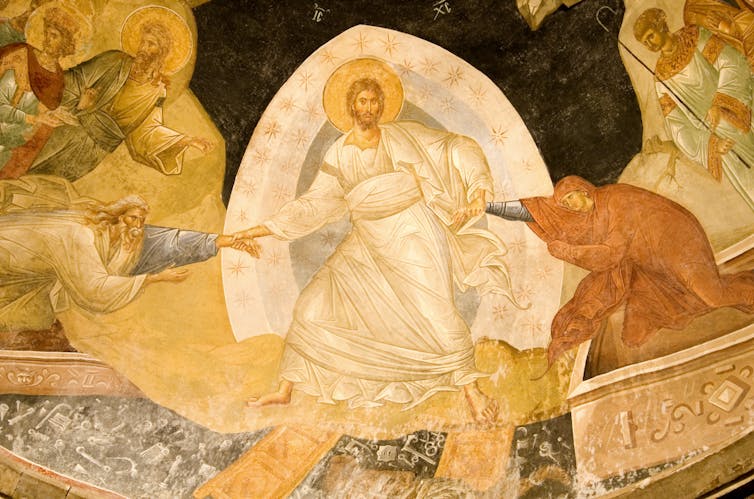
Resurrection of Christ depicted in 14th-century fresco in Chora Church, Istanbul, Turkey.
LP7/Collections E+ via Getty Images
By Jason Oliver Evans of University of Virginia
Every year, Christians from around the world gather for worship on Easter Sunday. Also known as Pascha or Resurrection Sunday, Easter is the final day of a weeklong commemoration of the story of Jesus’ final days in the city of Jerusalem leading up to his crucifixion and resurrection.
Most Christians refer to the week before Easter as Holy Week. In Western Christianity, Holy Week begins with Palm Sunday, which commemorates Jesus’ triumphal entry into Jerusalem. Easter is the third day of the larger three-day festival known as Holy Triduum, which begins on the evening of Maundy Thursday, marking the night of Jesus’ Last Supper with his disciples. Good Friday marks Jesus’ suffering, crucifixion and death. Holy Saturday marks Jesus’ burial in a tomb owned by Joseph of Arimathea. The festival reaches its climax on early Sunday morning with the Easter Vigil and ends on the evening of Easter Sunday.
As a Baptist minister and theologian myself, I believe it is important to understand how Christians more generally, and Baptists in particular, hold differing views on the meaning of the resurrection.
The resurrection
According to the Christian faith, resurrection is the pivotal event when “God raised Jesus from the dead” after he was crucified by the Roman governor Pontius Pilate.
While none of the four canonical Gospels of Matthew, Mark, Luke and John describe the actual event of the resurrection in detail, they nonetheless give varying reports about the empty tomb and Christ’s post-resurrection appearances among his followers both in Galilee and Jerusalem.
They also report that it was women who discovered the empty tomb and received and proclaimed the first message that Christ was risen from the dead. These narratives were passed down orally among the earliest Christian communities and then codified in the Gospel writings beginning some 30 years after Jesus’ death.
The Earliest Christians believed that by raising Jesus of Nazareth from the dead, God cleared Jesus from any wrongdoing for which he was tried and unjustly condemned to death by Pilate.
By affirming the resurrection, Christians do not mean that Jesus’ body was merely resuscitated. Rather, as New Testament scholar Luke Timothy Johnson writes, resurrection means that “[Jesus] entered into an entirely new form of existence.”
As the risen Christ, Jesus is believed to share God’s power to transform all life and also to share this same power with his followers. So the resurrection is believed to be something that happened not only to Jesus, but also an experience that happens to his followers.
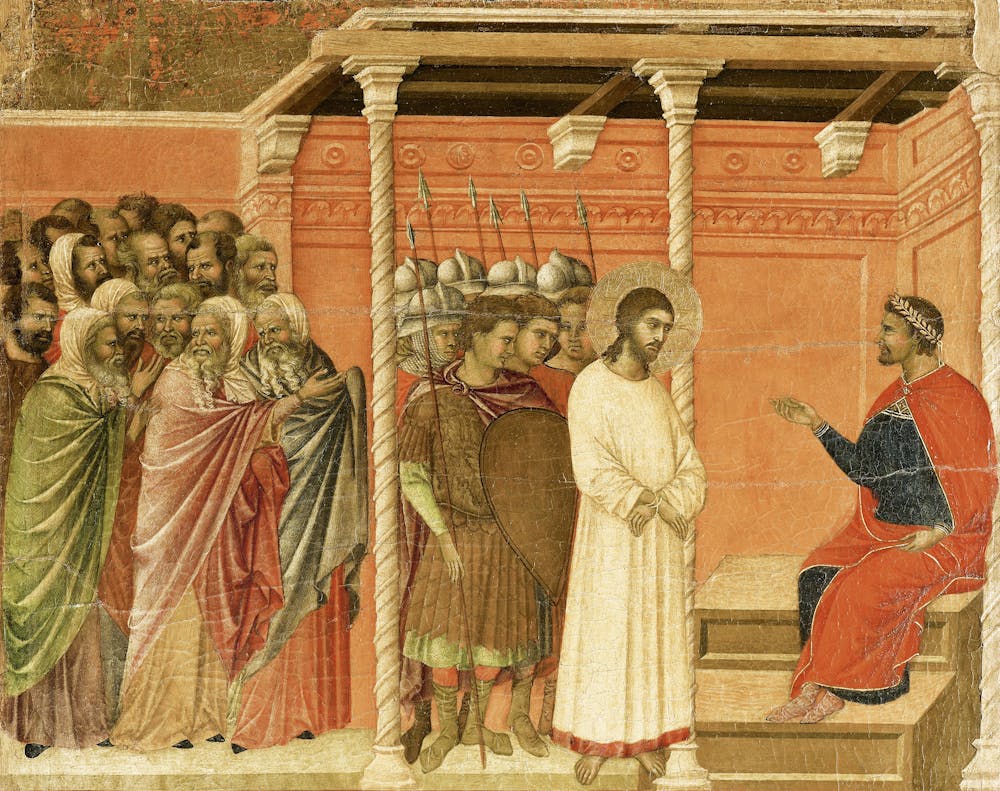
Christ before Pilate: Detail of a tile from the Cathedral of Siena, Italy.
DeAgostini/Getty Images
Opposing views
Over the years, Christians have engaged in passionate debates over this central doctrine of Christian faith.
Two major approaches emerged: the “liberal” view and the “conservative” or “traditional” view. Current perspectives on the resurrection have been predominated by two questions: “Was Jesus’ body literally raised from the dead?” and “What relevance does the resurrection have for those struggling for justice?”
These questions emerged in the wake of theological modernism, a European and North American movement dating back to the mid-19th century that sought to reinterpret Christianity to accommodate the emergence of modern science, history and ethics.
Theological modernism led liberal Christian theologians to create an alternative path between the rigid orthodoxies of Christian churches and the rationalism of atheists and others.
This meant that liberal Christians were willing to revise or jettison cherished Christian beliefs, such as the bodily resurrection of Jesus, if such beliefs could not be explained against the bar of human reason.
Baptist views on the resurrection
Just like all other Christian denominations, Baptists are divided on the issue of the bodily resurrection of Jesus. Arguably, what may be unique about the group is that Baptists believe that no external religious authority can force an individual member to adhere to the tenets of Christian faith in any prescribed way. One must be free to accept or reject any teaching of the church.
In the early 20th century, Baptists in the United States found themselves on both sides of a schism within American Christianity over doctrinal issues, known as the fundamentalist-modernist controversy.
The Rev. Harry Emerson Fosdick, a liberal Baptist pastor who served First Presbyterian Church and later Riverside Church in Manhattan, rejected the bodily resurrection of Jesus. Rather, Fosdick viewed the resurrection as a “persistence in [Christ’s] personality.”
In 1922, Fosdick delivered his famous sermon “Shall the Fundamentalists Win?” rebuking fundamentalists for their failure to tolerate difference on doctrinal matters such as the infallibility of the Bible, the virgin birth and bodily resurrection, among others, and for downplaying the weightier matter of addressing the societal needs of the day.
In his autobiography, civil rights leader and Baptist minister the Rev. Martin Luther King Jr. explained that in his early adolescence he denied the bodily resurrection of Jesus.
While attending Crozer Seminary in 1949, King wrote a paper trying to make sense of what led to the development of the Christian doctrine of Jesus’ bodily resurrection. For King, the experience of the early followers of Jesus was at the root of their belief in his resurrection.
“They had been captivated by the magnetic power of his personality,” King argued. “This basic experience led to the faith that he could never die.” In other words, the bodily resurrection of Jesus simply is the outward expression of early Christian experience, not an actual or, at least, a verifiable event in human history.
It is not clear from his later writings that King changed his views on the bodily resurrection. In one of his notable Easter sermons, King argued that the meaning behind the resurrection signaled a future where God will put an end to racial segregation.
Others within the Baptist movement disagreed. Like his fundamentalist forebears, conservative evangelical Baptist theologian Carl F.H. Henry argued in 1976 that all Christian doctrine can be rationally explained and can persuade any nonbeliever. Henry rigorously defended the bodily resurrection of Christ as a historical occurrence by appealing to the Gospels’ telling of the empty tomb and Christ’s appearances among his disciples after his resurrection.
In his six-volume magnum opus, “God, Revelation, and Authority,” Henry read these two elements of the Gospels as historical records that can be verified through modern historical methods.
Alternative views

Christians hold a diversity of perspectives on Christ’s resurrection.
Bruno Balestrini / Electa / Mondadori Portfolio via Getty Images
Despite their predominance, the liberal and conservative arguments on the resurrection of Jesus are not the only approaches held among Baptists.
In his book “Resurrection and Discipleship,” Baptist theologian Thorwald Lorenzen also outlines what he calls the “evangelical” approach, which seeks to transcend the distinctions of “liberal” and “conservative” approaches. He affirms, with the conservatives, the historical reality of the resurrection, but agrees with the liberals that such an event cannot be verified in the modern historical sense.
Other than these, there is a “liberation” approach, which stresses the social and political implications of the resurrection. Baptists who hold this view primarily interpret the resurrection as God’s response and commitment to liberating those who, like Jesus, experience poverty and oppression.
Given this diversity of perspectives on the resurrection, Baptists are not unique among Christians in engaging matters of faith practice. However, I argue that Baptists may be distinct in that they believe that such matters must be freely believed by one’s own conscience and not enforced by any external religious authority.

This article is republished from The Conversation, a nonprofit, independent news organization dedicated to unlocking the knowledge of experts for the public good.

About Jason Oliver Evans
Jason Oliver Evans is a Ph.D. Candidate in Religious Studies at the University of Virginia. You can read more about the author here.

Next Post
April 20, 2022 Who are the Jesuits?
Browse Our Archives
Select a Category Buddhism Christianity Hinduism Islam Judaism Religion and society Uncategorized
Select a Month July 2024 March 2024 February 2024 January 2024 December 2023 November 2023 October 2023 September 2023 August 2023 July 2023 January 2023 August 2022 July 2022 April 2022 February 2022 January 2022 October 2021 July 2021 June 2021 May 2021 April 2021 March 2021 February 2021 January 2021 December 2020 November 2020 October 2020 September 2020 August 2020 July 2020 June 2020 May 2020
Follow Us!
TAKE THE
Religious Wisdom Quiz
What does "Jericho" mean in Hebrew?
Select your answer to see how you score.
Place of salt Place of fragrance Mount of olives Dry ground
Related posts from The Conversation


How Christians Hold Differing Views On The Resurrection

Tattooing Dates Back To The Crucifixion

Pope Francis called surrogacy ‘deplorable’
TRENDING AT PATHEOS Religion News

Catholic Integralists believe that religious values – specifically Christian ones – should...

Electing A Virtuous President Would Make Immunity Irrelevant
Presidential immunity can bring with it many risks. So how can we...

Why The Olympic Games Are A ‘Civil Religious’...
Sporting events form a vital space where Americans display their 'civil religious...

After more than a decade of news, research updates, and insights on...

Q: Why do Southern Baptists and like-minded Protestants...
THE RELIGION GUY’S ANSWER: Why? Simple. Because they believe that’s what the...

THE QUESTION: Is gambling evil? THE RELIGION GUY’S ANSWER: Analysts anticipate a...
view all Religion News blogs
Ad-Free & Subscriber Log-In Subscription Support
- About Us
- 2026 Calendar
- Videos
- Podcasts
- Library of World Religions
- Faith In Media Tracker
- Advertise With Us
- Write for Us
- Privacy Policy
- Terms of Service
- Do Not Sell My Data
- Contact Us
- Radiant Digital
- Manage Newsletter Subscriptions
- Unsubscribe From Notifications
- Sitemap
Copyright 2008-2026, Patheos. All rights reserved.
Subscription Support Ad-Free & Subscriber Log-In
Follow Patheos