
BuddhistCatholicContemplativeEvangelicalGeneral ChristianHinduJewishLatter-day SaintMuslimNew VisionsProgressive Christian
Beliefs
- Buddhist
- Catholic
- Contemplative
- Evangelical
- General Christian
- Hindu
- Jewish
- Latter-day Saint
- More Voices
- Muslim
- New Visions
- Pagan
- Progressive Christian
Topics
- Religion News
- Food and Religion
- Sports and Religion
- Religious Art
- Religious Music and Entertainment
- Religious Events
- History and Religion
- Style and Religion
- Politics and Religion
- Women in Religion
- Recreation Outdoors and Religion
- Business Finance and Religion
- Careers Workplace and Religion
- Education and Religion
- Family Parenting and Religion
- Health Fitness and Religion
- Home and Religion
- Relationships and Religion
- Technology and Religion
- Travel and Religion
Columnists
- Buddhist Columnists
- Business Finance and Religion Columnists
- Careers Workplace and Religion Columnists
- Catholic Columnists
- Contemplative Columnists
- Education and Religion Columnists
- Evangelists Columnists
- Family Parenting and Religion Columnists
- General Christian Columnists
- Health Fitness and Religion Columnists
- Hindu Columnists
- History and Religion Columnists
- Home and Religion Columnists
- Jewish Columnists
- More Voices Columnists
- Latter Day Columnists
- Muslim Columnists
- New Visions Columnists
- Nonreligious Columnists
- Pagan Columnists
- Politics and Religion Columnists
- Progressive Columnists
- Recreation Outdoors and Religion Columnists
- Relationships and Religion Columnists
- Religion News Columnists
- Religious Art Columnists
- Religious Events Columnists
- Religious Music and Entertainment Columnists
- Sports and Religion Columnists
- Style and Religion Columnists
- Technology and Religion Columnists
- Travel and Religion Columnists
- Women in Religion Columnists
Resource Library
- 2026 Calendar
- Library of World Religions
- The 100 Most Holy Places on Earth
- Patheos Answers
- Podcasts
- Videos
- Faith Leaders Database
- Anglican Episcopalian
- Bahai
- Baptist
- Buddhism
- Christianity
- Confucianism
- Eastern Orthodoxy
- Hinduism
- Holiness and Pentecostal
- ISKCON
- Islam
- Judaism
- Lutheran
- Methodist
- The Church of Jesus Christ of Latter-day Saints
- New Age
- Paganism
- Presbytarian and Reformed
- Protestantism
- Religion Behind the Scenes
- Roman Catholic
- Scientology
- Shia Islam
- Sikhism
- Sufism
- Sunni Islam
- Taoism
- Zen
- See all religions
Research Tools
 Ad-Free & Subscriber Log-In Subscription Support
Ad-Free & Subscriber Log-In Subscription Support
Follow Patheos 

- Trending:
- Forgiveness
- |
- Marriage
- |
- Consciousness
- |
- Death Penalty
- |
- Election
- |
- Halloween

- Home
- Religion News
- Why church conflict in Ukraine reflects historic Russian-Ukrainian tensions
Why church conflict in Ukraine reflects historic Russian-Ukrainian tensions
Last updated on: February 20, 2022 at 10:10 am by The Conversation
Why church conflict in Ukraine reflects historic Russian-Ukrainian tensions 2022-02-20T10:10:20-04:00 The Conversation
Patheos Explore the world's faith through different perspectives on religion and spirituality! Patheos has the views of the prevalent religions and spiritualities of the world.
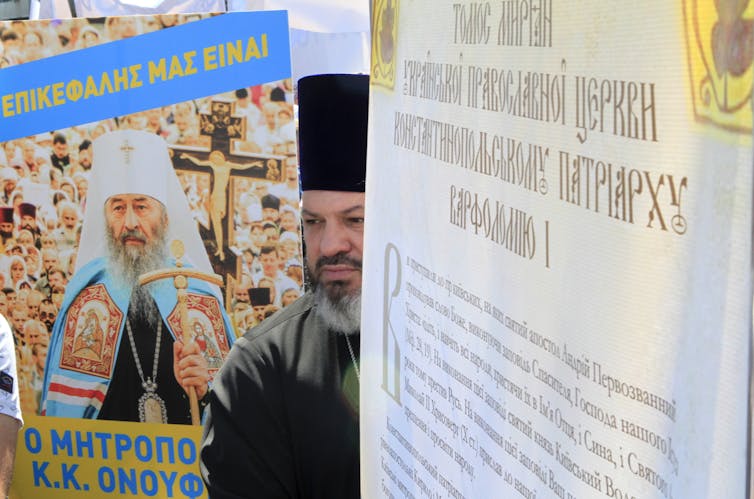
An Orthodox priest takes part in a rally in protest against an official visit of Ecumenical Patriarch Bartholomew I of Constantinople to Kyiv in August 2021.
Anna Marchenko\TASS via Getty Images
By J. Eugene Clay of Arizona State University
As Russia amasses troops on the Ukrainian border in preparation for a potential invasion, tensions between the two countries are also playing out through a conflict in the Orthodox Church.
Two different Orthodox churches claim to be the one true Ukrainian Orthodox Church for the Ukrainian people. The two churches offer strikingly different visions of the relationship between the Ukrainian and the Russian peoples.
Two Orthodox churches
The religious history of Russia and Ukraine has fascinated me since I first visited Kyiv on a scholarly exchange in 1984. In my current research I continue to explore the history of Christianity and the special role of religion in Eurasian societies and politics.
Since Russia invaded Ukraine and annexed Crimea in 2014, relations between the two countries have been especially strained. These tensions are reflected in the very different approaches of the two churches toward Russia.
The older and larger church is the Ukrainian Orthodox Church – Moscow Patriarchate. According to Ukrainian government statistics, this church had over 12,000 parishes in 2018. A branch of the Russian Orthodox Church, it is under the spiritual authority of Patriarch Kirill of Moscow. Patriarch Kirill and his predecessor, Patriarch Aleksii II, both have repeatedly emphasized the powerful bonds that link the peoples of Ukraine and Russia.
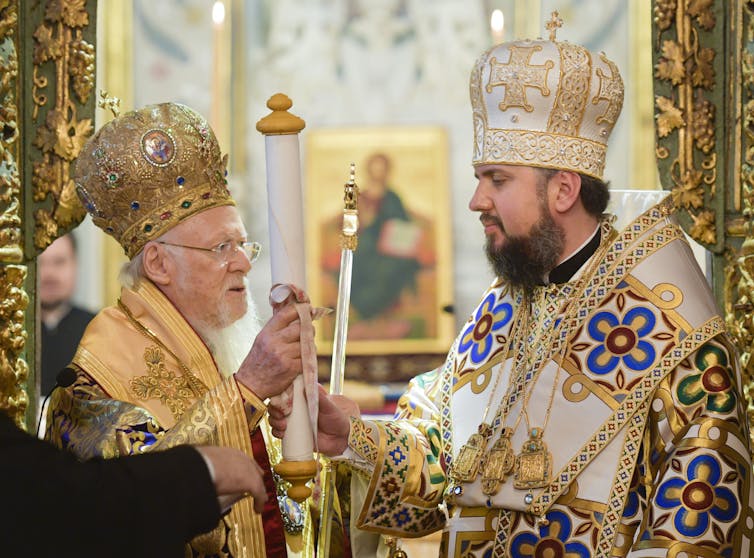
Patriarch Bartholomew handing the formal signed decree to Metropolitan Epifaniy, the new leader of an autocephalous Orthodox Church of Ukraine, in January 2019.
Presidential Administration of Ukraine, CC BY
By contrast, the second, newer church, the Orthodox Church of Ukraine, celebrates its independence from Moscow. With the blessing of the Ecumenical Patriarch Bartholomew of Constantinople, a solemn council met in Kyiv in December 2018, created the new church, and elected its leader, Metropolitan Epifaniy. In January 2019, Patriarch Bartholomew formally recognized the Orthodox Church of Ukraine as a separate, independent and equal member of the worldwide communion of Orthodox churches.
Completely self-governing, the Orthodox Church of Ukraine was the culmination of decades of efforts by Ukrainian believers who wanted their own national church, free from any foreign religious authority. As an expression of Ukrainian spiritual independence, this new self-governing Orthodox Church of Ukraine has been a challenge to Moscow. In Orthodox terminology, the Orthodox Church of Ukraine claims autocephaly.
Unlike the Catholic Church, which has a single supreme spiritual leader in the pope, the worldwide Orthodox Church is divided into 14 universally recognized, independent, autocephalous or self-headed churches. Each autocephalous church has its own head, or kephale in Greek. Every autocephalous church holds to the same faith as its sister churches. Most autocephalies are national churches, such as the Russian, Romanian and Greek Orthodox churches. Now, the Orthodox Church of Ukraine is claiming its place among the other autocephalous churches.
The Orthodox Church of Ukraine has over 7,000 parishes in 44 dioceses. It regards Russians and Ukrainians as two different peoples, each of whom deserves to have its own separate church.
The independent Orthodox Church of Ukraine
The chief issue separating the Orthodox Church of Ukraine from the Ukrainian Orthodox Church – Moscow Patriarchate is their relationship to the Russian Orthodox Church.
The Ukrainian Orthodox Church – Moscow Patriarchate has substantial autonomy in its internal affairs. Ultimately, however, it is subordinate to Patriarch Kirill of Moscow, who must formally confirm its leader. The church emphasizes the unity that it enjoys with the Russian Orthodox believers.
By contrast, the Orthodox Church of Ukraine is independent of any other religious body. For the church’s proponents, this independence allows it to develop a unique Ukrainian expression of Christianity.
A common Orthodox Christian tradition
In both Russia and Ukraine, Orthodox Christianity is the dominant religious tradition. According to a 2015 Pew survey, 71% of Russians and 78% of Ukrainians identified themselves as Orthodox. Religious identity remains an important cultural factor in both nations.
Orthodox Christians in both Russia and Ukraine trace their faith back to the conversion in A.D. 988 of the Grand Prince of Kyiv. Known as Vladimir by Russians and Volodymyr by Ukrainians, the pagan grand prince was baptized by missionaries from Constantinople, the capital of the Byzantine Empire. Kyiv became the most important religious center for the East Slavs.
Destroyed in 1240 by the Mongols, Kyiv fell into decline even as its northern neighbor, Moscow, became increasingly powerful. By 1686, Russia had conquered eastern Ukraine and Kyiv. In that year, the patriarch of Constantinople formally transferred his spiritual authority over Ukraine to the patriarch of Moscow.
In the 20th century, a growing nationalist movement demanded Ukrainian independence for both the church and the state. Although Ukraine became an independent country in 1991, its only universally recognized national Orthodox Church remained subject to Moscow.
Some Ukrainian Orthodox Christians tried to create an autocephalous church in 1921, 1942 and 1992. These efforts largely failed. The churches that they formed were not recognized by the worldwide Orthodox community.
Ukrainian autocephaly
In April 2018 Petro Poroshenko, then the president of Ukraine, again tried to form an autocephalous Ukrainian Orthodox Church.
No fewer than three different churches claimed to be the true Ukrainian Orthodox Church. Poroshenko hoped to unite these rival bodies.
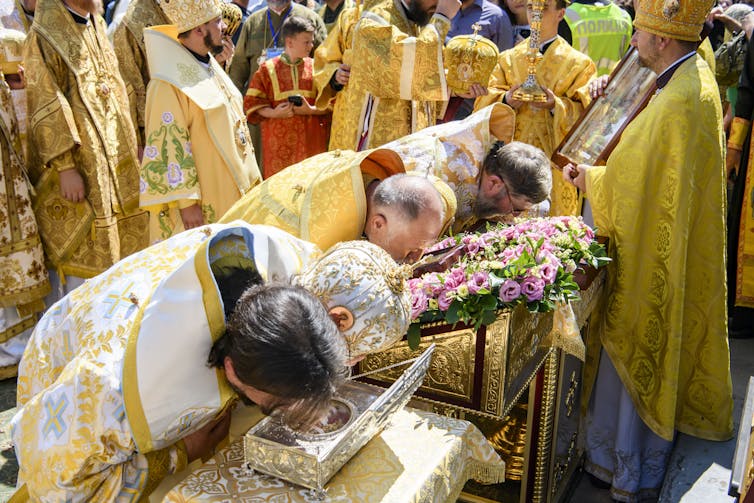
A prayer service of the Ukrainian Orthodox Church, held on the hill of St. Volodymyr in the center of Kyiv, Ukraine, in July 2019.
Maxym Marusenko/NurPhoto via Getty Images
The Ukrainian Orthodox Church – Moscow Patriarchate was the largest church, and it enjoyed the recognition of the worldwide Orthodox community. However, it was and is subject to the Patriarch of Moscow – an unacceptable status for many Ukrainians.
Two other churches, the Ukrainian Autocephalous Orthodox Church and the Ukrainian Orthodox Church-Kyiv Patriarchate, had failed to gain recognition from other Orthodox churches.
Support for Ukrainian church
The ecumenical patriarch of Constantinople, Bartholomew I, supported Poroshenko’s project. As the leading bishop of the ancient capital of the Byzantine Empire, Bartholomew enjoys first place in honor among all of the heads of the Orthodox churches.
Although Eastern Orthodox Christianity has no clear method of creating a new autocephalous church, Bartholomew argued that he had the authority to grant this status. Because Ukraine had originally received Christianity from the Byzantines, Constantinople was Kyiv’s mother church.
In December 2018 a unification council formally dissolved the other branches of Orthodoxy in Ukraine and created the Orthodox Church of Ukraine. In January 2019, Bartholomew signed a formal decree, or tomos, proclaiming the new church autocephalous.
Support and rejection
So far, the Orthodox Church of Ukraine has received recognition from four other autocephalous Orthodox churches. The churches of Constantinople, Alexandria, Greece and Cyprus have each welcomed the new church.
Three other autocephalous churches have explicitly rejected the new church. The Moscow Patriarchate even broke communion with Constantinople over its role in creating the new church.
Nadieszda Kizenko, a leading historian of Orthodoxy, has said that Bartholomew has shattered Orthodox unity to create a church of dubious legitimacy.
By contrast, the noted theologian Cyril Hovorun greeted the Orthodox Church of Ukraine as a positive “demonstration of solidarity with … the Ukrainian people who suffered from the Russian aggression.”
Two visions of history
Today, the two major rival expressions of Orthodoxy in Ukraine reflect two different historical visions of the relationship between Russians and Ukrainians.
For the Moscow Patriarchate, Russians and Ukrainians are one people. Therefore a single church should unite them.
President Vladimir Putin of Russia has made this very argument in a recent essay. He characterizes the Orthodox Church of Ukraine as an attack on the “spiritual unity” of the Russian and Ukrainian peoples.
The Orthodox Church of Ukraine holds a very different view. In an interview with the British Broadcasting Corp., Metropolitan Epifaniy firmly rejected “Russian imperial traditions.” As a separate people with a unique culture, Ukrainians require an independent church.
The future of the Orthodox Church of Ukraine is unclear. It enjoys the support of several of its sister churches. At the same time, it faces fierce opposition from Moscow. For now, it remains a source of controversy between Russia and Ukraine.
This article is republished from The Conversation, a nonprofit, independent news organization dedicated to unlocking the knowledge of experts for the public good.

About J. Eugene Clay
J. Eugene Clay is an Associate Professor of Religious Studies at the School of Historical, Philosophical and Religious Studies at Arizona State University. You can read more about the author here.

Next Post
February 21, 2022 Why are some Roman Catholic saints called doctors of the church
Browse Our Archives
Select a Category Buddhism Christianity Hinduism Islam Judaism Religion and society Uncategorized
Select a Month July 2024 March 2024 February 2024 January 2024 December 2023 November 2023 October 2023 September 2023 August 2023 July 2023 January 2023 August 2022 July 2022 April 2022 February 2022 January 2022 October 2021 July 2021 June 2021 May 2021 April 2021 March 2021 February 2021 January 2021 December 2020 November 2020 October 2020 September 2020 August 2020 July 2020 June 2020 May 2020
Follow Us!
TAKE THE
Religious Wisdom Quiz
Who did Paul send to check on the Thessalonians when he could not come himself?
Select your answer to see how you score.
Timothy Titus Luke Silas
Related posts from The Conversation


Electing A Virtuous President Would Make Immunity Irrelevant

Why The Olympic Games Are A ‘Civil Religious’...

The Catholic Church Is Using The Olympics To...
TRENDING AT PATHEOS Religion News

Catholic Integralists believe that religious values – specifically Christian ones – should...

Electing A Virtuous President Would Make Immunity Irrelevant
Presidential immunity can bring with it many risks. So how can we...

Why The Olympic Games Are A ‘Civil Religious’...
Sporting events form a vital space where Americans display their 'civil religious...

After more than a decade of news, research updates, and insights on...

Q: Why do Southern Baptists and like-minded Protestants...
THE RELIGION GUY’S ANSWER: Why? Simple. Because they believe that’s what the...

THE QUESTION: Is gambling evil? THE RELIGION GUY’S ANSWER: Analysts anticipate a...
view all Religion News blogs
Ad-Free & Subscriber Log-In Subscription Support
- About Us
- 2026 Calendar
- Videos
- Podcasts
- Library of World Religions
- Faith In Media Tracker
- Advertise With Us
- Write for Us
- Privacy Policy
- Terms of Service
- Do Not Sell My Data
- Contact Us
- Radiant Digital
- Manage Newsletter Subscriptions
- Unsubscribe From Notifications
- Sitemap
Copyright 2008-2026, Patheos. All rights reserved.
Subscription Support Ad-Free & Subscriber Log-In
Follow Patheos