
BuddhistCatholicContemplativeEvangelicalGeneral ChristianHinduJewishLatter-day SaintMuslimNew VisionsProgressive Christian
Beliefs
- Buddhist
- Catholic
- Contemplative
- Evangelical
- General Christian
- Hindu
- Jewish
- Latter-day Saint
- More Voices
- Muslim
- New Visions
- Pagan
- Progressive Christian
Topics
- Religion News
- Food and Religion
- Sports and Religion
- Religious Art
- Religious Music and Entertainment
- Religious Events
- History and Religion
- Style and Religion
- Politics and Religion
- Women in Religion
- Recreation Outdoors and Religion
- Business Finance and Religion
- Careers Workplace and Religion
- Education and Religion
- Family Parenting and Religion
- Health Fitness and Religion
- Home and Religion
- Relationships and Religion
- Technology and Religion
- Travel and Religion
Columnists
- Buddhist Columnists
- Business Finance and Religion Columnists
- Careers Workplace and Religion Columnists
- Catholic Columnists
- Contemplative Columnists
- Education and Religion Columnists
- Evangelists Columnists
- Family Parenting and Religion Columnists
- General Christian Columnists
- Health Fitness and Religion Columnists
- Hindu Columnists
- History and Religion Columnists
- Home and Religion Columnists
- Jewish Columnists
- More Voices Columnists
- Latter Day Columnists
- Muslim Columnists
- New Visions Columnists
- Nonreligious Columnists
- Pagan Columnists
- Politics and Religion Columnists
- Progressive Columnists
- Recreation Outdoors and Religion Columnists
- Relationships and Religion Columnists
- Religion News Columnists
- Religious Art Columnists
- Religious Events Columnists
- Religious Music and Entertainment Columnists
- Sports and Religion Columnists
- Style and Religion Columnists
- Technology and Religion Columnists
- Travel and Religion Columnists
- Women in Religion Columnists
Resource Library
- 2026 Calendar
- Library of World Religions
- The 100 Most Holy Places on Earth
- Patheos Answers
- Podcasts
- Videos
- Faith Leaders Database
- Anglican Episcopalian
- Bahai
- Baptist
- Buddhism
- Christianity
- Confucianism
- Eastern Orthodoxy
- Hinduism
- Holiness and Pentecostal
- ISKCON
- Islam
- Judaism
- Lutheran
- Methodist
- The Church of Jesus Christ of Latter-day Saints
- New Age
- Paganism
- Presbytarian and Reformed
- Protestantism
- Religion Behind the Scenes
- Roman Catholic
- Scientology
- Shia Islam
- Sikhism
- Sufism
- Sunni Islam
- Taoism
- Zen
- See all religions
Research Tools
 Ad-Free & Subscriber Log-In Subscription Support
Ad-Free & Subscriber Log-In Subscription Support
Follow Patheos 

- Trending:
- Forgiveness
- |
- Marriage
- |
- Consciousness
- |
- Death Penalty
- |
- Election
- |
- Halloween

- Home
- Religion News
- Why are some Roman Catholic saints called doctors of the church
Why are some Roman Catholic saints called doctors of the church
Last updated on: February 21, 2022 at 2:00 am by The Conversation
Why are some Roman Catholic saints called doctors of the church 2022-02-20T10:08:36-04:00 The Conversation
Patheos Explore the world's faith through different perspectives on religion and spirituality! Patheos has the views of the prevalent religions and spiritualities of the world.
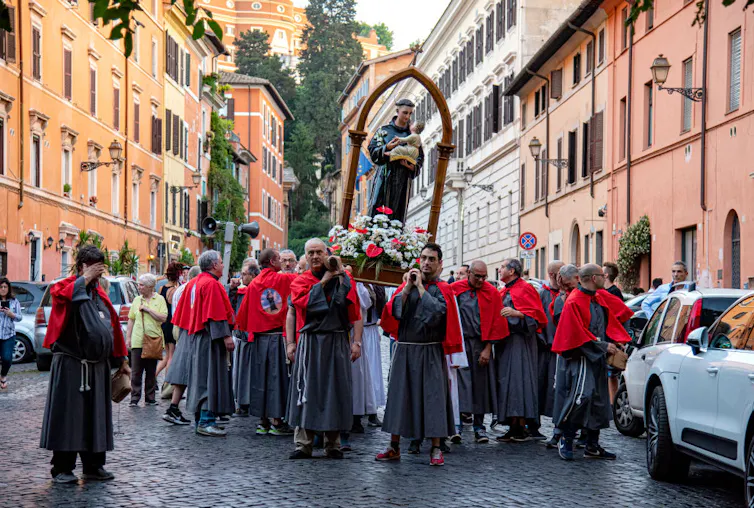
Bearers carry the relic and the statue in honor of St. Anthony of Padua during a procession in Rome, Italy. St. Anthony of Padua was proclaimed a doctor of the church in 1946.
Stefano Montesi – Corbis/Getty Images Europe via Getty Images
By Joanne M. Pierce of College of the Holy Cross
In January 2022, Pope Francis bestowed the title doctor of the church on St. Irenaeus of Lyons, a Christian bishop who died about A.D. 200 For centuries, Christians in both the Roman Catholic and Eastern Orthodox churches have venerated him as a saint.
As a specialist in medieval Christianity, I found myself reflecting on the meaning of this title and why is it important today. There are over 10,000 saints recognized by the Roman Catholic Church. However, only a few dozen of them have been named a doctor of the church, an honorific that recognizes the importance of their teaching, scholarship and writings.
Early saints
In early centuries, Christians executed in the Roman Empire for refusing to renounce their faith – called martyrs, meaning witnesses – were commemorated by their local communities and referred to as holy: sanctus or sancta, in Latin. The graves of these saints were considered holy places, and believers would visit them to pray.
Later, those who had been imprisoned but not put to death were honored by other Christians because of their outstanding courage and strength of faith. Their communities called them confessors because they professed their faith.
Other titles were eventually added to distinguish additional categories of saints, such as bishop, priest or widow. Even children were, and still can be, approved for saintly veneration.
For the first thousand years, holy men and women were venerated as saints regionally, usually with the approval of the local bishop. Later, the popes took charge of officially proclaiming saints, and a formal process developed for examining the applications, or causes, of saintly candidates proposed by regional bishops or other religious groups.
Scholars and teachers
Over time, a handful of Christian saints and teachers became especially renowned for their writings or scholarship. A few from the early centuries of the church were recognized as important teachers, or fathers of the church, by both Western and Eastern churches – which finally split into the Roman Catholic and Eastern Orthodox churches, respectively, in the 11th century.
In the Middle Ages, other saintly teachers in Western Europe were acclaimed specifically as doctors of the church by the authority of popes. Some revered theologians began to be known as doctor of a specific idea or characteristic. For example, contemporaries of the medieval theologian St. Albert the Great, who died in 1280, came to refer to him as the “universal doctor” because of the wide range of topics he covered in his writings. Even one or two of the earlier fathers of the church acquired these additional titles, such as St. Augustine. This North African saint, one of the most influential Christian theologians, died in 430 and became known as the “doctor of grace” because of his theories about grace as a free gift of God. In several regions, local communities gave similar titles to other respected figures even if they were not officially recognized as saints.
Formal lists of these doctors were compiled and expanded during the 16th through 20th centuries. Today, the Roman Catholic Church lists 37 saints officially recognized by papal pronouncement as doctors of the church.
Until after the Second Vatican Council, which met from 1962 to 1965 and initiated significant modern reforms in the church, all doctors of the church were men – usually bishops or priests. In the following decades, that changed.
Today the Catholic Church recognizes four saintly and learned women from several different centuries for their theological and spiritual writings. They include the 16th-century Spanish mystic Teresa of Avila and the 12th-century German abbess Hildegard of Bingen, an expert on herbal medicine and botany as well as liturgical drama and music.
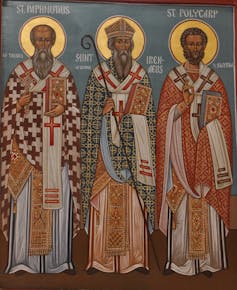
An icon in Christ the Savior Orthodox Church in Chicago shows St. Irenaeus, center, between St. Paphnutius and St. Polycarp.
Ted Bobosh/Moment Open via Getty Images
‘Doctor of unity’
So, why add another doctor now? St. Irenaeus was already recognized as one of the early fathers of the church. Born during the 2nd century in what is now Turkey, he served as bishop of Lyons in what is now France – moving from one side of the Roman Empire to the other.
He wrote forcefully against a philosophical and religious movement called gnosticism – from the Greek word gnosis, or knowledge – which he saw as a heresy threatening to separate Christians from beliefs handed down by Jesus’ apostles. Gnostic Christians taught that the physical world was created not by God, but by a lesser spiritual being, either in error or out of malice. They rejected the traditional Christian beliefs that material reality and the human body were fundamentally good and held that the body was a worthless obstacle to achieving spiritual perfection.
Irenaeus argued against the gnostics, insisting God created both material and spiritual reality and that both were rooted in God’s goodness. His critique of the gnostic view of Christian teaching reaffirmed the importance of the teaching of the apostles, based on the writings of the Old Testament prophets and the four Gospels of Matthew, Mark, Luke and John. So Irenaeus’ teaching was valued by later theologians working to strengthen the church’s definition of orthodox beliefs.
In 2021, members of the St. Irenaeus Joint Catholic-Orthodox Working Group, an unofficial group of theologians seeking to enrich mutual understanding, met in Rome. During that meeting, Pope Francis stated his intention to officially declare the saint a doctor of the church. As the pope later noted, Irenaeus’ life and teaching serve as a bridge between Eastern and Western Christianity. In his own life, he served churches in both traditions, and, despite their individual differences, strove to keep them united against divisive teachings.
Because of the influence of his theology and the example of his ministry, St. Irenaeus will be one of those doctors of the church, like St. Albert the Great, to be given a distinctive honorific title: “doctor of unity.”
At a time when disease, environmental disasters and wars threaten to divide Christianity and the world, many believe that a saintly “doctor of unity” may well inspire a more hope-filled future.
This article is republished from The Conversation, a nonprofit, independent news organization dedicated to unlocking the knowledge of experts for the public good.

About Joanne M. Pierce
Joanne M. Pierce is Professor Emerita of Religious Studies at College of the Holy Cross. You can read more about the author here.

Next Post
February 21, 2022 Japan’s Shinto religion is going global and attracting online followers
Browse Our Archives
Select a Category Buddhism Christianity Hinduism Islam Judaism Religion and society Uncategorized
Select a Month July 2024 March 2024 February 2024 January 2024 December 2023 November 2023 October 2023 September 2023 August 2023 July 2023 January 2023 August 2022 July 2022 April 2022 February 2022 January 2022 October 2021 July 2021 June 2021 May 2021 April 2021 March 2021 February 2021 January 2021 December 2020 November 2020 October 2020 September 2020 August 2020 July 2020 June 2020 May 2020
Follow Us!
TAKE THE
Religious Wisdom Quiz
Who did Paul send to check on the Thessalonians when he could not come himself?
Select your answer to see how you score.
Timothy Titus Luke Silas
Related posts from The Conversation


The Catholic Church Is Using The Olympics To...

How Christians Hold Differing Views On The Resurrection
Latin America’s colonial period was less Catholic
TRENDING AT PATHEOS Religion News

Catholic Integralists believe that religious values – specifically Christian ones – should...

Electing A Virtuous President Would Make Immunity Irrelevant
Presidential immunity can bring with it many risks. So how can we...

Why The Olympic Games Are A ‘Civil Religious’...
Sporting events form a vital space where Americans display their 'civil religious...

After more than a decade of news, research updates, and insights on...

Q: Why do Southern Baptists and like-minded Protestants...
THE RELIGION GUY’S ANSWER: Why? Simple. Because they believe that’s what the...

THE QUESTION: Is gambling evil? THE RELIGION GUY’S ANSWER: Analysts anticipate a...
view all Religion News blogs
Ad-Free & Subscriber Log-In Subscription Support
- About Us
- 2026 Calendar
- Videos
- Podcasts
- Library of World Religions
- Faith In Media Tracker
- Advertise With Us
- Write for Us
- Privacy Policy
- Terms of Service
- Do Not Sell My Data
- Contact Us
- Radiant Digital
- Manage Newsletter Subscriptions
- Unsubscribe From Notifications
- Sitemap
Copyright 2008-2026, Patheos. All rights reserved.
Subscription Support Ad-Free & Subscriber Log-In
Follow Patheos