
BuddhistCatholicContemplativeEvangelicalGeneral ChristianHinduJewishLatter-day SaintMuslimNew VisionsProgressive Christian
Beliefs
- Buddhist
- Catholic
- Contemplative
- Evangelical
- General Christian
- Hindu
- Jewish
- Latter-day Saint
- More Voices
- Muslim
- New Visions
- Pagan
- Progressive Christian
Topics
- Religion News
- Food and Religion
- Sports and Religion
- Religious Art
- Religious Music and Entertainment
- Religious Events
- History and Religion
- Style and Religion
- Politics and Religion
- Women in Religion
- Recreation Outdoors and Religion
- Business Finance and Religion
- Careers Workplace and Religion
- Education and Religion
- Family Parenting and Religion
- Health Fitness and Religion
- Home and Religion
- Relationships and Religion
- Technology and Religion
- Travel and Religion
Columnists
- Buddhist Columnists
- Business Finance and Religion Columnists
- Careers Workplace and Religion Columnists
- Catholic Columnists
- Contemplative Columnists
- Education and Religion Columnists
- Evangelists Columnists
- Family Parenting and Religion Columnists
- General Christian Columnists
- Health Fitness and Religion Columnists
- Hindu Columnists
- History and Religion Columnists
- Home and Religion Columnists
- Jewish Columnists
- More Voices Columnists
- Latter Day Columnists
- Muslim Columnists
- New Visions Columnists
- Nonreligious Columnists
- Pagan Columnists
- Politics and Religion Columnists
- Progressive Columnists
- Recreation Outdoors and Religion Columnists
- Relationships and Religion Columnists
- Religion News Columnists
- Religious Art Columnists
- Religious Events Columnists
- Religious Music and Entertainment Columnists
- Sports and Religion Columnists
- Style and Religion Columnists
- Technology and Religion Columnists
- Travel and Religion Columnists
- Women in Religion Columnists
Resource Library
- 2026 Calendar
- Library of World Religions
- The 100 Most Holy Places on Earth
- Patheos Answers
- Podcasts
- Videos
- Faith Leaders Database
- Anglican Episcopalian
- Bahai
- Baptist
- Buddhism
- Christianity
- Confucianism
- Eastern Orthodoxy
- Hinduism
- Holiness and Pentecostal
- ISKCON
- Islam
- Judaism
- Lutheran
- Methodist
- The Church of Jesus Christ of Latter-day Saints
- New Age
- Paganism
- Presbytarian and Reformed
- Protestantism
- Religion Behind the Scenes
- Roman Catholic
- Scientology
- Shia Islam
- Sikhism
- Sufism
- Sunni Islam
- Taoism
- Zen
- See all religions
Research Tools
 Ad-Free & Subscriber Log-In Subscription Support
Ad-Free & Subscriber Log-In Subscription Support
Follow Patheos 

- Trending:
- Forgiveness
- |
- Marriage
- |
- Consciousness
- |
- Death Penalty
- |
- Election
- |
- Halloween

- Home
- Religion News
- Thich Nhat Hanh, who worked for decades to teach mindfulness, approached death in that same spirit
Thich Nhat Hanh, who worked for decades to teach mindfulness, approached death in that same spirit
Last updated on: January 23, 2022 at 11:09 am by The Conversation
Thich Nhat Hanh, who worked for decades to teach mindfulness, approached death in that same spirit 2022-01-23T11:09:50-04:00 The Conversation
Patheos Explore the world's faith through different perspectives on religion and spirituality! Patheos has the views of the prevalent religions and spiritualities of the world.
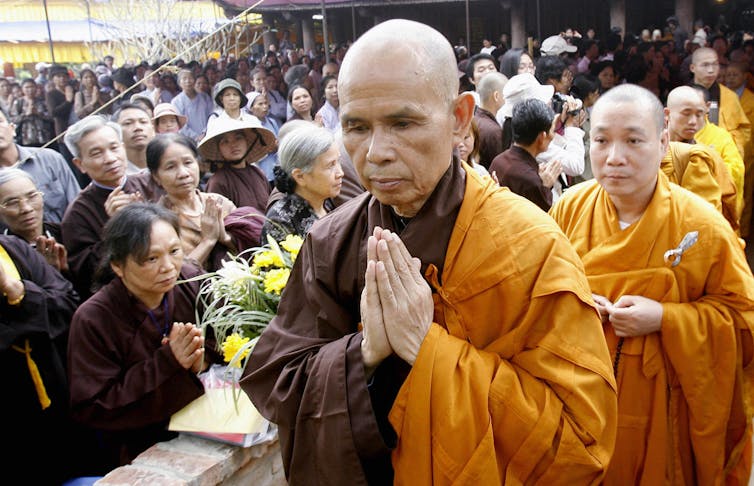
Zen Buddhist monk Thich Nhat Hanh praying during a three-day requiem for the souls of Vietnam War victims in 2007.
Hoang Dinh Nam/AFP via Getty Images
By Brooke Schedneck of Rhodes College
Thich Nhat Hanh, the monk who popularized mindfulness in the West, died in the Tu Hieu Temple in Hue, Vietnam, on Jan. 21, 2022. He was 95.
In 2014, Thich Nhat Hanh suffered a stroke. Since then he was unable to speak or continue his teaching. In October 2018 he expressed his wish, using gestures, to return to the temple in Vietnam where he had been ordained as a young monk. Devotees from many parts of the world had continued to visit him at the temple.
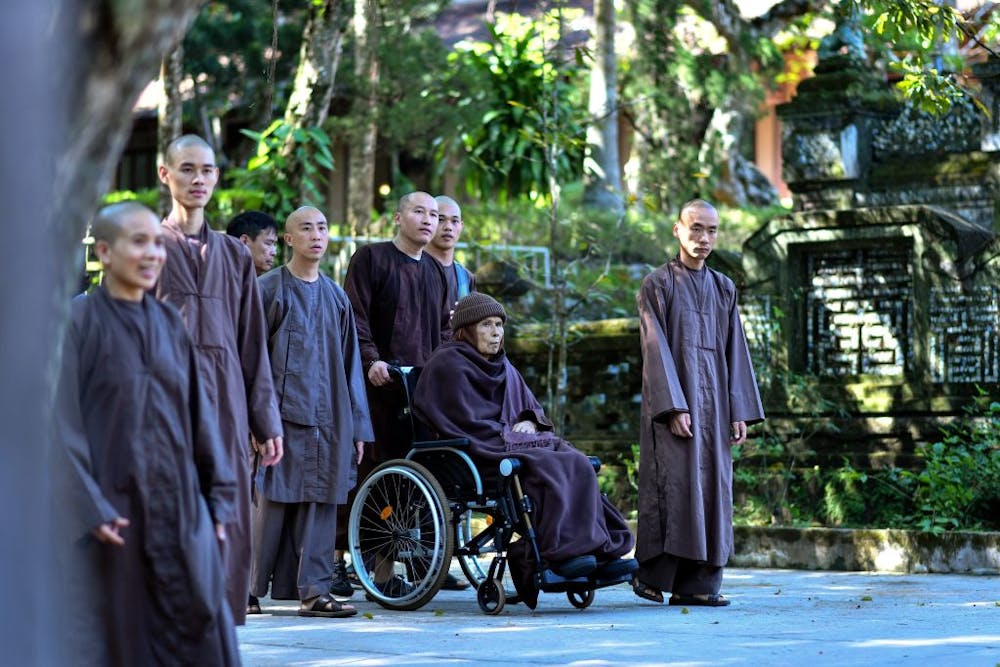
Thich Nhat Hanh in a wheelchair at the Tu Hieu pagoda in Hue, Vietnam, in 2018.
Manan Vatsyayana/AFP via Getty Images
As a scholar of the contemporary practices of Buddhist meditation, I have studied his simple yet profound teachings, which combine mindfulness along with social change, and which I believe will continue to have an impact around the world.
Peace activist
In the 1960s, Thich Nhat Hanh played an active role promoting peace during the years of war in Vietnam. He was in his mid-20s when he became active in efforts to revitalize Vietnamese Buddhism for peace efforts.
Over the next few years, Thich Nhat Hanh set up a number of organizations based on Buddhist principles of nonviolence and compassion. His School of Youth and Social Service, a grassroots relief organization, consisted of 10,000 volunteers and social workers offering aid to war-torn villages, rebuilding schools and establishing medical centers.
He also established the Order of Interbeing, a community of monastics and lay Buddhists who made a commitment to compassionate action and supported war victims. In addition, he founded a Buddhist university, a publishing house and a peace activist magazine as ways to spread the message of compassion.
In 1966, Thich Nhat Hanh traveled to the United States and Europe to appeal for peace in Vietnam.
In lectures delivered across many cities, he compellingly described the war’s devastation, spoke of the Vietnamese people’s wish for peace and appealed to the U.S. to cease its air offensive against Vietnam.
During his years in the U.S. he met Martin Luther King Jr., who nominated him for the Nobel Peace Prize in 1967.
However, because of his peace work and refusal to choose sides in his country’s civil war, both the communist and noncommunist governments banned him, forcing Thich Nhat Hanh to live in exile for over 40 years.
During these years, the emphasis of his message shifted from the immediacy of the Vietnam War to being present in the moment – an idea that has come to be called “mindfulness.”
Being aware of the present moment
Thich Nhat Hanh first started teaching mindfulness in the mid-1970s. The main vehicle for his early teachings was his books. In “The Miracle of Mindfulness,” for example, Thich Nhat Hanh gave simple instructions on how to apply mindfulness to daily life.
In his book “You Are Here,” he urged people to pay attention to what they were experiencing in their body and mind at any given moment, and not dwell in the past or think of the future. His emphasis was on the awareness of the breath. He taught his readers to say internally, “I’m breathing in; this is an in-breath. I’m breathing out; this is an out-breath.”

Thich Nhat Hanh emphasized that mindfulness could be practiced anywhere.
Antonio Guillem/Shutterstock.com
People interested in practicing meditation didn’t need to spend days at a meditation retreat or find a teacher. His teachings emphasized that mindfulness could be practiced anytime, even when doing routine chores.
Even doing the dishes, people could simply focus on the activity and be fully present. Peace, happiness, joy and true love, he said, could be found only in the present moment.
Mindfulness in America
Hanh’s mindfulness practices don’t advocate disengagement with the world. Rather, in his view, the practice of mindfulness could lead one toward “compassionate action,” like practicing openness to others’ viewpoints and sharing material resources with those in need.
Jeff Wilson, a scholar of American Buddhism, argues in his book “Mindful America” that it was Hanh’s combination of daily mindfulness practices with action in the world that contributed to the earliest strands of the mindfulness movement. This movement eventually became what Time magazine in 2014 called the “mindful revolution.” The article argues that the power of mindfulness lies in its universality, as the practice has entered into corporate headquarters, political offices, parenting guides and diet plans.
For Thich Nhat Hanh, however, mindfulness was not a means to a more productive day but a way of understanding “interbeing,” the connection and codependence of everyone and everything. In a documentary, “Walk With Me,” he illustrated interbeing in the following way:
A young girl asks him how to deal with the grief of her recently deceased dog. He instructs her to look into the sky and watch a cloud disappear. The cloud has not died but has become the rain and the tea in the teacup. Just as the cloud is alive in a new form, so is the dog. Being aware and mindful of the tea offers a reflection on the nature of reality. He believed this understanding could lead to more peace in the world.
Thich Nhat Hanh’s lasting impact
Thich Nhat Hanh will have a lasting impact through the legacy of his teachings in over 100 books, 11 global practice centers, over 1,000 global lay communities and dozens of online community groups. The disciples closest to him – the 600 monks and nuns ordained in his Plum Village tradition, along with lay teachers – have been planning to continue their teacher’s legacy for some time.
They have been writing books, offering teachings and leading retreats for several decades now. In March 2020, the Thich Nhat Hanh Foundation, along with Lion’s Roar, hosted an online summit called “In the Footsteps of Thich Nhat Hanh” to make people aware of his teachings through the disciples he trained.
Although Thich Naht Hanh’s death will change the community, his practices for being aware in the present moment and creating peace will live on.
 This article is republished from The Conversation a nonprofit, independent news organization dedicated to unlocking the knowledge of experts for the public good.
About Brooke Schedneck
Brooke Schedneck is an Assistant Professor of Religious Studies at Rhodes College. You can read more about the author here.
Next Post
January 24, 2022 Pope Benedict accused of mishandling sex abuse cases: 4 essential reads
Browse Our Archives
Select a Category Buddhism Christianity Hinduism Islam Judaism Religion and society Uncategorized
Select a Month July 2024 March 2024 February 2024 January 2024 December 2023 November 2023 October 2023 September 2023 August 2023 July 2023 January 2023 August 2022 July 2022 April 2022 February 2022 January 2022 October 2021 July 2021 June 2021 May 2021 April 2021 March 2021 February 2021 January 2021 December 2020 November 2020 October 2020 September 2020 August 2020 July 2020 June 2020 May 2020
Follow Us!
TAKE THE
Religious Wisdom Quiz
What does Proverbs compare wisdom to?
Select your answer to see how you score.
A woman A mountain A river A city
Related posts from The Conversation
Cherry Blossoms Show Appreciation Of Impermanence And Spring

AI Won’t Be Replacing Your Priest, Minister, Rabbi...
‘Journey to the West’: Why the Classic Chinese...
A chatbot willing to take on questions of...
TRENDING AT PATHEOS Religion News

Catholic Integralists believe that religious values – specifically Christian ones – should...

Electing A Virtuous President Would Make Immunity Irrelevant
Presidential immunity can bring with it many risks. So how can we...

Why The Olympic Games Are A ‘Civil Religious’...
Sporting events form a vital space where Americans display their 'civil religious...

After more than a decade of news, research updates, and insights on...

Q: Why do Southern Baptists and like-minded Protestants...
THE RELIGION GUY’S ANSWER: Why? Simple. Because they believe that’s what the...

THE QUESTION: Is gambling evil? THE RELIGION GUY’S ANSWER: Analysts anticipate a...
view all Religion News blogs
Ad-Free & Subscriber Log-In Subscription Support
- About Us
- 2026 Calendar
- Videos
- Podcasts
- Library of World Religions
- Faith In Media Tracker
- Advertise With Us
- Write for Us
- Privacy Policy
- Terms of Service
- Do Not Sell My Data
- Contact Us
- Radiant Digital
- Manage Newsletter Subscriptions
- Unsubscribe From Notifications
- Sitemap
Copyright 2008-2026, Patheos. All rights reserved.
Subscription Support Ad-Free & Subscriber Log-In
Follow Patheos