
BuddhistCatholicContemplativeEvangelicalGeneral ChristianHinduJewishLatter-day SaintMuslimNew VisionsProgressive Christian
Beliefs
- Buddhist
- Catholic
- Contemplative
- Evangelical
- General Christian
- Hindu
- Jewish
- Latter-day Saint
- More Voices
- Muslim
- New Visions
- Pagan
- Progressive Christian
Topics
- Religion News
- Food and Religion
- Sports and Religion
- Religious Art
- Religious Music and Entertainment
- Religious Events
- History and Religion
- Style and Religion
- Politics and Religion
- Women in Religion
- Recreation Outdoors and Religion
- Business Finance and Religion
- Careers Workplace and Religion
- Education and Religion
- Family Parenting and Religion
- Health Fitness and Religion
- Home and Religion
- Relationships and Religion
- Technology and Religion
- Travel and Religion
Columnists
- Buddhist Columnists
- Business Finance and Religion Columnists
- Careers Workplace and Religion Columnists
- Catholic Columnists
- Contemplative Columnists
- Education and Religion Columnists
- Evangelists Columnists
- Family Parenting and Religion Columnists
- General Christian Columnists
- Health Fitness and Religion Columnists
- Hindu Columnists
- History and Religion Columnists
- Home and Religion Columnists
- Jewish Columnists
- More Voices Columnists
- Latter Day Columnists
- Muslim Columnists
- New Visions Columnists
- Nonreligious Columnists
- Pagan Columnists
- Politics and Religion Columnists
- Progressive Columnists
- Recreation Outdoors and Religion Columnists
- Relationships and Religion Columnists
- Religion News Columnists
- Religious Art Columnists
- Religious Events Columnists
- Religious Music and Entertainment Columnists
- Sports and Religion Columnists
- Style and Religion Columnists
- Technology and Religion Columnists
- Travel and Religion Columnists
- Women in Religion Columnists
Resource Library
- 2026 Calendar
- Library of World Religions
- The 100 Most Holy Places on Earth
- Patheos Answers
- Podcasts
- Videos
- Faith Leaders Database
- Anglican Episcopalian
- Bahai
- Baptist
- Buddhism
- Christianity
- Confucianism
- Eastern Orthodoxy
- Hinduism
- Holiness and Pentecostal
- ISKCON
- Islam
- Judaism
- Lutheran
- Methodist
- The Church of Jesus Christ of Latter-day Saints
- New Age
- Paganism
- Presbytarian and Reformed
- Protestantism
- Religion Behind the Scenes
- Roman Catholic
- Scientology
- Shia Islam
- Sikhism
- Sufism
- Sunni Islam
- Taoism
- Zen
- See all religions
Research Tools
 Ad-Free & Subscriber Log-In Subscription Support
Ad-Free & Subscriber Log-In Subscription Support
Follow Patheos 

- Trending:
- Forgiveness
- |
- Marriage
- |
- Consciousness
- |
- Death Penalty
- |
- Election
- |
- Halloween

- Home
- Religion News
- What St. Thomas Aquinas can teach us about hope in times of despair
What St. Thomas Aquinas can teach us about hope in times of despair
Last updated on: January 27, 2022 at 11:10 am by The Conversation
What St. Thomas Aquinas can teach us about hope in times of despair 2022-01-24T17:12:11-04:00 The Conversation
Patheos Explore the world's faith through different perspectives on religion and spirituality! Patheos has the views of the prevalent religions and spiritualities of the world.
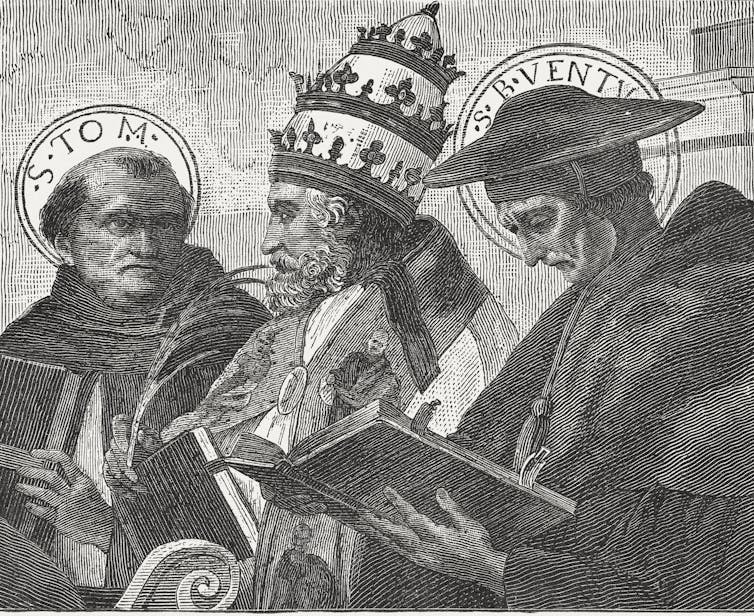
Thomas Aquinas, Pope Innocent III and Italian mathematician Bonaventura Francesco Cavalieri.
ZU_09/DigitalVision Vectors via Getty images
By Christopher Beem of Penn State
Polls show that a majority of Americans are very worried about the state of U.S. democracy. One survey from January 2022 finds that 64% of Americans believe U.S. democracy is “in crisis and at risk of failing.”
Both Republicans and Democrats affirm these concerns, but they have very different understandings of what exactly is in crisis and who is responsible. Most importantly, polls have repeatedly found that a majority of Republicans – tens of millions of Americans – continue to believe the lie that the 2020 election was stolen.
For those Americans who know that it was not, the entrenched commitment of their fellow Americans to a falsehood no doubt exacerbates their worries. How do you argue with someone who is committed to a lie? But the bigger question is what to do about it, given that so many Americans – myself included – fear for the very survival of our democracy.
As a scholar who researches democratic virtues, I have spent time with the work of Thomas Aquinas, a Dominican monk who lived in the 13th century. Aquinas’ words are relevant to the times in which we find ourselves. Above all, he shows what it means to hope.
Hope as a theological virtue
Aquinas is widely regarded as the single most important Catholic theologian. His massive body of work speaks to virtually every aspect of the Christian faith. Most importantly, perhaps, Aquinas insisted that reason and revelation were separate but complimentary forms of knowledge. He argued that since both ultimately come from God, they cannot be in conflict.
Accordingly, Aquinas is also one of the first thinkers to reconcile the work of ancient Greek philosopher Aristotle with Christianity. Aristotle argued that ethics is principally concerned with becoming the best version of ourselves. For Aristotle, a truly ethical person is also a truly excellent person.
Aquinas accepted this understanding. But he also argued that Aristotle’s interpretation of ethics was incomplete and imperfect. Aquinas said that ethics must also incorporate the theological virtues of faith, hope and charity. These virtues, Aquinas argued, come to us not from reason but from grace. They are gifts from God that serve to direct people toward their salvation. According to the theologian, they make it possible for human beings to achieve a dimension of both happiness and excellence that they cannot achieve otherwise.
Aristotle defined virtue as “a mean between two vices, that which depends on excess and that which depends on defect.” So, for example, Aristotle said that courage is found between recklessness – an excess of courage – on the one hand and cowardice, its deficiency, on the other.
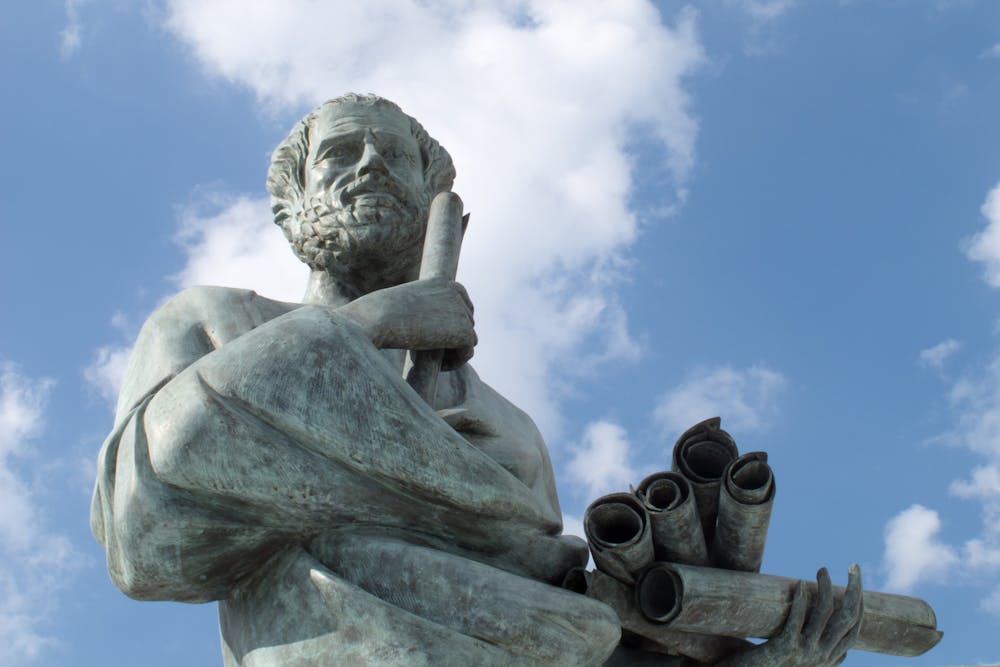
Aristotle thought courage could be found between recklessness and cowardice.
thelefty/iStock via Getty Images
Deciding how to be courageous is never simple and depends dramatically on circumstances, but courage will always be found between these extremes. Aquinas follows this concept of virtue, and he argues that the theological virtue of hope fits the pattern. According to him, it lies between two vices: Presumption is the excess of hope, while despair is its deficiency.
Presumption is the easy confidence that everything is going to be fine. The presumptive person thinks that no matter how much he sins, as Aquinas notes, “God would not punish him or exclude him from glory.”
Despair is the opposite. It means the sinner believes that she has fallen so far from God that she has no possibility of salvation.
The question of salvation is one thing, while the condition of American democracy is entirely another. Nevertheless, there are examples of many Americans responding to the current democratic crisis with the same vices of presumption and despair.
Democratic presumption and despair
In the current democratic crisis, presumption appears as a vague optimism that American democracy has survived many crises and that this is just another one. Many Americans believe that the current crisis is a problem for those in power to address; whistling past the graveyard, they see no reason to change their own behavior.
Political scientist Sam Rosenfeld notes that despite a prevailing feeling of crisis, “voting behavior has not changed in response; it’s shown remarkable stability and continuity with patterns established at the outset of the century.”
Despair is even more apparent. Most Americans have expressed at least temporary feelings of despair around climate change and a seemingly never-ending pandemic, and also about our democracy.
And no doubt having all of these crises coincide at once only adds to the sense that they are beyond our ability to solve. But for Aquinas, hope is not merely the mean between these two vices; it is also the more realistic response to our condition.
Hope as a democratic virtue
By Aquinas’ definition, hope is grounded in some desired future that is both possible to achieve but also very difficult. Hope is therefore more realistic than either vice.
Presumption denies the difficulty of the goal, but also the responsibility of the individual in making it happen, while despair denies the fact that the goal, despite its arduousness, is yet possible. Hope is the mean because it requires people to be both clear and conscientious about what they are up against, and what they are striving to achieve.
In this understanding, hope is much more than mere optimism. Hope is an act of will. One chooses to be hopeful. Hope insists that though the task is difficult, even daunting, change remains possible. It therefore sustains all who take up the work that must be done.
If this act of will seems beyond your ability right now, consider this. Aquinas said that “we hope chiefly in our friends.” It is easier to be hopeful when others love us, support us, and share our hopes. This is why, he says, Christians need a community of fellow believers.
[Over 140,000 readers rely on The Conversation’s newsletters to understand the world. Sign up today.]
For Americans faced with the current democratic crisis, community can include anybody who is likewise ready to embrace the hope that American democracy can endure. That community, as well, is better able to overcome the inclination to despair, and more able to achieve the desired outcome.
Understood the way Aquinas suggests, hope emerges as a distinctively democratic virtue. Without willful, realistic hope, and without a coalition of hopeful people working together, Jim Crow does not end, the Berlin Wall does not fall and marriage for gay couples remains impossible.
That history, as well, ought to inspire us to find the hope we need right now.
This article is republished from The Conversation a nonprofit, independent news organization dedicated to unlocking the knowledge of experts for the public good.

About Christopher Beem
Christopher Beem is the Managing Director of the McCourtney Institute of Democracy and Co-host of Democracy Works Podcast at Penn State University. You can read more about the author here.

Browse Our Archives
Select a Category Buddhism Christianity Hinduism Islam Judaism Religion and society Uncategorized
Select a Month July 2024 March 2024 February 2024 January 2024 December 2023 November 2023 October 2023 September 2023 August 2023 July 2023 January 2023 August 2022 July 2022 April 2022 February 2022 January 2022 October 2021 July 2021 June 2021 May 2021 April 2021 March 2021 February 2021 January 2021 December 2020 November 2020 October 2020 September 2020 August 2020 July 2020 June 2020 May 2020
Follow Us!
TAKE THE
Religious Wisdom Quiz
Which Old Testament book does not mention God?
Select your answer to see how you score.
Esther Ruth Ecclesiastes Song of Solomon
Related posts from The Conversation


How Christians Hold Differing Views On The Resurrection
Faith leaders have been protecting migrant rights for...
Latin America’s colonial period was less Catholic
TRENDING AT PATHEOS Religion News

Catholic Integralists believe that religious values – specifically Christian ones – should...

Electing A Virtuous President Would Make Immunity Irrelevant
Presidential immunity can bring with it many risks. So how can we...

Why The Olympic Games Are A ‘Civil Religious’...
Sporting events form a vital space where Americans display their 'civil religious...

After more than a decade of news, research updates, and insights on...

Q: Why do Southern Baptists and like-minded Protestants...
THE RELIGION GUY’S ANSWER: Why? Simple. Because they believe that’s what the...

THE QUESTION: Is gambling evil? THE RELIGION GUY’S ANSWER: Analysts anticipate a...
view all Religion News blogs
Ad-Free & Subscriber Log-In Subscription Support
- About Us
- 2026 Calendar
- Videos
- Podcasts
- Library of World Religions
- Faith In Media Tracker
- Advertise With Us
- Write for Us
- Privacy Policy
- Terms of Service
- Do Not Sell My Data
- Contact Us
- Radiant Digital
- Manage Newsletter Subscriptions
- Unsubscribe From Notifications
- Sitemap
Copyright 2008-2026, Patheos. All rights reserved.
Subscription Support Ad-Free & Subscriber Log-In
Follow Patheos