
BuddhistCatholicContemplativeEvangelicalGeneral ChristianHinduJewishLatter-day SaintMuslimNew VisionsProgressive Christian
Beliefs
- Buddhist
- Catholic
- Contemplative
- Evangelical
- General Christian
- Hindu
- Jewish
- Latter-day Saint
- More Voices
- Muslim
- New Visions
- Pagan
- Progressive Christian
Topics
- Religion News
- Food and Religion
- Sports and Religion
- Religious Art
- Religious Music and Entertainment
- Religious Events
- History and Religion
- Style and Religion
- Politics and Religion
- Women in Religion
- Recreation Outdoors and Religion
- Business Finance and Religion
- Careers Workplace and Religion
- Education and Religion
- Family Parenting and Religion
- Health Fitness and Religion
- Home and Religion
- Relationships and Religion
- Technology and Religion
- Travel and Religion
Columnists
- Buddhist Columnists
- Business Finance and Religion Columnists
- Careers Workplace and Religion Columnists
- Catholic Columnists
- Contemplative Columnists
- Education and Religion Columnists
- Evangelists Columnists
- Family Parenting and Religion Columnists
- General Christian Columnists
- Health Fitness and Religion Columnists
- Hindu Columnists
- History and Religion Columnists
- Home and Religion Columnists
- Jewish Columnists
- More Voices Columnists
- Latter Day Columnists
- Muslim Columnists
- New Visions Columnists
- Nonreligious Columnists
- Pagan Columnists
- Politics and Religion Columnists
- Progressive Columnists
- Recreation Outdoors and Religion Columnists
- Relationships and Religion Columnists
- Religion News Columnists
- Religious Art Columnists
- Religious Events Columnists
- Religious Music and Entertainment Columnists
- Sports and Religion Columnists
- Style and Religion Columnists
- Technology and Religion Columnists
- Travel and Religion Columnists
- Women in Religion Columnists
Resource Library
- 2026 Calendar
- Library of World Religions
- The 100 Most Holy Places on Earth
- Patheos Answers
- Podcasts
- Videos
- Faith Leaders Database
- Anglican Episcopalian
- Bahai
- Baptist
- Buddhism
- Christianity
- Confucianism
- Eastern Orthodoxy
- Hinduism
- Holiness and Pentecostal
- ISKCON
- Islam
- Judaism
- Lutheran
- Methodist
- The Church of Jesus Christ of Latter-day Saints
- New Age
- Paganism
- Presbytarian and Reformed
- Protestantism
- Religion Behind the Scenes
- Roman Catholic
- Scientology
- Shia Islam
- Sikhism
- Sufism
- Sunni Islam
- Taoism
- Zen
- See all religions
Research Tools
 Ad-Free & Subscriber Log-In Subscription Support
Ad-Free & Subscriber Log-In Subscription Support
Follow Patheos 

- Trending:
- Forgiveness
- |
- Marriage
- |
- Consciousness
- |
- Death Penalty
- |
- Election
- |
- Halloween

- Home
- Religion News
- Pope Benedict faulted over sex abuse claims: New report is just one chapter in his – and Catholic Church’s – fraught record
Pope Benedict faulted over sex abuse claims: New report is just one chapter in his – and Catholic Church’s – fraught record
Last updated on: January 29, 2022 at 6:33 pm by The Conversation
Pope Benedict faulted over sex abuse claims: New report is just one chapter in his – and Catholic Church’s – fraught record 2022-01-29T18:33:45-04:00 The Conversation
Patheos Explore the world's faith through different perspectives on religion and spirituality! Patheos has the views of the prevalent religions and spiritualities of the world.
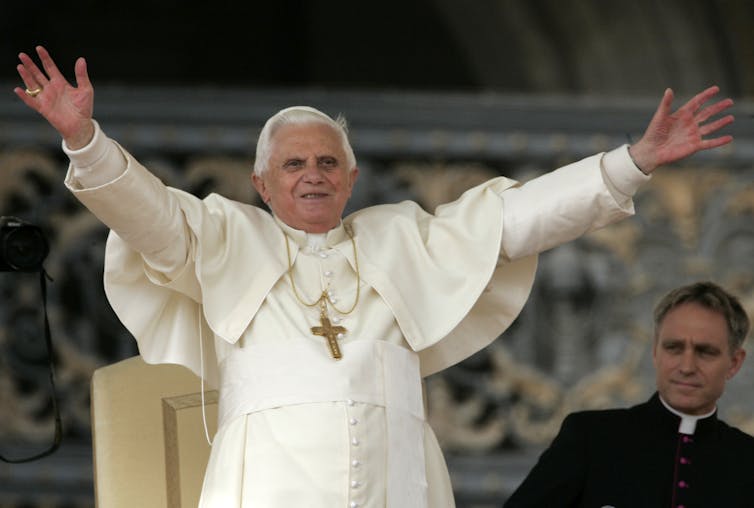
Pope Benedict XVI acknowledges the crowd during an audience in St. Peter’s Square at the Vatican on Oct.24, 2007. A January 2022 report faulted his handling of several sex abuse cases.
AP Photo/Plinio Lepri
By David Gibson of Fordham University
An in-depth report released last week alleges that former Pope Benedict XVI allowed four abusive priests in Munich to remain in ministry. The pope, then known as Cardinal Joseph Ratzinger, led the German archdiocese from 1977 to 1982.
The 1,900-page audit was commissioned by the Archdiocese of Munich and Freising but conducted by independent investigators. It covers the period from 1945 to 2019 and lists 235 alleged clergy who were perpetrators of sexual abuse and at least 497 minors who were victims.
Given Benedict’s status – he was pope from 2005 to 2013, until his historic resignation due to ill health – the news has put additional scrutiny on top leaders’ roles in allowing abusers to go unpunished. It also raises the classic questions of what Benedict knew, and when.
As a journalist, I covered Ratzinger in Rome in the 1980s and wrote a biography of him in 2006. Today, as director of the Center on Religion and Culture at Fordham University, I see this episode as an opportunity to understand the church’s fitful evolution on dealing with abuse.
Influential role
After Ratzinger left Munich in 1982, he came to Rome to serve as Pope John Paul II’s top defender of doctrine. For 23 years he led the Congregation for the Doctrine of the Faith, a body tasked with defending Catholic teaching, and arguably the most influential department in the Vatican.
As head, Ratzinger had a say in developing the church’s response to the increasingly public sex abuse crisis. John Paul consulted Ratzinger on important decisions, and major documents from other departments at the Vatican required his approval, or imprimatur, before they could be published.
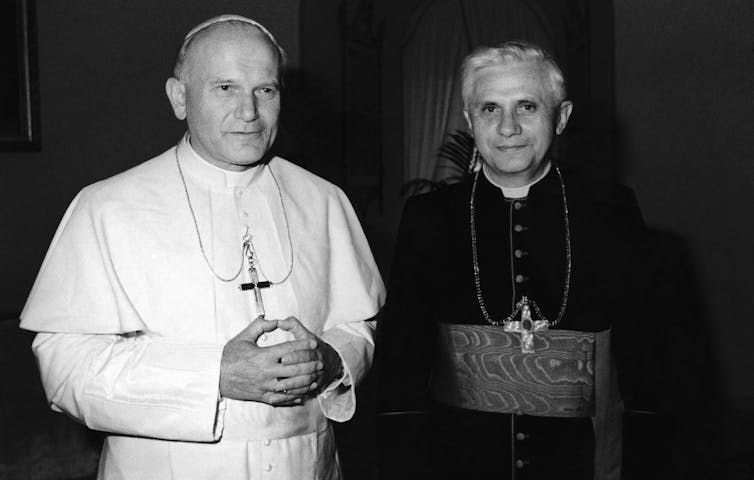
Pope John Paul II stands beside Cardinal Joseph Ratzinger, who would go on to become Pope Benedict XVI, in 1979.
AP Photo
Ratzinger’s initial responses to abuse cases mirrored his record in Munich. In one case in 1985, for example, he rejected an appeal to defrock, or “laicize,” an American priest who sexually abused children, even though the priest himself, as well as the bishop, requested it.
One of Ratzinger’s successors at the Congregation for the Doctrine of the Faith, Cardinal Gerhard Mueller, defended his mentor by arguing that in the 1970s and 1980s, neither the church nor society at large understood child sex abuse properly. “It was thought that therapy could resolve the problem. Today we know that this is useless for these criminals,” he said after the release of the Munich report.
‘Weakness of faith’
Another key factor many critics blame for the hierarchy’s resistance to punishing clergy is an attitude called “clericalism,” or treating priests as superior. The late Rev. Donald Cozzens, a Cleveland priest, seminary director and psychologist who published a book on the priesthood in 2000, defined clericalism as an attitude of “privilege and entitlement” among clergy, elites who “think they’re unlike the rest of the faithful.”
Ratzinger and many other church leaders preferred to view the problem as a spiritual one. “I think the essential point is a weakness of faith,” Ratzinger insisted in 2003. He also blamed the secular world, particularly what he called the “unprecedented” moral breakdown of the 1960s and 1970s, and the acceptance of homosexuality.
Two studies by professors at the John Jay College of Criminal Justice showed that abuse did start to spike in the 1960s and declined sharply in the 1980s. But the researchers note that almost 44% of accused abusers were ordained before 1960 and dismiss the notion that gay men are to blame. Moreover, historians have often pointed out that pedophilia and other sexual abuses by clergy are nothing new but date back to at least the 11th century.
When The Boston Globe’s “Spotlight” series finally broke the scandal wide open in January 2002, American bishops sought to institute a zero-tolerance policy for abusers and to hold bishops who covered up accountable. The Vatican pushed back, though the U.S. bishops were able to adopt a relatively strong system laying out procedures for removing accused priests.
Ratzinger also continued to minimize the extent of the scandal, arguing in November 2002 that “less than one percent” of priests were guilty of abuse and blaming the media for “a planned campaign” to “discredit the church.” The real figure was over 4% nationally.
A sudden shift
The previous year, however, Ratzinger had persuaded John Paul to let his office take charge of all abuse cases worldwide to expedite trials and defrock the guilty. The ensuing flood of cases seemed to have an effect: When John Paul died in April 2005 and Ratzinger was elected Pope Benedict XVI, he moved quickly to begin laicizing hundreds of abusers. He also apologized to victims and became the first pope ever to meet face to face with clergy abuse victims. This was a sea change for the church, and for Benedict.
But it went only so far. Though Benedict publicly dismissed a bishop whom he considered too liberal, he was not as assertive in taking action against bishops suspected of covering up abuse or being abusers themselves. A key example is the case of Theodore McCarrick, a former Washington, D.C., cardinal.
Allegations that McCarrick had abused children emerged in July 2018 and led to an investigation that showed that Benedict knew of other accusations against McCarrick of sexual misconduct with adults but took no public action.
After Francis was elected pope in 2013, he stripped McCarrick of his cardinal’s title and defrocked him. McCarrick has pleaded not guilty to charges of sexually assaulting a teenager in the 1970s.
Francis also began firing other bishops for covering for abusers and started to institute a system of accountability.
Benedict is nearing the end of his life, living in seclusion in a quiet monastery inside the Vatican walls. Beyond the damage to his reputation, he likely won’t face sanctions for his actions decades ago in Munich.
But this episode helps illustrate how the Catholic Church got to this point and what remains to be done. And it may sway cardinals in the next conclave to choose a pope who has a stronger record on abuse

This article is republished from The Conversation a nonprofit, independent news organization dedicated to unlocking the knowledge of experts for the public good.

About David Gibson
David Gibson is the director of the Center on Religion and Culture at Fordham University. You can read more about the author here.
Previous Post

January 27, 2022
What St. Thomas Aquinas can teach us about hope in times of despair

Browse Our Archives
Select a Category Buddhism Christianity Hinduism Islam Judaism Religion and society Uncategorized
Select a Month July 2024 March 2024 February 2024 January 2024 December 2023 November 2023 October 2023 September 2023 August 2023 July 2023 January 2023 August 2022 July 2022 April 2022 February 2022 January 2022 October 2021 July 2021 June 2021 May 2021 April 2021 March 2021 February 2021 January 2021 December 2020 November 2020 October 2020 September 2020 August 2020 July 2020 June 2020 May 2020
Follow Us!
TAKE THE
Religious Wisdom Quiz
What does "Golgotha" mean?
Select your answer to see how you score.
House of Bread Place of the Skull Mountain of God Valley of Death
Related posts from The Conversation


Electing A Virtuous President Would Make Immunity Irrelevant

Why The Olympic Games Are A ‘Civil Religious’...

The Catholic Church Is Using The Olympics To...
TRENDING AT PATHEOS Religion News

Catholic Integralists believe that religious values – specifically Christian ones – should...

Electing A Virtuous President Would Make Immunity Irrelevant
Presidential immunity can bring with it many risks. So how can we...

Why The Olympic Games Are A ‘Civil Religious’...
Sporting events form a vital space where Americans display their 'civil religious...

After more than a decade of news, research updates, and insights on...

Q: Why do Southern Baptists and like-minded Protestants...
THE RELIGION GUY’S ANSWER: Why? Simple. Because they believe that’s what the...

THE QUESTION: Is gambling evil? THE RELIGION GUY’S ANSWER: Analysts anticipate a...
view all Religion News blogs
Ad-Free & Subscriber Log-In Subscription Support
- About Us
- 2026 Calendar
- Videos
- Podcasts
- Library of World Religions
- Faith In Media Tracker
- Advertise With Us
- Write for Us
- Privacy Policy
- Terms of Service
- Do Not Sell My Data
- Contact Us
- Radiant Digital
- Manage Newsletter Subscriptions
- Unsubscribe From Notifications
- Sitemap
Copyright 2008-2026, Patheos. All rights reserved.
Subscription Support Ad-Free & Subscriber Log-In
Follow Patheos