
BuddhistCatholicContemplativeEvangelicalGeneral ChristianHinduJewishLatter-day SaintMuslimNew VisionsProgressive Christian
Beliefs
- Buddhist
- Catholic
- Contemplative
- Evangelical
- General Christian
- Hindu
- Jewish
- Latter-day Saint
- More Voices
- Muslim
- New Visions
- Pagan
- Progressive Christian
Topics
- Religion News
- Food and Religion
- Sports and Religion
- Religious Art
- Religious Music and Entertainment
- Religious Events
- History and Religion
- Style and Religion
- Politics and Religion
- Women in Religion
- Recreation Outdoors and Religion
- Business Finance and Religion
- Careers Workplace and Religion
- Education and Religion
- Family Parenting and Religion
- Health Fitness and Religion
- Home and Religion
- Relationships and Religion
- Technology and Religion
- Travel and Religion
Columnists
- Buddhist Columnists
- Business Finance and Religion Columnists
- Careers Workplace and Religion Columnists
- Catholic Columnists
- Contemplative Columnists
- Education and Religion Columnists
- Evangelists Columnists
- Family Parenting and Religion Columnists
- General Christian Columnists
- Health Fitness and Religion Columnists
- Hindu Columnists
- History and Religion Columnists
- Home and Religion Columnists
- Jewish Columnists
- More Voices Columnists
- Latter Day Columnists
- Muslim Columnists
- New Visions Columnists
- Nonreligious Columnists
- Pagan Columnists
- Politics and Religion Columnists
- Progressive Columnists
- Recreation Outdoors and Religion Columnists
- Relationships and Religion Columnists
- Religion News Columnists
- Religious Art Columnists
- Religious Events Columnists
- Religious Music and Entertainment Columnists
- Sports and Religion Columnists
- Style and Religion Columnists
- Technology and Religion Columnists
- Travel and Religion Columnists
- Women in Religion Columnists
Resource Library
- 2026 Calendar
- Library of World Religions
- The 100 Most Holy Places on Earth
- Patheos Answers
- Podcasts
- Videos
- Faith Leaders Database
- Anglican Episcopalian
- Bahai
- Baptist
- Buddhism
- Christianity
- Confucianism
- Eastern Orthodoxy
- Hinduism
- Holiness and Pentecostal
- ISKCON
- Islam
- Judaism
- Lutheran
- Methodist
- The Church of Jesus Christ of Latter-day Saints
- New Age
- Paganism
- Presbytarian and Reformed
- Protestantism
- Religion Behind the Scenes
- Roman Catholic
- Scientology
- Shia Islam
- Sikhism
- Sufism
- Sunni Islam
- Taoism
- Zen
- See all religions
Research Tools
 Ad-Free & Subscriber Log-In Subscription Support
Ad-Free & Subscriber Log-In Subscription Support
Follow Patheos 

- Trending:
- Forgiveness
- |
- Marriage
- |
- Consciousness
- |
- Death Penalty
- |
- Election
- |
- Halloween

- Home
- Religion News
- Buddhist nuns and female scholars are gaining new leadership roles, in a tradition that began with the ordination of Buddha’s foster mother
Buddhist nuns and female scholars are gaining new leadership roles, in a tradition that began with the ordination of Buddha’s foster mother
Last updated on: January 25, 2022 at 7:05 am by The Conversation
Buddhist nuns and female scholars are gaining new leadership roles, in a tradition that began with the ordination of Buddha’s foster mother 2022-01-24T17:08:10-04:00 The Conversation
Patheos Explore the world's faith through different perspectives on religion and spirituality! Patheos has the views of the prevalent religions and spiritualities of the world.
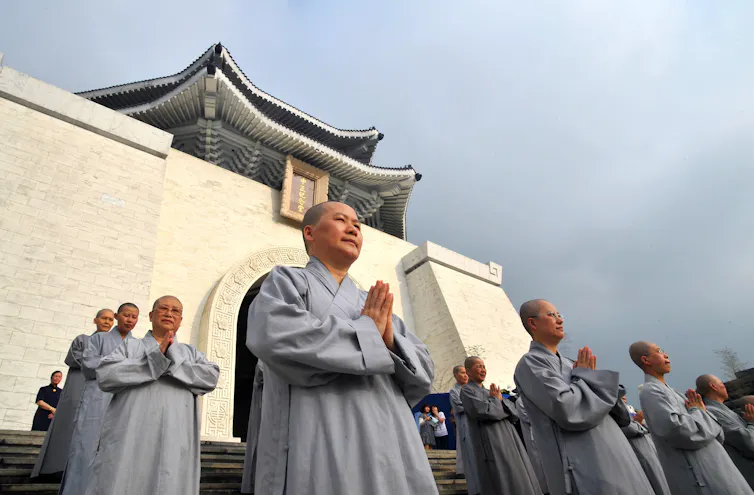
Nuns from Taiwan pray in Taipei on May 8, 2011, in celebration of the Buddha’s birth anniversary.
Patrick Lin/AFP via Getty Images
By Jue Liang of Denison University
In recent years, many Buddhist nuns have taken on leadership roles that require either ordination status or academic degrees, all of which was quite unheard of in Buddhist monastic traditions in the past.
However, this change has also met with much resistance, as traditionally Buddhism has allowed only men to serve in these roles. The early Pali Vinaya texts in the Buddhist canon recount how Buddha thrice rejected the request of his foster mother, Mahaprajapati, to be ordained, before his disciple, Ananda, persuaded him to accept women into the monastic body.
Ananda had to make two arguments for his case: an emotional one – that Mahaprajapati had been kind to the Buddha and raised him – and a logical one – that women, too, had the potential to become enlightened.
Even so, the Buddha stipulated an extra set of rules – the Eight Heavy Rules, or gurudharma in Sanskrit – that effectively placed the nuns under the supervision of monks. These rules have formed a crucial part of the Buddhist discourse on women’s status.
As a scholar of Buddhism with a focus on gender, I have been closely following the debates over women’s leadership. Nuns in virtually all Buddhist traditions, from Sri Lanka, Tibet and Nepal to Thailand, are becoming equal members in the sangha, or the Buddhist community.
Ordination and opportunities
The Buddhist monastic community is divided into a fourfold system of novice monks, novice nuns, fully ordained monks and fully ordained nuns, each with a set of precepts, or vinaya, that they need to follow.
Of the three major Buddhist monastic traditions – Theravada Buddhism in Sri Lanka and Southeast Asia, Mahayana Buddhism in East Asia and Tantric Buddhism in Tibet and the Himalayas – a continuous lineage of fully ordained nuns is found only in the East Asian Mahayana tradition.
This is because to conduct the full ordination ceremony there need to be five fully ordained monks and five fully ordained nuns present. While there are individual cases of fully ordained nuns in both the Theravada and the Tibetan traditions, the rarity of these cases made a continuous lineage practically impossible.
Those who are fully ordained have to adhere to many rules governing their speech, behavior, clothing, daily schedule, and interaction with others. While novice nuns have only about 100 precepts to follow; those who are fully ordained have to adhere to over 300. However, full ordination also offers prestigious standing in the community, higher ritual status, and freedom from serving monks and senior members, cooking, cleaning and performing daily maintenance.
Additionally, because of the lack of equal ordination status for nuns, lay patrons have generally preferred to have monks undertake ritual tasks instead. As a result, nuns not only receive less financial support from their families, than monks do, they are also paid less by patrons of their monastic community.
The overall lack of opportunity, income and prestige further perpetuates a cycle that disadvantages female monastics.
Seeking change
Buddhist women began to seek change and request full ordination from the East Asian tradition as early as the 1970s.
At the First International Conference for Buddhist Women in 1987, the issue of full ordination for Buddhist women emerged as one of the central themes. This conversation was initiated by a group of nuns from Europe and the United States in the Tibetan Buddhist tradition.
“Sakyadhita: International Association of Buddhist Women” was founded shortly after the conference. With its name inspired by the Pali and Sanskrit word meaning “daughters of the Buddha,” Sakyadhita serves as an international forum on women’s status and gender equality in Buddhism.
As with the admission of women into the Buddhist community, the establishment of a continuous lineage of full ordination was accompanied by controversy since its inception. The different opinions among Buddhist women and feminist scholars came to the fore at the International Congress on Women’s Role in the Sangha in Hamburg, Germany, in 2007.
While some hailed the return of full ordination for women as a victory against patriarchy, a group of Tibetan and Himalayan nuns affiliated with the Tibetan Nuns Project openly stated their discomfort with the feminist label placed on efforts to reinstate fully ordained nuns.
Despite the difference in their opinions, many more nuns have taken concrete steps to elevate their ordination status, either in groups or individually. For example, in Tibetan Buddhism, while the Dalai Lama has yet to weigh in on this issue, the 17th Karmapa, Ogyen Trinley Dorje, decided to initiate this change. The Karmapa is the leader of the Karma Kagyu school, another major Tibetan Buddhist school.
In March of 2017, with much fanfare and the Karmapa presiding, 19 women received novice monastic vows from a group of five fully ordained nuns from Nan Lin Vinaya Nunnery in Taiwan. It marked the first step to revive the long-lost tradition of full ordination for Tibetan and Himalayan Buddhist monastic women.
In addition, there are examples of women from Buddhist communities in Nepal, Bhutan, Sri Lanka and Burma receiving full ordination abroad. To do so, these nuns usually seek ordination from their East Asian Buddhist sisters, outside their own lineage.
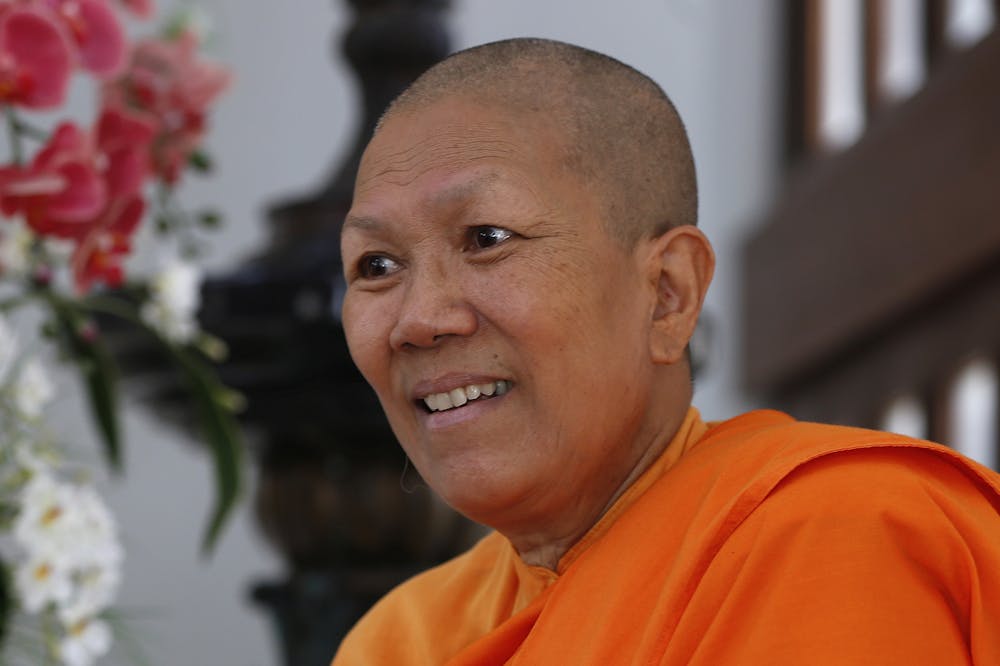
Dhammananda, the first bhikkhuni in Thailand from the Theravada branch of Buddhism.
AP Photo/Penny Yi Wang
While the issue of ordination remains controversial in the Thai Buddhist community, the presence of fully ordained female Buddhist leaders such as Dhammananda Bhikkhuni, a Thai Buddhist nun, scholar and activist, has encouraged many in Thailand to take similar steps and receive ordination from abroad.
Seeking higher religious education
In addition to providing equal standing for nuns through restoring ordination, another approach toward building future female Buddhist leadership has to do with education.
Historically, limited educational opportunities were available to Buddhist women. However, in recent years two emerging education initiatives have come to fruition across the Himalayas: Nuns in the Tibetan Buddhist tradition are, for the first time in Buddhist history, receiving the highest degrees and becoming Buddhist scholars and educators themselves.
The first of such gender-equal monastic education programs started in Eastern Tibet. It grants the title of khenmo – the highest degree in Buddhist learning in the Nyingma tradition – to nuns who have completed a rigorous decadelong curriculum. Since the 1990s, over 200 women have graduated from the program. Some remained in teaching roles, while others assumed editorial or publishing roles, or became administrators at the Buddhist academy.
Another group of Tibetan nuns at Dolmaling Nunnery in Himachal Pradesh, India, have received the geshema degree – the highest degree in Tibetan Gelugpa monastic learning – since 2016, following a precedent set by the German Tibetan nun Kelsang Wangmo. As of 2019, 44 nuns hold the geshema degree. Like their counterparts in Eastern Tibet, many geshema graduates became teachers at their institutions and are cultivating future generations of female scholars.
In a tradition that associates much status and prestige with lineage transmission and scholarly achievement, establishing a legitimate ordination lineage and providing equal education opportunities clear the way for women to become leaders in unprecedented ways. It also ensures a continuous impact on future generations.
This article is republished from The Conversation a nonprofit, independent news organization dedicated to unlocking the knowledge of experts for the public good.

About Jue Liang
Jue Liang is a Visiting Assistant Professor at Denison University. You can read more about the author here.


Browse Our Archives
Select a Category Buddhism Christianity Hinduism Islam Judaism Religion and society Uncategorized
Select a Month July 2024 March 2024 February 2024 January 2024 December 2023 November 2023 October 2023 September 2023 August 2023 July 2023 January 2023 August 2022 July 2022 April 2022 February 2022 January 2022 October 2021 July 2021 June 2021 May 2021 April 2021 March 2021 February 2021 January 2021 December 2020 November 2020 October 2020 September 2020 August 2020 July 2020 June 2020 May 2020
Follow Us!
TAKE THE
Religious Wisdom Quiz
What type of wood was Noah’s Ark made from?
Select your answer to see how you score.
Cedar Gopher wood Oak Olive wood
Related posts from The Conversation


Electing A Virtuous President Would Make Immunity Irrelevant

Why The Olympic Games Are A ‘Civil Religious’...

The Catholic Church Is Using The Olympics To...
TRENDING AT PATHEOS Religion News

Catholic Integralists believe that religious values – specifically Christian ones – should...

Electing A Virtuous President Would Make Immunity Irrelevant
Presidential immunity can bring with it many risks. So how can we...

Why The Olympic Games Are A ‘Civil Religious’...
Sporting events form a vital space where Americans display their 'civil religious...

After more than a decade of news, research updates, and insights on...

Q: Why do Southern Baptists and like-minded Protestants...
THE RELIGION GUY’S ANSWER: Why? Simple. Because they believe that’s what the...

THE QUESTION: Is gambling evil? THE RELIGION GUY’S ANSWER: Analysts anticipate a...
view all Religion News blogs
Ad-Free & Subscriber Log-In Subscription Support
- About Us
- 2026 Calendar
- Videos
- Podcasts
- Library of World Religions
- Faith In Media Tracker
- Advertise With Us
- Write for Us
- Privacy Policy
- Terms of Service
- Do Not Sell My Data
- Contact Us
- Radiant Digital
- Manage Newsletter Subscriptions
- Unsubscribe From Notifications
- Sitemap
Copyright 2008-2026, Patheos. All rights reserved.
Subscription Support Ad-Free & Subscriber Log-In
Follow Patheos