
BuddhistCatholicContemplativeEvangelicalGeneral ChristianHinduJewishLatter-day SaintMuslimNew VisionsProgressive Christian
Beliefs
- Buddhist
- Catholic
- Contemplative
- Evangelical
- General Christian
- Hindu
- Jewish
- Latter-day Saint
- More Voices
- Muslim
- New Visions
- Pagan
- Progressive Christian
Topics
- Religion News
- Food and Religion
- Sports and Religion
- Religious Art
- Religious Music and Entertainment
- Religious Events
- History and Religion
- Style and Religion
- Politics and Religion
- Women in Religion
- Recreation Outdoors and Religion
- Business Finance and Religion
- Careers Workplace and Religion
- Education and Religion
- Family Parenting and Religion
- Health Fitness and Religion
- Home and Religion
- Relationships and Religion
- Technology and Religion
- Travel and Religion
Columnists
- Buddhist Columnists
- Business Finance and Religion Columnists
- Careers Workplace and Religion Columnists
- Catholic Columnists
- Contemplative Columnists
- Education and Religion Columnists
- Evangelists Columnists
- Family Parenting and Religion Columnists
- General Christian Columnists
- Health Fitness and Religion Columnists
- Hindu Columnists
- History and Religion Columnists
- Home and Religion Columnists
- Jewish Columnists
- More Voices Columnists
- Latter Day Columnists
- Muslim Columnists
- New Visions Columnists
- Nonreligious Columnists
- Pagan Columnists
- Politics and Religion Columnists
- Progressive Columnists
- Recreation Outdoors and Religion Columnists
- Relationships and Religion Columnists
- Religion News Columnists
- Religious Art Columnists
- Religious Events Columnists
- Religious Music and Entertainment Columnists
- Sports and Religion Columnists
- Style and Religion Columnists
- Technology and Religion Columnists
- Travel and Religion Columnists
- Women in Religion Columnists
Resource Library
- 2026 Calendar
- Library of World Religions
- The 100 Most Holy Places on Earth
- Patheos Answers
- Podcasts
- Videos
- Faith Leaders Database
- Anglican Episcopalian
- Bahai
- Baptist
- Buddhism
- Christianity
- Confucianism
- Eastern Orthodoxy
- Hinduism
- Holiness and Pentecostal
- ISKCON
- Islam
- Judaism
- Lutheran
- Methodist
- The Church of Jesus Christ of Latter-day Saints
- New Age
- Paganism
- Presbytarian and Reformed
- Protestantism
- Religion Behind the Scenes
- Roman Catholic
- Scientology
- Shia Islam
- Sikhism
- Sufism
- Sunni Islam
- Taoism
- Zen
- See all religions
Research Tools
 Ad-Free & Subscriber Log-In Subscription Support
Ad-Free & Subscriber Log-In Subscription Support
Follow Patheos 

- Trending:
- Forgiveness
- |
- Marriage
- |
- Consciousness
- |
- Death Penalty
- |
- Election
- |
- Halloween

- Home
- Religion News
- White Gen X and millennial evangelicals are losing faith in the conservative culture wars
White Gen X and millennial evangelicals are losing faith in the conservative culture wars
Last updated on: October 6, 2021 at 7:38 pm by The Conversation
White Gen X and millennial evangelicals are losing faith in the conservative culture wars 2021-10-06T19:38:44-04:00 The Conversation
Patheos Explore the world's faith through different perspectives on religion and spirituality! Patheos has the views of the prevalent religions and spiritualities of the world.
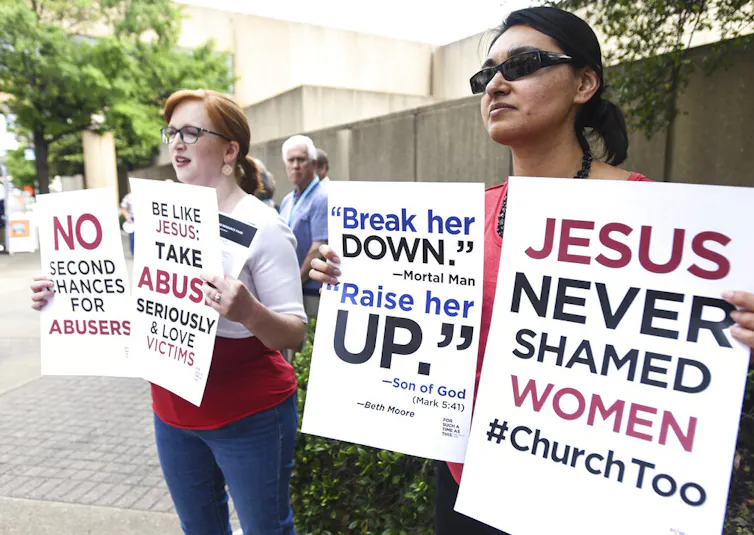
Younger evangelicals are openly questioning the religious and political traditions of their parents and grandparents.
Julie Bennett/AP
By Terry Shoemaker of Arizona State University
Since the 1970s, white American evangelicals – a large subsection of Protestants who hold to a literal reading of the Bible – have often managed to get specific privileges through their political engagement primarily through supporting the Republican Party.
In the 1980s, President Ronald Reagan symbolically consolidated the alliance by bringing religious freedom and morality into public conversations that questioned the separation of church and state. In 2003, President George W. Bush signed the Partial-Birth Abortion Ban Act into law. In October 2020, President Donald Trump appointed a conservative Christian, Amy Coney Barrett, to the Supreme Court, and went on to win 80% of the white evangelical vote in the following month’s election.
Trump went so far as to appoint a faith consultant board composed of influential evangelical leaders. They included Paula White, a well-known pastor and televangelist; and James Dobson, founder of Focus on the Family, a leading organization in evangelical efforts to embed “family values” into politics. These panel members heralded gestures by Trump, such as signing the “Presidential Executive Order Promoting Free Speech and Religious Liberty,” which targeted enforcement of the Johnson Amendment, a 1954 tax law requiring houses of worship to stay out of politics in order to remain tax-exempt.
Although it’s debated what specifically constitutes an evangelical, many agree that they are conservatives who are highly motivated by culture war issues like abortion, same-sex marriage and sexuality.
But even though evangelicals are often presented as monolithic in the media, current research signals a more complex picture.
Over the past six years, I have been working with an interdisciplinary team of scholars at the American Academy of Religion to analyze generational shifts in evangelicalism and religion more broadly in the United States. We are finding that some of the younger evangelicals are openly questioning their religious and political traditions. In short, the majority of white evangelicals are aging and a portion of younger evangelicals are engaging in both religion and politics differently.
Leaving the faith versus reforming from within
My research consists of hours of participant observation within younger evangelical faith communities, along with 50 in-depth, qualitative interviews with individuals who were raised in the politically charged evangelicalism in the southeastern United States, a region dominated by evangelicals.
Taken together, this research indicates increasing disaffection among white millennial and Gen X evangelicals with the cultural and political preoccupations that have strongly motivated their parents and grandparents. There is a growing number of “Exvangelicals” who disavow their previous stances on same-sex marriage, race and sexuality.
Evangelicals, often citing the biblical text, typically maintain that marriage is between one man and one woman. Over 75% tend to worship in racially segregated congregations and favor gun rights and ownership more than other faith groups.
But my interviewees tend toward intense critiques of their previous religious tradition, as well as rejecting the evangelical faith completely.
This data parallels other scholarship unearthing racialized structures within white, American evangelicalism like the work of sociologist Robert P. Jones and religious studies scholar Anthea Butler. Likewise, historian Kristen Kobes Du Mez examines how hypermasculinity is embedded in American evangelicalism.
Expanding religion and politics
My research reveals communities of younger evangelicals who are expanding their religious boundaries and rethinking their stances on culture war issues, as well as questioning the merits of the culture war.
These younger evangelicals are trying to reform their communities from within the tradition as loyal but highly critical members. Sometimes these groups are called “emerging evangelicals” or “progressive Christians,” with some debating whether “evangelical” as a label is redeemable.
I observed several younger evangelicals working within their religious communities to encourage acceptance of those outside of the Christian tradition as co-religionists on similar faith paths. They herald interfaith interactions as positive. One interviewee proudly detailed to me how her church partnered with the local imam and Muslim community to educate each other on their religious practices and volunteered together at a local food bank. This kind of attitude typically is resisted by their older evangelical counterparts, as I learned in previous research. Many traditional evangelicals believe that their faith is the sole path to religious redemption, and interfaith cooperation might harm their followers.
Additionally, some younger evangelicals tend toward adopting spiritual resources outside of the Christian tradition. Whether incorporating meditation techniques or yoga, my interviewees highlighted the ways in which they are exploring their religious and spiritual beliefs.
This contrasts with older evangelicals who perceive their tradition as providing all necessary resources for spiritual growth and reject any outside or Eastern influences. One interviewee noted that she had to change evangelical churches after her evangelical church prohibited her from being both a church member and a local yoga instructor.
Losing interest in the culture war
Many of the younger evangelicals in my study stated that their stances on culture war issues were significantly different from the evangelical majority of the past 50 years, which aligns with the findings of a 2017 Pew Research Center poll. This survey found that younger generations of millennials are more liberal than older evangelicals on numerous political issues.
My interviewees cited an acceptance and welcoming of those who identify as LGBTQ into their communities as both members and leaders. They support and ally with the objectives of the #BlackLivesMatter movement. In sum, they are actively dismantling many of the insider/outsider distinctions established by older white evangelicals and transforming what it means to be a politically engaged evangelical in America.
Furthermore, many of the people that I spoke with cited a culture war fatigue. Some believe that evangelicalism’s multi-decade investment in campaigning for these conservative stances and alliance with the Republican Party actually harmed the evangelical tradition instead of empowering it, while others are simply trying to opt out of the culture war and focus on their faith instead.

Influential figures like Paula White, left, helped rally evangelical support for Donald Trump, who in turn rewarded them with advisory and other roles in his administration.
Pablo Martinez Monsivais/AP
Interviewees also told me that often their views are creating familial conflict, since their parents and grandparents cannot understand why any evangelical would not be committed to the older generations’ conservative political causes.
Political conversion
Research to date, including my own, has yet to measure how widespread these shifts of attitude and belief among young white evangelicals may be. But there is other evidence of internal unraveling.
Take a recent announcement by Beth Moore, an influential evangelical speaker and author, that she has decided to leave the Southern Baptist Convention – the largest evangelical group in the U.S. – and end her relationship with a prominent evangelical publisher.
Or consider former Southern Baptist Theological Seminary president and pastor Russell Moore’s recent departure from the Southern Baptist Convention’s leadership, amid leaked communications over the denomination’s handling of racial issues. These developments indicate a growing internal struggle over who can legitimately claim authority for the evangelical tradition.
The last several decades of American politics have been dominated by culture war issues, with white evangelicals in positions of national power. But as my research is documenting, a political transformation seems to be underway. With younger, white evangelicals rethinking their alliances and continued participation in the culture wars, it is possible that conservative politicians may not be able to count on white evangelical support for much longer.
This could have broader implications for the American political landscape. Without evangelical support and influence, the issues that are often at center stage could drastically change.
Editor’s note: This article has been updated to clarify Supreme Court Justice Amy Coney Barrett’s faith as a conservative Christian.
This article is republished from The Conversation, a nonprofit news organization dedicated to unlocking ideas from academia, under a Creative Commons license.
[This week in religion, a global roundup each Thursday. Sign up.]

About Terry Shoemaker
Terry Shoemaker is a Lecturer, School of Historical, Philosophical and Religious Studies at Arizona State University. You can read more about the author here.


Browse Our Archives
Select a Category Buddhism Christianity Hinduism Islam Judaism Religion and society Uncategorized
Select a Month July 2024 March 2024 February 2024 January 2024 December 2023 November 2023 October 2023 September 2023 August 2023 July 2023 January 2023 August 2022 July 2022 April 2022 February 2022 January 2022 October 2021 July 2021 June 2021 May 2021 April 2021 March 2021 February 2021 January 2021 December 2020 November 2020 October 2020 September 2020 August 2020 July 2020 June 2020 May 2020
Follow Us!
TAKE THE
Religious Wisdom Quiz
"______ is the same yesterday and today and forever."
Select your answer to see how you score.
The Universe Jesus Christ God's Plan Our Calling
Related posts from The Conversation


Electing A Virtuous President Would Make Immunity Irrelevant

Why The Olympic Games Are A ‘Civil Religious’...

The Catholic Church Is Using The Olympics To...
TRENDING AT PATHEOS Religion News

Catholic Integralists believe that religious values – specifically Christian ones – should...

Electing A Virtuous President Would Make Immunity Irrelevant
Presidential immunity can bring with it many risks. So how can we...

Why The Olympic Games Are A ‘Civil Religious’...
Sporting events form a vital space where Americans display their 'civil religious...

After more than a decade of news, research updates, and insights on...

Q: Why do Southern Baptists and like-minded Protestants...
THE RELIGION GUY’S ANSWER: Why? Simple. Because they believe that’s what the...

THE QUESTION: Is gambling evil? THE RELIGION GUY’S ANSWER: Analysts anticipate a...
view all Religion News blogs
Ad-Free & Subscriber Log-In Subscription Support
- About Us
- 2026 Calendar
- Videos
- Podcasts
- Library of World Religions
- Faith In Media Tracker
- Advertise With Us
- Write for Us
- Privacy Policy
- Terms of Service
- Do Not Sell My Data
- Contact Us
- Radiant Digital
- Manage Newsletter Subscriptions
- Unsubscribe From Notifications
- Sitemap
Copyright 2008-2026, Patheos. All rights reserved.
Subscription Support Ad-Free & Subscriber Log-In
Follow Patheos