
BuddhistCatholicContemplativeEvangelicalGeneral ChristianHinduJewishLatter-day SaintMuslimNew VisionsProgressive Christian
Beliefs
- Buddhist
- Catholic
- Contemplative
- Evangelical
- General Christian
- Hindu
- Jewish
- Latter-day Saint
- More Voices
- Muslim
- New Visions
- Pagan
- Progressive Christian
Topics
- Religion News
- Food and Religion
- Sports and Religion
- Religious Art
- Religious Music and Entertainment
- Religious Events
- History and Religion
- Style and Religion
- Politics and Religion
- Women in Religion
- Recreation Outdoors and Religion
- Business Finance and Religion
- Careers Workplace and Religion
- Education and Religion
- Family Parenting and Religion
- Health Fitness and Religion
- Home and Religion
- Relationships and Religion
- Technology and Religion
- Travel and Religion
Columnists
- Buddhist Columnists
- Business Finance and Religion Columnists
- Careers Workplace and Religion Columnists
- Catholic Columnists
- Contemplative Columnists
- Education and Religion Columnists
- Evangelists Columnists
- Family Parenting and Religion Columnists
- General Christian Columnists
- Health Fitness and Religion Columnists
- Hindu Columnists
- History and Religion Columnists
- Home and Religion Columnists
- Jewish Columnists
- More Voices Columnists
- Latter Day Columnists
- Muslim Columnists
- New Visions Columnists
- Nonreligious Columnists
- Pagan Columnists
- Politics and Religion Columnists
- Progressive Columnists
- Recreation Outdoors and Religion Columnists
- Relationships and Religion Columnists
- Religion News Columnists
- Religious Art Columnists
- Religious Events Columnists
- Religious Music and Entertainment Columnists
- Sports and Religion Columnists
- Style and Religion Columnists
- Technology and Religion Columnists
- Travel and Religion Columnists
- Women in Religion Columnists
Resource Library
- 2026 Calendar
- Library of World Religions
- The 100 Most Holy Places on Earth
- Patheos Answers
- Podcasts
- Videos
- Faith Leaders Database
- Anglican Episcopalian
- Bahai
- Baptist
- Buddhism
- Christianity
- Confucianism
- Eastern Orthodoxy
- Hinduism
- Holiness and Pentecostal
- ISKCON
- Islam
- Judaism
- Lutheran
- Methodist
- The Church of Jesus Christ of Latter-day Saints
- New Age
- Paganism
- Presbytarian and Reformed
- Protestantism
- Religion Behind the Scenes
- Roman Catholic
- Scientology
- Shia Islam
- Sikhism
- Sufism
- Sunni Islam
- Taoism
- Zen
- See all religions
Research Tools
 Ad-Free & Subscriber Log-In Subscription Support
Ad-Free & Subscriber Log-In Subscription Support
Follow Patheos 

- Trending:
- Forgiveness
- |
- Marriage
- |
- Consciousness
- |
- Death Penalty
- |
- Election
- |
- Halloween

- Home
- Religion News
- Caring for the environment has a long Catholic lineage – hundreds of years before Pope Francis
Caring for the environment has a long Catholic lineage – hundreds of years before Pope Francis
Last updated on: October 14, 2021 at 9:14 pm by The Conversation
Caring for the environment has a long Catholic lineage – hundreds of years before Pope Francis 2021-10-14T21:14:17-04:00 The Conversation
Patheos Explore the world's faith through different perspectives on religion and spirituality! Patheos has the views of the prevalent religions and spiritualities of the world.
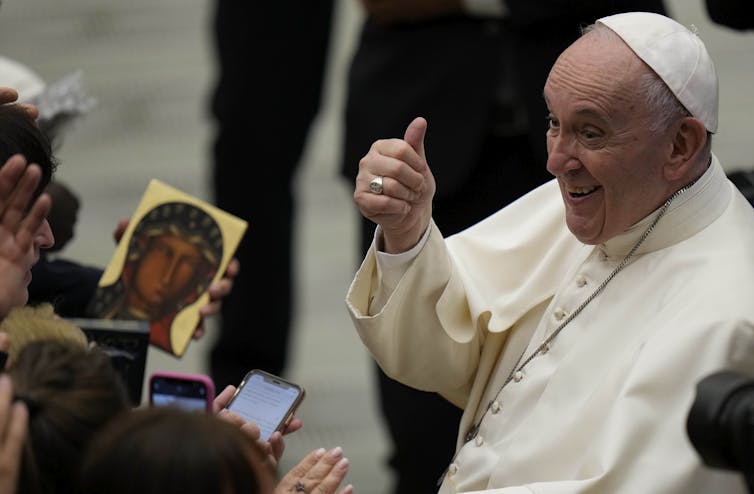
Pope Francis has laid emphasis on protecting the environment, but he’s not the only pope to speak about caring for nature.
AP Photo/Alessandra Tarantino
By Joanne M. Pierce of College of the Holy Cross
Pope Francis led dozens of religious leaders Oct. 4, 2021 in issuing a plea to protect the environment, warning that “Future generations will never forgive us if we miss the opportunity to protect our common home.”
The appeal, which calls for net-zero emissions, was released after months of meetings leading up to the United Nations’ November climate conference in Glasgow, Scotland.
The pope has voiced support for green policies before, including his 2015 encyclical letter to the entire Catholic Church “On Care for Our Common Home.”
But Francis is not the first Catholic leader to emphasize care for the planet. In fact, every pope for the past half-century – except John Paul I, who died after just one month in office – has addressed environmental issues in their official publications.
As a scholar whose research focuses on the medieval Church, I see many of these concerns deeply rooted in the history of the Catholic tradition.
The early tradition
One of the basic beliefs of Christianity is that the material world was created directly by God, and thus fundamentally connected with God’s goodness.
This is clearly expressed in the creation narrative in the book of Genesis, part of the sacred scripture shared by Christians and Jews. As God completes each element of the world – day, night, land, sea, etc. – he sees that “it was good.” On the sixth day, when God creates human beings in God’s own image, they are given “dominion” or “rule” over everything that lives on the Earth.
Early Christians insisted that the beauty of creation reflected God’s glory. But as Christianity spread throughout the Roman Empire, they had to defend this view of the basic goodness of creation when challenged by another religious viewpoint.
This movement – called Gnosticism, from the Greek word meaning “knowledge” – taught that the physical world was created not directly by God, but by a lesser spiritual being, out of malice or ignorance. At best, the material world was a worthless distraction; at worst, an evil snare for human souls. Gnostic teachers offered to teach their followers how to free their spirits from attachment to their physical bodies and the material world. In this way, after death they could return to the realm of spiritual reality and reunite with the divine.
Many theologians and bishops criticized this interpretation of their faith. Several wrote lengthy, detailed critiques of Gnostic teaching; at stake, they believed, was the salvation of souls.
The most prominent of these was St. Irenaeus of Lyons, who lived in the second century A.D. On Oct. 7, 2021, Francis announced that he would declare Irenaeus a “Doctor of the Church,” a title reserved for saints whose writings have had a profound impact on the life of the Church.
In Irenaeus’ treatise Against the Heresies, a passionate defense of the teaching of the scriptures and apostles, he states that creation itself reveals God and God’s glory; the only higher revelation is Jesus Christ himself.
At the beginning of the Middle Ages, however, Western Christianity was left with a lingering suspicion of “worldly things,” despite this early stress on the basic goodness of material creation.

Hildegard of Bingen did it all: music, botany, medicine, drama and theology.
Miniatur aus dem Rupertsberger Codex des Liber Scivias/Wikimedia Commons
The Benedictine tradition
By the third century, some Christians began to seek a life more fully focused on God by removing themselves from society to pray and work together in communal groups. This kind of monasticism swept across Western Europe during the medieval period.
The most influential of these monastic orders were the Benedictines, who balanced their lives between daily prayer services and work – which often involved agriculture and care of the surrounding environment. Each monk or nun pledged to remain at the same monastery for life, unless its abbot or abbess – the monk or nun in charge – ordered them to move to another. Because of this, Benedictines became known as “lovers of place.”
Today, one Benedictine saint has become especially connected with environmental concerns: St. Hildegard of Bingen, who died in A.D. 1179. This German abbess was one of the most accomplished women of the Middle Ages. An expert on herbal medicines and botany, she also wrote religious plays, composed liturgical chants and hymns, and authored theological works and poems based on her mystical experiences. She insisted that God loved the Earth as a husband loves a wife, and espoused a kind of “green” theology, called viriditas, condemning the harm that human activity could do to nature.
Hildegard has been acclaimed as an unofficial patron saint of environmentalists. In 2012, Pope Benedict XVI declared her a “Doctor of the Church,” like Irenaeus.
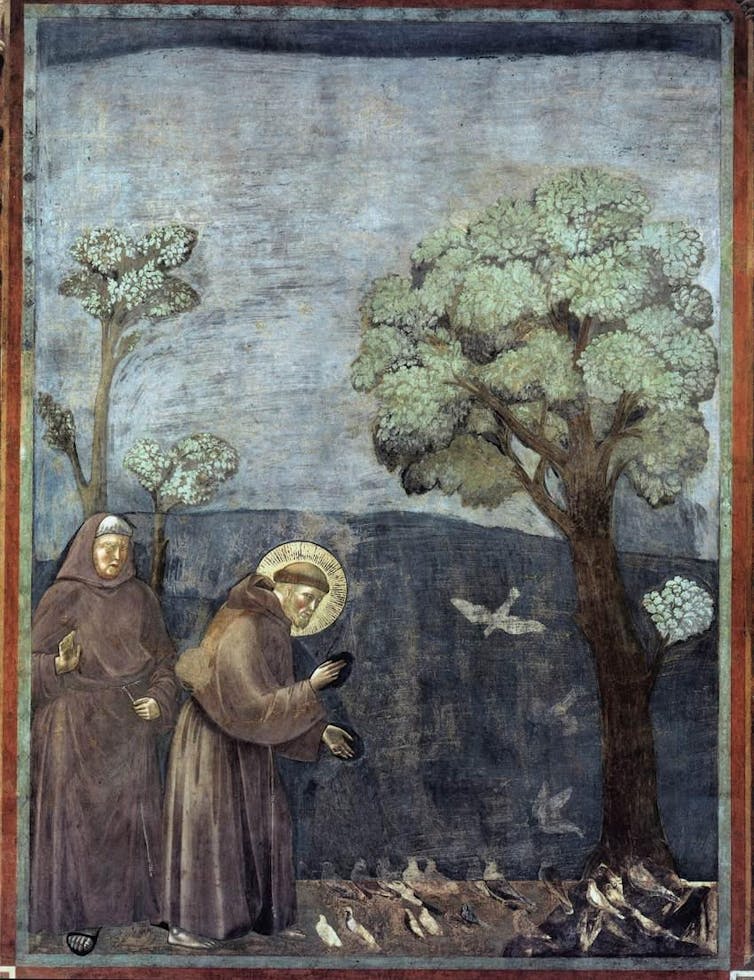
St. Francis, patron saint of animals and ecology, famously preached to the birds.
Giotto di Bondone/Basilica of San Francesco d’Assisi/Wikimedia Commons
The Franciscan tradition
St. Francis of Assisi, son of an Italian cloth merchant, has over the centuries become renowned for his love of the natural world. After time as a soldier and prisoner of war, Francis underwent a spiritual conversion. Rejecting his father’s wealth, he chose to live a life of radical poverty and public preaching until his death in A.D. 1226. Early on, male members of his new mendicant movement, the Franciscians, took religious vows but traveled from town to town with no fixed residence, begging for food and lodging.
One of Francis’ few documents is a poem, the Canticle of the Sun, which lyrically expressed his belief in the kinship between human beings and the rest of the natural world. Even the Sun and the Moon are addressed as “brother” and “sister.” And as he lay dying, it is said that he asked to be laid on the bare Earth.
Legends about his preaching and miracles circulated widely, and some involved his concern for animals, treating them with the same dignity as human beings. One story holds that he preached to birds and convinced a vicious wolf to live in peace with nearby townspeople.
[Over 110,000 readers rely on The Conversation’s newsletter to understand the world. Sign up today.]
In 1979, Pope John Paul II named St. Francis the patron saint of ecology because he “revered nature as a wonderful gift of God.” And in 2015, Pope Francis used the first words of the Canticle of the Sun, Laudatio si’, to open his encyclical on the environment and serve as its official title.
Although often overshadowed by the notion that the material world is only a passing distraction, reverence for a creation deeply loved by God has also been an important part of Catholic tradition. Contemporary teaching on the environment is only its most recent expression.
This article is republished from The Conversation a nonprofit, independent news organization dedicated to unlocking the knowledge of experts for the public good.

About Joanne M. Pierce
Joanne M. Pierce is a Professor Emerita of Religious Studies at College of the Holy Cross. You can read more about the author here.



Next Post
October 17, 2021 What is the Synod of Bishops? A Catholic priest and theologian explains
Browse Our Archives
Select a Category Buddhism Christianity Hinduism Islam Judaism Religion and society Uncategorized
Select a Month July 2024 March 2024 February 2024 January 2024 December 2023 November 2023 October 2023 September 2023 August 2023 July 2023 January 2023 August 2022 July 2022 April 2022 February 2022 January 2022 October 2021 July 2021 June 2021 May 2021 April 2021 March 2021 February 2021 January 2021 December 2020 November 2020 October 2020 September 2020 August 2020 July 2020 June 2020 May 2020
Follow Us!
TAKE THE
Religious Wisdom Quiz
What animal is mentioned in Proverbs as having little strength but great wisdom?
Select your answer to see how you score.
Ox Lion Bear Ant
Related posts from The Conversation


Electing A Virtuous President Would Make Immunity Irrelevant

Why The Olympic Games Are A ‘Civil Religious’...

The Catholic Church Is Using The Olympics To...
TRENDING AT PATHEOS Religion News

Catholic Integralists believe that religious values – specifically Christian ones – should...

Electing A Virtuous President Would Make Immunity Irrelevant
Presidential immunity can bring with it many risks. So how can we...

Why The Olympic Games Are A ‘Civil Religious’...
Sporting events form a vital space where Americans display their 'civil religious...

After more than a decade of news, research updates, and insights on...

Q: Why do Southern Baptists and like-minded Protestants...
THE RELIGION GUY’S ANSWER: Why? Simple. Because they believe that’s what the...

THE QUESTION: Is gambling evil? THE RELIGION GUY’S ANSWER: Analysts anticipate a...
view all Religion News blogs
Ad-Free & Subscriber Log-In Subscription Support
- About Us
- 2026 Calendar
- Videos
- Podcasts
- Library of World Religions
- Faith In Media Tracker
- Advertise With Us
- Write for Us
- Privacy Policy
- Terms of Service
- Do Not Sell My Data
- Contact Us
- Radiant Digital
- Manage Newsletter Subscriptions
- Unsubscribe From Notifications
- Sitemap
Copyright 2008-2026, Patheos. All rights reserved.
Subscription Support Ad-Free & Subscriber Log-In
Follow Patheos