
BuddhistCatholicContemplativeEvangelicalGeneral ChristianHinduJewishLatter-day SaintMuslimNew VisionsProgressive Christian
Beliefs
- Buddhist
- Catholic
- Contemplative
- Evangelical
- General Christian
- Hindu
- Jewish
- Latter-day Saint
- More Voices
- Muslim
- New Visions
- Pagan
- Progressive Christian
Topics
- Religion News
- Food and Religion
- Sports and Religion
- Religious Art
- Religious Music and Entertainment
- Religious Events
- History and Religion
- Style and Religion
- Politics and Religion
- Women in Religion
- Recreation Outdoors and Religion
- Business Finance and Religion
- Careers Workplace and Religion
- Education and Religion
- Family Parenting and Religion
- Health Fitness and Religion
- Home and Religion
- Relationships and Religion
- Technology and Religion
- Travel and Religion
Columnists
- Buddhist Columnists
- Business Finance and Religion Columnists
- Careers Workplace and Religion Columnists
- Catholic Columnists
- Contemplative Columnists
- Education and Religion Columnists
- Evangelists Columnists
- Family Parenting and Religion Columnists
- General Christian Columnists
- Health Fitness and Religion Columnists
- Hindu Columnists
- History and Religion Columnists
- Home and Religion Columnists
- Jewish Columnists
- More Voices Columnists
- Latter Day Columnists
- Muslim Columnists
- New Visions Columnists
- Nonreligious Columnists
- Pagan Columnists
- Politics and Religion Columnists
- Progressive Columnists
- Recreation Outdoors and Religion Columnists
- Relationships and Religion Columnists
- Religion News Columnists
- Religious Art Columnists
- Religious Events Columnists
- Religious Music and Entertainment Columnists
- Sports and Religion Columnists
- Style and Religion Columnists
- Technology and Religion Columnists
- Travel and Religion Columnists
- Women in Religion Columnists
Resource Library
- 2026 Calendar
- Library of World Religions
- The 100 Most Holy Places on Earth
- Patheos Answers
- Podcasts
- Videos
- Faith Leaders Database
- Anglican Episcopalian
- Bahai
- Baptist
- Buddhism
- Christianity
- Confucianism
- Eastern Orthodoxy
- Hinduism
- Holiness and Pentecostal
- ISKCON
- Islam
- Judaism
- Lutheran
- Methodist
- The Church of Jesus Christ of Latter-day Saints
- New Age
- Paganism
- Presbytarian and Reformed
- Protestantism
- Religion Behind the Scenes
- Roman Catholic
- Scientology
- Shia Islam
- Sikhism
- Sufism
- Sunni Islam
- Taoism
- Zen
- See all religions
Research Tools
 Ad-Free & Subscriber Log-In Subscription Support
Ad-Free & Subscriber Log-In Subscription Support
Follow Patheos 

- Trending:
- Forgiveness
- |
- Marriage
- |
- Consciousness
- |
- Death Penalty
- |
- Election
- |
- Halloween

- Home
- Religion News
- Americans are in a mental health crisis – especially African Americans. Can churches help?
Americans are in a mental health crisis – especially African Americans. Can churches help?
Last updated on: October 10, 2021 at 11:20 pm by The Conversation
Americans are in a mental health crisis – especially African Americans. Can churches help? 2021-10-10T23:20:52-04:00 The Conversation
Patheos Explore the world's faith through different perspectives on religion and spirituality! Patheos has the views of the prevalent religions and spiritualities of the world.
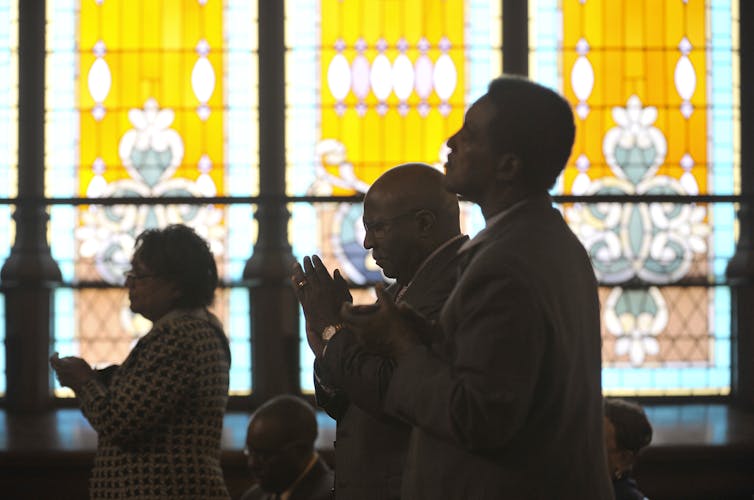
The 160-year-old John Wesley AME Zion Church is one of the few predominantly African American churches that still exists in downtown Washington, D.C.
Marvin Joseph/The Washington Post via Getty Images
By Brad R. Fulton of Indiana University
Centuries of systemic racism and everyday discrimination in the U.S. have left a major mental health burden on African American communities, and the past few years have dealt especially heavy blows.
Data from the Centers for Disease Control and Prevention indicate that Black Americans are twice as likely to die of COVID-19, compared with white Americans. Their communities have also been hit disproportionately by job losses, food insecurity and homelessness as a result of the pandemic.
Meanwhile, racial injustice and high-profile police killings of Black men have amplified stress. During the summer of 2020, amid both the pandemic and Black Lives Matter protests, a CDC survey found that 15% of Black respondents had “seriously considered suicide in the past 30 days,” compared with 8% of white respondents.
For a variety of reasons, many African Americans face barriers to mental health care. But as a sociologist who focuses on community-based organizations, I find that strengthening relationships between churches and mental health providers can be one way to increase access to needed services. In research with my collaborators Eunice Wong and Kathryn Derose, I analyzed data on the prevalence of mental health care provision among religious congregations and found that many African American congregations offer such programs.
Need versus access
Roughly 1 in 5 Americans experience mental illness in a given year. Yet fewer than half of adults with a mental health condition receive mental health services.
African Americans utilize mental health services at about one-half the rate of white Americans. In part, this underuse may stem from African Americans’ often fraught relationship with medical establishments in the U.S., given their histories of racial bias and malpractice against people of color. Part of the reason may also derive from stigma among some African Americans perceiving mental illness and seeking help as signs of weakness. Treatment “deserts” where mental health providers are scarce may also be a factor.

Students participate in an activity about mental health and suicide prevention at Uplift Hampton Preparatory School in Dallas in 2018.
AP Photo/Benny Snyder
Care at church
One often overlooked resource for mental health care, however, are churches. For the past decade, the National Congregations Study has documented the prevalence of mental health care provision among places of worship in the U.S. Based on data from the NCS’ 2018 survey, 26% of congregations provide mental health programming, and 37% of people who attend religious services attend one of these congregations. Such programming can include support groups, meetings and classes focused on addressing mental health concerns.
Previously, my co-researchers and I analyzed 2012 NCS data to better understand mental health resources within religious congregations. One of our goals was to identify factors that contribute to a congregation offering mental health care. These factors include having more members, employing staff for social service programs and providing health-focused programs. Other significant predictors include conducting community needs assessments, hosting speakers from social service organizations and being located in a predominantly African American community.
Based on the new 2018 survey, 45% percent of African American congregations offer some form of mental health service and nearly half of all African American churchgoers attend a congregation with such programs. These rates show an increase since 2012, and are roughly 50% greater than those among predominantly white congregations.
This research supports longstanding observations about African American congregations as critical sources of spiritual, emotional and social support for their communities. Many religious people see their spiritual health and mental health as intertwined, and research indicates that spiritual practices, such as prayer and meditation, can also support mental health.
Strengthening support
Our research suggests that building collaborations between African American congregations and the mental health sector is a promising strategy to increase access to needed services. Given that 61% of African Americans say they attend worship services at least a few times a year, congregations may provide an accessible resource.
At times, pairing religion and mental health may prove harmful. Some congregations see mental health problems as a product of personal sin, for example, and stigmatize people suffering from mental illness.
[This week in religion, a global roundup each Thursday. Sign up.]
But congregations can also be helpful environments. When clinical treatment is supplemented with social support, the likelihood of successful outcomes is greater, and houses of worship often provide built-in social networks. People participating in a congregation-led grief recovery group, for example, can be involved in the congregation beyond their weekly meeting. In addition, some mental health professionals provide pro bono services for congregation-based programs.
Social worker Victor Armstrong, the director of North Carolina’s Division of Mental Health, Developmental Disabilities and Substance Abuse Services, asserts that African American faith leaders can play a “pivotal role” in mental wellness. He suggests shifting language to focus on “wellness” rather than “illness” in order to decrease stigma, among other recommendations.
Greater collaboration between congregations and mental health providers could help stem the growing mental health crisis, particularly within African American communities.
This article is republished from The Conversation a nonprofit, independent news organization dedicated to unlocking the knowledge of experts for the public good.

About Brad R. Fulton
Brad R. Fulton is an Associate Professor at Indiana University. You can read more about the author here.
Browse Our Archives
Select a Category Buddhism Christianity Hinduism Islam Judaism Religion and society Uncategorized
Select a Month July 2024 March 2024 February 2024 January 2024 December 2023 November 2023 October 2023 September 2023 August 2023 July 2023 January 2023 August 2022 July 2022 April 2022 February 2022 January 2022 October 2021 July 2021 June 2021 May 2021 April 2021 March 2021 February 2021 January 2021 December 2020 November 2020 October 2020 September 2020 August 2020 July 2020 June 2020 May 2020
Follow Us!
TAKE THE
Religious Wisdom Quiz
Who compared himself to a gentle lamb led to the slaughter?
Select your answer to see how you score.
Ezekiel Isaiah Jeremiah Job
Related posts from The Conversation


Electing A Virtuous President Would Make Immunity Irrelevant

Why The Olympic Games Are A ‘Civil Religious’...

The Catholic Church Is Using The Olympics To...
TRENDING AT PATHEOS Religion News

Catholic Integralists believe that religious values – specifically Christian ones – should...

Electing A Virtuous President Would Make Immunity Irrelevant
Presidential immunity can bring with it many risks. So how can we...

Why The Olympic Games Are A ‘Civil Religious’...
Sporting events form a vital space where Americans display their 'civil religious...

After more than a decade of news, research updates, and insights on...

Q: Why do Southern Baptists and like-minded Protestants...
THE RELIGION GUY’S ANSWER: Why? Simple. Because they believe that’s what the...

THE QUESTION: Is gambling evil? THE RELIGION GUY’S ANSWER: Analysts anticipate a...
view all Religion News blogs
Ad-Free & Subscriber Log-In Subscription Support
- About Us
- 2026 Calendar
- Videos
- Podcasts
- Library of World Religions
- Faith In Media Tracker
- Advertise With Us
- Write for Us
- Privacy Policy
- Terms of Service
- Do Not Sell My Data
- Contact Us
- Radiant Digital
- Manage Newsletter Subscriptions
- Unsubscribe From Notifications
- Sitemap
Copyright 2008-2026, Patheos. All rights reserved.
Subscription Support Ad-Free & Subscriber Log-In
Follow Patheos