
BuddhistCatholicContemplativeEvangelicalGeneral ChristianHinduJewishLatter-day SaintMuslimNew VisionsProgressive Christian
Beliefs
- Buddhist
- Catholic
- Contemplative
- Evangelical
- General Christian
- Hindu
- Jewish
- Latter-day Saint
- More Voices
- Muslim
- New Visions
- Pagan
- Progressive Christian
Topics
- Religion News
- Food and Religion
- Sports and Religion
- Religious Art
- Religious Music and Entertainment
- Religious Events
- History and Religion
- Style and Religion
- Politics and Religion
- Women in Religion
- Recreation Outdoors and Religion
- Business Finance and Religion
- Careers Workplace and Religion
- Education and Religion
- Family Parenting and Religion
- Health Fitness and Religion
- Home and Religion
- Relationships and Religion
- Technology and Religion
- Travel and Religion
Columnists
- Buddhist Columnists
- Business Finance and Religion Columnists
- Careers Workplace and Religion Columnists
- Catholic Columnists
- Contemplative Columnists
- Education and Religion Columnists
- Evangelists Columnists
- Family Parenting and Religion Columnists
- General Christian Columnists
- Health Fitness and Religion Columnists
- Hindu Columnists
- History and Religion Columnists
- Home and Religion Columnists
- Jewish Columnists
- More Voices Columnists
- Latter Day Columnists
- Muslim Columnists
- New Visions Columnists
- Nonreligious Columnists
- Pagan Columnists
- Politics and Religion Columnists
- Progressive Columnists
- Recreation Outdoors and Religion Columnists
- Relationships and Religion Columnists
- Religion News Columnists
- Religious Art Columnists
- Religious Events Columnists
- Religious Music and Entertainment Columnists
- Sports and Religion Columnists
- Style and Religion Columnists
- Technology and Religion Columnists
- Travel and Religion Columnists
- Women in Religion Columnists
Resource Library
- 2026 Calendar
- Library of World Religions
- The 100 Most Holy Places on Earth
- Patheos Answers
- Podcasts
- Videos
- Faith Leaders Database
- Anglican Episcopalian
- Bahai
- Baptist
- Buddhism
- Christianity
- Confucianism
- Eastern Orthodoxy
- Hinduism
- Holiness and Pentecostal
- ISKCON
- Islam
- Judaism
- Lutheran
- Methodist
- The Church of Jesus Christ of Latter-day Saints
- New Age
- Paganism
- Presbytarian and Reformed
- Protestantism
- Religion Behind the Scenes
- Roman Catholic
- Scientology
- Shia Islam
- Sikhism
- Sufism
- Sunni Islam
- Taoism
- Zen
- See all religions
Research Tools
 Ad-Free & Subscriber Log-In Subscription Support
Ad-Free & Subscriber Log-In Subscription Support
Follow Patheos 

- Trending:
- Forgiveness
- |
- Marriage
- |
- Consciousness
- |
- Death Penalty
- |
- Election
- |
- Halloween

- Home
- Religion News
- Do people become more religious in times of crisis?
Do people become more religious in times of crisis?
Last updated on: June 26, 2021 at 9:45 pm by The Conversation
Do people become more religious in times of crisis? 2021-06-26T21:45:29-04:00 The Conversation
Patheos Explore the world's faith through different perspectives on religion and spirituality! Patheos has the views of the prevalent religions and spiritualities of the world.
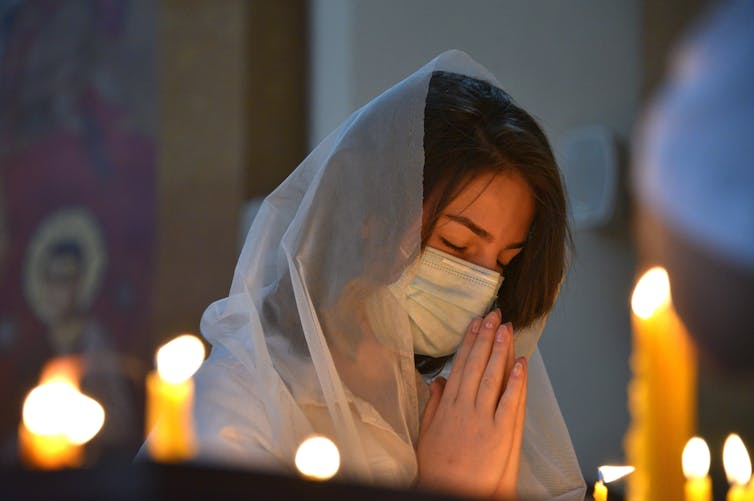
Has COVID-19 strengthened people’s faith?
Karen Minasyan/AFP via Getty Images
By Danielle Tumminio Hansen of Seminary of the Southwest
Organized religion has been on the decline for decades in the United States. However, during the COVID-19 pandemic, researchers found that online searches for the word “prayer” soared to their highest level ever
in over 90 countries. And a 2020 Pew Research study showed that 24% of U.S. adults stated their faith had become stronger during the pandemic.
I am a theologian who studies trauma and this shift makes sense to me. I often teach that traumatic events are, at their heart, crises of meaning that cause people to question assumptions about their lives, including their spiritual beliefs. The years 2020 and 2021 certainly fit that bill: The global COVID-19 pandemic has indeed led to traumatic experiences for many people, due to the isolation, illness, fear and death that it created.
Questioning beliefs
People who experience traumas tend to question some of the assumptions they might have had about their faith – what pastoral theologian Carrie Doehring calls “embedded beliefs.” These beliefs may include ideas about who God is, the purpose of life or why evil events happen to good people.
So, for instance, many Christians may inherit an embedded belief from the tradition that God is all good and that evil emerges when God “rightly” punishes people for their sins. In other words, an all-good God would not punish someone without a reason.
Christians raised with that assumption might ask what made them incur God’s wrath if they contracted COVID-19. In such an event, the embedded belief in a punishing God may become something called a negative coping strategy – a coping strategy that has negative effects on a person’s life.
Here’s what this might look like practically: If a person believes they’re being punished by God, they may feel shame or despair. If they feel God is punishing them for no reason, they may feel confusion or try to identify something that is problematic or sinful about their identity. As a result, their faith becomes something that is a source of stress or cognitive dissonance rather than a source of comfort. If that happens, then the belief is functioning as a negative coping strategy that the person needs to address.
Trauma and religiosity
Mental health experts like Judith Herman have known for several decades that healing from trauma involves making meaning of the traumatic event. Traumatic events are often confusing for people because they don’t make much sense. In other words, traumas differ from the expectations of everyday life, and as a result, they seem to defy meaning or purpose.
Spiritually, individuals may begin to recognize that some of their beliefs got challenged by the trauma. This is the time when spiritual meaning-making occurs because people start to discern which embedded beliefs still make sense and which need to be revised.
During this stage of recovery, theologian and trauma expert Shelly Rambo explains that traumatized individuals may draw on prayers, personal reflections, rituals and conversations with spiritual experts such as chaplains, ministers and spiritual directors. These have been shown to function as positive coping mechanisms that help individuals feel more grounded in the aftermath of a trauma.
Over time, these resources help individuals develop more intentional beliefs, meaning consciously chosen beliefs that take their suffering into account. These might include reasons why the suffering occurred and what its significance is for the overall meaning of the person’s life. Doehring refers to these as deliberative, or consciously chosen, beliefs. Individuals have a sense of commitment to these beliefs because they make sense in light of the trauma.
So in the hypothetical case of someone who believes God is punishing them for contracting COVID-19, that feeling of shame and despair may result from a failure to understand why God would treat them that way. These negative feelings would then function as negative coping mechanisms that prevent healing, as psychologist Kenneth Pargament and his colleagues have observed about similar situations where people felt God was punishing them.
The person might then try to alleviate their distress by questioning the assumption that God punishes people with illness, thereby starting a kind of spiritual quest or reassessment of beliefs. They may even start to think differently about God being a punishing deity. The shift between what the person assumed about God and this new, consciously chosen belief, is an example of the shift between embedded and deliberative beliefs.
Trauma and atheism
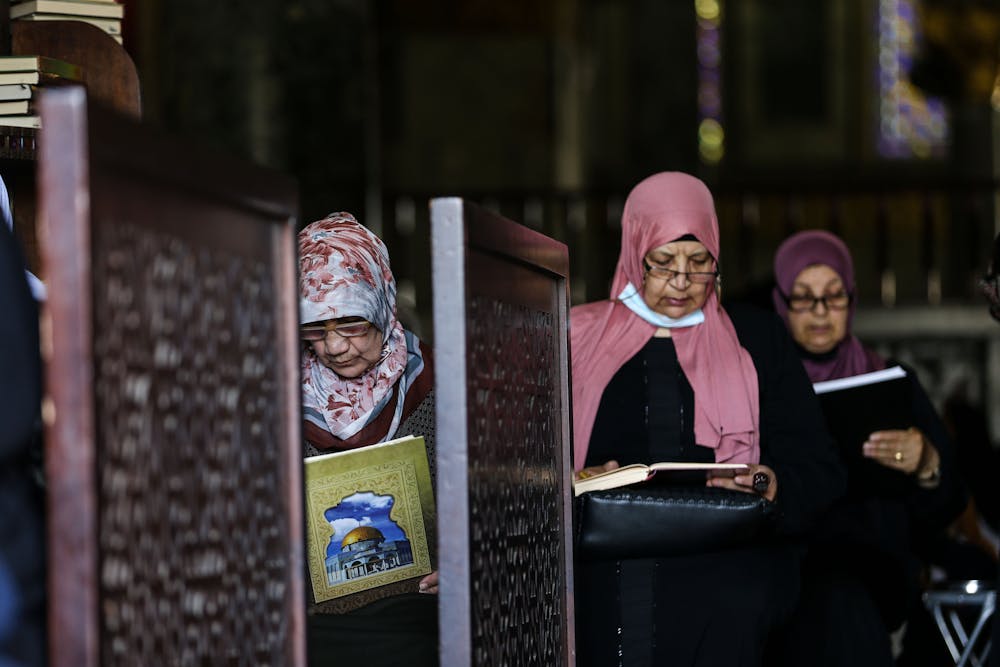
Traumatic events could make a person more spiritual.
Mostafa Alkharouf/Anadolu Agency via Getty Images
Some people may argue that suffering logically ought to turn people into atheists. After all, the horror of something like the COVID-19 pandemic could easily make someone question how it would be possible for any deity to allow such horrors.
It would make far more sense to reason that creation is random, chaotic and determined only by some combination of the forces of nature and human decisions. The agnostic philosopher Bertrand Russell crafted such a proposal when he argued that Christians should accompany him to a children’s hospital unit because they would inevitably stop believing in God once they saw such profound suffering.
The way humans experience suffering spiritually, however, may not necessarily lead to atheism or agnosticism. Indeed, research from experts who study the intersection of psychology and religion – including psychologists of religion and pastoral theologians – has found that events that could be labeled as traumatic do not necessarily destroy faith.
Indeed, they can also strengthen it because faith-based beliefs and practices can help individuals make sense of their life’s story. In other words, trauma challenges so many assumptions about who we are, what our purpose is and how to make sense of a traumatic event. Faith-based beliefs and practices offer meaningful resources to help navigate those questions.
This is why spiritual beliefs and practices across various religions can often lead to faith strengthening rather than weakening, following a trauma.
So even though people may have had limited access to buildings like churches or synagogues during the pandemic, they still had access to spiritual resources that can help them navigate traumatic events. This may explain data showing that some individuals are stating their faith is stronger than it was prior to the COVID-19 pandemic.

Seminary of the Southwest is a member of the Association of Theological Schools.
The ATS is a funding partner of The Conversation US.
This article is republished from The Conversation, a nonprofit news organization dedicated to unlocking ideas from academia, under a Creative Commons license.
[This week in religion, a global roundup each Thursday. Sign up.]

About Danielle Tumminio Hansen
Danielle Tumminio Hansen is an Assistant Professor of Pastoral Theology & Director of Field Education at Seminary of the Southwest. You can read more about the author here.
Next Post
June 28, 2021 Controversy over Communion in the Catholic Church goes back some 2,000 years
Browse Our Archives
Select a Category Buddhism Christianity Hinduism Islam Judaism Religion and society Uncategorized
Select a Month July 2024 March 2024 February 2024 January 2024 December 2023 November 2023 October 2023 September 2023 August 2023 July 2023 January 2023 August 2022 July 2022 April 2022 February 2022 January 2022 October 2021 July 2021 June 2021 May 2021 April 2021 March 2021 February 2021 January 2021 December 2020 November 2020 October 2020 September 2020 August 2020 July 2020 June 2020 May 2020
Follow Us!
TAKE THE
Religious Wisdom Quiz
Which Old Testament book does not mention God?
Select your answer to see how you score.
Esther Ruth Ecclesiastes Song of Solomon
Related posts from The Conversation


Electing A Virtuous President Would Make Immunity Irrelevant

Why The Olympic Games Are A ‘Civil Religious’...

The Catholic Church Is Using The Olympics To...
TRENDING AT PATHEOS Religion News

Catholic Integralists believe that religious values – specifically Christian ones – should...

Electing A Virtuous President Would Make Immunity Irrelevant
Presidential immunity can bring with it many risks. So how can we...

Why The Olympic Games Are A ‘Civil Religious’...
Sporting events form a vital space where Americans display their 'civil religious...

After more than a decade of news, research updates, and insights on...

Q: Why do Southern Baptists and like-minded Protestants...
THE RELIGION GUY’S ANSWER: Why? Simple. Because they believe that’s what the...

THE QUESTION: Is gambling evil? THE RELIGION GUY’S ANSWER: Analysts anticipate a...
view all Religion News blogs
Ad-Free & Subscriber Log-In Subscription Support
- About Us
- 2026 Calendar
- Videos
- Podcasts
- Library of World Religions
- Faith In Media Tracker
- Advertise With Us
- Write for Us
- Privacy Policy
- Terms of Service
- Do Not Sell My Data
- Contact Us
- Radiant Digital
- Manage Newsletter Subscriptions
- Unsubscribe From Notifications
- Sitemap
Copyright 2008-2026, Patheos. All rights reserved.
Subscription Support Ad-Free & Subscriber Log-In
Follow Patheos