
BuddhistCatholicContemplativeEvangelicalGeneral ChristianHinduJewishLatter-day SaintMuslimNew VisionsProgressive Christian
Beliefs
- Buddhist
- Catholic
- Contemplative
- Evangelical
- General Christian
- Hindu
- Jewish
- Latter-day Saint
- More Voices
- Muslim
- New Visions
- Pagan
- Progressive Christian
Topics
- Religion News
- Food and Religion
- Sports and Religion
- Religious Art
- Religious Music and Entertainment
- Religious Events
- History and Religion
- Style and Religion
- Politics and Religion
- Women in Religion
- Recreation Outdoors and Religion
- Business Finance and Religion
- Careers Workplace and Religion
- Education and Religion
- Family Parenting and Religion
- Health Fitness and Religion
- Home and Religion
- Relationships and Religion
- Technology and Religion
- Travel and Religion
Columnists
- Buddhist Columnists
- Business Finance and Religion Columnists
- Careers Workplace and Religion Columnists
- Catholic Columnists
- Contemplative Columnists
- Education and Religion Columnists
- Evangelists Columnists
- Family Parenting and Religion Columnists
- General Christian Columnists
- Health Fitness and Religion Columnists
- Hindu Columnists
- History and Religion Columnists
- Home and Religion Columnists
- Jewish Columnists
- More Voices Columnists
- Latter Day Columnists
- Muslim Columnists
- New Visions Columnists
- Nonreligious Columnists
- Pagan Columnists
- Politics and Religion Columnists
- Progressive Columnists
- Recreation Outdoors and Religion Columnists
- Relationships and Religion Columnists
- Religion News Columnists
- Religious Art Columnists
- Religious Events Columnists
- Religious Music and Entertainment Columnists
- Sports and Religion Columnists
- Style and Religion Columnists
- Technology and Religion Columnists
- Travel and Religion Columnists
- Women in Religion Columnists
Resource Library
- 2026 Calendar
- Library of World Religions
- The 100 Most Holy Places on Earth
- Patheos Answers
- Podcasts
- Videos
- Faith Leaders Database
- Anglican Episcopalian
- Bahai
- Baptist
- Buddhism
- Christianity
- Confucianism
- Eastern Orthodoxy
- Hinduism
- Holiness and Pentecostal
- ISKCON
- Islam
- Judaism
- Lutheran
- Methodist
- The Church of Jesus Christ of Latter-day Saints
- New Age
- Paganism
- Presbytarian and Reformed
- Protestantism
- Religion Behind the Scenes
- Roman Catholic
- Scientology
- Shia Islam
- Sikhism
- Sufism
- Sunni Islam
- Taoism
- Zen
- See all religions
Research Tools
 Ad-Free & Subscriber Log-In Subscription Support
Ad-Free & Subscriber Log-In Subscription Support
Follow Patheos 

- Trending:
- Forgiveness
- |
- Marriage
- |
- Consciousness
- |
- Death Penalty
- |
- Election
- |
- Halloween

- Home
- Religion News
- Controversy over Communion in the Catholic Church goes back some 2,000 years
Controversy over Communion in the Catholic Church goes back some 2,000 years
Last updated on: June 28, 2021 at 1:20 pm by The Conversation
Controversy over Communion in the Catholic Church goes back some 2,000 years 2021-06-28T13:20:14-04:00 The Conversation
Patheos Explore the world's faith through different perspectives on religion and spirituality! Patheos has the views of the prevalent religions and spiritualities of the world.
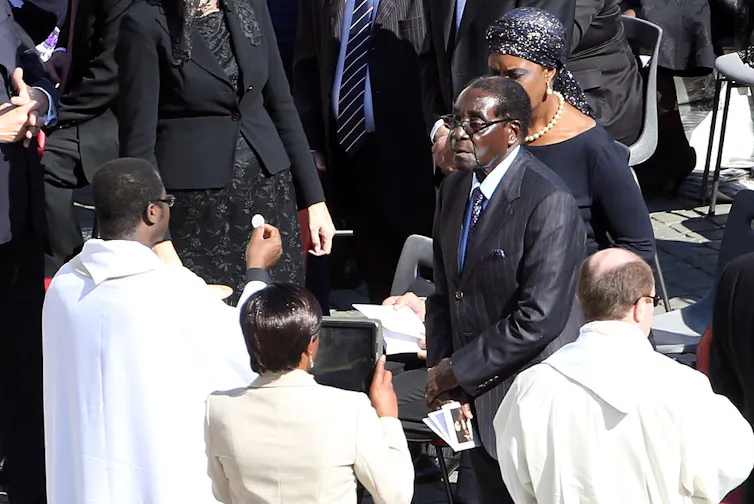
When Pope John Paul II was beatified, Zimbabwe’s ruler, Robert Mugabe, was in attendance and given Communion.
Franco Origlia/Getty Images
By Mathew Schmalz of College of the Holy Cross
The United States Conference of Catholic Bishops recently approved drafting a document on receiving Communion in the Catholic Church. It will include a section regarding standards for politicians and public figures who support laws allowing abortion, euthanasia and other “moral evils.”
The proposed document has already caused controversy. The Vatican has warned against exclusively focusing on abortion and euthanasia and cautioned that the document could further divide U.S. Catholics.
As a Catholic scholar of religion, I would argue that battles over Communion are nothing new in the Catholic Church.
The importance of Communion

The U.S. Conference of Catholic Bishops is debating which Catholics are worthy of receiving Communion.
AP Photo/Damian Dovarganes, File
In the Catholic Church, the Communion service is one of seven rituals called sacraments that have a primary significance. During this service, called a Mass, Catholics believe that the bread and wine, when specially blessed by a priest, become the body and blood of Jesus Christ. Ritually consuming this bread and wine is a special way to “commune,” or be united, with Jesus Christ.
Catholics call both the celebration of Mass and the blessed bread and wine the Eucharist, from the Greek word meaning “thanksgiving.” Receiving Communion can also be called receiving the Eucharist.
The Catholic Church teaches that in order to receive Communion, a person must not be conscious of a serious sin – such as murder or adultery – that has not already been absolved through confession to a priest.
In early Christianity, rules about receiving Communion could be strict. Christians who were known to be guilty of serious sins were not supposed to receive Communion until they went through a process of reconciliation with a local bishop. In the Middle Ages, very few Catholics actually received Communion at all, as many believed that they were unworthy to do so.
The possibility of scandal
In the 19th and 20th centuries, the Catholic Church encouraged a more frequent – even daily – reception of Communion.
Still, one of the main concerns surrounding Communion is that someone publicly known to be committing serious sins would receive Communion. Such cases create “scandal.”
In the Catholic Church’s terminology, scandal is “an attitude or behavior which leads another to do evil.” So, someone who accepts Communion while at the same time publicly continuing in sinful behavior encourages others to continue to do the same as well.
When it comes to public policy, the compendium of Catholic doctrine, the Catholic Cathechism, specifically states, “they are guilty of scandal who establish laws or social structures leading to the decline of morals and the corruption of religious practice.”
Denying Communion
There is a history of the Catholic Church denying Communion to those participating in what is considered publicly sinful behavior.
One of the most famous examples is of Ambrose, bishop of Milan, who baptized the theologian Augustine of Hippo, who later became one of the most influential figures in Christian history. Ambrose denied Communion to the Roman Emperor Theodosius in the fourth century. Enraged by the lynching of a leader of a Roman army garrison, Theodosius gave orders that led to a massacre in the port city of Thessalonica, which killed 7,000 citizens. In a letter calling for Theodosius to take responsibility for his actions, Ambrose wrote, “Are you ashamed, O Emperor?”
From 1208 to 1214, Pope Innocent III asked his bishops to place England and Wales under “interdict,” or “prohibition,” which banned the performance of all sacraments – including the Eucharist – except for baptism and confession of the dying. The reason for this extreme act was said to be that King John had rejected Innocent III’s candidate for the important position of archbishop of Canterbury.
In the early 20th century, Irish bishops spoke against continuing acts of violence by Irish nationalists who opposed the Anglo-Irish treaty of 1921, which established the Irish Free State and ended the Irish War of Independence. In a letter published on 22 October 1922, the Irish bishops denied absolution and Communion to “irregulars” using violence against the “legitimate authority” of the government.
More recently, it was reported in 2011 that priests in Malta were denying Communion to Catholics who supported legalizing divorce. In the United States, presidential candidate John Kerry was denied Communion in 2004, reportedly for his support for abortion rights. The same issue saw Joseph Biden denied Communion in 2019 by a church in South Carolina.
Communion controversies
At the same time, the Catholic Church has also been questioned for not denying Communion to Catholic public figures who have behaved sinfully.
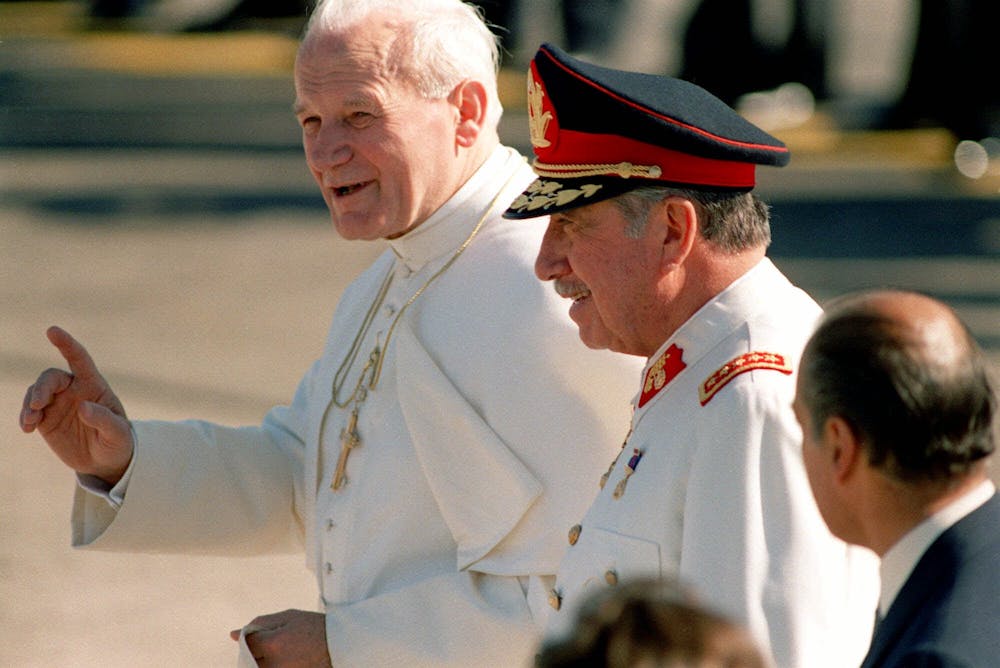
Pope John Paul II gave Communion to military dictator Augusto Pinochet.
AP Photo/Pete Leabo
In his trip to Chile in 1987, Pope John Paul II criticized the military dictatorship under the Army General Augusto Pinochet. Pinochet led a revolt that toppled the elected government. Thousands were tortured and executed under his rule. But the pope still gave Pinochet Communion.
When Pope John Paul II was beatified – a crucial step in becoming named a saint – Zimbabwe’s ruler, Robert Mugabe, was in attendance. Among many human rights abuses, Mugabe sanctioned the killing of 20,000 people belonging to the Ndebele ethnic minority who were loyal to his rival, Joshua Nkomo. Nonetheless, Mugabe was allowed to take Communion at the Vatican, in St. Peter’s Square. Some in the African Catholic media called this a “scandal.”
The path forward
Pope Francis has stated: “The Eucharist, although it is the fullness of sacramental life, is not a prize for the perfect but a powerful medicine and nourishment for the weak.” And so one of the key issues that the United States Conference of Catholic Bishops’ proposed document will surely need to address is when human weakness becomes serious sin and scandal.
While the United States Conference of Catholic Bishops will issue guidelines for reception of Communion, it will be the task of individual bishops to decide how to put them into practice. And some Catholic bishops, notably Cardinal Wilton Gregory of Washington D.C., have said they will not deny communion to President Biden in their jurisdictions.
At the present time, the Catholic Church in America is highly polarized. For his part, President Biden, who goes to Mass every week, has said that he has no plan to change how he worships. In such a context, U.S. Catholic bishops will have to move forward very carefully. 
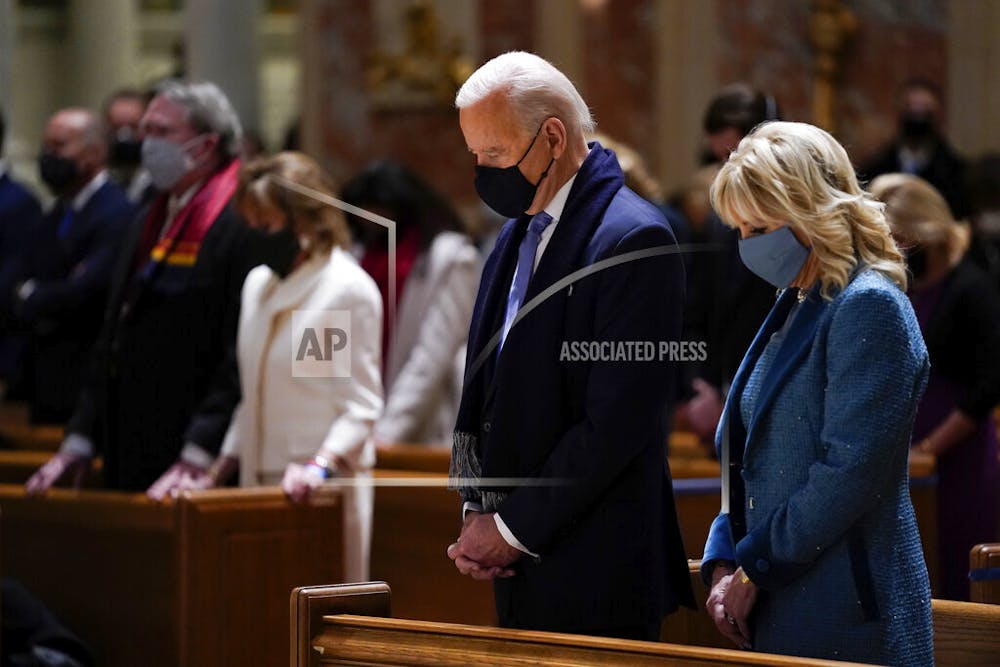
President Biden is an observant Catholic who regularly attends Mass.
AP Photo/Evan Vucci, File
This article is republished from The Conversation, a nonprofit news organization dedicated to unlocking ideas from academia, under a Creative Commons license.
[This week in religion, a global roundup each Thursday. Sign up.]

About Mathew Schmalz
Mathew Schmalz is a Professor of Religious Studies at College of the Holy Cross. You can read more about the author here.
Previous Post
June 26, 2021
Do people become more religious in times of crisis?

Browse Our Archives
Select a Category Buddhism Christianity Hinduism Islam Judaism Religion and society Uncategorized
Select a Month July 2024 March 2024 February 2024 January 2024 December 2023 November 2023 October 2023 September 2023 August 2023 July 2023 January 2023 August 2022 July 2022 April 2022 February 2022 January 2022 October 2021 July 2021 June 2021 May 2021 April 2021 March 2021 February 2021 January 2021 December 2020 November 2020 October 2020 September 2020 August 2020 July 2020 June 2020 May 2020
Follow Us!
TAKE THE
Religious Wisdom Quiz
What is the Christian teaching about temptation?
Select your answer to see how you score.
Ignore it Deny it exists Give in quickly Resist and pray for strength
Related posts from The Conversation


Electing A Virtuous President Would Make Immunity Irrelevant

Why The Olympic Games Are A ‘Civil Religious’...

The Catholic Church Is Using The Olympics To...
TRENDING AT PATHEOS Religion News

Catholic Integralists believe that religious values – specifically Christian ones – should...

Electing A Virtuous President Would Make Immunity Irrelevant
Presidential immunity can bring with it many risks. So how can we...

Why The Olympic Games Are A ‘Civil Religious’...
Sporting events form a vital space where Americans display their 'civil religious...

After more than a decade of news, research updates, and insights on...

Q: Why do Southern Baptists and like-minded Protestants...
THE RELIGION GUY’S ANSWER: Why? Simple. Because they believe that’s what the...

THE QUESTION: Is gambling evil? THE RELIGION GUY’S ANSWER: Analysts anticipate a...
view all Religion News blogs
Ad-Free & Subscriber Log-In Subscription Support
- About Us
- 2026 Calendar
- Videos
- Podcasts
- Library of World Religions
- Faith In Media Tracker
- Advertise With Us
- Write for Us
- Privacy Policy
- Terms of Service
- Do Not Sell My Data
- Contact Us
- Radiant Digital
- Manage Newsletter Subscriptions
- Unsubscribe From Notifications
- Sitemap
Copyright 2008-2026, Patheos. All rights reserved.
Subscription Support Ad-Free & Subscriber Log-In
Follow Patheos