
BuddhistCatholicContemplativeEvangelicalGeneral ChristianHinduJewishLatter-day SaintMuslimNew VisionsProgressive Christian
Beliefs
- Buddhist
- Catholic
- Contemplative
- Evangelical
- General Christian
- Hindu
- Jewish
- Latter-day Saint
- More Voices
- Muslim
- New Visions
- Pagan
- Progressive Christian
Topics
- Religion News
- Food and Religion
- Sports and Religion
- Religious Art
- Religious Music and Entertainment
- Religious Events
- History and Religion
- Style and Religion
- Politics and Religion
- Women in Religion
- Recreation Outdoors and Religion
- Business Finance and Religion
- Careers Workplace and Religion
- Education and Religion
- Family Parenting and Religion
- Health Fitness and Religion
- Home and Religion
- Relationships and Religion
- Technology and Religion
- Travel and Religion
Columnists
- Buddhist Columnists
- Business Finance and Religion Columnists
- Careers Workplace and Religion Columnists
- Catholic Columnists
- Contemplative Columnists
- Education and Religion Columnists
- Evangelists Columnists
- Family Parenting and Religion Columnists
- General Christian Columnists
- Health Fitness and Religion Columnists
- Hindu Columnists
- History and Religion Columnists
- Home and Religion Columnists
- Jewish Columnists
- More Voices Columnists
- Latter Day Columnists
- Muslim Columnists
- New Visions Columnists
- Nonreligious Columnists
- Pagan Columnists
- Politics and Religion Columnists
- Progressive Columnists
- Recreation Outdoors and Religion Columnists
- Relationships and Religion Columnists
- Religion News Columnists
- Religious Art Columnists
- Religious Events Columnists
- Religious Music and Entertainment Columnists
- Sports and Religion Columnists
- Style and Religion Columnists
- Technology and Religion Columnists
- Travel and Religion Columnists
- Women in Religion Columnists
Resource Library
- 2026 Calendar
- Library of World Religions
- The 100 Most Holy Places on Earth
- Patheos Answers
- Podcasts
- Videos
- Faith Leaders Database
- Anglican Episcopalian
- Bahai
- Baptist
- Buddhism
- Christianity
- Confucianism
- Eastern Orthodoxy
- Hinduism
- Holiness and Pentecostal
- ISKCON
- Islam
- Judaism
- Lutheran
- Methodist
- The Church of Jesus Christ of Latter-day Saints
- New Age
- Paganism
- Presbytarian and Reformed
- Protestantism
- Religion Behind the Scenes
- Roman Catholic
- Scientology
- Shia Islam
- Sikhism
- Sufism
- Sunni Islam
- Taoism
- Zen
- See all religions
Research Tools
 Ad-Free & Subscriber Log-In Subscription Support
Ad-Free & Subscriber Log-In Subscription Support
Follow Patheos 

- Trending:
- Forgiveness
- |
- Marriage
- |
- Consciousness
- |
- Death Penalty
- |
- Election
- |
- Halloween

- Home
- Religion News
- Famine in the Bible is more than a curse: It is a signal of change and a chance for a new beginning
Famine in the Bible is more than a curse: It is a signal of change and a chance for a new beginning
Last updated on: May 2, 2021 at 10:25 pm by The Conversation
Famine in the Bible is more than a curse: It is a signal of change and a chance for a new beginning 2021-05-02T22:25:40-04:00 The Conversation
Patheos Explore the world's faith through different perspectives on religion and spirituality! Patheos has the views of the prevalent religions and spiritualities of the world.
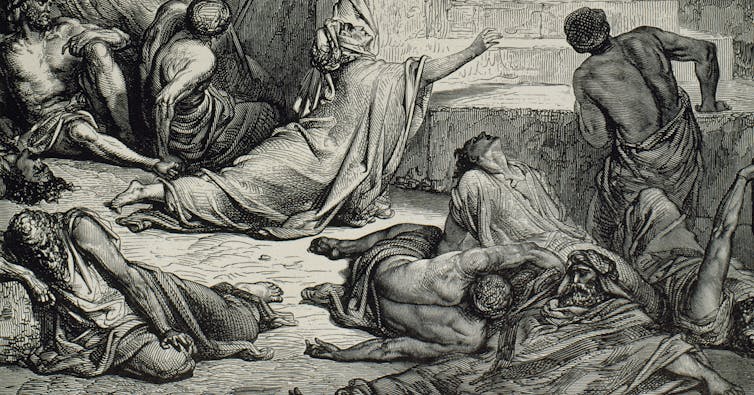
The famine in Samaria was one of many depicted in the Bible.
PHAS/Universal Images Group via Getty Images
By Joel Baden of Yale Divinity School
As the coronavirus spread rapidly around the world last year, the United Nations warned that the economic disruption of the pandemic could result in famines of “biblical proportions.”
The choice of words conveys more than just scale. Biblical stories of devastating famines are familiar to many. As a scholar of the Hebrew Bible, I understand that famines in biblical times were interpreted as more than mere natural occurrences. The authors of the Hebrew Bible used famine as a mechanism of divine wrath and destruction – but also as a storytelling device, a way to move the narrative forward.
When the heavens don’t open
Underlying the texts about famine in the Hebrew Bible was the constant threat and recurring reality of famine in ancient Israel.
Israel occupied the rocky highlands of Canaan – the area of present-day Jerusalem and the hills to the north of it – rather than fertile coastal plains. Even in the best of years, it took enormous effort to coax sufficient sustenance out of the ground. The rainy seasons were brief; any precipitation less than normal could be devastating.
Across the ancient Near East, drought and famine were feared. In the 13th century B.C., nearly all of the Eastern Mediterranean civilizations collapsed because of a prolonged drought.
For the biblical authors, rain was a blessing and drought a curse – quite literally. In the book of Deuteronomy, the fifth book of the Hebrew Bible, God proclaims that if Israel obeys the laws, “the Lord will open for you his bounteous store, the heavens, to provide rain for your land in season.”
Disobedience, however, will have the opposite effect: “The skies above your head shall be copper and the earth under you iron. The Lord will make the rain of your land dust, and sand shall drop on you from the sky, until you are wiped out.”
To ancient Israelites there was no such thing as nature as we understand it today and no such thing as chance. If things were good, it was because God was happy. If things were going badly, it was because the deity was angry. For a national catastrophe like famine, the sin had to lie either with the entire people, or with the monarchs who represented them. And it was the task of prophets and oracles to determine the cause of the divine wrath.
Divine anger…and punishment
Famine was seen as both punishment and opportunity. Suffering opened the door for repentance and change. For example, when the famously wise King Solomon inaugurates the temple in Jerusalem, he prays that God will be forgiving when, in the future, a famine-stricken Israel turns toward the newly built temple for mercy.
The Bible’s association of famine and other natural disasters with divine anger and punishment paved the way for faith leaders throughout the ages to use their pulpits to cast blame on those they found morally wanting. Preachers during the Dust Bowl of 1920s and 1930s America held alcohol and immorality responsible for provoking God’s anger. In 2005, televangelist Pat Robertson blamed abortion for Hurricane Katrina. Today some religious leaders have even assigned responsibility for the coronavirus pandemic to LGBTQ people.
In the book of Samuel, we read that Israel endured a three-year famine in the time of David, considered Israel’s greatest king. When David inquires as to the cause of the famine, he is told that it is due to the sins of his predecessor and mortal enemy, Saul. The story illustrates how biblical authors, like modern moral crusaders, used the opportunity of famine to demonize their opponents.
For the biblical writers interested in legislating and prophesying about Israel’s behavior, famine was both an ending – the result of disobedience and sin – and also a beginning, a potential turning point toward a better, more faithful future.
Other biblical authors, however, focused less on how or why famines happened and more on the opportunities that famine provided for telling new stories.
Seeking refuge
Famine as a narrative device – rather than as a theological tool – is found regularly throughout the Bible. The writers of the Hebrew Bible used famine as the motivating factor for major changes in the lives of its characters – undoubtedly reflecting the reality of famine’s impact in the ancient world.
We see this numerous times in the book of Genesis. For example, famine drives the biblical characters of Abraham to Egypt, Isaac to the land of the Philistines and Jacob and his entire family to Egypt.
Similarly, the book of Ruth opens with a famine that forces Naomi, the mother-in-law of Ruth, and her family to move first to, and then away from, Moab.

Naomi instructs her daughter-in-law Ruth to leave after famine struck.
Hulton Archive/Getty Images
The story of Ruth depends on the initial famine; it ends with Ruth being the ancestor of King David. Neither the Exodus nor King David – the central story and a major character of the Hebrew Bible – would exist without famine.
All of these stories share a common feature: famine as an impetus for the movement of people. And with that movement, in the ancient world as today, comes vulnerability. Residing in a foreign land meant abandoning social protections: land and kin, and perhaps even deity. One was at the mercy of the local populace.
This is why Israel, at least, had a wide range of laws intended to protect the stranger. It was understood that famine, or plague, or war, was common enough that anyone might be forced to leave their land to seek refuge in another. The principle of hospitality, still common in the region, ensured that the displaced would be protected.
Famine was a constant threat and a very real part of life for the ancient Israelite world that produced the Hebrew Bible. The ways that the Bible understood and addressed famine, in turn, have had a lasting impact down to the present. Most people today may not see famine as a manifestation of divine wrath. But they might recognize in famine the same opportunities to consider how we treat the displaced, and to imagine a better future.

Yale Divinity School is a member of the Association of Theological Schools.
The ATS is a funding partner of The Conversation US.
This article is republished from The Conversation, a nonprofit news organization dedicated to unlocking ideas from academia, under a Creative Commons license.
[This week in religion, a global roundup each Thursday. Sign up.]

About Joel Baden
Joel Baden is a Professor of Hebrew Bible at Yale Divinity School. You can read more about the author here.

Browse Our Archives
Select a Category Buddhism Christianity Hinduism Islam Judaism Religion and society Uncategorized
Select a Month July 2024 March 2024 February 2024 January 2024 December 2023 November 2023 October 2023 September 2023 August 2023 July 2023 January 2023 August 2022 July 2022 April 2022 February 2022 January 2022 October 2021 July 2021 June 2021 May 2021 April 2021 March 2021 February 2021 January 2021 December 2020 November 2020 October 2020 September 2020 August 2020 July 2020 June 2020 May 2020
Follow Us!
TAKE THE
Religious Wisdom Quiz
Four beasts rose from the sea—one like a lion with eagle's wings, one like a bear, one like a leopard, and a fourth terrifying beast. What did these represent?
Select your answer to see how you score.
Four kingdoms Four kings Four ages Four judgments
Related posts from The Conversation


How Christians Hold Differing Views On The Resurrection

Pope Francis called surrogacy ‘deplorable’

How religion and politics will mix in 2024
TRENDING AT PATHEOS Religion News

Catholic Integralists believe that religious values – specifically Christian ones – should...

Electing A Virtuous President Would Make Immunity Irrelevant
Presidential immunity can bring with it many risks. So how can we...

Why The Olympic Games Are A ‘Civil Religious’...
Sporting events form a vital space where Americans display their 'civil religious...

After more than a decade of news, research updates, and insights on...

Q: Why do Southern Baptists and like-minded Protestants...
THE RELIGION GUY’S ANSWER: Why? Simple. Because they believe that’s what the...

THE QUESTION: Is gambling evil? THE RELIGION GUY’S ANSWER: Analysts anticipate a...
view all Religion News blogs
Ad-Free & Subscriber Log-In Subscription Support
- About Us
- 2026 Calendar
- Videos
- Podcasts
- Library of World Religions
- Faith In Media Tracker
- Advertise With Us
- Write for Us
- Privacy Policy
- Terms of Service
- Do Not Sell My Data
- Contact Us
- Radiant Digital
- Manage Newsletter Subscriptions
- Unsubscribe From Notifications
- Sitemap
Copyright 2008-2026, Patheos. All rights reserved.
Subscription Support Ad-Free & Subscriber Log-In
Follow Patheos