
BuddhistCatholicContemplativeEvangelicalGeneral ChristianHinduJewishLatter-day SaintMuslimNew VisionsProgressive Christian
Beliefs
- Buddhist
- Catholic
- Contemplative
- Evangelical
- General Christian
- Hindu
- Jewish
- Latter-day Saint
- More Voices
- Muslim
- New Visions
- Pagan
- Progressive Christian
Topics
- Religion News
- Food and Religion
- Sports and Religion
- Religious Art
- Religious Music and Entertainment
- Religious Events
- History and Religion
- Style and Religion
- Politics and Religion
- Women in Religion
- Recreation Outdoors and Religion
- Business Finance and Religion
- Careers Workplace and Religion
- Education and Religion
- Family Parenting and Religion
- Health Fitness and Religion
- Home and Religion
- Relationships and Religion
- Technology and Religion
- Travel and Religion
Columnists
- Buddhist Columnists
- Business Finance and Religion Columnists
- Careers Workplace and Religion Columnists
- Catholic Columnists
- Contemplative Columnists
- Education and Religion Columnists
- Evangelists Columnists
- Family Parenting and Religion Columnists
- General Christian Columnists
- Health Fitness and Religion Columnists
- Hindu Columnists
- History and Religion Columnists
- Home and Religion Columnists
- Jewish Columnists
- More Voices Columnists
- Latter Day Columnists
- Muslim Columnists
- New Visions Columnists
- Nonreligious Columnists
- Pagan Columnists
- Politics and Religion Columnists
- Progressive Columnists
- Recreation Outdoors and Religion Columnists
- Relationships and Religion Columnists
- Religion News Columnists
- Religious Art Columnists
- Religious Events Columnists
- Religious Music and Entertainment Columnists
- Sports and Religion Columnists
- Style and Religion Columnists
- Technology and Religion Columnists
- Travel and Religion Columnists
- Women in Religion Columnists
Resource Library
- 2026 Calendar
- Library of World Religions
- The 100 Most Holy Places on Earth
- Patheos Answers
- Podcasts
- Videos
- Faith Leaders Database
- Anglican Episcopalian
- Bahai
- Baptist
- Buddhism
- Christianity
- Confucianism
- Eastern Orthodoxy
- Hinduism
- Holiness and Pentecostal
- ISKCON
- Islam
- Judaism
- Lutheran
- Methodist
- The Church of Jesus Christ of Latter-day Saints
- New Age
- Paganism
- Presbytarian and Reformed
- Protestantism
- Religion Behind the Scenes
- Roman Catholic
- Scientology
- Shia Islam
- Sikhism
- Sufism
- Sunni Islam
- Taoism
- Zen
- See all religions
Research Tools
 Ad-Free & Subscriber Log-In Subscription Support
Ad-Free & Subscriber Log-In Subscription Support
Follow Patheos 

- Trending:
- Forgiveness
- |
- Marriage
- |
- Consciousness
- |
- Death Penalty
- |
- Election
- |
- Halloween

- Home
- Religion News
- Faith in numbers: Is church attendance linked to higher rates of coronavirus?
Faith in numbers: Is church attendance linked to higher rates of coronavirus?
Last updated on: May 26, 2021 at 11:50 am by The Conversation
Faith in numbers: Is church attendance linked to higher rates of coronavirus? 2021-05-26T11:50:57-04:00 The Conversation
Patheos Explore the world's faith through different perspectives on religion and spirituality! Patheos has the views of the prevalent religions and spiritualities of the world.
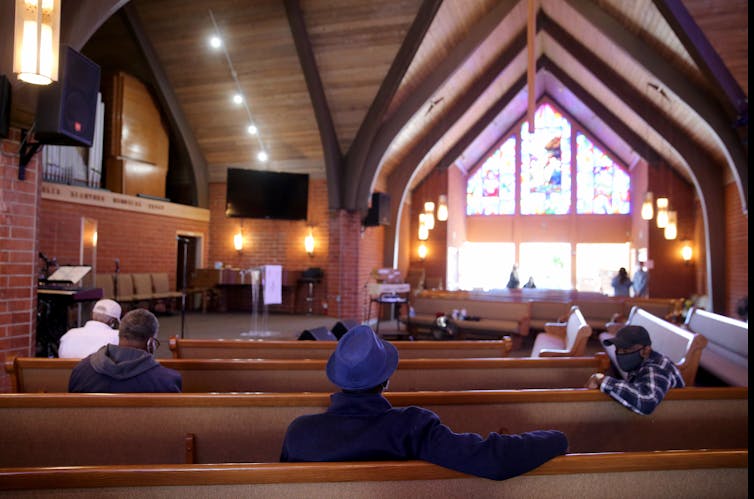
Church closures were among the most contested measures brought in to fight COVID-19.
Mario Tama/Getty Images
By Ryan Burge of Eastern Illinois University
The lockdowns that almost every state went into in order to combat the spread of COVID-19 in the spring of 2020 interrupted nearly every aspect of Americans’ lives. Businesses were shuttered, schools closed and social groups stopped meeting as scientists rushed to understand the pathways through which the virus spread.
One of the most controversial parts of the lockdown strategy in the United States was the closure of churches across the country.
But as an analyst of religious data, I believe the latest evidence appears to point to the clear conclusion that there was a correlation between attending church and the spread of COVID-19.
Closures and backlash
Public health experts strongly urged churches to cease congregational meetings during the worst parts of the pandemic, noting that religious services were an ideal vector to spread the virus. They pointed to incidents such as that in March 2020 when a choir practice in a church resulted in 87% of attendees being infected with COVID-19, and two members losing their lives.
But the closures were met by a massive backlash among conservative Christians who believed that executive orders closing religious institutions were a clear violation of the First Amendment’s freedom of religion protection. Some places of worship simply ignored state closure orders. As the pandemic wore on and people tired of socially isolating, many churches, mosques and synagogues began to reopen.
Although this was bad news from a public health perspective, it meant social scientists were able to investigate whether churchgoing during the pandemic did indeed lead to a higher level of infection. And in March 2021, the Cooperative Election Study released the results of a survey it fielded in October of 2020. The annual survey of the American public saw a total of 61,000 respondents quizzed over a number of topics.
Alongside a question about their level of church attendance, respondents were asked if they had been diagnosed with COVID-19 during the past year. Because of the highly partisan nature of the response to the pandemic and the subsequent lockdowns, the sample was divided into Republicans, Democrats and independents.
The trend in the data is unmistakable – the more frequently someone goes to church, the more likely they were to report that they had been diagnosed with COVID-19 during the first seven months of the pandemic.
Just 3% of Republicans and 4% of Democrats who never attended church were more likely to respond that they have been infected. Among those who attended church multiple times per week, nearly 11% of Democrats had tested positive for the coronavirus, while 8% of Republicans reported the same.
It’s worth pointing out that there’s not a large partisan gap in those reporting a positive COVID-19 test – in most cases the share of Democrats and Republicans who had been infected did not deviate by more than one percentage point. There’s ample evidence that Democrats took public health directives more seriously; however, that may have been offset by the fact that Democratic areas tend to have high population density. Urban areas were especially hard-hit in the early days of the pandemic.
The survey results do come with some caveats. It’s important to note that this is a survey of self-reported infections, without any independent verification. A concept in public opinion research called “social desirability bias” highlights the tendency of respondents to lie when they are asked a question that is sensitive in nature. As such, the number of people infected may be an underestimate. Also, the data was compiled before the largest spike in COVID-19 infections in early January 2021, and as a result the data captures only those who got infected earlier in the pandemic.
And while the focus here is on church attendance, it’s logical to conclude that individuals who felt comfortable going back to weekend worship were also more willing to engage in other social activities. It is therefore difficult to isolate whether church attendance was the vector that most likely spread the infection, or if a general disposition toward social gatherings drove up the likelihood of testing positive for COVID-19.
Nonetheless, it does seem fair to conclude that those who attended church more frequently in 2020 were also more likely to be infected with COVID-19. There is now plenty of research to suggest that social distancing, avoiding crowds and meeting people only outdoors are mitigation factors when it comes to the spread of the virus – all things that are harder to do in the confines of a church.

This article is republished from The Conversation, a nonprofit news organization dedicated to unlocking ideas from academia, under a Creative Commons license.
[This week in religion, a global roundup each Thursday. Sign up.]

About Ryan Burge
Ryan Burge is an Assistant Professor of Political Science at Eastern Illinois University. You can read more about the author here.
Previous Post
May 19, 2021
Cancel culture looks a lot like old-fashioned church discipline
Next Post
June 26, 2021 Do people become more religious in times of crisis?
Browse Our Archives
Select a Category Buddhism Christianity Hinduism Islam Judaism Religion and society Uncategorized
Select a Month July 2024 March 2024 February 2024 January 2024 December 2023 November 2023 October 2023 September 2023 August 2023 July 2023 January 2023 August 2022 July 2022 April 2022 February 2022 January 2022 October 2021 July 2021 June 2021 May 2021 April 2021 March 2021 February 2021 January 2021 December 2020 November 2020 October 2020 September 2020 August 2020 July 2020 June 2020 May 2020
Follow Us!
TAKE THE
Religious Wisdom Quiz
Who provided bread and Goliath's sword to David at Nob?
Select your answer to see how you score.
Abiathar Abner Ahimelech the priest Jonathan
Related posts from The Conversation


Electing A Virtuous President Would Make Immunity Irrelevant

Why The Olympic Games Are A ‘Civil Religious’...

The Catholic Church Is Using The Olympics To...
TRENDING AT PATHEOS Religion News

Catholic Integralists believe that religious values – specifically Christian ones – should...

Electing A Virtuous President Would Make Immunity Irrelevant
Presidential immunity can bring with it many risks. So how can we...

Why The Olympic Games Are A ‘Civil Religious’...
Sporting events form a vital space where Americans display their 'civil religious...

After more than a decade of news, research updates, and insights on...

Q: Why do Southern Baptists and like-minded Protestants...
THE RELIGION GUY’S ANSWER: Why? Simple. Because they believe that’s what the...

THE QUESTION: Is gambling evil? THE RELIGION GUY’S ANSWER: Analysts anticipate a...
view all Religion News blogs
Ad-Free & Subscriber Log-In Subscription Support
- About Us
- 2026 Calendar
- Videos
- Podcasts
- Library of World Religions
- Faith In Media Tracker
- Advertise With Us
- Write for Us
- Privacy Policy
- Terms of Service
- Do Not Sell My Data
- Contact Us
- Radiant Digital
- Manage Newsletter Subscriptions
- Unsubscribe From Notifications
- Sitemap
Copyright 2008-2026, Patheos. All rights reserved.
Subscription Support Ad-Free & Subscriber Log-In
Follow Patheos