
BuddhistCatholicContemplativeEvangelicalGeneral ChristianHinduJewishLatter-day SaintMuslimNew VisionsProgressive Christian
Beliefs
- Buddhist
- Catholic
- Contemplative
- Evangelical
- General Christian
- Hindu
- Jewish
- Latter-day Saint
- More Voices
- Muslim
- New Visions
- Pagan
- Progressive Christian
Topics
- Religion News
- Food and Religion
- Sports and Religion
- Religious Art
- Religious Music and Entertainment
- Religious Events
- History and Religion
- Style and Religion
- Politics and Religion
- Women in Religion
- Recreation Outdoors and Religion
- Business Finance and Religion
- Careers Workplace and Religion
- Education and Religion
- Family Parenting and Religion
- Health Fitness and Religion
- Home and Religion
- Relationships and Religion
- Technology and Religion
- Travel and Religion
Columnists
- Buddhist Columnists
- Business Finance and Religion Columnists
- Careers Workplace and Religion Columnists
- Catholic Columnists
- Contemplative Columnists
- Education and Religion Columnists
- Evangelists Columnists
- Family Parenting and Religion Columnists
- General Christian Columnists
- Health Fitness and Religion Columnists
- Hindu Columnists
- History and Religion Columnists
- Home and Religion Columnists
- Jewish Columnists
- More Voices Columnists
- Latter Day Columnists
- Muslim Columnists
- New Visions Columnists
- Nonreligious Columnists
- Pagan Columnists
- Politics and Religion Columnists
- Progressive Columnists
- Recreation Outdoors and Religion Columnists
- Relationships and Religion Columnists
- Religion News Columnists
- Religious Art Columnists
- Religious Events Columnists
- Religious Music and Entertainment Columnists
- Sports and Religion Columnists
- Style and Religion Columnists
- Technology and Religion Columnists
- Travel and Religion Columnists
- Women in Religion Columnists
Resource Library
- 2026 Calendar
- Library of World Religions
- The 100 Most Holy Places on Earth
- Patheos Answers
- Podcasts
- Videos
- Faith Leaders Database
- Anglican Episcopalian
- Bahai
- Baptist
- Buddhism
- Christianity
- Confucianism
- Eastern Orthodoxy
- Hinduism
- Holiness and Pentecostal
- ISKCON
- Islam
- Judaism
- Lutheran
- Methodist
- The Church of Jesus Christ of Latter-day Saints
- New Age
- Paganism
- Presbytarian and Reformed
- Protestantism
- Religion Behind the Scenes
- Roman Catholic
- Scientology
- Shia Islam
- Sikhism
- Sufism
- Sunni Islam
- Taoism
- Zen
- See all religions
Research Tools
 Ad-Free & Subscriber Log-In Subscription Support
Ad-Free & Subscriber Log-In Subscription Support
Follow Patheos 

- Trending:
- Forgiveness
- |
- Marriage
- |
- Consciousness
- |
- Death Penalty
- |
- Election
- |
- Halloween

- Home
- Religion News
- Cancel culture looks a lot like old-fashioned church discipline
Cancel culture looks a lot like old-fashioned church discipline
Last updated on: May 19, 2021 at 10:43 am by The Conversation
Cancel culture looks a lot like old-fashioned church discipline 2021-05-19T10:43:15-04:00 The Conversation
Patheos Explore the world's faith through different perspectives on religion and spirituality! Patheos has the views of the prevalent religions and spiritualities of the world.
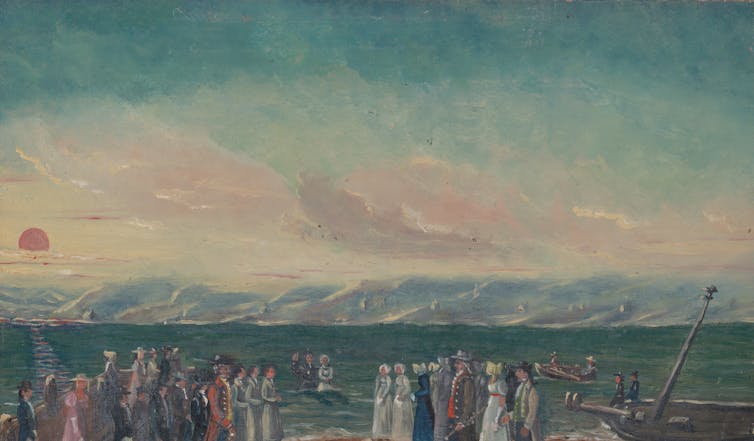
A form of ‘canceling’ was common among Baptists in America.
Heritage Art/Heritage Images via Getty Images
By Christopher Schelin of Starr King School for the Ministry
Blink and you may have missed one of the more recent controversies over cancel culture.
On March 23, 2021, columnist Hemal Jhaveri published an opinion piece at For The Win, a sports commentary website operated by USA Today. In it, she remarked on the “Cinderella story” then forming around the surprising success of Oral Roberts University, an evangelical Christian school, in the NCAA Men’s Basketball Tournament. Rather than cheer, Jhaveri suggested, fans should protest the team over the “university’s deeply bigoted anti-LGBTQ+ policies.”
Two days later, USA Today published a response by Ed Stetzer, a professor at the evangelical Wheaton College, who criticized a supposed “mob” for rushing to cancel ORU from March Madness. Ironically, it was Jhaveri who was canceled – that is to say, fired – by USA Today the next day in the wake of a tweet about mass shootings, one that she would acknowledge was ill-considered. ORU’s basketball team, meanwhile, was removed from the tournament not by howling protesters but by Arkansas in a Sweet 16 matchup.
Church discipline
Extensive debate has swirled around the purpose, effectiveness and even the very existence of what has been called “cancel culture.” The phrase itself may have originated as a joke. But the phenomenon is rooted in what has been characterized as efforts by political progressives to “call out” individuals and organizations engaged in offensive or damaging behavior. It entails public efforts, usually on social media, to shame the perpetrator and instill consequences and has been seized on by many on the political right as a wedge issue in the so-called culture wars.
But “canceling” is not wholly embraced on the left, nor is it unknown among political or religious conservatives.
In fact, cancel culture should have a ring of familiarity for Stetzer, a Southern Baptist. As a scholar of practical and political theology, I see echoes of the phenomenon in the history of the church.
From their origins in the 17th century through the late 19th century, Baptists in America – most especially in the South – vigorously engaged in the practice of church discipline. Believers who had allegedly sinned would be accused, tried and then convicted by their peers – the verdict was decided by democratic vote. While the repentant were restored to fellowship, the obstinate were excommunicated, or to borrow from today’s parlance, “canceled.”
Cleansing the body politic
Baptists prosecuted their own for a panoply of offenses, including alcoholism, social dancing and erroneous beliefs. They disciplined white males for mistreating their wives and slaves, but they also disciplined wives for disobedience to their husbands.
At its height, the church discipline generated a massive turnover in membership. The historian Gregory Wills, in his book “Democratic Religion,” claims that Baptists in Georgia excommunicated more than 40,000 members in the years preceding the Civil War.
Church discipline relaxed over time and essentially disappeared by the end of the 1920s. But some Southern Baptists today aim to restore its place in congregational life as a bulwark against what they see as “moral relativism” and a way to address what they see as offenses such as homosexuality, sex outside of marriage and false teaching.
At first glance, evangelical disciplinarians and progressive “cancelers” may seem worlds apart. Yet I believe they share certain key features. They both express what can be described as a purity ethic that aims to root out behaviors deemed to be harmful from the body politic.
Both struggle with the question of appropriate response. Do the offender’s actions warrant exclusion? Is there an opportunity for rehabilitation and, if so, how is this achieved?
Both disciplining and canceling are also, in my view, acts of meaning-making that may be called religious. As the sociologist Peter Berger famously argued, religion erects a “sacred canopy” that provides order to one’s experience of the world. Secularization has, in many cases, transferred the function of religion to other domains, especially politics.
So, just as a Baptist in 1821 maintained his sacred canopy, the Kingdom of God, in part through upholding church discipline, a political activist in 2021 might maintain their “sacred canopy” – whether it is called “social justice” or “freedom” – by calling out opinions they consider too abhorrent to be tolerated in contemporary society.
Chance of reconciliation
We not only discover a form of “cancel culture” in the history of American evangelicalism, but also some examples of how to overcome the polarization that often defines its contemporary expressions.

Pastor Jesse Mercer uncanceled a congregant.
Wikimedia
In 1817, one “Brother Lancaster” was brought before the membership of Powelton Baptist Church for allowing dancing at his daughter’s wedding. Lancaster admitted his guilt but turned accuser, declaring that the church had neglected to address weightier sins, including favoritism of the rich over the poor. The pastor, Jesse Mercer, was brought to tears and prayed for reconciliation. The church welcomed Lancaster back in to the fold, then broke into song.
For a fractured nation, Lancaster’s story provides an important reminder from Stetzer’s and my ancestors in faith. The quest for moral accountability finds its greatest successes – and surprises – when rebuke and counterrebuke give way to authentic listening.
Editor’s note: The main image on this article was changed on May 1, 2021.
This article is republished from The Conversation, a nonprofit news organization dedicated to unlocking ideas from academia, under a Creative Commons license.
[This week in religion, a global roundup each Thursday. Sign up.]

About Christopher Schelin
Christopher Schelin is an Assistant Professor of Practical and Political Theologies at Starr King School for the Ministry. You can read more about the author here.


Next Post
May 26, 2021 Faith in numbers: Is church attendance linked to higher rates of coronavirus?
Browse Our Archives
Select a Category Buddhism Christianity Hinduism Islam Judaism Religion and society Uncategorized
Select a Month July 2024 March 2024 February 2024 January 2024 December 2023 November 2023 October 2023 September 2023 August 2023 July 2023 January 2023 August 2022 July 2022 April 2022 February 2022 January 2022 October 2021 July 2021 June 2021 May 2021 April 2021 March 2021 February 2021 January 2021 December 2020 November 2020 October 2020 September 2020 August 2020 July 2020 June 2020 May 2020
Follow Us!
TAKE THE
Religious Wisdom Quiz
I cleansed the temple in sixteen days and celebrated Passover so joyfully that we extended it another seven days. Who am I?
Select your answer to see how you score.
Asa Hezekiah Jehoshaphat Josiah
Related posts from The Conversation


Electing A Virtuous President Would Make Immunity Irrelevant

Why The Olympic Games Are A ‘Civil Religious’...

The Catholic Church Is Using The Olympics To...
TRENDING AT PATHEOS Religion News

Catholic Integralists believe that religious values – specifically Christian ones – should...

Electing A Virtuous President Would Make Immunity Irrelevant
Presidential immunity can bring with it many risks. So how can we...

Why The Olympic Games Are A ‘Civil Religious’...
Sporting events form a vital space where Americans display their 'civil religious...

After more than a decade of news, research updates, and insights on...

Q: Why do Southern Baptists and like-minded Protestants...
THE RELIGION GUY’S ANSWER: Why? Simple. Because they believe that’s what the...

THE QUESTION: Is gambling evil? THE RELIGION GUY’S ANSWER: Analysts anticipate a...
view all Religion News blogs
Ad-Free & Subscriber Log-In Subscription Support
- About Us
- 2026 Calendar
- Videos
- Podcasts
- Library of World Religions
- Faith In Media Tracker
- Advertise With Us
- Write for Us
- Privacy Policy
- Terms of Service
- Do Not Sell My Data
- Contact Us
- Radiant Digital
- Manage Newsletter Subscriptions
- Unsubscribe From Notifications
- Sitemap
Copyright 2008-2026, Patheos. All rights reserved.
Subscription Support Ad-Free & Subscriber Log-In
Follow Patheos