
BuddhistCatholicContemplativeEvangelicalGeneral ChristianHinduJewishLatter-day SaintMuslimNew VisionsProgressive Christian
Beliefs
- Buddhist
- Catholic
- Contemplative
- Evangelical
- General Christian
- Hindu
- Jewish
- Latter-day Saint
- More Voices
- Muslim
- New Visions
- Pagan
- Progressive Christian
Topics
- Religion News
- Food and Religion
- Sports and Religion
- Religious Art
- Religious Music and Entertainment
- Religious Events
- History and Religion
- Style and Religion
- Politics and Religion
- Women in Religion
- Recreation Outdoors and Religion
- Business Finance and Religion
- Careers Workplace and Religion
- Education and Religion
- Family Parenting and Religion
- Health Fitness and Religion
- Home and Religion
- Relationships and Religion
- Technology and Religion
- Travel and Religion
Columnists
- Buddhist Columnists
- Business Finance and Religion Columnists
- Careers Workplace and Religion Columnists
- Catholic Columnists
- Contemplative Columnists
- Education and Religion Columnists
- Evangelists Columnists
- Family Parenting and Religion Columnists
- General Christian Columnists
- Health Fitness and Religion Columnists
- Hindu Columnists
- History and Religion Columnists
- Home and Religion Columnists
- Jewish Columnists
- More Voices Columnists
- Latter Day Columnists
- Muslim Columnists
- New Visions Columnists
- Nonreligious Columnists
- Pagan Columnists
- Politics and Religion Columnists
- Progressive Columnists
- Recreation Outdoors and Religion Columnists
- Relationships and Religion Columnists
- Religion News Columnists
- Religious Art Columnists
- Religious Events Columnists
- Religious Music and Entertainment Columnists
- Sports and Religion Columnists
- Style and Religion Columnists
- Technology and Religion Columnists
- Travel and Religion Columnists
- Women in Religion Columnists
Resource Library
- 2026 Calendar
- Library of World Religions
- The 100 Most Holy Places on Earth
- Patheos Answers
- Podcasts
- Videos
- Faith Leaders Database
- Anglican Episcopalian
- Bahai
- Baptist
- Buddhism
- Christianity
- Confucianism
- Eastern Orthodoxy
- Hinduism
- Holiness and Pentecostal
- ISKCON
- Islam
- Judaism
- Lutheran
- Methodist
- The Church of Jesus Christ of Latter-day Saints
- New Age
- Paganism
- Presbytarian and Reformed
- Protestantism
- Religion Behind the Scenes
- Roman Catholic
- Scientology
- Shia Islam
- Sikhism
- Sufism
- Sunni Islam
- Taoism
- Zen
- See all religions
Research Tools
 Ad-Free & Subscriber Log-In Subscription Support
Ad-Free & Subscriber Log-In Subscription Support
Follow Patheos 

- Trending:
- Forgiveness
- |
- Marriage
- |
- Consciousness
- |
- Death Penalty
- |
- Election
- |
- Halloween

- Home
- Religion News
- Ancient Christian thinkers made a case for reparations that has striking relevance today
Ancient Christian thinkers made a case for reparations that has striking relevance today
Last updated on: May 16, 2021 at 4:31 pm by The Conversation
Ancient Christian thinkers made a case for reparations that has striking relevance today 2021-05-16T16:31:34-04:00 The Conversation
Patheos Explore the world's faith through different perspectives on religion and spirituality! Patheos has the views of the prevalent religions and spiritualities of the world.
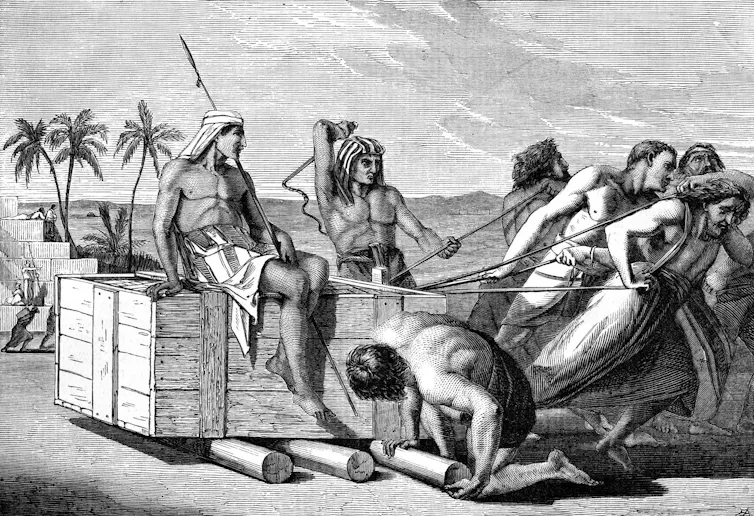
Some ancient theologians argued that the Israelites deserved a share of Egypt’s wealth after being enslaved for centuries.
Culture Club/Hulton Archive via Getty Images
By David Lincicum of University of Notre Dame
Reparations to Black Americans for centuries of slavery and oppression have been discussed for a long time. But ever since journalist and author Ta-Nehisi Coates wrote “The Case for Reparations” in The Atlantic in 2014, the conversation has taken on a new urgency. Just this month a House committee voted to create a commission to consider reparations.
However, debates over compensating a group of people for past injuries or abuses date back to at least the early centuries of the common era. As a professor of theology who teaches about Jewish and Christian antiquity, I have studied how the logic of reparations has roots in the Hebrew Bible and in early Christian biblical interpretation.

Writer Ta-Nehisi Coates testifies during a 2019 hearing on slavery reparations.
Zach Gibson/Getty Images
Exodus from Egypt
The classic text for thinking about reparations is the story of the Israelites’ flight from Egypt, recounted in detail in the Book of Exodus, the second book of the Old Testament.
The Israelites had been enslaved by the Egyptians and subjected to forced labor for hundreds of years. As the story goes, through divine intervention and the leadership of the prophet Moses, the people were set free and allowed to depart Egypt.
As God announces the plan in advance to Moses, he assures him:
“I will bring this people into such favor with the Egyptians that, when you go, you will not go empty-handed; each woman shall ask her neighbor and any woman living in the neighbor’s house for jewelry of silver and of gold, and clothing, and you shall put them on your sons and on your daughters; and so you shall plunder the Egyptians.”
When the Israelites ask as commanded, the Egyptians surprisingly comply. “And so,” the text laconically summarizes, “they plundered the Egyptians.”
Literal or allegorical plunder?
The story seems to have been a source of embarrassment to Jews and Christians in antiquity and even in more recent times.
Whether deceit was involved has been a matter of scholarly discussion, but at least one ancient historian used the account to paint the Jews of his day in a dim light. Around the turn of the millennium, Pompeius Trogus wrote that Moses led the Israelites in “carrying off by stealth the sacred utensils of the Egyptians.”
Perhaps in light of similar accusations, some Jews and, subsequently, Christians, interpreted the text as a story about symbolic and not literal plunder.
The Jewish Alexandrian philosopher Philo, an older contemporary of Jesus in the first century, interpreted the event literally and justified the Israelites’ actions.
“For what resemblance is there between forfeiture of money and deprivation of liberty,” he wrote, “for which men of sense are willing to sacrifice not only their substance but their life?”
In other words, the Israelites were in the right to take material goods from the Egyptians since the Egyptians had deprived them of the far greater good of freedom.
But in another treatise, Philo gave an allegorical interpretation in which the Egyptians’ wealth represented pagan philosophy.
He felt that ideas that might originate in “pagan” philosophy could be put to good use – or “plundered” – for Jewish purposes. By way of comparison, one might imagine a contemporary preacher using, say, insights from psychoanalysis to elucidate the meaning of a biblical passage.
Two centuries later, the Christian scholar Origen of Alexandria used a similar argument to make the case that “pagan” philosophy should be studied by Christians as the “adjunct to Christianity” – to prepare for and supplement true Christian teaching. He justifies this taking of intellectual property by using the example of the Israelites making off with the Egyptians’ possessions. He understood the biblical text’s account of the plundering of the Egyptians to be a symbolic authorization for Christians to take the intellectual property of the surrounding pagan culture.
Subsequent Christians theologians, from St. Augustine in the late fourth century onward throughout the medieval period, took up this line of interpretation.
‘Not just a few dishes’
But Philo’s literal understanding of the passage – that the Israelites took property from the Egyptians as a form of just repayment for their enslavement – also found followers among the early Christians.
In the second century A.D., a debate raged in the Christian Church as to whether the Jewish scriptures should be authoritative for Christians. Marcion, a charismatic leader from the Black Sea region, contended that the Hebrew Bible attested an inferior god and so should be discarded. He and his followers urged that it contained morally reprehensible stories, and held up the plundering of the Egyptians as an example.
The theologians Irenaeus of Lyons and Tertullian of North Africa, who argued for what ultimately became the form of Christian belief backed by political authorities, however, disagreed.
Irenaeus replied to the Marcionite argument in his treatise “Against Heresies,” which contains a remarkable display of the logic of reparations.
He writes that the Egyptians held the Israelites in “abject slavery” while at the same time contemplating their “utter annihilation.” Meanwhile, the Israelites built them “fenced cities” and made them even more wealthy.
“In what way, then,” Irenaeus asks, “did the Israelites act unjustly, if out of many things they took a few?”
His argument is straightforward: The Israelites deserved to be repaid for their forced labor. They contributed to the wealth of the Egyptians, and so had a right to a share of it.
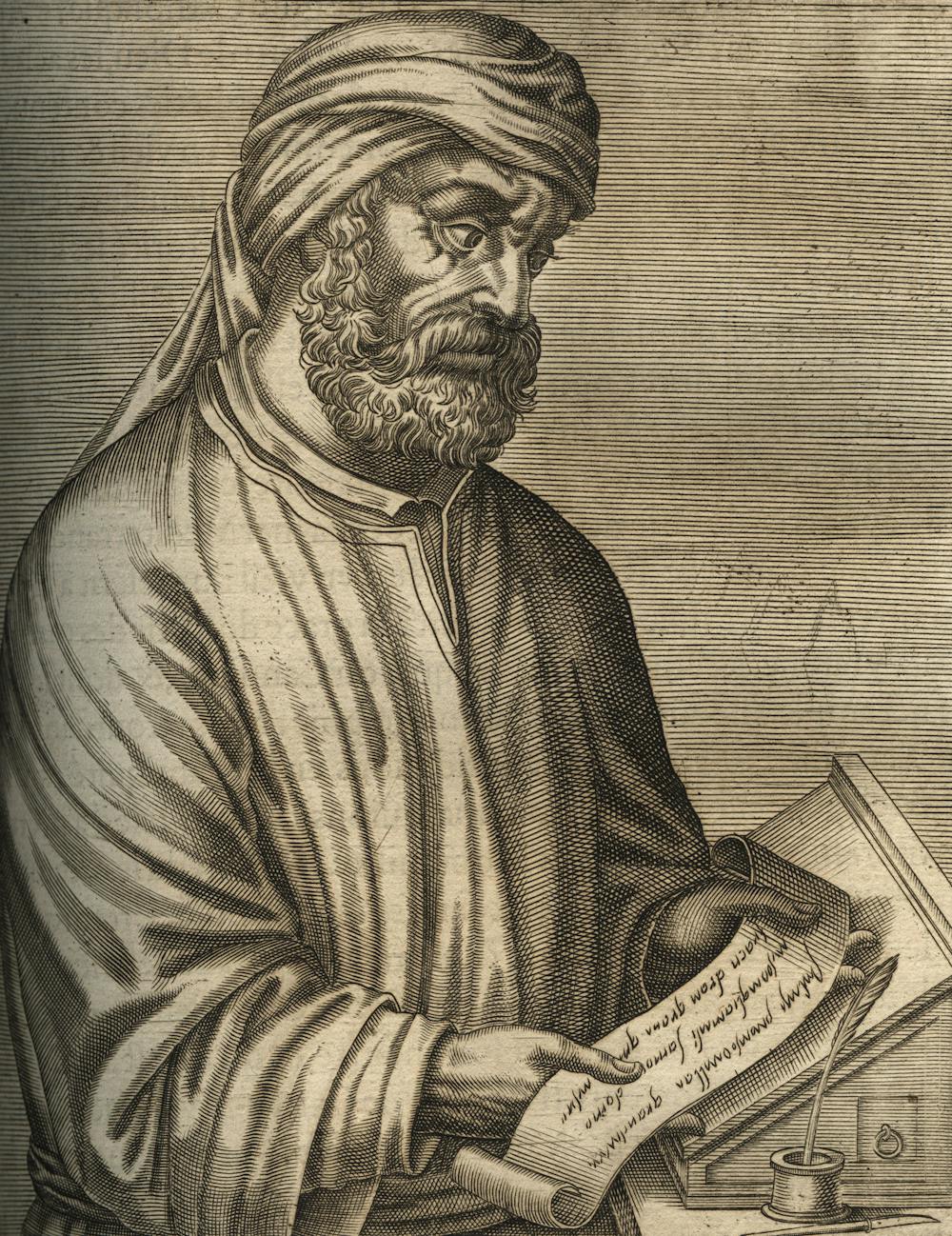
Early Christian author Quintus Septimius Florens Tertullianus, aka Tertullian, circa A.D. 200.
Adoc-Photos/Corbis Historical Collection via Getty Images
Some 25 years later, Tertullian wrote a systematic refutation of Marcion’s position, entitled “Against Marcion.” In it, he repeated some of Irenaeus’ arguments, including his case for reparations.
Tertullian imagines a court in his own day hearing the claims of “the Hebrews.” He argues that no amount of gold and silver could repay the Israelites for their hardship. “[They] were free men reduced to slavery,” he writes. “If their legal representatives were to display in court no more than their shoulders scarred with the abusive outrage of whippings, any judge would have agreed that the Hebrews must receive in recompense not just a few dishes and flagons … but the whole of those rich men’s property.”
Particularly notable is the fact that Tertullian makes the case for reparations to be paid to the descendants of the Israelites who had been forcibly enslaved centuries earlier. Although the force of the passage is driven by a debate about scriptural interpretation, its logic strikingly anticipates the case for reparations in the U.S. today.


The ATS is a funding partner of The Conversation US.
This article is republished from The Conversation, a nonprofit news organization dedicated to unlocking ideas from academia, under a Creative Commons license.
[This week in religion, a global roundup each Thursday. Sign up.]

About David Lincicum
David Lincicum is an Associate Professor of Theology at University of Notre Dame. You can read more about the author here.

Next Post

May 19, 2021 Cancel culture looks a lot like old-fashioned church discipline
Browse Our Archives
Select a Category Buddhism Christianity Hinduism Islam Judaism Religion and society Uncategorized
Select a Month July 2024 March 2024 February 2024 January 2024 December 2023 November 2023 October 2023 September 2023 August 2023 July 2023 January 2023 August 2022 July 2022 April 2022 February 2022 January 2022 October 2021 July 2021 June 2021 May 2021 April 2021 March 2021 February 2021 January 2021 December 2020 November 2020 October 2020 September 2020 August 2020 July 2020 June 2020 May 2020
Follow Us!
TAKE THE
Religious Wisdom Quiz
The beginning of knowledge starts with this.
Select your answer to see how you score.
Understanding Fear of the Lord Wisdom Instruction
Related posts from The Conversation


Electing A Virtuous President Would Make Immunity Irrelevant

Why The Olympic Games Are A ‘Civil Religious’...

The Catholic Church Is Using The Olympics To...
TRENDING AT PATHEOS Religion News

Catholic Integralists believe that religious values – specifically Christian ones – should...

Electing A Virtuous President Would Make Immunity Irrelevant
Presidential immunity can bring with it many risks. So how can we...

Why The Olympic Games Are A ‘Civil Religious’...
Sporting events form a vital space where Americans display their 'civil religious...

After more than a decade of news, research updates, and insights on...

Q: Why do Southern Baptists and like-minded Protestants...
THE RELIGION GUY’S ANSWER: Why? Simple. Because they believe that’s what the...

THE QUESTION: Is gambling evil? THE RELIGION GUY’S ANSWER: Analysts anticipate a...
view all Religion News blogs
Ad-Free & Subscriber Log-In Subscription Support
- About Us
- 2026 Calendar
- Videos
- Podcasts
- Library of World Religions
- Faith In Media Tracker
- Advertise With Us
- Write for Us
- Privacy Policy
- Terms of Service
- Do Not Sell My Data
- Contact Us
- Radiant Digital
- Manage Newsletter Subscriptions
- Unsubscribe From Notifications
- Sitemap
Copyright 2008-2026, Patheos. All rights reserved.
Subscription Support Ad-Free & Subscriber Log-In
Follow Patheos