
BuddhistCatholicContemplativeEvangelicalGeneral ChristianHinduJewishLatter-day SaintMuslimNew VisionsProgressive Christian
Beliefs
- Buddhist
- Catholic
- Contemplative
- Evangelical
- General Christian
- Hindu
- Jewish
- Latter-day Saint
- More Voices
- Muslim
- New Visions
- Pagan
- Progressive Christian
Topics
- Religion News
- Food and Religion
- Sports and Religion
- Religious Art
- Religious Music and Entertainment
- Religious Events
- History and Religion
- Style and Religion
- Politics and Religion
- Women in Religion
- Recreation Outdoors and Religion
- Business Finance and Religion
- Careers Workplace and Religion
- Education and Religion
- Family Parenting and Religion
- Health Fitness and Religion
- Home and Religion
- Relationships and Religion
- Technology and Religion
- Travel and Religion
Columnists
- Buddhist Columnists
- Business Finance and Religion Columnists
- Careers Workplace and Religion Columnists
- Catholic Columnists
- Contemplative Columnists
- Education and Religion Columnists
- Evangelists Columnists
- Family Parenting and Religion Columnists
- General Christian Columnists
- Health Fitness and Religion Columnists
- Hindu Columnists
- History and Religion Columnists
- Home and Religion Columnists
- Jewish Columnists
- More Voices Columnists
- Latter Day Columnists
- Muslim Columnists
- New Visions Columnists
- Nonreligious Columnists
- Pagan Columnists
- Politics and Religion Columnists
- Progressive Columnists
- Recreation Outdoors and Religion Columnists
- Relationships and Religion Columnists
- Religion News Columnists
- Religious Art Columnists
- Religious Events Columnists
- Religious Music and Entertainment Columnists
- Sports and Religion Columnists
- Style and Religion Columnists
- Technology and Religion Columnists
- Travel and Religion Columnists
- Women in Religion Columnists
Resource Library
- 2026 Calendar
- Library of World Religions
- The 100 Most Holy Places on Earth
- Patheos Answers
- Podcasts
- Videos
- Faith Leaders Database
- Anglican Episcopalian
- Bahai
- Baptist
- Buddhism
- Christianity
- Confucianism
- Eastern Orthodoxy
- Hinduism
- Holiness and Pentecostal
- ISKCON
- Islam
- Judaism
- Lutheran
- Methodist
- The Church of Jesus Christ of Latter-day Saints
- New Age
- Paganism
- Presbytarian and Reformed
- Protestantism
- Religion Behind the Scenes
- Roman Catholic
- Scientology
- Shia Islam
- Sikhism
- Sufism
- Sunni Islam
- Taoism
- Zen
- See all religions
Research Tools
 Ad-Free & Subscriber Log-In Subscription Support
Ad-Free & Subscriber Log-In Subscription Support
Follow Patheos 

- Trending:
- Forgiveness
- |
- Marriage
- |
- Consciousness
- |
- Death Penalty
- |
- Election
- |
- Halloween

- Home
- Religion News
- Why parts of Good Friday worship have been controversial
Why parts of Good Friday worship have been controversial
Last updated on: April 1, 2021 at 11:25 am by The Conversation
Why parts of Good Friday worship have been controversial 2021-04-01T11:25:35-04:00 The Conversation
Patheos Explore the world's faith through different perspectives on religion and spirituality! Patheos has the views of the prevalent religions and spiritualities of the world.
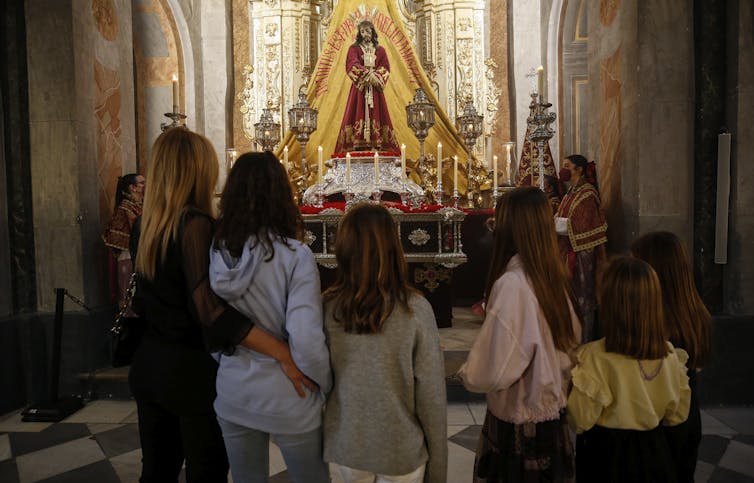
People visiting a Christ sculpture at the Santa Maria Magdalena Church during the Holy Week in Granada, Spain.
Álex Cámara/NurPhoto via Getty Images
By Joanne M. Pierce of College of the Holy Cross
Churches around the world will be holding services for their three most important days during this Holy Week: Holy Thursday, sometimes called Maundy Thursday, Good Friday and Easter Sunday.
Easter commemorates Christ’s resurrection from the dead, the fundamental belief of Christianity. It is the earliest and most central of all Christian holidays, more ancient than Christmas.
As a scholar in medieval Christian liturgy, I know that historically the most controversial of these three holy days has been the worship service for Good Friday, which focuses on the crucifixion of Jesus Christ.
Two parts of the contemporary Good Friday worship service could be misunderstood as implicitly anti-Semitic or racist. Both are derived from the medieval Good Friday liturgy that Catholics and some other Christian churches continue to use in a modified form today.
These are the solemn orations and the veneration of the cross.
Prayer and anti-Semitism
The solemn orations are formal prayers offered by the assembled local community for the wider church, for example, for the pope. These orations also include other prayers for members of different religions, and for other needs of the world.
One of these prayers is offered “for the Jewish people.”
For centuries, this prayer was worded in a way to imply an anti-Semitic meaning, referring to the Jews as “perfidis,” meaning “treacherous” or “unfaithful.”
However, the Catholic Church made important changes in the 20th century. In 1959, Pope John XXIII dropped the word “perfidis” entirely from the Latin prayer in the all-Latin Roman missal. This missal, an official liturgical book containing the readings and prayers for the celebration of Mass and Holy Week, is used by Catholics all over the world. However, when the next edition of the Latin Roman missal was published in 1962, the text of the prayer still mentioned the “conversion” of the Jews and referred to their “blindness.”
The Second Vatican Council, or Vatican II, a major meeting of all Catholic bishops worldwide held between 1962 and 1965, mandated the reform of Catholic life and practice in a number of ways. Open discussion with members of other Christian denominations, as well as other non-Christian religions, was encouraged, and a Vatican commission on Catholic interaction with Jews was established in the early 1970s.
Vatican II also called for a renewal of Catholic worship. The revised liturgy was to be celebrated not just in Latin, but also in local vernacular languages, including English. The first English Roman missal was published in 1974. Today, these post-Vatican religious rituals are known as the “ordinary form” of the Roman rite.
The completely reworded prayer text reflected the renewed understanding of the relationship between Catholics and Jews mandated by Vatican II and supported by decades of interreligious dialogue. For example, in 2015 the Vatican commission released a document clarifying the relationship between Catholicism and Judaism as one of “rich complementarity,” putting an end to organized efforts to convert Jews and strongly condemning anti-Semitism.
However, another important development took place in 2007. More than 40 years after Vatican II, Pope Benedict XVI allowed a wider use of the pre-Vatican II missal of 1962, known as the “extraordinary form.”
At first, this pre-Vatican II missal retained the potentially offensive wording of the prayer for the Jews.
The prayer was quickly reworded, but it does still ask that their hearts be “illuminated” to “recognize Jesus Christ.”
Although the extraordinary form is used only by small groups of traditionalist Catholics, the text of this prayer continues to trouble many.
In 2020, on the 75th anniversary of the liberation of the concentration camp at Auschwiz, Pope Francis repeated the vehement Catholic rejection of anti-Semitism. While the pope has not revoked the use of the extraordinary form, in 2020 he ordered a review of its use by surveying the Catholic bishops of the world.
The cross and what it symbolizes
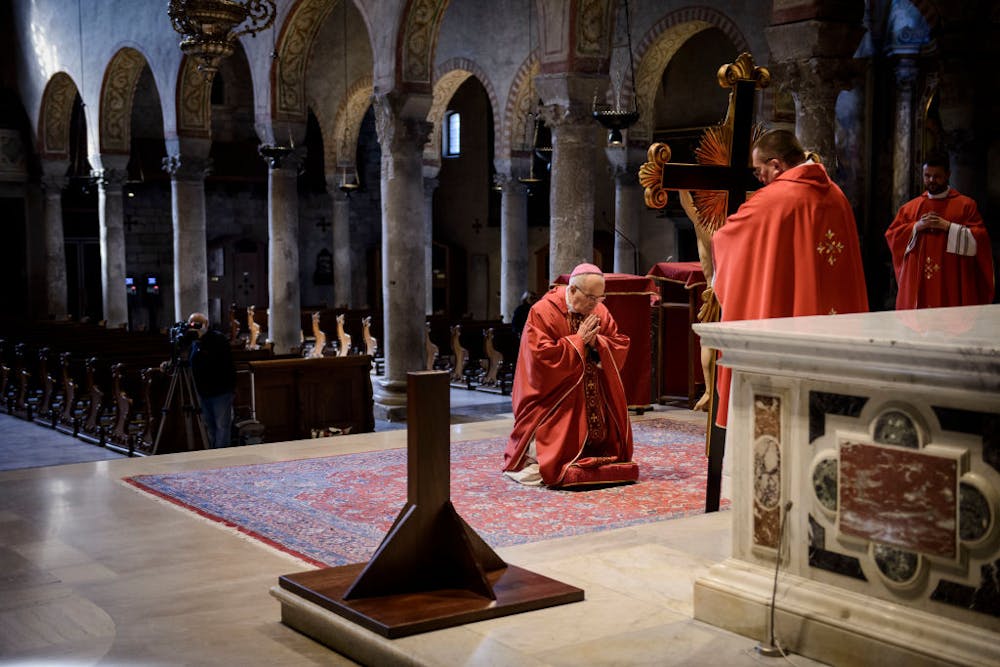
The veneration of the cross is celebrated on Good Friday the Cathedral of San Giusto in Italy.
Jacopo Landi/NurPhoto via Getty Images
There has been similar sensitivity about another part of the Catholic Good Friday tradition: the ritual veneration of the cross.
The earliest evidence of a Good Friday procession by lay people to venerate the cross on Good Friday comes from fourth-century Jerusalem. Catholics would proceed one by one to venerate what was believed to be a piece of the actual wooden cross used to crucify Jesus, and honor it with a reverent touch or kiss.
So sacred was this cross fragment that it was heavily guarded by the clergy during the procession in case someone might try to bite off a sliver to keep for themselves, as was rumored to have happened during a past Good Friday service.
During the medieval period, this veneration rite, elaborated by additional prayers and chant, spread widely across Western Europe. Blessed by priests or bishops, ordinary wooden crosses or crucifixes depicting Christ nailed to the cross took the place of fragments of the “true cross” itself. Catholics venerated the cross on both Good Friday and other feast days.
In this part of the Good Friday liturgy, controversy centers around the physical symbol of the cross and the layers of meaning it has communicated in the past and today. Ultimately, to Catholics and other Christians, it represents Christ’s unselfish sacrificing of his life to save others, an example to be followed by Christians in different ways during their lives.
Historically, however, the cross has also been held up in Western Christianity as a rallying point for violence against groups that were deemed by the church and secular authorities to threaten the safety of Christians and the security of Christian societies.
From the late 11th through 13th centuries, soldiers would “take the cross” and join crusades against these real and perceived threats, whether these opponents were Western Christian heretics, Jewish communities, Muslim armies, or the Greek orthodox Byzantine Empire. Other religious wars in the 14th through 16th centuries continued in this “crusading” spirit.
From the 19th century on, Americans and other English speakers use the term “crusade” for any effort to promote a specific idea or movement, often one based on a moral ideal. Examples in the United States include the 19th-century antislavery abolitionist movement and the civil rights movement of the 20th century.
But today certain “ideals” have been rejected by the wider culture.
Contemporary alt-right groups use what has been called the “Deus vult” cross. The words “Deus vult” mean “God wills (it),” a rallying cry for medieval Christian armies seeking to take control of the Holy Land from Muslims. These groups today view themselves as modern crusaders fighting against Islam.
Some white supremacy groups use versions of the cross
as symbols of protest or provocation. The Celtic cross, a compact cross within a circle, is a common example. And a full-sized wooden cross was carried by at least one protester during the Capitol insurrection in January.
Prayers and symbols have the power to bind people together in a common purpose and identity. But without understanding their context, it is all too easy to manipulate them in support of dated or limited political and social agendas.

This article is republished from The Conversation, a nonprofit news organization dedicated to unlocking ideas from academia, under a Creative Commons license.
[Deep knowledge, daily. Sign up for The Conversation’s newsletter.]

About Joanne M. Pierce
Joanne M. Pierce is a Professor of Religious Studies at College of the Holy Cross You can read more about the author here.

Next Post

April 2, 2021 Christian nationalism is a barrier to mass vaccination against COVID-19
Browse Our Archives
Select a Category Buddhism Christianity Hinduism Islam Judaism Religion and society Uncategorized
Select a Month July 2024 March 2024 February 2024 January 2024 December 2023 November 2023 October 2023 September 2023 August 2023 July 2023 January 2023 August 2022 July 2022 April 2022 February 2022 January 2022 October 2021 July 2021 June 2021 May 2021 April 2021 March 2021 February 2021 January 2021 December 2020 November 2020 October 2020 September 2020 August 2020 July 2020 June 2020 May 2020
Follow Us!
TAKE THE
Religious Wisdom Quiz
In Revelation, what are the names of the two cities that the two witnesses' bodies lie in?
Select your answer to see how you score.
Babylon and Jerusalem Damascus and Tyre Rome and Athens Sodom and Egypt (figuratively called)
Related posts from The Conversation


Why The Olympic Games Are A ‘Civil Religious’...

How Christians Hold Differing Views On The Resurrection
Tattooing Dates Back To The Crucifixion
TRENDING AT PATHEOS Religion News

Catholic Integralists believe that religious values – specifically Christian ones – should...

Electing A Virtuous President Would Make Immunity Irrelevant
Presidential immunity can bring with it many risks. So how can we...

Why The Olympic Games Are A ‘Civil Religious’...
Sporting events form a vital space where Americans display their 'civil religious...

After more than a decade of news, research updates, and insights on...

Q: Why do Southern Baptists and like-minded Protestants...
THE RELIGION GUY’S ANSWER: Why? Simple. Because they believe that’s what the...

THE QUESTION: Is gambling evil? THE RELIGION GUY’S ANSWER: Analysts anticipate a...
view all Religion News blogs
Ad-Free & Subscriber Log-In Subscription Support
- About Us
- 2026 Calendar
- Videos
- Podcasts
- Library of World Religions
- Faith In Media Tracker
- Advertise With Us
- Write for Us
- Privacy Policy
- Terms of Service
- Do Not Sell My Data
- Contact Us
- Radiant Digital
- Manage Newsletter Subscriptions
- Unsubscribe From Notifications
- Sitemap
Copyright 2008-2026, Patheos. All rights reserved.
Subscription Support Ad-Free & Subscriber Log-In
Follow Patheos