
BuddhistCatholicContemplativeEvangelicalGeneral ChristianHinduJewishLatter-day SaintMuslimNew VisionsProgressive Christian
Beliefs
- Buddhist
- Catholic
- Contemplative
- Evangelical
- General Christian
- Hindu
- Jewish
- Latter-day Saint
- More Voices
- Muslim
- New Visions
- Pagan
- Progressive Christian
Topics
- Religion News
- Food and Religion
- Sports and Religion
- Religious Art
- Religious Music and Entertainment
- Religious Events
- History and Religion
- Style and Religion
- Politics and Religion
- Women in Religion
- Recreation Outdoors and Religion
- Business Finance and Religion
- Careers Workplace and Religion
- Education and Religion
- Family Parenting and Religion
- Health Fitness and Religion
- Home and Religion
- Relationships and Religion
- Technology and Religion
- Travel and Religion
Columnists
- Buddhist Columnists
- Business Finance and Religion Columnists
- Careers Workplace and Religion Columnists
- Catholic Columnists
- Contemplative Columnists
- Education and Religion Columnists
- Evangelists Columnists
- Family Parenting and Religion Columnists
- General Christian Columnists
- Health Fitness and Religion Columnists
- Hindu Columnists
- History and Religion Columnists
- Home and Religion Columnists
- Jewish Columnists
- More Voices Columnists
- Latter Day Columnists
- Muslim Columnists
- New Visions Columnists
- Nonreligious Columnists
- Pagan Columnists
- Politics and Religion Columnists
- Progressive Columnists
- Recreation Outdoors and Religion Columnists
- Relationships and Religion Columnists
- Religion News Columnists
- Religious Art Columnists
- Religious Events Columnists
- Religious Music and Entertainment Columnists
- Sports and Religion Columnists
- Style and Religion Columnists
- Technology and Religion Columnists
- Travel and Religion Columnists
- Women in Religion Columnists
Resource Library
- 2026 Calendar
- Library of World Religions
- The 100 Most Holy Places on Earth
- Patheos Answers
- Podcasts
- Videos
- Faith Leaders Database
- Anglican Episcopalian
- Bahai
- Baptist
- Buddhism
- Christianity
- Confucianism
- Eastern Orthodoxy
- Hinduism
- Holiness and Pentecostal
- ISKCON
- Islam
- Judaism
- Lutheran
- Methodist
- The Church of Jesus Christ of Latter-day Saints
- New Age
- Paganism
- Presbytarian and Reformed
- Protestantism
- Religion Behind the Scenes
- Roman Catholic
- Scientology
- Shia Islam
- Sikhism
- Sufism
- Sunni Islam
- Taoism
- Zen
- See all religions
Research Tools
 Ad-Free & Subscriber Log-In Subscription Support
Ad-Free & Subscriber Log-In Subscription Support
Follow Patheos 

- Trending:
- Forgiveness
- |
- Marriage
- |
- Consciousness
- |
- Death Penalty
- |
- Election
- |
- Halloween

- Home
- Religion News
- What can you do with unwanted holy cards and Grandma’s religious statues? Well, that depends
What can you do with unwanted holy cards and Grandma’s religious statues? Well, that depends
Last updated on: April 7, 2021 at 8:28 am by The Conversation
What can you do with unwanted holy cards and Grandma’s religious statues? Well, that depends 2021-04-01T11:29:18-04:00 The Conversation
Patheos Explore the world's faith through different perspectives on religion and spirituality! Patheos has the views of the prevalent religions and spiritualities of the world.
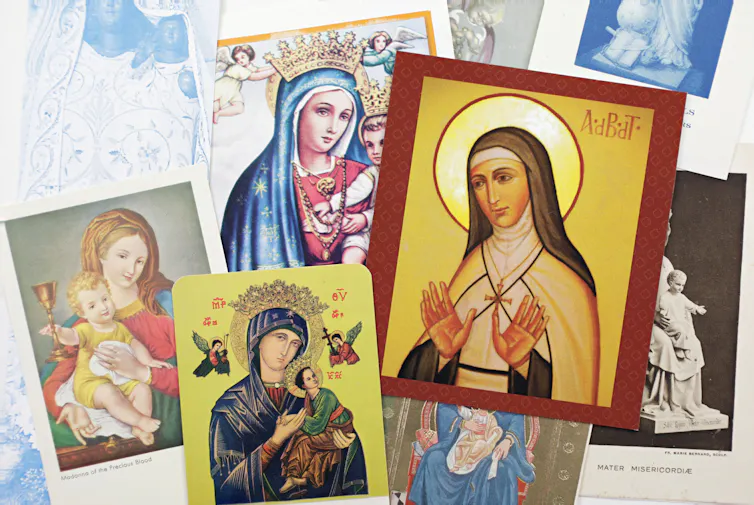
Holy cards are highly collectible but also very, very numerous.
Ryan O’Grady, The Marian Library, University of Dayton, CC BY-SA
By Kayla Harris and Sarah B. Cahalan of University of Dayton
When a rosary was made for King Henry VIII in 1509, it was hand-carved in intricate detail by a master artisan. By contrast, many of the rosaries around today are made from the same plastic that goes into mass-produced objects such as children’s toys or water bottles.
It doesn’t matter much to the faithful; for devoted Catholics, praying with plastic is just as good as praying with a great work of art.
But it does pose a dilemma for us. As librarians at the University of Dayton’s Marian Library, we help curate a collection of religious artifacts that, depending on how you count it, numbers in the hundreds of thousands. It includes postage stamps, wine labels, books, statues and rosaries. Many of the items are Catholic and have been gifted to the library by charitable individuals looking to do the right thing with a family heirloom or the collection of a recently deceased loved one. Donations could include anything from medieval manuscripts to a car air freshener featuring Our Lady of Guadalupe.
In many cases, donations are welcome. But we struggle with what to do when donations duplicate items we already have, or if the gifted item is not of particular value. And this happens frequently, especially with mass-produced items such as rosaries or cheap plastic statues.
Mass-produced cards
Another example is the holy card. Holy cards or prayer cards are in many ways the religious equivalent to baseball trading cards – they even attract the same type of fanatical collecting. The front usually includes an image of a saint or a religious scene, while the back often has a particular prayer, or the biography of the saint. Early examples of holy cards might be printed on silk or colored by hand. Some can look a bit like the fanciest Valentine’s Day card, with lace borders and room for personal messages.
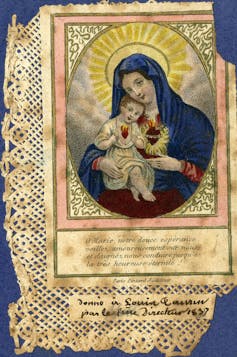
Some holy cards are intricately designed and made with lace borders.
The Marian Library, University of Dayton, CC BY-SA
With advances in printing processes, mass production of holy cards accelerated in the 19th century and continues today, with millions being produced each year. Today, you can purchase 100 new holy cards for less than US$20, and they’re common to pick up at funerals, baptisms or special Masses.
With the mass production and wide distribution of items like holy cards and rosary beads, donations to our collection can multiply quickly. Most months we receive unsolicited gifts of mass-produced materials in the mail. And we are not alone – other libraries, archives and museums likewise receive such gifts.
A widely used guide for running a Catholic church by liturgical scholar G. Thomas Ryan suggests that objects no longer needed should be donated to an archive or museum. But often institutions are short on both staff to process the gifts and space to house them.
Anything can be blessed
Our first step with an unwanted donation is to try to return it to the donor. But that is not always possible when materials appear anonymously or the donor does not want them back.
Someone who has driven several hours to deposit Grandma’s statues unannounced often just wants to drive away unencumbered. So, we look for good homes for items when possible, such as local Catholic schools or parishes.
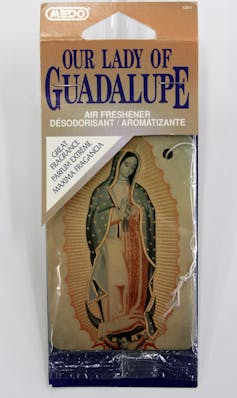
Purifying the air in a saintly fashion.
The Marian Library, University of Dayton, CC BY-SA
When regifting isn’t an option, we are presented with a problem. While some unwanted nonreligious donations to libraries might be able to go straight into the trash, that is not an option with many religious objects. As a result, we have needed to investigate the correct way to dispose of religious objects.
According to canon law of the Catholic Church, certain types of especially sacred material, such as holy water and holy oil, must be treated with care and disposed of in specific ways.
The law explains that “sacred objects, set aside for divine worship by dedication or blessing, are to be treated with reverence.” But the law does not explicitly define which objects count as sacred.
Catholic convention is that discarding objects such as statues, rosaries or the palms from Palm Sunday should be by means of respectful burning or burial. But this is not normal practice for most libraries, and the burning of books and artwork has worrying associations with censorship or even war crimes.
But in Catholicism, it would be more scandalous to throw certain religious objects in the trash or sell them for a profit than it would be to burn or bury them, even if no one wants them and they do not fit in our collection.
In addition to protocols around specific types of object, many other Catholic artifacts could be considered sacred depending on how they have been used. This is especially the case if they have been prayed with or blessed.
It can be impossible for us as librarians to know the history of how an object has been used by previous owners – especially if passed to us from a third party. Any holy card, statue or painting could have been blessed as an image and therefore designated as sacred.
In addition to blessings for objects designated for sacred purposes, the Catholic Church literally has a “blessing of anything,” meaning any object could have been blessed by a priest. While this does not necessarily render an object sacred, it does indicate the freedom with which blessings are distributed.
Burn after reading room?
So what are curators supposed to do, given the ongoing mass production, wide distribution and frequent donation of such objects?
The best solution we have found is to remember that intention matters. Our intentions as stewards of these items are good: We communicate up front that not all donations can be accepted, and we try to find new homes for objects that do not belong in the Marian Library – whether by offering items for free to the community or communicating with another library that might be a better fit.
Disposal would be a last resort. To date, we have yet to have a prayerful, respectful fire to destroy duplicate holy cards – but we are not ruling it out.

This article is republished from The Conversation, a nonprofit news organization dedicated to unlocking ideas from academia, under a Creative Commons license.
[Deep knowledge, daily. Sign up for The Conversation’s newsletter.]

About Kayla Harris & Sarah B. Cahalan
Kayla Harris and Sarah B. Cahalan work at the Marian Library at University of Dayton. You can read more about the author here.


Browse Our Archives
Select a Category Buddhism Christianity Hinduism Islam Judaism Religion and society Uncategorized
Select a Month July 2024 March 2024 February 2024 January 2024 December 2023 November 2023 October 2023 September 2023 August 2023 July 2023 January 2023 August 2022 July 2022 April 2022 February 2022 January 2022 October 2021 July 2021 June 2021 May 2021 April 2021 March 2021 February 2021 January 2021 December 2020 November 2020 October 2020 September 2020 August 2020 July 2020 June 2020 May 2020
Follow Us!
TAKE THE
Religious Wisdom Quiz
Who provided bread and Goliath's sword to David at Nob?
Select your answer to see how you score.
Abiathar Abner Ahimelech the priest Jonathan
Related posts from The Conversation


How Christians Hold Differing Views On The Resurrection
Latin America’s colonial period was less Catholic

Pope Francis called surrogacy ‘deplorable’
TRENDING AT PATHEOS Religion News

Catholic Integralists believe that religious values – specifically Christian ones – should...

Electing A Virtuous President Would Make Immunity Irrelevant
Presidential immunity can bring with it many risks. So how can we...

Why The Olympic Games Are A ‘Civil Religious’...
Sporting events form a vital space where Americans display their 'civil religious...

After more than a decade of news, research updates, and insights on...

Q: Why do Southern Baptists and like-minded Protestants...
THE RELIGION GUY’S ANSWER: Why? Simple. Because they believe that’s what the...

THE QUESTION: Is gambling evil? THE RELIGION GUY’S ANSWER: Analysts anticipate a...
view all Religion News blogs
Ad-Free & Subscriber Log-In Subscription Support
- About Us
- 2026 Calendar
- Videos
- Podcasts
- Library of World Religions
- Faith In Media Tracker
- Advertise With Us
- Write for Us
- Privacy Policy
- Terms of Service
- Do Not Sell My Data
- Contact Us
- Radiant Digital
- Manage Newsletter Subscriptions
- Unsubscribe From Notifications
- Sitemap
Copyright 2008-2026, Patheos. All rights reserved.
Subscription Support Ad-Free & Subscriber Log-In
Follow Patheos