
BuddhistCatholicContemplativeEvangelicalGeneral ChristianHinduJewishLatter-day SaintMuslimNew VisionsProgressive Christian
Beliefs
- Buddhist
- Catholic
- Contemplative
- Evangelical
- General Christian
- Hindu
- Jewish
- Latter-day Saint
- More Voices
- Muslim
- New Visions
- Pagan
- Progressive Christian
Topics
- Religion News
- Food and Religion
- Sports and Religion
- Religious Art
- Religious Music and Entertainment
- Religious Events
- History and Religion
- Style and Religion
- Politics and Religion
- Women in Religion
- Recreation Outdoors and Religion
- Business Finance and Religion
- Careers Workplace and Religion
- Education and Religion
- Family Parenting and Religion
- Health Fitness and Religion
- Home and Religion
- Relationships and Religion
- Technology and Religion
- Travel and Religion
Columnists
- Buddhist Columnists
- Business Finance and Religion Columnists
- Careers Workplace and Religion Columnists
- Catholic Columnists
- Contemplative Columnists
- Education and Religion Columnists
- Evangelists Columnists
- Family Parenting and Religion Columnists
- General Christian Columnists
- Health Fitness and Religion Columnists
- Hindu Columnists
- History and Religion Columnists
- Home and Religion Columnists
- Jewish Columnists
- More Voices Columnists
- Latter Day Columnists
- Muslim Columnists
- New Visions Columnists
- Nonreligious Columnists
- Pagan Columnists
- Politics and Religion Columnists
- Progressive Columnists
- Recreation Outdoors and Religion Columnists
- Relationships and Religion Columnists
- Religion News Columnists
- Religious Art Columnists
- Religious Events Columnists
- Religious Music and Entertainment Columnists
- Sports and Religion Columnists
- Style and Religion Columnists
- Technology and Religion Columnists
- Travel and Religion Columnists
- Women in Religion Columnists
Resource Library
- 2026 Calendar
- Library of World Religions
- The 100 Most Holy Places on Earth
- Patheos Answers
- Podcasts
- Videos
- Faith Leaders Database
- Anglican Episcopalian
- Bahai
- Baptist
- Buddhism
- Christianity
- Confucianism
- Eastern Orthodoxy
- Hinduism
- Holiness and Pentecostal
- ISKCON
- Islam
- Judaism
- Lutheran
- Methodist
- The Church of Jesus Christ of Latter-day Saints
- New Age
- Paganism
- Presbytarian and Reformed
- Protestantism
- Religion Behind the Scenes
- Roman Catholic
- Scientology
- Shia Islam
- Sikhism
- Sufism
- Sunni Islam
- Taoism
- Zen
- See all religions
Research Tools
 Ad-Free & Subscriber Log-In Subscription Support
Ad-Free & Subscriber Log-In Subscription Support
Follow Patheos 

- Trending:
- Forgiveness
- |
- Marriage
- |
- Consciousness
- |
- Death Penalty
- |
- Election
- |
- Halloween

- Home
- Religion News
- The US has never had much of a pilgrimage tradition – perhaps now is the opportunity
The US has never had much of a pilgrimage tradition – perhaps now is the opportunity
Last updated on: April 3, 2021 at 12:24 pm by The Conversation
The US has never had much of a pilgrimage tradition – perhaps now is the opportunity 2021-04-01T12:24:52-04:00 The Conversation
Patheos Explore the world's faith through different perspectives on religion and spirituality! Patheos has the views of the prevalent religions and spiritualities of the world.
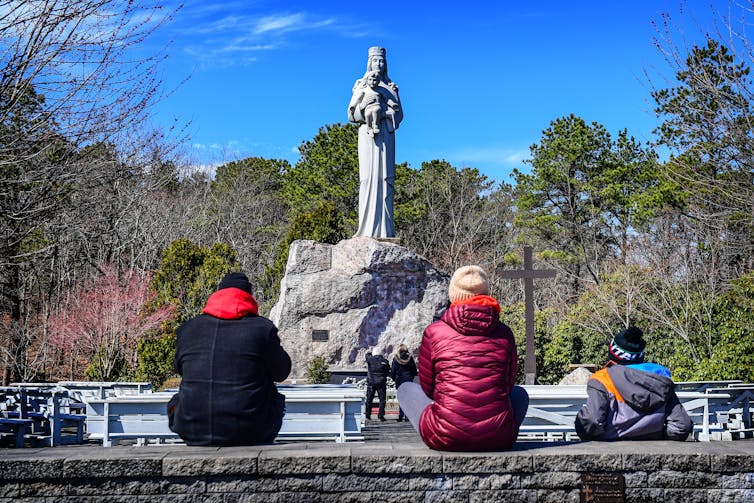
Sites of pilgrimages are few and far between in the U.S.
Thomas A. Ferrara/Newsday RM via Getty Images
By James Mills of State University of New York at Oneonta
One feature of the pandemic has been the curtailment of a practice that for millennia has provided an outlet for healing in times of crisis: pilgrimage.
From restrictions on the Hajj for Muslims to the Catholic pilgrimage to Lourdes going virtual, people of faith have been unable to embark on journeys that would in other times provide solace and community.
As a scholar of religion and geography who has written about the role of pilgrimage, I know the U.S. has never had a strong tradition of pilgrimage. But I believe that could change and give Americans new ways to heal in the post-pandemic era.
The progress of pilgrimages
Pilgrims have embarked on journeys in search of healing for at least 10,000 years and in virtually all religious traditions including Christianity, Islam, Hinduism and Buddhism. In earlier times, the healing pilgrims sought was often to be cured of disease or some physical ailment. Some still do. Crutches that cover the walls of pilgrimage destinations such as the Chimayo chapel in New Mexico attest to those who hobbled to these sites and then, it is said, walked away cured.
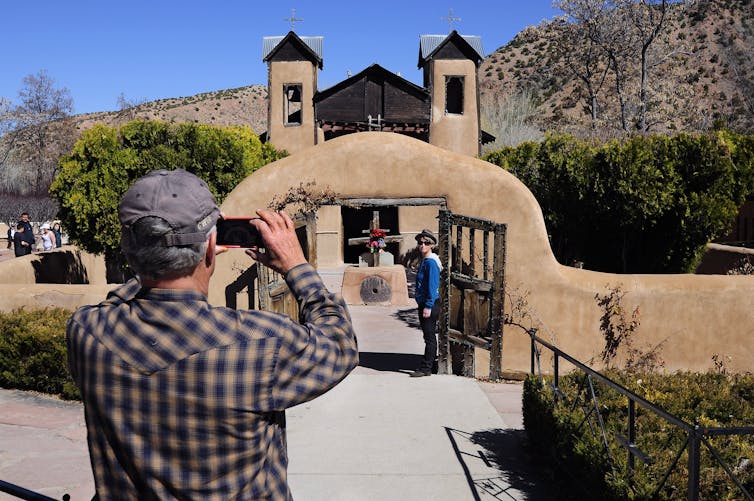
Visitor in front of El Santuario de Chimayo in Chimayo, New Mexico.
Robert Alexander/Getty Images
Nowadays the healing most pilgrims seek is more psychological and spiritual in nature. Pilgrims often undertake their journeys to grieve and heal after the death of loved ones or after experiencing other traumas in their own lives.
Pilgrimage is common and even increasing in most parts of the world. The Camino de Santiago in Spain has seen an extraordinary increase in the number of pilgrims in the past 30 years, and scores of new pilgrimage routes have recently opened in the U.K.
A Protestant objection
The U.S., however, has few destinations and even fewer designated routes for pilgrims to use. The reasons for this are varied, but historically the majority of U.S. citizens and almost all those in power identified as Protestants. Even today, close to half of all Americans identify as Protestant.
Protestantism has had less of a tradition of church-sanctioned pilgrimage than other religions. In fact, Protestantism emerged in the 1500s in no small part as a reaction to the licentious behavior of some pilgrims and priests, the selling of indulgences to enrich the church or various members of the clergy, and the corruption that was associated with many pilgrimages of the time.
Martin Luther, the founder of Protestantism, said all pilgrimages should be stopped because they only gave people opportunities to sin. He wrote that there is no biblical basis for the practice.
Most Protestants over the past few centuries followed Luther’s lead and continued to avoid or denounce pilgrimage. Protestants denied the significance of saints, so they didn’t go on pilgrimages to shrines commemorating them. They focused more on doctrine and have generally been wary of embodied rituals, such as dancing or pilgrimages.
A secondary reason that the U.S. never developed a pilgrimage tradition is that religious pilgrims tend to be attracted to places where key figures in their faith – such as Jesus, Muhammad, the Buddha, or various saints – lived out their lives.
Jerusalem, as well as Mecca in Saudi Arabia, India’s Bodh Gaya and other places associated with the birth of religions or major moments in their development, are all in Asia. As a result, Americans seeking such pilgrimage have felt the need to travel overseas, which limits who can go and how often pilgrimages can be undertaken.
There are some pilgrimage sites in the U.S. Mormons have a number of American destinations – such as the Hill Cumorah in Palmyra, New York, and Temple Square in Salt Lake City, Utah – because the U.S. is where the religion started and grew. Catholics have U.S. pilgrimage destinations as well, such as the Basilica of the National Shrine of Mary, Help of Christians, at Holy Hill in Wisconsin. These places are typically associated with miraculous events or dedicated to saints such as the Virgin Mary.
Pathways to healing
Times are changing, however. Evidence suggests that more and more Americans would like to go on a pilgrimage or have more ways to engage in spiritual tourism. This growing desire to go on a spiritual journey provides a great opportunity to meet the demand by creating domestic pilgrimages not only for personal healing, but also to construct walking pathways that could, I believe, help heal entire communities or even the country.
Imagine a network of local pilgrimages that focuses on the route rather than any singular destination. These paths could interconnect to form regional networks.
Such pathways could be much more than simple thoroughfares. They could be designed to provide rich spiritual experiences for people of all faiths and those of no formal affiliation. Nondenominational meditation spots, gardens and liminal components such as gateways, bridges and shorelines could all be incorporated.
These routes could be open to all and provide an opportunity to encourage interfaith and intergroup communication. Pilgrims might choose to walk with others of different backgrounds or there might be side trips that bring pilgrims to a variety of denominational destinations.
U.S. cities are deeply segregated by class, ethnicity and race. Urban pilgrimages could help break down barriers by providing opportunities for residents to experience neighborhoods other than their own.
This isn’t just a pipe dream. In the U.K. there is an organization dedicated to renewing the idea of pilgrimage “as a form of cultural heritage that promotes holistic well being.” There is no reason such a movement cannot develop in the U.S. too.
In fact, the Adirondack to Algonquin (A2A) Initiative is already creating a 400-mile wildlife corridor that the planners hope will double as a pilgrimage route for humans.
After the hardships caused by the pandemic, 2021 and beyond could be a time for healing – both of oneself and the wider community. Pursuing development of a network of pilgrimage pathways across the U.S. would, I believe, be a positive and creative way for Americans to work toward that goal.
This article is republished from The Conversation, a nonprofit news organization dedicated to unlocking ideas from academia, under a Creative Commons license.
[Deep knowledge, daily. Sign up for The Conversation’s newsletter.]

About James Mill
James Mills is an Associate Professor of Geography and Environmental Sustainability at the State University of New York at Oneonta. You can read more about the author here.
Previous Post

April 2, 2021
Christian nationalism is a barrier to mass vaccination against COVID-19

Browse Our Archives
Select a Category Buddhism Christianity Hinduism Islam Judaism Religion and society Uncategorized
Select a Month July 2024 March 2024 February 2024 January 2024 December 2023 November 2023 October 2023 September 2023 August 2023 July 2023 January 2023 August 2022 July 2022 April 2022 February 2022 January 2022 October 2021 July 2021 June 2021 May 2021 April 2021 March 2021 February 2021 January 2021 December 2020 November 2020 October 2020 September 2020 August 2020 July 2020 June 2020 May 2020
Follow Us!
TAKE THE
Religious Wisdom Quiz
Who was Jesus' earthly father?
Select your answer to see how you score.
Joachim Joseph Zechariah Simeon
Related posts from The Conversation


Electing A Virtuous President Would Make Immunity Irrelevant

Why The Olympic Games Are A ‘Civil Religious’...

The Catholic Church Is Using The Olympics To...
TRENDING AT PATHEOS Religion News

Catholic Integralists believe that religious values – specifically Christian ones – should...

Electing A Virtuous President Would Make Immunity Irrelevant
Presidential immunity can bring with it many risks. So how can we...

Why The Olympic Games Are A ‘Civil Religious’...
Sporting events form a vital space where Americans display their 'civil religious...

After more than a decade of news, research updates, and insights on...

Q: Why do Southern Baptists and like-minded Protestants...
THE RELIGION GUY’S ANSWER: Why? Simple. Because they believe that’s what the...

THE QUESTION: Is gambling evil? THE RELIGION GUY’S ANSWER: Analysts anticipate a...
view all Religion News blogs
Ad-Free & Subscriber Log-In Subscription Support
- About Us
- 2026 Calendar
- Videos
- Podcasts
- Library of World Religions
- Faith In Media Tracker
- Advertise With Us
- Write for Us
- Privacy Policy
- Terms of Service
- Do Not Sell My Data
- Contact Us
- Radiant Digital
- Manage Newsletter Subscriptions
- Unsubscribe From Notifications
- Sitemap
Copyright 2008-2026, Patheos. All rights reserved.
Subscription Support Ad-Free & Subscriber Log-In
Follow Patheos