
BuddhistCatholicContemplativeEvangelicalGeneral ChristianHinduJewishLatter-day SaintMuslimNew VisionsProgressive Christian
Beliefs
- Buddhist
- Catholic
- Contemplative
- Evangelical
- General Christian
- Hindu
- Jewish
- Latter-day Saint
- More Voices
- Muslim
- New Visions
- Pagan
- Progressive Christian
Topics
- Religion News
- Food and Religion
- Sports and Religion
- Religious Art
- Religious Music and Entertainment
- Religious Events
- History and Religion
- Style and Religion
- Politics and Religion
- Women in Religion
- Recreation Outdoors and Religion
- Business Finance and Religion
- Careers Workplace and Religion
- Education and Religion
- Family Parenting and Religion
- Health Fitness and Religion
- Home and Religion
- Relationships and Religion
- Technology and Religion
- Travel and Religion
Columnists
- Buddhist Columnists
- Business Finance and Religion Columnists
- Careers Workplace and Religion Columnists
- Catholic Columnists
- Contemplative Columnists
- Education and Religion Columnists
- Evangelists Columnists
- Family Parenting and Religion Columnists
- General Christian Columnists
- Health Fitness and Religion Columnists
- Hindu Columnists
- History and Religion Columnists
- Home and Religion Columnists
- Jewish Columnists
- More Voices Columnists
- Latter Day Columnists
- Muslim Columnists
- New Visions Columnists
- Nonreligious Columnists
- Pagan Columnists
- Politics and Religion Columnists
- Progressive Columnists
- Recreation Outdoors and Religion Columnists
- Relationships and Religion Columnists
- Religion News Columnists
- Religious Art Columnists
- Religious Events Columnists
- Religious Music and Entertainment Columnists
- Sports and Religion Columnists
- Style and Religion Columnists
- Technology and Religion Columnists
- Travel and Religion Columnists
- Women in Religion Columnists
Resource Library
- 2026 Calendar
- Library of World Religions
- The 100 Most Holy Places on Earth
- Patheos Answers
- Podcasts
- Videos
- Faith Leaders Database
- Anglican Episcopalian
- Bahai
- Baptist
- Buddhism
- Christianity
- Confucianism
- Eastern Orthodoxy
- Hinduism
- Holiness and Pentecostal
- ISKCON
- Islam
- Judaism
- Lutheran
- Methodist
- The Church of Jesus Christ of Latter-day Saints
- New Age
- Paganism
- Presbytarian and Reformed
- Protestantism
- Religion Behind the Scenes
- Roman Catholic
- Scientology
- Shia Islam
- Sikhism
- Sufism
- Sunni Islam
- Taoism
- Zen
- See all religions
Research Tools
 Ad-Free & Subscriber Log-In Subscription Support
Ad-Free & Subscriber Log-In Subscription Support
Follow Patheos 

- Trending:
- Forgiveness
- |
- Marriage
- |
- Consciousness
- |
- Death Penalty
- |
- Election
- |
- Halloween

- Home
- Religion News
- How the Supreme Court found its faith and put ‘religious liberty’ on a winning streak
How the Supreme Court found its faith and put ‘religious liberty’ on a winning streak
Last updated on: April 14, 2021 at 5:32 pm by The Conversation
How the Supreme Court found its faith and put ‘religious liberty’ on a winning streak 2021-04-14T17:32:33-04:00 The Conversation
Patheos Explore the world's faith through different perspectives on religion and spirituality! Patheos has the views of the prevalent religions and spiritualities of the world.
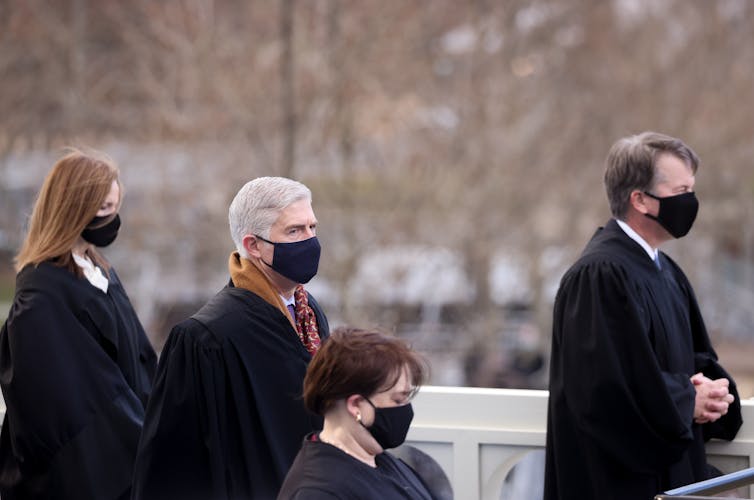
Justices Amy Coney Barrett, Neil Gorsuch and Brett Kavanaugh have bolstered the conservative wing of the Supreme Court.
Jonathan Ernst/Getty Images
By Steven K. Green of Willamette University
The Supreme Court’s current term is winding down, but there are still several cases to be decided – and, as with most terms, a controversy over church-state matters looms.
Fulton vs. City of Philadelphia is among the cases still to be decided. It centers on a requirement that private agencies that receive city funding – in this case an adoption agency – do not discriminate against any community they serve, including members of the LGBTQ community. This nondiscrimination requirement applies to both religious and nonreligious organizations. But the adoption service at the heart of the case – Catholic Social Services – refused to comply, asserting that not being allowed to discriminate against gay couples infringed upon its religious beliefs.
It would appear on first glance that the city’s position is strong – after all, it provides the money and has a legitimate interest in ensuring that funding does not perpetuate discrimination based on sexual orientation.
Yet, Catholic Social Services and its counsel, Becket Fund for Religious Liberty, believe that they have the wind at their back regarding their claim. From my perspective as a professor of law who has closely monitored such religious liberty cases, they could be right. Religious claimants have been on a winning streak before the Supreme Court in recent years. They notched up their latest victory on April 9 when justices ruled that California could not impose COVID-19 restrictions on religious gatherings at private homes.
A noticeable shift
The Supreme Court has become increasingly conservative over the past two decades, with five of the last seven justices appointed by Republicans. As a result, it has become increasingly sympathetic to claims by religious conservatives that mandatory nondiscrimination laws violate their ability to practice their beliefs, as protected by the Constitution and federal law.
Two recent studies have confirmed this trend. One found that since the George W. Bush-appointed John Roberts assumed the role of chief justice in 2005, the Supreme Court has ruled in favor of religious claimants 81% of the time. This compares with a rate of about 50% for the 20th century.
Some of the recent cases are familiar; others, less so. In 2014, the justices relieved the craft store chain Hobby Lobby from having to provide employees with health insurance that covers contraception, as mandated by the Affordable Care Act. Hobby Lobby had objected to the requirement on religious grounds.
And in 2020, the Supreme Court ruled that teachers employed by religious schools were not entitled to protection against age and disability discrimination as a result of the “ministerial exception” – which allows religious entities to ignore anti-bias legislation if they can assert that staff perform even minimal religious duties.
Meanwhile, in 2018, a majority of justices suggested that a small business – here, a baker – could refuse to serve gay customers because of the owner’s religious objections to same-sex marriage. The court has also held that states have to give the same grants and tax breaks to churches and religious schools that they do to nonreligious entities.
This trend has extended into the COVID-19 pandemic. Initially, a sharply divided court refused to overturn state restrictions – which for the most part classified houses of worship alongside restaurants and movie theaters as “nonessential,” distinguishing them from “essential” services such as medical offices, pharmacies and grocery stores. But in late fall and again in February, a majority including the newly appointed religiously conservative Justice Amy Barrett struck down such orders. In so doing, they ruled that states must treat houses of worship no worse than the most favored category of essential services.
Redefining religious freedom
In prioritizing religious liberty claims over health and anti-bias concerns, the Supreme Court’s conservative majority has, to my mind, promoted a skewed conception of what religious freedom is.
Religious freedom has traditionally meant more than simply the ability to practice one’s beliefs unencumbered, free from state interference. It is a condition that lives alongside other important democratic values – such as equal rights and a separation of church and state.
But the Supreme Court’s conservative majority has come down on the side of a narrower interpretation of religious liberty to mean the right of individuals or groups to practice their faith as they see fit.
The court’s new emphasis on protecting religious liberty has redefined the conventional understanding of the free exercise clause. Traditionally, that has meant the government could not impose a substantial burden on one’s ability to practice religion, but that lesser restrictions on that practice – such as adhering to health or safety regulations – were not unconstitutional.
But under the current Supreme Court, the degree of burden is less important than whether the state is treating religion differently from secular counterparts. Furthermore, in the view of another Trump appointee, Justice Brett Kavanaugh, religion deserves most-favored-nation status.
In this way, religious entities cannot be treated any differently in the pandemic from the most essential service – but they would be able to discriminate against customers or employees in a way the essential services cannot. It is, I believe the legal equivalent of having your cake and eating it, too.

This article is republished from The Conversation, a nonprofit news organization dedicated to unlocking ideas from academia, under a Creative Commons license.
[This week in religion, a global roundup each Thursday. Sign up.]

About Steven K. Green
Steven K. Green is a Professor of Law and Director of the Center for Religion, Law & Democracy at Willamette University. You can read more about the author here.

Next Post

April 22, 2021 Is magic immoral? It played a role in the development of early Christianity
Browse Our Archives
Select a Category Buddhism Christianity Hinduism Islam Judaism Religion and society Uncategorized
Select a Month July 2024 March 2024 February 2024 January 2024 December 2023 November 2023 October 2023 September 2023 August 2023 July 2023 January 2023 August 2022 July 2022 April 2022 February 2022 January 2022 October 2021 July 2021 June 2021 May 2021 April 2021 March 2021 February 2021 January 2021 December 2020 November 2020 October 2020 September 2020 August 2020 July 2020 June 2020 May 2020
Follow Us!
TAKE THE
Religious Wisdom Quiz
"______ is the same yesterday and today and forever."
Select your answer to see how you score.
The Universe Jesus Christ God's Plan Our Calling
Related posts from The Conversation


Electing A Virtuous President Would Make Immunity Irrelevant

Why The Olympic Games Are A ‘Civil Religious’...

The Catholic Church Is Using The Olympics To...
TRENDING AT PATHEOS Religion News

Catholic Integralists believe that religious values – specifically Christian ones – should...

Electing A Virtuous President Would Make Immunity Irrelevant
Presidential immunity can bring with it many risks. So how can we...

Why The Olympic Games Are A ‘Civil Religious’...
Sporting events form a vital space where Americans display their 'civil religious...

After more than a decade of news, research updates, and insights on...

Q: Why do Southern Baptists and like-minded Protestants...
THE RELIGION GUY’S ANSWER: Why? Simple. Because they believe that’s what the...

THE QUESTION: Is gambling evil? THE RELIGION GUY’S ANSWER: Analysts anticipate a...
view all Religion News blogs
Ad-Free & Subscriber Log-In Subscription Support
- About Us
- 2026 Calendar
- Videos
- Podcasts
- Library of World Religions
- Faith In Media Tracker
- Advertise With Us
- Write for Us
- Privacy Policy
- Terms of Service
- Do Not Sell My Data
- Contact Us
- Radiant Digital
- Manage Newsletter Subscriptions
- Unsubscribe From Notifications
- Sitemap
Copyright 2008-2026, Patheos. All rights reserved.
Subscription Support Ad-Free & Subscriber Log-In
Follow Patheos