
BuddhistCatholicContemplativeEvangelicalGeneral ChristianHinduJewishLatter-day SaintMuslimNew VisionsProgressive Christian
Beliefs
- Buddhist
- Catholic
- Contemplative
- Evangelical
- General Christian
- Hindu
- Jewish
- Latter-day Saint
- More Voices
- Muslim
- New Visions
- Pagan
- Progressive Christian
Topics
- Religion News
- Food and Religion
- Sports and Religion
- Religious Art
- Religious Music and Entertainment
- Religious Events
- History and Religion
- Style and Religion
- Politics and Religion
- Women in Religion
- Recreation Outdoors and Religion
- Business Finance and Religion
- Careers Workplace and Religion
- Education and Religion
- Family Parenting and Religion
- Health Fitness and Religion
- Home and Religion
- Relationships and Religion
- Technology and Religion
- Travel and Religion
Columnists
- Buddhist Columnists
- Business Finance and Religion Columnists
- Careers Workplace and Religion Columnists
- Catholic Columnists
- Contemplative Columnists
- Education and Religion Columnists
- Evangelists Columnists
- Family Parenting and Religion Columnists
- General Christian Columnists
- Health Fitness and Religion Columnists
- Hindu Columnists
- History and Religion Columnists
- Home and Religion Columnists
- Jewish Columnists
- More Voices Columnists
- Latter Day Columnists
- Muslim Columnists
- New Visions Columnists
- Nonreligious Columnists
- Pagan Columnists
- Politics and Religion Columnists
- Progressive Columnists
- Recreation Outdoors and Religion Columnists
- Relationships and Religion Columnists
- Religion News Columnists
- Religious Art Columnists
- Religious Events Columnists
- Religious Music and Entertainment Columnists
- Sports and Religion Columnists
- Style and Religion Columnists
- Technology and Religion Columnists
- Travel and Religion Columnists
- Women in Religion Columnists
Resource Library
- 2026 Calendar
- Library of World Religions
- The 100 Most Holy Places on Earth
- Patheos Answers
- Podcasts
- Videos
- Faith Leaders Database
- Anglican Episcopalian
- Bahai
- Baptist
- Buddhism
- Christianity
- Confucianism
- Eastern Orthodoxy
- Hinduism
- Holiness and Pentecostal
- ISKCON
- Islam
- Judaism
- Lutheran
- Methodist
- The Church of Jesus Christ of Latter-day Saints
- New Age
- Paganism
- Presbytarian and Reformed
- Protestantism
- Religion Behind the Scenes
- Roman Catholic
- Scientology
- Shia Islam
- Sikhism
- Sufism
- Sunni Islam
- Taoism
- Zen
- See all religions
Research Tools
 Ad-Free & Subscriber Log-In Subscription Support
Ad-Free & Subscriber Log-In Subscription Support
Follow Patheos 

- Trending:
- Forgiveness
- |
- Marriage
- |
- Consciousness
- |
- Death Penalty
- |
- Election
- |
- Halloween

- Home
- Religion News
- Faith in numbers: Trump held steady among believers at the ballot – it was the nonreligious vote he lost in 2020
Faith in numbers: Trump held steady among believers at the ballot – it was the nonreligious vote he lost in 2020
Last updated on: April 12, 2021 at 8:15 am by The Conversation
Faith in numbers: Trump held steady among believers at the ballot – it was the nonreligious vote he lost in 2020 2021-04-11T16:59:14-04:00 The Conversation
Patheos Explore the world's faith through different perspectives on religion and spirituality! Patheos has the views of the prevalent religions and spiritualities of the world.
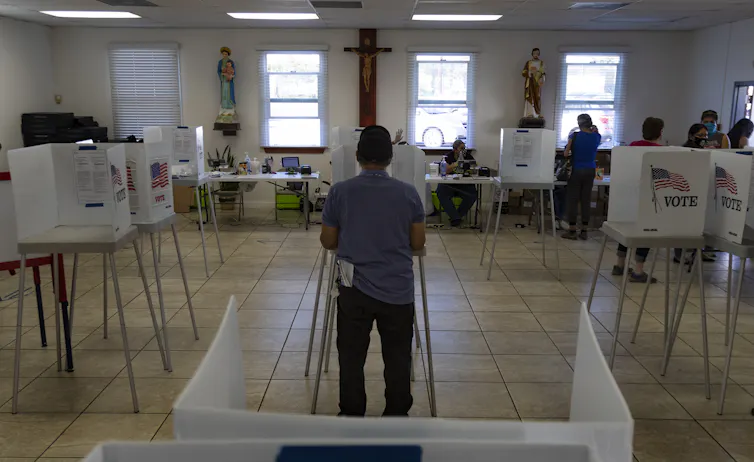
White evangelicals continued to back Trump in 2020 in significant numbers.
Gina Ferazzi/Los Angeles Times via Getty Images
By Ryan Burge of Eastern Illinois University
For all the predictions and talk of a slump in support among evangelicals, it appears Donald Trump’s election loss was not at the hands of religious voters.
As an analyst of religious data, I’ve been crunching data released in March 2021 that breaks down the 2020 U.S. presidential election results by faith. And by and large there was very little notable change in the vote choice of religious groups between 2016 and 2020 – in fact, for most faiths, support for Trump ticked up slightly. Instead, it was among those who do not identify with any religion that Trump saw a noticeable drop.
Despite exit poll data initially pointing toward a drop in white evangelical support for Trump in 2020, the latest data shows this not to be the case. The data is based on the Cooperative Election Study, which has become the gold standard for assessing vote choice because of its sample size and its ability to accurately represent the voting population of the United States.
In fact, with 80% of white evangelicals backing Trump in 2020, support actually ticked up from the 78% who voted for him four years earlier.
Trump also saw two-point increases in the vote of nonwhite evangelicals, white Catholics, Black Protestants and Jews compared with four years ago.
These differences are not statistically significant, and as such it would be wrong to say it definitively shows Trump gained among religious groups. But it indicates that among the largest religious groups in the U.S., voting patterns in the November 2020 vote seemed to hold largely steady with four years earlier. Trump did not manage to win significantly larger shares, nor was winner Joe Biden able to peel away religious voters from the Trump coalition.
Losing the nonreligious
However, there are some interesting and statistically significant trends when you break down the data further. Nonwhite Catholics shifted four points toward Donald Trump. This fits with what we saw in places like the heavily Hispanic and Catholic Miami-Dade County, Florida, where Trump’s overall vote share improved from 35% to 46% between 2016 and 2020.
Trump also managed to pick up 15 percentage points among the Mormon vote. On first glance this would appear a large jump. But it makes sense when you factor in that around 15% of the Mormon vote in 2016 went to Utah native and fellow Mormon Evan McMullin, who ran in that year’s election as a third-party candidate. Without McMullin in 2020, Trump picked up Mormon voters – as did Joe Biden, who did slightly better than Hillary Clinton had among Mormons.
There is also some weak evidence that the Republican candidate picked up some support among smaller religious groups in the U.S., like Hindus and Buddhists. Trump increased his share among these two groups by four percentage points each. But it is important to note that these two groups combined constitute only about 1.5% of the American population. As such, a four-point increase translates to only a very small fraction of the overall popular vote.
What is clear is that Trump lost a good amount of ground among the religious unaffiliated. Trump’s share of the atheist vote declined from 14% in 2016 to just 11% in 2020; the decline among agnostics was slightly larger, from 23% to 18%.
Additionally, those who identify as “nothing in particular” – a group that represents 21% of the overall U.S. population – were not as supportive of Trump in his reelection bid. His vote share among this group dropped by three percentage points, while Biden’s rose by over seven points, with the Democrat managing to win over many of the “nothing in particulars” who had backed third-party candidates in the 2016 election.
Looked at broadly, Trump did slightly better among Christians and other smaller religious groups in the U.S. but lost ground among the religiously unaffiliated. What these results cannot account for, however, is record turnout. There were nearly 22 million more votes cast in 2020 than in 2016. So while vote shares may not have changed that much, the number of votes cast helped swing the election for the Democratic candidate. A more detailed breakdown of voter turnout is due to be released in July 2021 by the team that administers the Cooperative Election Study; that will bring the picture of religion and the 2020 vote into clearer focus.

This article is republished from The Conversation, a nonprofit news organization dedicated to unlocking ideas from academia, under a Creative Commons license.
[This week in religion, a global roundup each Thursday. Sign up.]

About Ryan Burge
Ryan Burge is an Assistant Professor of Political Science at Eastern Illinois University. You can read more about the author here.


Browse Our Archives
Select a Category Buddhism Christianity Hinduism Islam Judaism Religion and society Uncategorized
Select a Month July 2024 March 2024 February 2024 January 2024 December 2023 November 2023 October 2023 September 2023 August 2023 July 2023 January 2023 August 2022 July 2022 April 2022 February 2022 January 2022 October 2021 July 2021 June 2021 May 2021 April 2021 March 2021 February 2021 January 2021 December 2020 November 2020 October 2020 September 2020 August 2020 July 2020 June 2020 May 2020
Follow Us!
TAKE THE
Religious Wisdom Quiz
What does "Golgotha" mean?
Select your answer to see how you score.
House of Bread Place of the Skull Mountain of God Valley of Death
Related posts from The Conversation


Electing A Virtuous President Would Make Immunity Irrelevant

Why The Olympic Games Are A ‘Civil Religious’...

The Catholic Church Is Using The Olympics To...
TRENDING AT PATHEOS Religion News

Catholic Integralists believe that religious values – specifically Christian ones – should...

Electing A Virtuous President Would Make Immunity Irrelevant
Presidential immunity can bring with it many risks. So how can we...

Why The Olympic Games Are A ‘Civil Religious’...
Sporting events form a vital space where Americans display their 'civil religious...

After more than a decade of news, research updates, and insights on...

Q: Why do Southern Baptists and like-minded Protestants...
THE RELIGION GUY’S ANSWER: Why? Simple. Because they believe that’s what the...

THE QUESTION: Is gambling evil? THE RELIGION GUY’S ANSWER: Analysts anticipate a...
view all Religion News blogs
Ad-Free & Subscriber Log-In Subscription Support
- About Us
- 2026 Calendar
- Videos
- Podcasts
- Library of World Religions
- Faith In Media Tracker
- Advertise With Us
- Write for Us
- Privacy Policy
- Terms of Service
- Do Not Sell My Data
- Contact Us
- Radiant Digital
- Manage Newsletter Subscriptions
- Unsubscribe From Notifications
- Sitemap
Copyright 2008-2026, Patheos. All rights reserved.
Subscription Support Ad-Free & Subscriber Log-In
Follow Patheos