
BuddhistCatholicContemplativeEvangelicalGeneral ChristianHinduJewishLatter-day SaintMuslimNew VisionsProgressive Christian
Beliefs
- Buddhist
- Catholic
- Contemplative
- Evangelical
- General Christian
- Hindu
- Jewish
- Latter-day Saint
- More Voices
- Muslim
- New Visions
- Pagan
- Progressive Christian
Topics
- Religion News
- Food and Religion
- Sports and Religion
- Religious Art
- Religious Music and Entertainment
- Religious Events
- History and Religion
- Style and Religion
- Politics and Religion
- Women in Religion
- Recreation Outdoors and Religion
- Business Finance and Religion
- Careers Workplace and Religion
- Education and Religion
- Family Parenting and Religion
- Health Fitness and Religion
- Home and Religion
- Relationships and Religion
- Technology and Religion
- Travel and Religion
Columnists
- Buddhist Columnists
- Business Finance and Religion Columnists
- Careers Workplace and Religion Columnists
- Catholic Columnists
- Contemplative Columnists
- Education and Religion Columnists
- Evangelists Columnists
- Family Parenting and Religion Columnists
- General Christian Columnists
- Health Fitness and Religion Columnists
- Hindu Columnists
- History and Religion Columnists
- Home and Religion Columnists
- Jewish Columnists
- More Voices Columnists
- Latter Day Columnists
- Muslim Columnists
- New Visions Columnists
- Nonreligious Columnists
- Pagan Columnists
- Politics and Religion Columnists
- Progressive Columnists
- Recreation Outdoors and Religion Columnists
- Relationships and Religion Columnists
- Religion News Columnists
- Religious Art Columnists
- Religious Events Columnists
- Religious Music and Entertainment Columnists
- Sports and Religion Columnists
- Style and Religion Columnists
- Technology and Religion Columnists
- Travel and Religion Columnists
- Women in Religion Columnists
Resource Library
- 2026 Calendar
- Library of World Religions
- The 100 Most Holy Places on Earth
- Patheos Answers
- Podcasts
- Videos
- Faith Leaders Database
- Anglican Episcopalian
- Bahai
- Baptist
- Buddhism
- Christianity
- Confucianism
- Eastern Orthodoxy
- Hinduism
- Holiness and Pentecostal
- ISKCON
- Islam
- Judaism
- Lutheran
- Methodist
- The Church of Jesus Christ of Latter-day Saints
- New Age
- Paganism
- Presbytarian and Reformed
- Protestantism
- Religion Behind the Scenes
- Roman Catholic
- Scientology
- Shia Islam
- Sikhism
- Sufism
- Sunni Islam
- Taoism
- Zen
- See all religions
Research Tools
 Ad-Free & Subscriber Log-In Subscription Support
Ad-Free & Subscriber Log-In Subscription Support
Follow Patheos 

- Trending:
- Forgiveness
- |
- Marriage
- |
- Consciousness
- |
- Death Penalty
- |
- Election
- |
- Halloween

- Home
- Religion News
- What the mythical figure of Şahmeran in Turkey represents and why activists use it
What the mythical figure of Şahmeran in Turkey represents and why activists use it
Last updated on: March 3, 2021 at 10:30 am by The Conversation
What the mythical figure of Şahmeran in Turkey represents and why activists use it 2021-03-03T10:30:12-04:00 The Conversation
Patheos Explore the world's faith through different perspectives on religion and spirituality! Patheos has the views of the prevalent religions and spiritualities of the world.
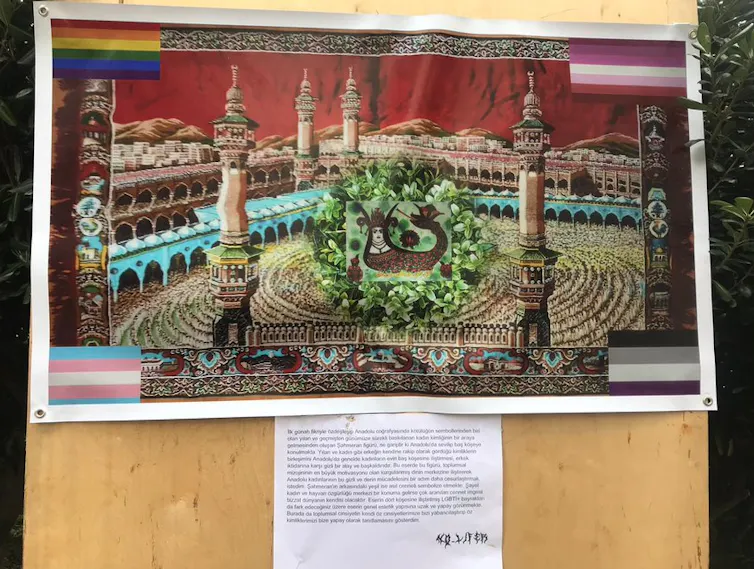
A pro-LGBTQ poster at Bosphorus University in Turkey with the image of the mythical creature Şahmeran.
Via Twitter
By Christiane Gruber of University of Michigan
At the center of recent protests over civil liberties and religious sensibilities in Turkey looms a half-woman, half-snake figure known as Şahmeran.
The mythical creature was included in a pro-LGBTQ poster on display at a recent exhibit at the prestigious Bosphorus University in Istanbul. Her image was superimposed over the Kaaba – a sacred black cuboid structure in Mecca that Muslims the world over face when praying.
Although the artist remained anonymous, several university students have been arrested and charged with insulting Islam in relation to the poster, which also included gender-identity flags. Accompanying the poster was a manifesto that called for respecting the rights of women, members of the LGBTQ community and nature itself.
As a scholar specializing in Islamic art history and visual culture, I was drawn by the appearance of Şahmeran’s image in these protests. Its use by young college students in Turkey who identify as LGBTQ suggest that they see this mythical creature as embodying their own identity.
The mythical protective figure
The figure of Şahmeran, meaning “Ruler of Snakes,” goes back to pre-Islamic times. Depicted with the face of a beautiful woman wearing a crown in the upper half of her body and the form of a serpent from the waist down, she is at the heart of numerous folk tales.
Although details vary, many legends tell the story of a young man named Jamasp, or Jamisav, who falls in love with the beautiful Şahmeran. Forced by a king’s evil adviser, who is also a magician, Jamasp is compelled to reveal the hideout of this mythic creature.
But tortured at seeing Şahmeran being killed, he ingests her toxic flesh to kill himself. Instead, Şahmeran transmits her wisdom to him, while her venom kills the king’s adviser. The tale’s ending thus suggests potential redemption for a breach of trust.
Recited by storytellers in both the Turkish and Kurdish languages, these tales convey Şahmeran’s ability to cure illness, provide long life and impart wisdom.
Her legends are especially popular in the eastern Anatolia region of Turkey and among Kurds, an ethnic minority comprising approximately 15% to 20% of the population in Turkey. In the southeastern Turkish city of Mardin, where there is a diverse population comprising Kurds and Arabs, there are workshops where artists specifically produce images of Şahmeran. These images, as I noticed during my visit to the city a few years ago, appear on wooden panels, metal platters and mirrors.

Mirrors ornamented with paintings of Şahmeran on a wooden frame in Mardin.
Anonymous, CC BY
Some people hang paintings of Şahmeran on their walls to protect their homes or wear the image on ornaments for good fortune. Such images are also popular as amulets, much like the five-digit hand, also known as the Hand of Fatima, and blue glass beads or nazar boncuğu believed by some individuals to avert the evil eye.
Activism and composite creatures
In more recent years, mythical figures such as Şahmeran and others have been used by activists in the Middle East to raise their voices on several issues.
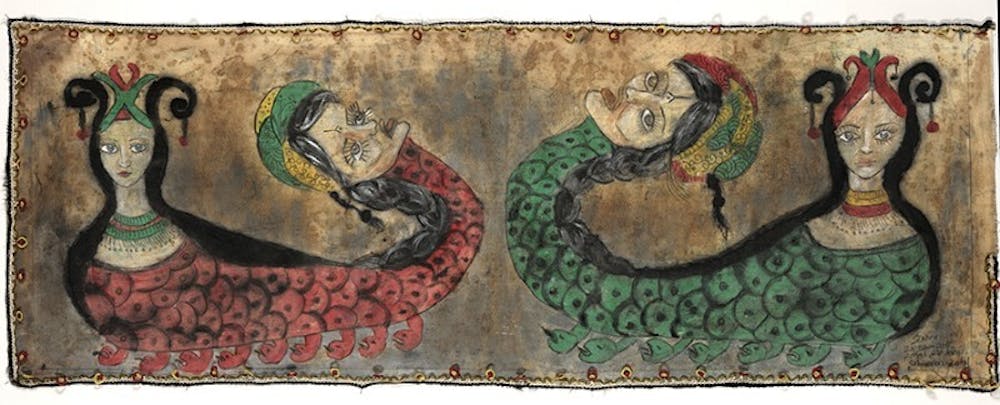
Zehra Doğan’s ‘Beautiful Şahmeran,’ painted in February 2018 in the Diyarbakir prison in southeastern Turkey.
Image courtesy of Zehra Doğan. Photograph by Jef Rabillon.
For example, in 2016 Şahmeran was depicted by Zehra Doğan, a Kurdish journalist and artist, as a double image, each with two heads, to symbolize the redoubled strength of today’s Kurdish women. She painted Şahmeran while being held in prison for another painting critical of the Turkish military’s destruction of the Kurdish town of Nusaybin. Through her painting of Şahmeran, she also invokes Kurdish identity with its red, green and yellow pigments that refer to the flag of Kurdistan.
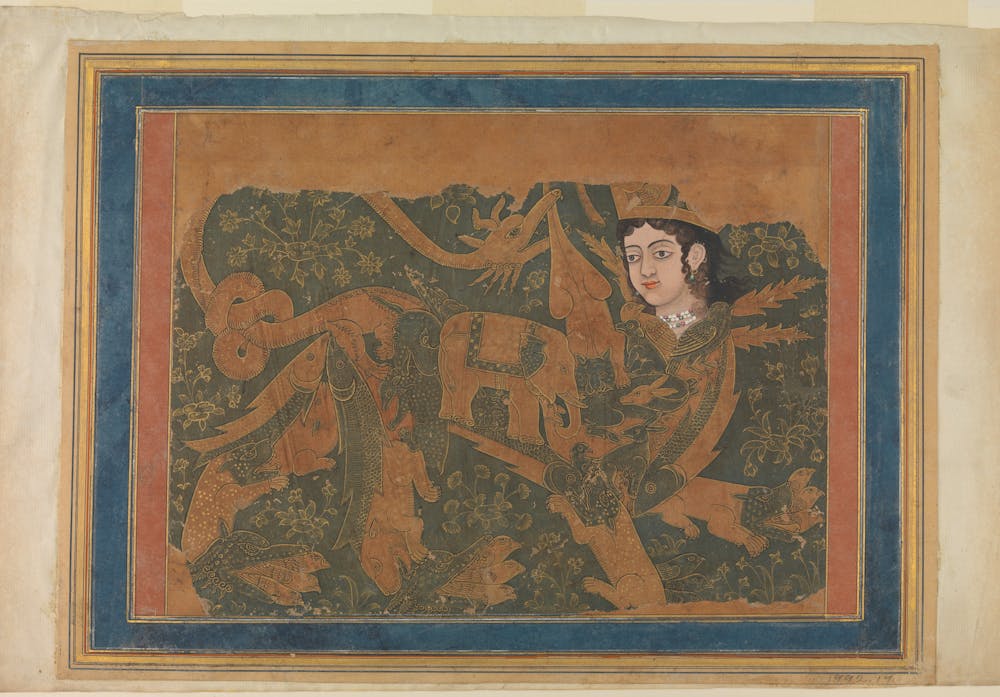
The mythical creature al-Buraq, on which Muhammad is supposed to have made his journey to heaven.
Metropolitan Museum, Purchase Rogers Fund, Elizabeth S. Ettinghausen Gift, in memory of Richard Ettinghausen, and Ehsan Yarshater Gift, 1992
Another mythical figure – that of al Buraq, the prophet Muhammad’s flying, human-headed steed – has also been used to bring attention to LGBTQ issues.
Islamic tales describe al Buraq as the “steed of prophets” upon which Muhammad rode during his celestial ascension to the heavens. Texts relate that this heavenly ascent saw Muhammad rise through the skies, encounter angels and prophets, speak with God and visit heaven and hell in one night.
They also tend to stress al-Buraq’s composite nature, which at times is said to include an elephant’s ears, a horse’s rump, a mule’s feet, a bull’s tail, and peacock feathers.
Appearing at the intersection between human and animal as “nonbinary” creatures, such mythical figures are not bound to distinct categories. As a result, members of trans communities in Turkey and elsewhere have embraced al-Buraq and Şahmeran to express their own queer identities.
Beyond Turkey, Lebanese artist Chaza Charafeddine also overlays portrait photographs of cross-dressers and transgender individuals on premodern painted images of al-Buraq to call attention to those who face discrimination and violence in predominantly Muslim countries and the world at large.
A litmus test
The Şahmeran poster that landed several university students under house arrest brings together many tense religious, cultural and political issues in Turkey today. Among other issues, the image of this hybrid figure was used to highlight a lack of freedom for women and discrimination against those who embrace diverse gender identities.
The anonymous artist used a wall carpet representing the pilgrimage, or hajj, as the backdrop. Superimposed on it was the figure of Şahmeran and a wreath of leaves. As a result, to an observer, Islam’s key architectural symbol of worship appeared to be replaced with a tribute to a female, a snake and nature.
On the one hand, these visual motifs, as the manifesto clearly stated, were intended to send a powerful message against faith-based misogyny, physical violence, animal abuse and ecological collapse; on the other, the Turkish government sees this pictorial manipulation as an “ugly attack” on Islamic religious values and hence a “crime” requiring punishment.
For their part, scholars all over the world have criticized the student arrests, which they see as a serious infringement of academic autonomy and freedom of expression.
As I see it, the age-old figure of Şahmeran has made a strong comeback in the Turkish public sphere, acting as a perilous testing ground, especially for members of the LGBTQ and Kurdish communities.
This article is republished from The Conversation, a nonprofit news organization dedicated to unlocking ideas from academia, under a Creative Commons license.
[Deep knowledge, daily. Sign up for The Conversation’s newsletter.]

About Christiane Gruber
Christiane Gruber is a Professor of Islamic Art at the University of Michigan. You can read more about the author here.
Previous Post

February 26, 2021
How New York's 19th-century Jews turned Purim into an American party

Browse Our Archives
Select a Category Buddhism Christianity Hinduism Islam Judaism Religion and society Uncategorized
Select a Month July 2024 March 2024 February 2024 January 2024 December 2023 November 2023 October 2023 September 2023 August 2023 July 2023 January 2023 August 2022 July 2022 April 2022 February 2022 January 2022 October 2021 July 2021 June 2021 May 2021 April 2021 March 2021 February 2021 January 2021 December 2020 November 2020 October 2020 September 2020 August 2020 July 2020 June 2020 May 2020
Follow Us!
TAKE THE
Religious Wisdom Quiz
I cleansed the temple in sixteen days and celebrated Passover so joyfully that we extended it another seven days. Who am I?
Select your answer to see how you score.
Asa Hezekiah Jehoshaphat Josiah
Related posts from The Conversation

Saudi Reforms Are Softening Islam’s Role, But Critics...

Islam’s call to prayer is ringing out in...

There is no one Islamic interpretation on ethics...
Pope's upcoming visit brings attention to the dwindling...
TRENDING AT PATHEOS Religion News

Catholic Integralists believe that religious values – specifically Christian ones – should...

Electing A Virtuous President Would Make Immunity Irrelevant
Presidential immunity can bring with it many risks. So how can we...

Why The Olympic Games Are A ‘Civil Religious’...
Sporting events form a vital space where Americans display their 'civil religious...

After more than a decade of news, research updates, and insights on...

Q: Why do Southern Baptists and like-minded Protestants...
THE RELIGION GUY’S ANSWER: Why? Simple. Because they believe that’s what the...

THE QUESTION: Is gambling evil? THE RELIGION GUY’S ANSWER: Analysts anticipate a...
view all Religion News blogs
Ad-Free & Subscriber Log-In Subscription Support
- About Us
- 2026 Calendar
- Videos
- Podcasts
- Library of World Religions
- Faith In Media Tracker
- Advertise With Us
- Write for Us
- Privacy Policy
- Terms of Service
- Do Not Sell My Data
- Contact Us
- Radiant Digital
- Manage Newsletter Subscriptions
- Unsubscribe From Notifications
- Sitemap
Copyright 2008-2026, Patheos. All rights reserved.
Subscription Support Ad-Free & Subscriber Log-In
Follow Patheos