
BuddhistCatholicContemplativeEvangelicalGeneral ChristianHinduJewishLatter-day SaintMuslimNew VisionsProgressive Christian
Beliefs
- Buddhist
- Catholic
- Contemplative
- Evangelical
- General Christian
- Hindu
- Jewish
- Latter-day Saint
- More Voices
- Muslim
- New Visions
- Pagan
- Progressive Christian
Topics
- Religion News
- Food and Religion
- Sports and Religion
- Religious Art
- Religious Music and Entertainment
- Religious Events
- History and Religion
- Style and Religion
- Politics and Religion
- Women in Religion
- Recreation Outdoors and Religion
- Business Finance and Religion
- Careers Workplace and Religion
- Education and Religion
- Family Parenting and Religion
- Health Fitness and Religion
- Home and Religion
- Relationships and Religion
- Technology and Religion
- Travel and Religion
Columnists
- Buddhist Columnists
- Business Finance and Religion Columnists
- Careers Workplace and Religion Columnists
- Catholic Columnists
- Contemplative Columnists
- Education and Religion Columnists
- Evangelists Columnists
- Family Parenting and Religion Columnists
- General Christian Columnists
- Health Fitness and Religion Columnists
- Hindu Columnists
- History and Religion Columnists
- Home and Religion Columnists
- Jewish Columnists
- More Voices Columnists
- Latter Day Columnists
- Muslim Columnists
- New Visions Columnists
- Nonreligious Columnists
- Pagan Columnists
- Politics and Religion Columnists
- Progressive Columnists
- Recreation Outdoors and Religion Columnists
- Relationships and Religion Columnists
- Religion News Columnists
- Religious Art Columnists
- Religious Events Columnists
- Religious Music and Entertainment Columnists
- Sports and Religion Columnists
- Style and Religion Columnists
- Technology and Religion Columnists
- Travel and Religion Columnists
- Women in Religion Columnists
Resource Library
- 2026 Calendar
- Library of World Religions
- The 100 Most Holy Places on Earth
- Patheos Answers
- Podcasts
- Videos
- Faith Leaders Database
- Anglican Episcopalian
- Bahai
- Baptist
- Buddhism
- Christianity
- Confucianism
- Eastern Orthodoxy
- Hinduism
- Holiness and Pentecostal
- ISKCON
- Islam
- Judaism
- Lutheran
- Methodist
- The Church of Jesus Christ of Latter-day Saints
- New Age
- Paganism
- Presbytarian and Reformed
- Protestantism
- Religion Behind the Scenes
- Roman Catholic
- Scientology
- Shia Islam
- Sikhism
- Sufism
- Sunni Islam
- Taoism
- Zen
- See all religions
Research Tools
 Ad-Free & Subscriber Log-In Subscription Support
Ad-Free & Subscriber Log-In Subscription Support
Follow Patheos 

- Trending:
- Forgiveness
- |
- Marriage
- |
- Consciousness
- |
- Death Penalty
- |
- Election
- |
- Halloween

- Home
- Religion News
- US army chaplain Emil Kapaun advancing toward sainthood
US army chaplain Emil Kapaun advancing toward sainthood
Last updated on: March 10, 2021 at 2:00 pm by The Conversation
US army chaplain Emil Kapaun advancing toward sainthood 2021-03-10T14:00:31-04:00 The Conversation
Patheos Explore the world's faith through different perspectives on religion and spirituality! Patheos has the views of the prevalent religions and spiritualities of the world.
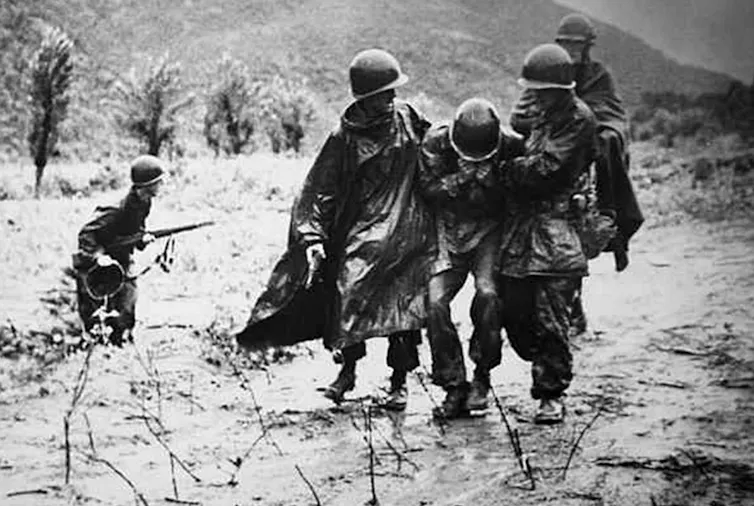
Army chaplain Emil Kapaun helps a soldier on the battlefield during the Korean War in 1952.
Universal History Archive/Universal Images Group via Getty Images
By Joanne M. Pierce of College of the Holy Cross
At the end of a small cemetery on the campus of the College of the Holy Cross, the Jesuit college where I teach, is the grave of Joseph O’Callahan, former professor of mathematics. O’Callahan is one of the few Catholic military chaplains to have been awarded the Congressional Medal of Honor, for his heroic actions during World War II.
Only five Catholic priests have received this highest American military honor. Two of them are in the process of being considered for the highest honor recognized in Catholicism: becoming a canonized saint. They are Vincent Capodanno, a Navy chaplain killed in Vietnam while assigned to a Marine unit in 1967, and Emil Kapaun, an Army chaplain who died in a prison camp during the Korean War in 1951 – and whose remains were recently identified by the Pentagon.
What interests me as a specialist in medieval liturgy and worship is the connection between military bravery and spiritual heroism.
Christian pacifism and military service
Kapaun was captured while ministering, unarmed, to wounded and dying soldiers in active battle. His fellow soldiers lauded the way in which he continued to assist other prisoners before dying of pneumonia in the prison. He was awarded the Medal of Honor posthumously in 2013.
Kapaun’s spiritual heroism was also noted by those he served. A preliminary evaluation of his sanctity, or “cause” for canonization, was accepted by Pope John Paul II in 1993, and he was proclaimed “Servant of God.” It is not unusual for decades to pass before this approval; in fact, a mandatory five-year waiting period has become a first step in the formal process of becoming a saint.
After this, officials in the Diocese of Wichita, Kansas, Kapaun’s home, spent several years conducting a thorough investigation into his life and ministry. A final report, called a “positio,” was accepted and approved by Vatican officials in 2016. Now the pope must decide on declaring Kapaun “Venerable,” the third step toward canonization.
It might seem unusual to associate priestly ministry with the violence of war. In the early first century, Jesus himself preached peace and nonviolence instead of retaliation.
In some early Christian communities during the second and third centuries, soldiers could be accepted as candidates for baptism, the ritual immersion in water necessary for becoming a member of the church, only if they refused to kill other human beings.
In addition, Christians who wanted to become soldiers would be rejected by some Christian communities. However, this was not a universal practice, and in other Christian communities, Christians did enter military service in the Roman imperial legions. In fact, by the end of the third century, Roman emperors would attempt to purge the army of all Christian soldiers.
Christianity as a religion was illegal in the Roman empire during these early centuries. However, at the beginning of the fourth century, Constantine, a military commander, became emperor and legalized Christianity throughout the Roman Empire. By the end of that century, Christianity had become the official religion of the empire.
But a Christian empire still needed to wage war and spill blood to survive. During this time, the theologian Augustine began to develop what came to be called the “Just War Theory.”
In the 13th century, theologian Thomas Aquinas provided further explanation of how ordinary lay Christians could, under certain conditions, engage in warfare. A war had to be declared for just reasons and conducted by the appropriate authorities. The “legitimate” killing of enemy combatants was accepted by Christian bishops and the popes for several more centuries.
However, the role of bishops, priests and other ordained clerics in warfare was less clear, because actual practice did not always reflect theological ideals.
Conflicting practices
During the Middle Ages, this Just War theory was not always followed in the heat of combat. Before the 12th century, it was not uncommon for armed bishops to lead troops personally into battle and fight themselves.
Priests, too, could be called into military service. However, the decrees of local Christian councils continued to forbid clerics from carrying weapons and shedding blood.
Even in the later medieval period, the question of bishops and clerics serving in the military was muddled. Priests did accompany Christian armies to provide moral and sacramental support. But certainly, priests and monks, like the influential abbot and spiritual author Bernard of Clairvaux, took active roles in preaching in support of wars against heretics and Muslims as well.
These religious wars, the Crusades, took place between the 11th and 15th centuries. Popes such as Urban II and Innocent III would call for Crusades to the Holy Land or areas of Europe led by dissident secular rulers.
Aquinas himself offers two apparently contradictory opinions on the role of clergy in wars. He concluded that they could not fight as soldiers because they would be obliged to shed blood, but elsewhere he defended the founding of religious orders of soldiers who would fight to defend the church and the poor. Most members of these orders did take religious vows but were unordained laymen.
Patron saint of military chaplains
Even in pre-Christian times, religious figures accompanied armies to the battlefield and offered sacrifices and blessings for their victories. This continued to be true in medieval and modern Europe, and later, in the United States.
Catholics already venerate one saint as the patron saint of military chaplains. He is St. John of Capistrano, a 15th-century lawyer and politician who became a Franciscan friar and a famous preacher.
Nicknamed the “Soldier Saint,” he personally led troops into battle at the city of Belgrade in an effort to stop the advance of a Muslim Turkish army into Europe.
However, John of Capistrano is also hugely controversial. His assumption of a military role was criticized because some found it inappropriate for a priest. His constant campaigning against the Jews reinforced existing hostility, leading to legal restrictions, anti-Semitic violence and forced exile for many Jewish communities in parts of Germany and Poland.
Kapaun as patron saint?
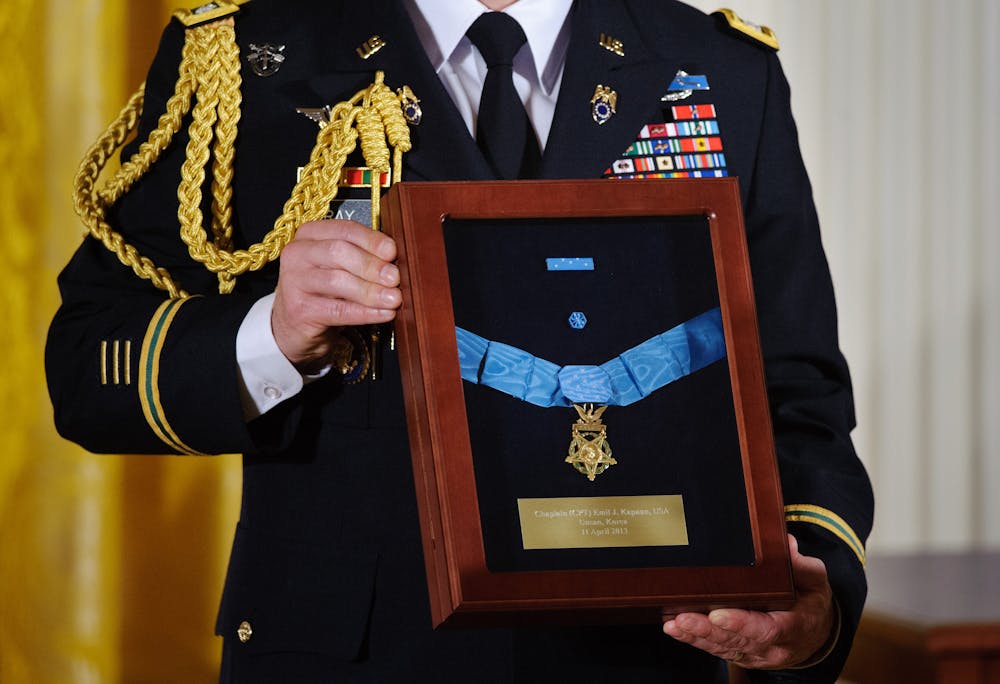
The Rev. Kapaun was awarded the Medal of Honor posthumously in 2013 for his service.
Mandel Ngan/AFP via Getty Images
In the contemporary American military, regulations require that chaplains go unarmed into combat; international law states that they may not be treated as prisoners of war if captured, but must be treated with respect and released.
Apart from actually using weapons against enemy forces, military chaplains share the experiences of other soldiers. Many come under fire themselves, risking their own lives on active battlefields to minister to the dying and rescue the wounded. Their service is to all personnel regardless of differences in faith or religion – for example, in conducting funeral rites.
For many Catholics, Kapaun’s selfless actions during combat and imprisonment would demonstrate extraordinary heroism, not just in fighting the armed enemies, but also in what the Vatican calls “offering of one’s life” for other human beings.
With the recent official identification of Kapaun’s remains, the next few stages to sainthood may proceed more quickly. Diocesan officials note that part of the process involves exhuming and securing the candidate’s body, which had not been possible for Kapaun until the return of American POW remains from their mass graves.
For the moment, perhaps his work as a Catholic chaplain could offer a resolution to a centuries-old paradox: the pragmatic goals of military service and the Christian call to a life of ultimate peacemaking.

This article is republished from The Conversation, a nonprofit news organization dedicated to unlocking ideas from academia, under a Creative Commons license.
[Deep knowledge, daily. Sign up for The Conversation’s newsletter.]

About Joanne M. Pierce
Joanne M. Pierce is a Professor of Religious Studies at College of the Holy Cross You can read more about the author here.


Browse Our Archives
Select a Category Buddhism Christianity Hinduism Islam Judaism Religion and society Uncategorized
Select a Month July 2024 March 2024 February 2024 January 2024 December 2023 November 2023 October 2023 September 2023 August 2023 July 2023 January 2023 August 2022 July 2022 April 2022 February 2022 January 2022 October 2021 July 2021 June 2021 May 2021 April 2021 March 2021 February 2021 January 2021 December 2020 November 2020 October 2020 September 2020 August 2020 July 2020 June 2020 May 2020
Follow Us!
TAKE THE
Religious Wisdom Quiz
Who was the last king of Judah before the Babylonian exile?
Select your answer to see how you score.
Jehoiakim Zedekiah Hezekiah Josiah
Related posts from The Conversation


Why The Olympic Games Are A ‘Civil Religious’...

How Christians Hold Differing Views On The Resurrection
Faith leaders have been protecting migrant rights for...
TRENDING AT PATHEOS Religion News

Catholic Integralists believe that religious values – specifically Christian ones – should...

Electing A Virtuous President Would Make Immunity Irrelevant
Presidential immunity can bring with it many risks. So how can we...

Why The Olympic Games Are A ‘Civil Religious’...
Sporting events form a vital space where Americans display their 'civil religious...

After more than a decade of news, research updates, and insights on...

Q: Why do Southern Baptists and like-minded Protestants...
THE RELIGION GUY’S ANSWER: Why? Simple. Because they believe that’s what the...

THE QUESTION: Is gambling evil? THE RELIGION GUY’S ANSWER: Analysts anticipate a...
view all Religion News blogs
Ad-Free & Subscriber Log-In Subscription Support
- About Us
- 2026 Calendar
- Videos
- Podcasts
- Library of World Religions
- Faith In Media Tracker
- Advertise With Us
- Write for Us
- Privacy Policy
- Terms of Service
- Do Not Sell My Data
- Contact Us
- Radiant Digital
- Manage Newsletter Subscriptions
- Unsubscribe From Notifications
- Sitemap
Copyright 2008-2026, Patheos. All rights reserved.
Subscription Support Ad-Free & Subscriber Log-In
Follow Patheos