
BuddhistCatholicContemplativeEvangelicalGeneral ChristianHinduJewishLatter-day SaintMuslimNew VisionsProgressive Christian
Beliefs
- Buddhist
- Catholic
- Contemplative
- Evangelical
- General Christian
- Hindu
- Jewish
- Latter-day Saint
- More Voices
- Muslim
- New Visions
- Pagan
- Progressive Christian
Topics
- Religion News
- Food and Religion
- Sports and Religion
- Religious Art
- Religious Music and Entertainment
- Religious Events
- History and Religion
- Style and Religion
- Politics and Religion
- Women in Religion
- Recreation Outdoors and Religion
- Business Finance and Religion
- Careers Workplace and Religion
- Education and Religion
- Family Parenting and Religion
- Health Fitness and Religion
- Home and Religion
- Relationships and Religion
- Technology and Religion
- Travel and Religion
Columnists
- Buddhist Columnists
- Business Finance and Religion Columnists
- Careers Workplace and Religion Columnists
- Catholic Columnists
- Contemplative Columnists
- Education and Religion Columnists
- Evangelists Columnists
- Family Parenting and Religion Columnists
- General Christian Columnists
- Health Fitness and Religion Columnists
- Hindu Columnists
- History and Religion Columnists
- Home and Religion Columnists
- Jewish Columnists
- More Voices Columnists
- Latter Day Columnists
- Muslim Columnists
- New Visions Columnists
- Nonreligious Columnists
- Pagan Columnists
- Politics and Religion Columnists
- Progressive Columnists
- Recreation Outdoors and Religion Columnists
- Relationships and Religion Columnists
- Religion News Columnists
- Religious Art Columnists
- Religious Events Columnists
- Religious Music and Entertainment Columnists
- Sports and Religion Columnists
- Style and Religion Columnists
- Technology and Religion Columnists
- Travel and Religion Columnists
- Women in Religion Columnists
Resource Library
- 2026 Calendar
- Library of World Religions
- The 100 Most Holy Places on Earth
- Patheos Answers
- Podcasts
- Videos
- Faith Leaders Database
- Anglican Episcopalian
- Bahai
- Baptist
- Buddhism
- Christianity
- Confucianism
- Eastern Orthodoxy
- Hinduism
- Holiness and Pentecostal
- ISKCON
- Islam
- Judaism
- Lutheran
- Methodist
- The Church of Jesus Christ of Latter-day Saints
- New Age
- Paganism
- Presbytarian and Reformed
- Protestantism
- Religion Behind the Scenes
- Roman Catholic
- Scientology
- Shia Islam
- Sikhism
- Sufism
- Sunni Islam
- Taoism
- Zen
- See all religions
Research Tools
 Ad-Free & Subscriber Log-In Subscription Support
Ad-Free & Subscriber Log-In Subscription Support
Follow Patheos 

- Trending:
- Forgiveness
- |
- Marriage
- |
- Consciousness
- |
- Death Penalty
- |
- Election
- |
- Halloween

- Home
- Religion News
- This Passover, as in the past, will be a time to recognize tragedies and offer hope for the future
This Passover, as in the past, will be a time to recognize tragedies and offer hope for the future
Last updated on: March 28, 2021 at 11:54 am by The Conversation
This Passover, as in the past, will be a time to recognize tragedies and offer hope for the future 2021-03-28T11:54:06-04:00 The Conversation
Patheos Explore the world's faith through different perspectives on religion and spirituality! Patheos has the views of the prevalent religions and spiritualities of the world.
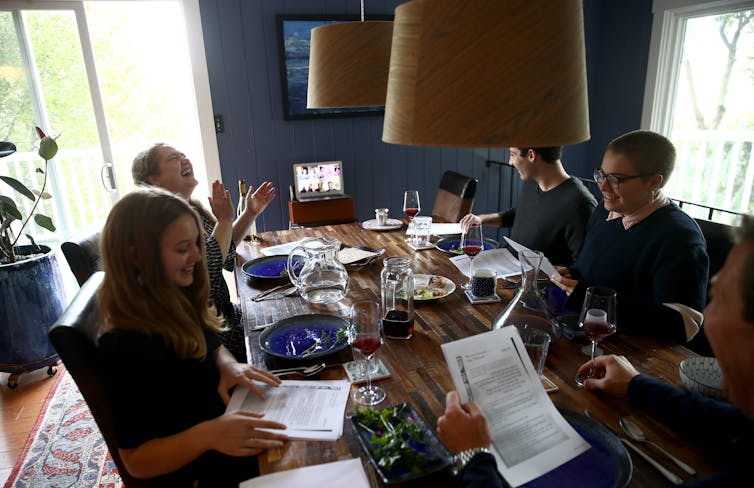
A Jewish family gathers in person and over video conferencing for Passover celebrations in 2020.
Ezra Shaw/Getty Images
By Samuel L. Boyd of University of Colorado Boulder
Jewish families will gather for Passover this year in circumstances that will, like the celebration itself, reflect on dark times while holding out for better to come.
The holiday lasts from the evening of March 27 to the evening of April 4 in 2021. The first two nights of the celebration, March 27 and 28, require a Seder, a ritual meal bringing together the family.
As a scholar of the Bible and ancient Judaism, I believe Passover is a particularly poignant time to recognize the tragedies of the past year and offer hope for the future.
Passover story
The Passover is a festival found in the Bible that commemorates the escape of the Israelites, led by Moses, from Egypt as recounted in the book of Exodus. Prior to the departure of the enslaved Israelites, God delivered a series of plagues on Egypt, culminating in the killing of the firstborn son in every Egyptian family, including the firstborn of the livestock.
The Israelites, however, place the blood of a lamb on their doorposts to signal that the “destroyer,” an angel responsible for the killing, should skip, or pass over, those homes.
This story came to function as a powerful narrative of persecution and liberation for Jewish people. The command to celebrate and remember the exodus from Egypt and the Passover for future generations is encoded in the Bible itself: according to the book of Exodus, God commands Moses, even prior to their departure from Egypt, that the Israelites and their descendants are to commemorate this event.
The celebration of the Passover includes a script, called the Passover Haggadah. The Haggadah contains ancient rituals, some of which may have been practiced as early as the second century A.D., though the full script exists in later, medieval manuscripts.
Story of the four sons
Today, many families also create their own versions of the Haggadah, offering celebrations of the Passover that infuse personal and family experiences.
Each member of the family plays certain roles, as found in the biblical story. This enactment of parts of the Exodus narrative fuses the present moment with the past, encouraging each participant to imagine themselves as part of the first generation to leave Egypt.
Some characters not found explicitly in the biblical text were also added to the Haggadah script. Prominent among them is an addition from the ninth century A.D. – a story about the four sons or children – the wise, the wicked, the simple and the one who does not know what to ask.
The versions varied, but the characters became a prominent part of the celebration. In many families today, they are called “children” or “daughters,” allowing for the inclusion of all members of the family regardless of gender.
These characters were inspired by a variety of biblical and rabbinic sources in which children ask certain questions about the celebration of the Passover. In the case of the son who does not know what to ask, the parent directly tells the child about the importance of the exodus without waiting for the question.
The Bible speaks of interactions between parents and children, but does not label the children in a specific manner. The main purpose is telling, examining and passing on the significance of the exodus from a number of different perspectives. The distinct roles of each child encourage the participants to reflect, in different ways, on the significance of liberation and how to communicate it to future generations.
Almost like a time machine, then, the Haggadah and celebration of Passover incorporates the manner in which history, the present and the future relate to one another. This unfolding of all dimensions of time allows those who celebrate to remember tragedies and loss in the past while also generating a real sense of hope for the future.
Flexibility and adaptation
According to many parts of the Bible, the Passover festival was to occur once a year, and only in Jerusalem where the temple to the Israelite deity existed.
The celebration of Passover evolved into a home-based commemoration with the destruction of the temple by the Romans in A.D. 70. The biblical Passover mentioned in the book of Exodus also occurred in individual homes.
As such, the Bible provided ways to adapt the celebration in light of changed circumstances. The Bible describes how the second Passover – a year after the Israelites left Egypt – is celebrated in the wilderness, but seems to presuppose that its future celebration will be in the temple in Jerusalem. At that time, allowance would be made for those who had to travel long distances, by delaying its observance by 30 days.
This delay anticipated that geographical separation and time may not allow for normal Passover observance, a comfort directly derived from the Bible for those families who were not able to celebrate in 2020 in person.
The possibility now exists in 2021 that grandparents might be able to visit their families again since public health guidelines suggest it’s low-risk for vaccinated people to gather in small groups. When families gather for Passover, however, many may choose to reflect on the hard times of the past year as part of the Seder. Indeed, the celebration of the Passover has in it other references related to Jewish history, even if they were not always positive.

A young girl pretends to ‘steal’ the Afikomen, as part of the celebrations.
Bettmann via Getty images
For example, part of the celebration of the Passover Haggadah entails the breaking of unleavened bread, a piece of which is known as the Afikomen, which is then hidden. Children try to find it for a prize, called a “treasure from Egypt.” The term Afikomen is itself a Greek word, referring possibly to after-dinner revelry. It is a reminder of another historical moment in which Jewish cultures were heavily surrounded and influenced by the Greeks.
The relationship with the Greeks was a complex one. Some part of the Greek influence was celebrated in early Jewish society. For example, the translation of the Old Testament from Hebrew into Greek, starting in the third century B.C., was considered a divine act.
There were also conflicts between Greek rulers and local Jewish populations, which led to a war in the second century B.C., known as the Maccabean Revolt. Indeed, there were debates in Judaism whether or not one could recite parts of the Bible in Greek, in worship services.
Yet the incorporation of the word Afikomen in the Passover Haggadah displays a willingness to borrow a Greek term into an important Jewish celebration.
Next year in Jerusalem
Looking to the future is central to the celebration of the Passover Haggadah. Despite the deliverance from slavery in Egypt, the meal concludes with the phrase, also said at the end of another celebration known as Yom Kippur, “Next year in Jerusalem.”
In a meal that blends past and present and nods toward the future, ending the Haggadah with such a proclamation highlights the reality that despite freedom from Egypt, most Jewish communities over time celebrated the Passover Haggadah away from their ancestral home and in circumstances that were not ideal.
This yearning for a world that is not yet healed and the toggling between past, present and future in the Passover celebration will perhaps hold special significance for many grandparents and their families in 2021.

This article is republished from The Conversation, a nonprofit news organization dedicated to unlocking ideas from academia, under a Creative Commons license.
[Deep knowledge, daily. Sign up for The Conversation’s newsletter.]

About Samuel L. Boyd
Samuel L. Boyd is an Assistant Professor of Religious Studies and Jewish Studies at the University of Colorado Boulder. You can read more about the author here.
Previous Post

March 10, 2021
US army chaplain Emil Kapaun advancing toward sainthood
Next Post
April 1, 2021 Why parts of Good Friday worship have been controversial
Browse Our Archives
Select a Category Buddhism Christianity Hinduism Islam Judaism Religion and society Uncategorized
Select a Month July 2024 March 2024 February 2024 January 2024 December 2023 November 2023 October 2023 September 2023 August 2023 July 2023 January 2023 August 2022 July 2022 April 2022 February 2022 January 2022 October 2021 July 2021 June 2021 May 2021 April 2021 March 2021 February 2021 January 2021 December 2020 November 2020 October 2020 September 2020 August 2020 July 2020 June 2020 May 2020
Follow Us!
TAKE THE
Religious Wisdom Quiz
What is the Christian teaching about temptation?
Select your answer to see how you score.
Ignore it Deny it exists Give in quickly Resist and pray for strength
Related posts from The Conversation


Electing A Virtuous President Would Make Immunity Irrelevant

Why The Olympic Games Are A ‘Civil Religious’...

The Catholic Church Is Using The Olympics To...
TRENDING AT PATHEOS Religion News

Catholic Integralists believe that religious values – specifically Christian ones – should...

Electing A Virtuous President Would Make Immunity Irrelevant
Presidential immunity can bring with it many risks. So how can we...

Why The Olympic Games Are A ‘Civil Religious’...
Sporting events form a vital space where Americans display their 'civil religious...

After more than a decade of news, research updates, and insights on...

Q: Why do Southern Baptists and like-minded Protestants...
THE RELIGION GUY’S ANSWER: Why? Simple. Because they believe that’s what the...

THE QUESTION: Is gambling evil? THE RELIGION GUY’S ANSWER: Analysts anticipate a...
view all Religion News blogs
Ad-Free & Subscriber Log-In Subscription Support
- About Us
- 2026 Calendar
- Videos
- Podcasts
- Library of World Religions
- Faith In Media Tracker
- Advertise With Us
- Write for Us
- Privacy Policy
- Terms of Service
- Do Not Sell My Data
- Contact Us
- Radiant Digital
- Manage Newsletter Subscriptions
- Unsubscribe From Notifications
- Sitemap
Copyright 2008-2026, Patheos. All rights reserved.
Subscription Support Ad-Free & Subscriber Log-In
Follow Patheos