
BuddhistCatholicContemplativeEvangelicalGeneral ChristianHinduJewishLatter-day SaintMuslimNew VisionsProgressive Christian
Beliefs
- Buddhist
- Catholic
- Contemplative
- Evangelical
- General Christian
- Hindu
- Jewish
- Latter-day Saint
- More Voices
- Muslim
- New Visions
- Pagan
- Progressive Christian
Topics
- Religion News
- Food and Religion
- Sports and Religion
- Religious Art
- Religious Music and Entertainment
- Religious Events
- History and Religion
- Style and Religion
- Politics and Religion
- Women in Religion
- Recreation Outdoors and Religion
- Business Finance and Religion
- Careers Workplace and Religion
- Education and Religion
- Family Parenting and Religion
- Health Fitness and Religion
- Home and Religion
- Relationships and Religion
- Technology and Religion
- Travel and Religion
Columnists
- Buddhist Columnists
- Business Finance and Religion Columnists
- Careers Workplace and Religion Columnists
- Catholic Columnists
- Contemplative Columnists
- Education and Religion Columnists
- Evangelists Columnists
- Family Parenting and Religion Columnists
- General Christian Columnists
- Health Fitness and Religion Columnists
- Hindu Columnists
- History and Religion Columnists
- Home and Religion Columnists
- Jewish Columnists
- More Voices Columnists
- Latter Day Columnists
- Muslim Columnists
- New Visions Columnists
- Nonreligious Columnists
- Pagan Columnists
- Politics and Religion Columnists
- Progressive Columnists
- Recreation Outdoors and Religion Columnists
- Relationships and Religion Columnists
- Religion News Columnists
- Religious Art Columnists
- Religious Events Columnists
- Religious Music and Entertainment Columnists
- Sports and Religion Columnists
- Style and Religion Columnists
- Technology and Religion Columnists
- Travel and Religion Columnists
- Women in Religion Columnists
Resource Library
- 2026 Calendar
- Library of World Religions
- The 100 Most Holy Places on Earth
- Patheos Answers
- Podcasts
- Videos
- Faith Leaders Database
- Anglican Episcopalian
- Bahai
- Baptist
- Buddhism
- Christianity
- Confucianism
- Eastern Orthodoxy
- Hinduism
- Holiness and Pentecostal
- ISKCON
- Islam
- Judaism
- Lutheran
- Methodist
- The Church of Jesus Christ of Latter-day Saints
- New Age
- Paganism
- Presbytarian and Reformed
- Protestantism
- Religion Behind the Scenes
- Roman Catholic
- Scientology
- Shia Islam
- Sikhism
- Sufism
- Sunni Islam
- Taoism
- Zen
- See all religions
Research Tools
 Ad-Free & Subscriber Log-In Subscription Support
Ad-Free & Subscriber Log-In Subscription Support
Follow Patheos 

- Trending:
- Forgiveness
- |
- Marriage
- |
- Consciousness
- |
- Death Penalty
- |
- Election
- |
- Halloween

- Home
- Religion News
- Pope’s upcoming visit brings attention to the dwindling population of Christians in Iraq
Pope’s upcoming visit brings attention to the dwindling population of Christians in Iraq
Last updated on: March 4, 2021 at 12:48 pm by The Conversation
Pope’s upcoming visit brings attention to the dwindling population of Christians in Iraq 2021-03-04T12:48:24-04:00 The Conversation
Patheos Explore the world's faith through different perspectives on religion and spirituality! Patheos has the views of the prevalent religions and spiritualities of the world.
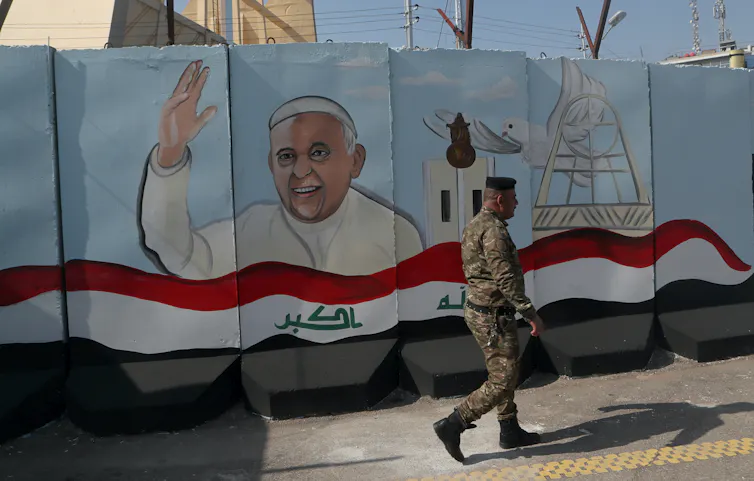
A mural depicting Pope Francis on a concrete wall around the Our Lady of Salvation Church in Baghdad, in preparation for the pontiff’s visit,
AP/Photo/Khalid Mohammed
By Ramazan Kılınç of University of Nebraska Omaha
Pope Francis will arrive in Iraq on Friday in a first-ever papal visit to the country that is expected to raise awareness about the challenges facing Iraqi Christians – a majority of whom are Catholic.
In the past two decades, the Christian population in Iraq has fallen by over 80%. The 1987 Iraqi census reported that there were 1.4 million Christians in Iraq, and today it is estimated that the Christian population is less than 250,000. Spurred by political instability and war, many Christians have immigrated to other regions, including North America, Western Europe and Australia.
My recent book, “Alien Citizens: The State and Religious Minorities in Turkey and France,” examines how international factors influence the status of religious minorities. I argue that in Iraq’s case, it was a series of international interventions that eventually led to the dwindling of the Christian minority.
Who are Iraq’s Christians?
Most Iraqi Christians are ethnically Assyrian, and they belong to the historic Church of the East, one of the three major branches of Eastern Christianity. The language of worship is a dialect of Aramaic, the language that Jesus is said to have spoken.
The largest of these Assyrian communities belongs to the Chaldean Catholic Church, making up more than two-thirds of all Christians living in Iraq.
The Assyrian Church of the East and the Ancient Church of the East are other smaller Assyrian communities that constitute about 5% of Iraqi Christians.
Syriacs, who constitute somewhere between 10% to 15% of Iraqi Christians, are organized around the Syriac Catholic Church and the Syriac Orthodox Church, which are headquartered in Lebanon and Syria respectively.
Armenians and Arab Christians, along with other small groups, constitute the rest of the Christians living in Iraq.
Christians flee Iraq after war
The events that followed the 2003 U.S. invasion of Iraq led to a large-scale persecution of the Christian population.
While Saddam Hussein repressed ethnic and religious groups such as Kurds and Shiites, Christians fared relatively better under his rule. As religion scholar Kristian Girling wrote, in return for their acquiescence to Saddam’s authoritarianism, Christians were given protections and gained prominence in business and cultural life.
Tariq Aziz, who was the deputy prime minister in Saddam’s Cabinet between 1979 and 2003, was affiliated with the Chaldean Catholic Church.
The ousting of Saddam by U.S. troops led to a power vacuum in which sectarianism and instability helped create the conditions for the rise of extremist groups such as al-Qaida in Iraq from 2004.
Violence against Christians in the form of killings, attacks and kidnappings soared.
As a result, many Christians fled Iraq. According to data compiled from U.S. International Religious Freedom reports, by 2013, a decade after the invasion, more than half the Christian population had left the country.
The destruction by Islamic State group
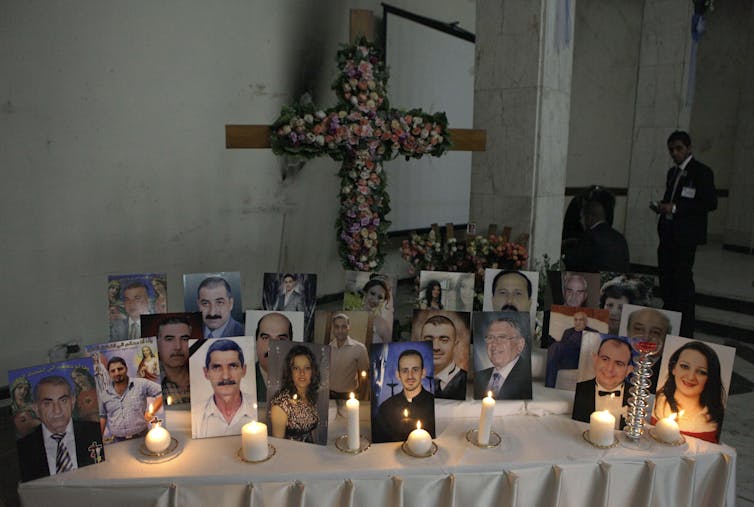
Pictures of slain Iraqi Christians displayed at Our Lady of Salvation church in Baghdad in 2010.
AP Photo/Khalid Mohammed
The plight of Iraq’s Christians became more precarious as the Islamic State group took hold of swaths of the country.
In 2014, IS controlled the territories around Mosul in Northern Iraq and expelled Christians from Nineveh Plains. According to some estimates, more than 100,000 Christians fled from Nineveh Plains to the autonomous Kurdish regions.
Many never returned after the defeat of IS in 2017. Those who did had to face the Shiite militant groups who helped the Iraqi government defeat IS and controlled some Christian territories.
Until the Iraqi government had tamed these militias and had political control over them, Christians had skirmishes with them over properties and lands. According to media reports, many more Christians left Iraq in this period.
In short, the U.S. invasion of Iraq started a cycle of violence that put Christianity under threat. As foreign correspondent Stephen Kinzer wrote in a piece for The Boston Globe: “By overthrowing Hussein, we hastened the end of Christianity in a land to which Saint John is said to have brought it soon after the Crucifixion.”
Is there hope?
Between 2017 and 2019, the Trump administration provided over US$300 million in aid to support the rebuilding of the Christian cities and villages of Nineveh Plains destroyed by IS in Northern Iraq.
However, a long-lasting solution to improving Christians’ status is maintaining the rule of law in Iraq. The Iraqi constitution, drafted in 2005, declares Islam as the country’s official religion. Singling out one religion at the expense of others can put religious minorities at risk unless clear protections are provided. Iraq needs a legal framework for equal citizenship to create a safe environment for religious minorities.
The Iraqi government invited Pope Francis to visit. The president of Iraq, Barham Salih, described the visit as “a message of peace to Iraqis of all religions.” Media reports have quoted a Vatican source as saying the pope aims “to comfort Christians who, amid wars and conflicts, have been forced to flee from Iraq.”
One cannot know if the pope’s visit will help Iraqi Christians heal from many years of suffering, but it will definitely bring public attention to their situation.
This article is republished from The Conversation, a nonprofit news organization dedicated to unlocking ideas from academia, under a Creative Commons license.
[Deep knowledge, daily. Sign up for The Conversation’s newsletter.]

About Ramazan Kılınç
Ramazan Kılınç is an Associate Professor of Political Science at the University of Nebraska Omaha. You can read more about the author here.
Next Post
March 10, 2021 US army chaplain Emil Kapaun advancing toward sainthood
Browse Our Archives
Select a Category Buddhism Christianity Hinduism Islam Judaism Religion and society Uncategorized
Select a Month July 2024 March 2024 February 2024 January 2024 December 2023 November 2023 October 2023 September 2023 August 2023 July 2023 January 2023 August 2022 July 2022 April 2022 February 2022 January 2022 October 2021 July 2021 June 2021 May 2021 April 2021 March 2021 February 2021 January 2021 December 2020 November 2020 October 2020 September 2020 August 2020 July 2020 June 2020 May 2020
Follow Us!
TAKE THE
Religious Wisdom Quiz
"______ is the same yesterday and today and forever."
Select your answer to see how you score.
The Universe Jesus Christ God's Plan Our Calling
Related posts from The Conversation


How Christians Hold Differing Views On The Resurrection
Latin America’s colonial period was less Catholic
Pope Francis called surrogacy ‘deplorable’
TRENDING AT PATHEOS Religion News

Catholic Integralists believe that religious values – specifically Christian ones – should...

Electing A Virtuous President Would Make Immunity Irrelevant
Presidential immunity can bring with it many risks. So how can we...

Why The Olympic Games Are A ‘Civil Religious’...
Sporting events form a vital space where Americans display their 'civil religious...

After more than a decade of news, research updates, and insights on...

Q: Why do Southern Baptists and like-minded Protestants...
THE RELIGION GUY’S ANSWER: Why? Simple. Because they believe that’s what the...

THE QUESTION: Is gambling evil? THE RELIGION GUY’S ANSWER: Analysts anticipate a...
view all Religion News blogs
Ad-Free & Subscriber Log-In Subscription Support
- About Us
- 2026 Calendar
- Videos
- Podcasts
- Library of World Religions
- Faith In Media Tracker
- Advertise With Us
- Write for Us
- Privacy Policy
- Terms of Service
- Do Not Sell My Data
- Contact Us
- Radiant Digital
- Manage Newsletter Subscriptions
- Unsubscribe From Notifications
- Sitemap
Copyright 2008-2026, Patheos. All rights reserved.
Subscription Support Ad-Free & Subscriber Log-In
Follow Patheos