
BuddhistCatholicContemplativeEvangelicalGeneral ChristianHinduJewishLatter-day SaintMuslimNew VisionsProgressive Christian
Beliefs
- Buddhist
- Catholic
- Contemplative
- Evangelical
- General Christian
- Hindu
- Jewish
- Latter-day Saint
- More Voices
- Muslim
- New Visions
- Pagan
- Progressive Christian
Topics
- Religion News
- Food and Religion
- Sports and Religion
- Religious Art
- Religious Music and Entertainment
- Religious Events
- History and Religion
- Style and Religion
- Politics and Religion
- Women in Religion
- Recreation Outdoors and Religion
- Business Finance and Religion
- Careers Workplace and Religion
- Education and Religion
- Family Parenting and Religion
- Health Fitness and Religion
- Home and Religion
- Relationships and Religion
- Technology and Religion
- Travel and Religion
Columnists
- Buddhist Columnists
- Business Finance and Religion Columnists
- Careers Workplace and Religion Columnists
- Catholic Columnists
- Contemplative Columnists
- Education and Religion Columnists
- Evangelists Columnists
- Family Parenting and Religion Columnists
- General Christian Columnists
- Health Fitness and Religion Columnists
- Hindu Columnists
- History and Religion Columnists
- Home and Religion Columnists
- Jewish Columnists
- More Voices Columnists
- Latter Day Columnists
- Muslim Columnists
- New Visions Columnists
- Nonreligious Columnists
- Pagan Columnists
- Politics and Religion Columnists
- Progressive Columnists
- Recreation Outdoors and Religion Columnists
- Relationships and Religion Columnists
- Religion News Columnists
- Religious Art Columnists
- Religious Events Columnists
- Religious Music and Entertainment Columnists
- Sports and Religion Columnists
- Style and Religion Columnists
- Technology and Religion Columnists
- Travel and Religion Columnists
- Women in Religion Columnists
Resource Library
- 2026 Calendar
- Library of World Religions
- The 100 Most Holy Places on Earth
- Patheos Answers
- Podcasts
- Videos
- Faith Leaders Database
- Anglican Episcopalian
- Bahai
- Baptist
- Buddhism
- Christianity
- Confucianism
- Eastern Orthodoxy
- Hinduism
- Holiness and Pentecostal
- ISKCON
- Islam
- Judaism
- Lutheran
- Methodist
- The Church of Jesus Christ of Latter-day Saints
- New Age
- Paganism
- Presbytarian and Reformed
- Protestantism
- Religion Behind the Scenes
- Roman Catholic
- Scientology
- Shia Islam
- Sikhism
- Sufism
- Sunni Islam
- Taoism
- Zen
- See all religions
Research Tools
 Ad-Free & Subscriber Log-In Subscription Support
Ad-Free & Subscriber Log-In Subscription Support
Follow Patheos 

- Trending:
- Forgiveness
- |
- Marriage
- |
- Consciousness
- |
- Death Penalty
- |
- Election
- |
- Halloween

- Home
- Religion News
- Stuck inside your home this Groundhog Day? Be like Phil the weatherman, and try some mindfulness
Stuck inside your home this Groundhog Day? Be like Phil the weatherman, and try some mindfulness
Last updated on: February 2, 2021 at 10:24 am by The Conversation
Stuck inside your home this Groundhog Day? Be like Phil the weatherman, and try some mindfulness 2021-02-02T10:24:09-04:00 The Conversation
Patheos Explore the world's faith through different perspectives on religion and spirituality! Patheos has the views of the prevalent religions and spiritualities of the world.

Bill Murray and Andie MacDowell in a scene from the film ‘Groundhog Day.’
Columbia Pictures/Getty Images
By Jeremy David Engels of Penn State
Many of us will recall the American comedy film “Groundhog Day.”
Originally released in 1993, it stars the incomparable Bill Murray as Phil Conners, an insufferable Pittsburgh weatherman. A minor local celebrity who believes himself destined for much better things, he resents his piddling assignment to report on the Groundhog Day celebration in Punxsutawney, Pennsylvania.

Punxsutawney Phil after emerging from his burrow on Gobblers Knob in Punxsutawney, Pennsylvania.
AP Photo/Gene J. Puskar
The plan is to return to Pittsburgh after the festivities. But when a blizzard shuts down the highway, Phil finds himself trapped in Punxsutawney. He wakes up the next day, only to discover that it’s not the next day at all. It’s Groundhog Day all over again.
For some reason he’s trapped in Feb. 2, forced to relive the same day over and over again.
“What if there is no tomorrow?” he asks at one point, adding: “There wasn’t one today.”
It is a question that will resonate with millions living in quarantine today – as people wake up every morning wondering if the day ahead will be any different from the 24 hours they have just endured.
But I have a more positive spin. As a scholar of communication and ethics, I argue that the lesson at the heart of the movie is that because we can never count on tomorrow, life must be lived fully in the present, not just for oneself, but also for others. Ultimately, “Groundhog Day” gives us a lesson in mindfulness.
Metaphor for mindlessness?
Phil was trapped in Groundhog Day, perhaps for hundreds of years. The original script said 10,000 years, though the director reportedly said it was 10. Either way, that’s a long time to wake up to the same song every morning.
Finally, Phil awakens, and it’s Feb. 3, that is, the next day.
I believe what brings about tomorrow for Phil is that he learns to practice mindfulness.
Phil’s repetitive existence can stand for a metaphor for mindlessness, for how we all get stuck in cycles of reactivity, addiction and habit. Locked in our routines, life can lose its luster.
It can quickly seem like nothing we do matters all that much. “What would you do if you were stuck in one place, and every day was exactly the same, and nothing that you did mattered?” Phil asks two local guys at the bowling alley. “That about sums it up for me,” one of them responds.
Contemporary practices of mindfulness can trace their roots back to Buddhism. For Buddhists, the concept of reincarnation or rebirth is important. Many Buddhists believe that all living beings go through many births until they achieve salvation.
As a scholar, I believe the idea of rebirth is more complex than is often understood in popular culture.
Pali is the ancient sacred language of Theravada Buddhism. Scholar of Buddhism Stephen Batchelor notes that the ancient Pali language word “punabbhava,” often translated as “rebirth,” literally means “again-becoming,” or what we might think of as “repetitive existence.”
That’s Phil’s life, stuck in Groundhog Day. That’s what Phil is trying to escape, and what we are all trying to escape in COVID times – repetitive existence, a life stuck in one gear, frozen by habits and patterns that make every day feel the same, as though nothing matters.
Taking a moment – to respond
If Phil’s stuckness is a metaphor for mindlessness, Phil’s awakening, I argue, is a metaphor for mindfulness. Mindfulness is the practice of experiencing life as it is happening, squarely in the now, without immediately reacting to it or being carried away by it.
Mindfulness is a practice of getting to know ourselves and our conditioning a little better. Conditioning is an automatic pattern of reacting to the world. By stepping out of autopilot, pausing, and noticing, many of us can find that we are no longer captive to our conditioning. Consequently, we gain the space to make choices about how we want to respond to life.
That is what Phil does in the movie – he escapes repetitive existence by overcoming his initial conditioned, obnoxious, egotistical reactions to the world. At the beginning of the film, he calls himself the “talent” and berates the “hicks” who live in the small town. He is too good for Groundhog Day. He wants to escape Punxsutawney as fast as possible.
As the film continues, Phil accepts his situation and turns repetition into an opportunity for growth. He begins to find meaning in the place where he is trapped. He embraces life, fully, which also means that he notices his own suffering and the suffering of those around him.
Phil addresses his own suffering by pursuing his passions and developing his skills. He learns to play the piano and becomes an accomplished ice sculptor.
Initially, Phil felt nothing for those around him. People were objects to him, if he noticed them at all. By the end of the film, he feels compassion, which, according to the mindfulness teacher Rhonda Magee, means “the will to act to alleviate the suffering of others.” Mindfulness is a practice that draws us into the world, into service. Compassion is at the heart of a mindfulness practice.
Mindfulness in pandemic times
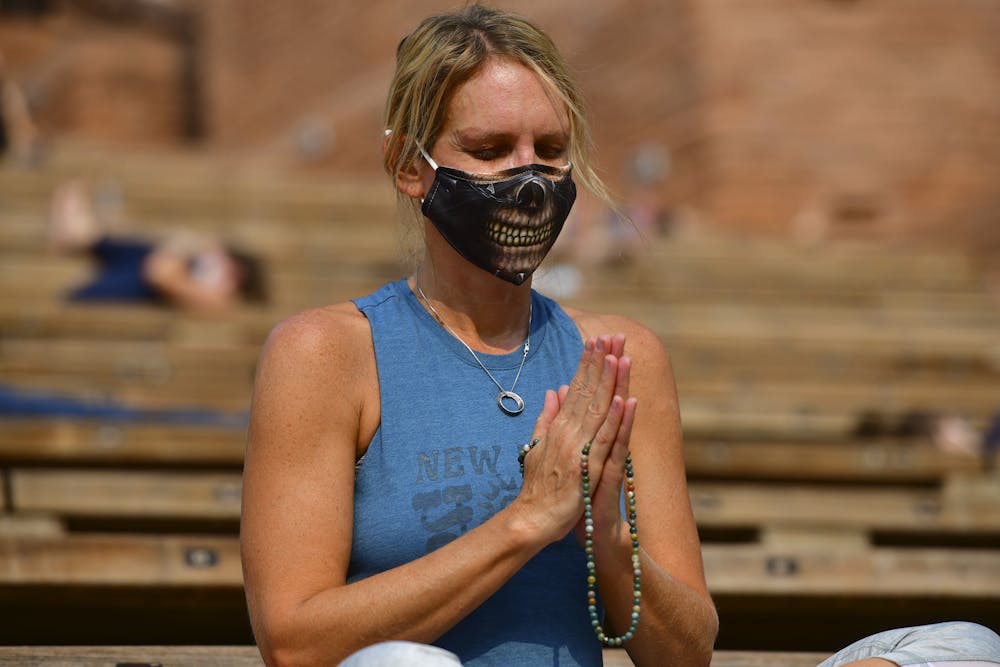
Compassion is at the heart of meditation.
Mark Makela/Getty Images
Mindfulness does not mean turning away from difficulty. It is a practice of meeting difficulty with compassion. Though Phil finally accepts that there might not be a tomorrow, nevertheless he acts to ensure that if tomorrow comes for himself and those around him, it will be better than today.
For example, Phil saves the lives of at least two people: a young boy who, before Phil’s intervention, falls out of a tree onto a hard sidewalk, and the town’s mayor, who, before Phil bursts in to give him the Heimlich, chokes on his lunch.
Phil’s mindful awareness of what is happening in the moment allows him to act for tomorrow without losing track of today. Phil’s mindfulness, and his compassion, drive the film’s central love story between Phil and Rita. At the beginning of the film, he was capable of loving only himself. By the end of the film, Phil has learned to love mindfully.
According to Thich Nhat Hanh, loving mindfully means that “you must love in such a way that the person you love feels free.” Phil has learned that love is not about manipulation or possession but about collaboration in making a shared life together.
To the best of his ability, Phil dedicates himself to alleviating the suffering of others in a present that is real and for a future that might not come. He does this in small acts of compassion like fixing a flat tire and more momentous acts like saving a life. This mindful dedication to the future in the face of uncertainty is, I argue, what allows him to wake up to a new day.
This is a good lesson for us all, stuck, as we are, in a perpetual pandemic Groundhog Day, and dreaming, as we are, of tomorrow.

This article is republished from The Conversation, a nonprofit news organization dedicated to unlocking ideas from academia, under a Creative Commons license.
[Deep knowledge, daily. Sign up for The Conversation’s newsletter.]

About Jeremy David Engels
Jeremy David Engels is a Professor of Communication Arts and Sciences at Penn State. You can read more about the author here.
Previous Post

January 28, 2021
The problem with India's 'love jihad' laws

Browse Our Archives
Select a Category Buddhism Christianity Hinduism Islam Judaism Religion and society Uncategorized
Select a Month July 2024 March 2024 February 2024 January 2024 December 2023 November 2023 October 2023 September 2023 August 2023 July 2023 January 2023 August 2022 July 2022 April 2022 February 2022 January 2022 October 2021 July 2021 June 2021 May 2021 April 2021 March 2021 February 2021 January 2021 December 2020 November 2020 October 2020 September 2020 August 2020 July 2020 June 2020 May 2020
Follow Us!
TAKE THE
Religious Wisdom Quiz
What book has the most references to the word "love" in the New Testament?
Select your answer to see how you score.
John Matthew Romans 1 John
Related posts from The Conversation


Electing A Virtuous President Would Make Immunity Irrelevant

Why The Olympic Games Are A ‘Civil Religious’...

The Catholic Church Is Using The Olympics To...
TRENDING AT PATHEOS Religion News

Catholic Integralists believe that religious values – specifically Christian ones – should...

Electing A Virtuous President Would Make Immunity Irrelevant
Presidential immunity can bring with it many risks. So how can we...

Why The Olympic Games Are A ‘Civil Religious’...
Sporting events form a vital space where Americans display their 'civil religious...

After more than a decade of news, research updates, and insights on...

Q: Why do Southern Baptists and like-minded Protestants...
THE RELIGION GUY’S ANSWER: Why? Simple. Because they believe that’s what the...

THE QUESTION: Is gambling evil? THE RELIGION GUY’S ANSWER: Analysts anticipate a...
view all Religion News blogs
Ad-Free & Subscriber Log-In Subscription Support
- About Us
- 2026 Calendar
- Videos
- Podcasts
- Library of World Religions
- Faith In Media Tracker
- Advertise With Us
- Write for Us
- Privacy Policy
- Terms of Service
- Do Not Sell My Data
- Contact Us
- Radiant Digital
- Manage Newsletter Subscriptions
- Unsubscribe From Notifications
- Sitemap
Copyright 2008-2026, Patheos. All rights reserved.
Subscription Support Ad-Free & Subscriber Log-In
Follow Patheos