
BuddhistCatholicContemplativeEvangelicalGeneral ChristianHinduJewishLatter-day SaintMuslimNew VisionsProgressive Christian
Beliefs
- Buddhist
- Catholic
- Contemplative
- Evangelical
- General Christian
- Hindu
- Jewish
- Latter-day Saint
- More Voices
- Muslim
- New Visions
- Pagan
- Progressive Christian
Topics
- Religion News
- Food and Religion
- Sports and Religion
- Religious Art
- Religious Music and Entertainment
- Religious Events
- History and Religion
- Style and Religion
- Politics and Religion
- Women in Religion
- Recreation Outdoors and Religion
- Business Finance and Religion
- Careers Workplace and Religion
- Education and Religion
- Family Parenting and Religion
- Health Fitness and Religion
- Home and Religion
- Relationships and Religion
- Technology and Religion
- Travel and Religion
Columnists
- Buddhist Columnists
- Business Finance and Religion Columnists
- Careers Workplace and Religion Columnists
- Catholic Columnists
- Contemplative Columnists
- Education and Religion Columnists
- Evangelists Columnists
- Family Parenting and Religion Columnists
- General Christian Columnists
- Health Fitness and Religion Columnists
- Hindu Columnists
- History and Religion Columnists
- Home and Religion Columnists
- Jewish Columnists
- More Voices Columnists
- Latter Day Columnists
- Muslim Columnists
- New Visions Columnists
- Nonreligious Columnists
- Pagan Columnists
- Politics and Religion Columnists
- Progressive Columnists
- Recreation Outdoors and Religion Columnists
- Relationships and Religion Columnists
- Religion News Columnists
- Religious Art Columnists
- Religious Events Columnists
- Religious Music and Entertainment Columnists
- Sports and Religion Columnists
- Style and Religion Columnists
- Technology and Religion Columnists
- Travel and Religion Columnists
- Women in Religion Columnists
Resource Library
- 2026 Calendar
- Library of World Religions
- The 100 Most Holy Places on Earth
- Patheos Answers
- Podcasts
- Videos
- Faith Leaders Database
- Anglican Episcopalian
- Bahai
- Baptist
- Buddhism
- Christianity
- Confucianism
- Eastern Orthodoxy
- Hinduism
- Holiness and Pentecostal
- ISKCON
- Islam
- Judaism
- Lutheran
- Methodist
- The Church of Jesus Christ of Latter-day Saints
- New Age
- Paganism
- Presbytarian and Reformed
- Protestantism
- Religion Behind the Scenes
- Roman Catholic
- Scientology
- Shia Islam
- Sikhism
- Sufism
- Sunni Islam
- Taoism
- Zen
- See all religions
Research Tools
 Ad-Free & Subscriber Log-In Subscription Support
Ad-Free & Subscriber Log-In Subscription Support
Follow Patheos 

- Trending:
- Forgiveness
- |
- Marriage
- |
- Consciousness
- |
- Death Penalty
- |
- Election
- |
- Halloween

- Home
- Religion News
- How New York’s 19th-century Jews turned Purim into an American party
How New York’s 19th-century Jews turned Purim into an American party
Last updated on: February 26, 2021 at 2:15 pm by The Conversation
How New York’s 19th-century Jews turned Purim into an American party 2021-02-26T14:15:21-04:00 The Conversation
Patheos Explore the world's faith through different perspectives on religion and spirituality! Patheos has the views of the prevalent religions and spiritualities of the world.

The Jewish Museum’s Purim Ball at the Park Avenue Armory in 2015 in New York City.
Andrew Toth/Getty Images
By Rabbi Zev Eleff of Touro College
Purim, which falls this year on Feb. 26, ranks among Judaism’s most joyous holidays.
In synagogues, Jews read the Scroll of Esther, a book in the Hebrew Bible that explains how Purim came to be. Jewish people dress up in costumes and host carnivals. At home, they indulge in festive dinners with ample wine. It’s a time of togetherness. Jews deliver treats to one another and make sure to provide charity for their most needy.
As a historian of American Judaism, I point to Purim as an important holiday that did much to increase Jews’ visibility in the United States in the 19th century.
During that period, Purim put a social spotlight on New York’s Jews and their up-and-coming relationship to the city’s most elite class.
The story of Purim
Purim tells the tale of Esther, an orphaned girl-turned-queen, how she married King Achashverosh, then saved the entire Jewish community in the ancient Persian city of Shushan, through her bravery and wit.
The story, going back to the fourth century, describes the plot of Haman, a top advisor to King Achashverosh, to exterminate the local Jewish community. Haman was jealous of the local Jewish leader Mordecai, who enjoyed high standing in Achashverosh’s court.
Mordecai was also Esther’s uncle, a fact unknown to Achashverosh, so that Esther’s Jewish identity could remain concealed. When Queen Esther learns about Haman’s plan, she risks her life and discloses her Jewishness to her husband. The king sides with his bride over his doomed advisor. Purim became a celebration of the victory of Shushan’s Jews over the evil Haman.
The Purim story resonates with today’s American Jews. It’s packed with contemporary themes such as charges of dual loyalty, that Jews cannot be trusted as Americans when they remain tied to Israel. With many Jews marrying outside of their religion, Purim rings relevant on the issue of intermarriage as well.
Yet, Esther’s tale was perhaps less useful in the 19th century when America’s Jews were not so visible and they weren’t as concerned about assimilation. When a group of New York Jewish socialites invented the Purim Ball in the 1860s, their intention was to downplay Purim’s Persian legend.
Their goal was to be the same, not different. They wanted to be counted in Manhattan’s upper crust.
The start of a fancy Purim Ball
In January 1860, Myer Isaacs, a lawyer and political activist, issued a proposal in the pages of the Jewish Messenger, a weekly published in his native New York by his father, Samuel Myer Isaacs. The younger Isaacs suggested “Purim night should be selected as the occasion of a good fancy dress ball, the proceeds to be devoted to charity.”
Isaacs’s assumptions about the linkage between a classy event and fundraising was typical of the “charity market” among Victorian Era elites. Philanthropy was an exchange: The donor obtained an “experience” — musical concerts, theater, for example — for his or her generous contribution.
It was a period when charity provided the affluent with an opportunity to solidify their place atop the social ladder.
Purim was an ideal candidate for this sort of ritual enhancement for New York’s Jewish elite. One of its traditions was charity-giving; the Purim Ball over time would become a reliable source of income for the Jewish orphanages and welfare societies in New York.
Purim in New York
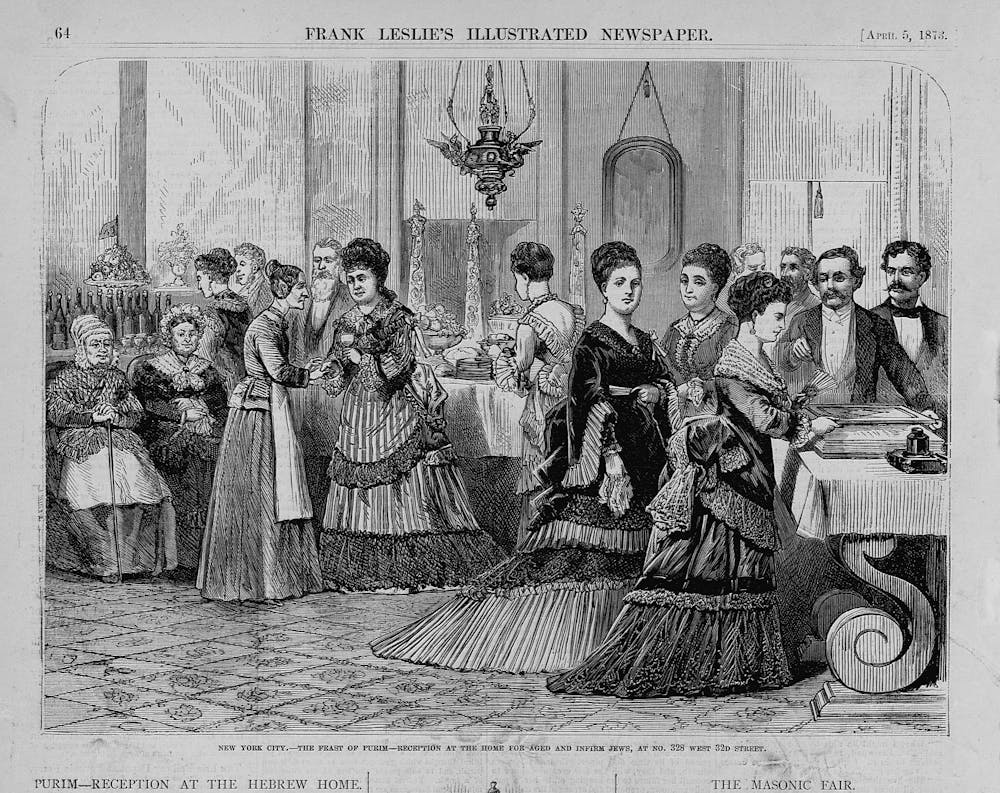
The Feast of Purim – Reception at the Home for Aged and Infirm Jews, at No. 328 West 32nd Street.
Corbis/Corbis via Getty Images
No one was quick to pick up on Isaacs’s recommendation, however. Isaacs tried again the following year, always in the pages of his father’s newspaper.
In 1862, he took more concrete steps. The 20-year-old gathered a small group of first-generation American Jews with aspirations to appear on a routine basis in the New York society columns. They organized the first Purim ball at Irving Hall, a prominent theater space in Manhattan, decorating the space with ornaments and plenty of pageantry such as entertainment and plays.
New York statute forbade masquerades, so Isaacs and his friends publicized it to wealthy New Yorkers as a “Fancy Dress Ball.” The guests, Jews and non-Jews, intuited the meaning and appeared dressed as Little Red Riding Hood and Shakespearean figures such as Romeo and Hamlet. Even though it was a Purim event, there was no mention that anyone was expected to dress up as Queen Esther.
The affair was very well received by attendees, compelling Isaacs to formalize the Purim Association of the City of New York to help ensure the newfound tradition persisted.
The Purim Ball straddled the line between a Jewish ritual and a New York society event. Yet, it hewed in the direction of the latter, attracting the leading women and men of New York. The mayor, police chief and leading figures of Tammany Hall frequented the balls. The Purim Association did not hold the gala on the actual date of Purim — usually it was held the day after or in the subsequent week — allowing New York’s Jews to observe Purim with its more traditional and less extravagant trappings.
The Purim Ball’s second installment was upgraded to the grander and more capacious Academy of Music. Its organizers distributed 800 invitations, which turned out to be quite insufficient. In all, 3,000 women and men attended the ball in March 1863. A report published in the New York Times declared that a “more brilliant affair has never been witnessed at the Academy.”
The Times article stated, “Very many exquisite evening toilettes set off the charms of the black-eyed belles in the boxes, and the universal masculine verdict is, that so many pretty faces have never before been seen at any one occasion, within the walls of the Academy.”
A Manhattan ‘institution’

Persian food for Purim – Pistachio Rosewater Hamantaschen.
Tom McCorkle for The Washington Post via Getty Images; food styling by Lisa Cherkasky for The Washington Post via Getty Images
The masquerade theme might have fit into Purim tradition, but Isaacs intended for it to accommodate all New Yorkers. As Isaac then wrote in the Jewish Messenger, he wanted it to “come off in such a way as to justify the suggestion that all New York is celebrating Purim.”
The favorable reviews were sufficient for Isaacs to declare that the Purim Ball had emerged, by its second iteration, as a Manhattan “institution,” an affair “naturalized in New York.”
The archives at the American Jewish Historical Society reveal that the top-priced seating boxes went to couples with Jewish surnames such as Seligman, Rosenwald, Schiff and Guggenheim. The Purim Association spared no expense on the music.
New York socialites and leading politicians continued to gravitate to the event, looking forward to the Purim Ball. Tickets for the event, sold at auction, did not last long on the open market, especially the preferred theater boxes.
By the 1890s, the Purim Association rented a larger space in Madison Square Garden and held bidding for the choicest seats in the vestry room of one of New York’s most well-heeled synagogue, Temple Emanu-El.
Beyond New York
The success of New York’s Purim Ball inspired others to organize similar events. By the 1880s, it was replicated in dozens of communities.
St. Louis’s Jews were very proud of their “well-regulated” masquerade ball which, they claimed was “one of the most enjoyable affairs in the society world.”
In 1891, the Purim program held in Philadelphia, much influenced by a local aristocratic spirit, was fashioned more like a debutante ball, a coming-of-age event for upper-class young ladies.
The Purim Ball, then, was a cultural transaction. Jews believed it led them to acquire status and America obtained a curious and swanky incarnation of Purim, in New York and beyond.
This article is republished from The Conversation, a nonprofit news organization dedicated to unlocking ideas from academia, under a Creative Commons license.
[Deep knowledge, daily. Sign up for The Conversation’s newsletter.]

About Zev Eleff
Zev Eleff is an Associate Professor of Jewish History at Touro College. You can read more about the author here.
Previous Post

February 22, 2021
What are the origins of Lent?

Browse Our Archives
Select a Category Buddhism Christianity Hinduism Islam Judaism Religion and society Uncategorized
Select a Month July 2024 March 2024 February 2024 January 2024 December 2023 November 2023 October 2023 September 2023 August 2023 July 2023 January 2023 August 2022 July 2022 April 2022 February 2022 January 2022 October 2021 July 2021 June 2021 May 2021 April 2021 March 2021 February 2021 January 2021 December 2020 November 2020 October 2020 September 2020 August 2020 July 2020 June 2020 May 2020
Follow Us!
TAKE THE
Religious Wisdom Quiz
Who provided bread and Goliath's sword to David at Nob?
Select your answer to see how you score.
Abiathar Abner Ahimelech the priest Jonathan
Related posts from The Conversation
Hanukkah Celebrations Have Changed Dramatically − But The...
Rosh Hashana and Yom Kippur Are Times For...

What the pope’s visit to Mongolia says about...
How 'complementarianism' – the belief that God assigned...
TRENDING AT PATHEOS Religion News

Catholic Integralists believe that religious values – specifically Christian ones – should...

Electing A Virtuous President Would Make Immunity Irrelevant
Presidential immunity can bring with it many risks. So how can we...

Why The Olympic Games Are A ‘Civil Religious’...
Sporting events form a vital space where Americans display their 'civil religious...

After more than a decade of news, research updates, and insights on...

Q: Why do Southern Baptists and like-minded Protestants...
THE RELIGION GUY’S ANSWER: Why? Simple. Because they believe that’s what the...

THE QUESTION: Is gambling evil? THE RELIGION GUY’S ANSWER: Analysts anticipate a...
view all Religion News blogs
Ad-Free & Subscriber Log-In Subscription Support
- About Us
- 2026 Calendar
- Videos
- Podcasts
- Library of World Religions
- Faith In Media Tracker
- Advertise With Us
- Write for Us
- Privacy Policy
- Terms of Service
- Do Not Sell My Data
- Contact Us
- Radiant Digital
- Manage Newsletter Subscriptions
- Unsubscribe From Notifications
- Sitemap
Copyright 2008-2026, Patheos. All rights reserved.
Subscription Support Ad-Free & Subscriber Log-In
Follow Patheos