
BuddhistCatholicContemplativeEvangelicalGeneral ChristianHinduJewishLatter-day SaintMuslimNew VisionsProgressive Christian
Beliefs
- Buddhist
- Catholic
- Contemplative
- Evangelical
- General Christian
- Hindu
- Jewish
- Latter-day Saint
- More Voices
- Muslim
- New Visions
- Pagan
- Progressive Christian
Topics
- Religion News
- Food and Religion
- Sports and Religion
- Religious Art
- Religious Music and Entertainment
- Religious Events
- History and Religion
- Style and Religion
- Politics and Religion
- Women in Religion
- Recreation Outdoors and Religion
- Business Finance and Religion
- Careers Workplace and Religion
- Education and Religion
- Family Parenting and Religion
- Health Fitness and Religion
- Home and Religion
- Relationships and Religion
- Technology and Religion
- Travel and Religion
Columnists
- Buddhist Columnists
- Business Finance and Religion Columnists
- Careers Workplace and Religion Columnists
- Catholic Columnists
- Contemplative Columnists
- Education and Religion Columnists
- Evangelists Columnists
- Family Parenting and Religion Columnists
- General Christian Columnists
- Health Fitness and Religion Columnists
- Hindu Columnists
- History and Religion Columnists
- Home and Religion Columnists
- Jewish Columnists
- More Voices Columnists
- Latter Day Columnists
- Muslim Columnists
- New Visions Columnists
- Nonreligious Columnists
- Pagan Columnists
- Politics and Religion Columnists
- Progressive Columnists
- Recreation Outdoors and Religion Columnists
- Relationships and Religion Columnists
- Religion News Columnists
- Religious Art Columnists
- Religious Events Columnists
- Religious Music and Entertainment Columnists
- Sports and Religion Columnists
- Style and Religion Columnists
- Technology and Religion Columnists
- Travel and Religion Columnists
- Women in Religion Columnists
Resource Library
- 2026 Calendar
- Library of World Religions
- The 100 Most Holy Places on Earth
- Patheos Answers
- Podcasts
- Videos
- Faith Leaders Database
- Anglican Episcopalian
- Bahai
- Baptist
- Buddhism
- Christianity
- Confucianism
- Eastern Orthodoxy
- Hinduism
- Holiness and Pentecostal
- ISKCON
- Islam
- Judaism
- Lutheran
- Methodist
- The Church of Jesus Christ of Latter-day Saints
- New Age
- Paganism
- Presbytarian and Reformed
- Protestantism
- Religion Behind the Scenes
- Roman Catholic
- Scientology
- Shia Islam
- Sikhism
- Sufism
- Sunni Islam
- Taoism
- Zen
- See all religions
Research Tools
 Ad-Free & Subscriber Log-In Subscription Support
Ad-Free & Subscriber Log-In Subscription Support
Follow Patheos 

- Trending:
- Forgiveness
- |
- Marriage
- |
- Consciousness
- |
- Death Penalty
- |
- Election
- |
- Halloween

- Home
- Religion News
- Think US evangelicals are dying out? Well, define evangelicalism …
Think US evangelicals are dying out? Well, define evangelicalism …
Last updated on: January 27, 2021 at 2:18 pm by The Conversation
Think US evangelicals are dying out? Well, define evangelicalism … 2021-01-27T14:18:07-04:00 The Conversation
Patheos Explore the world's faith through different perspectives on religion and spirituality! Patheos has the views of the prevalent religions and spiritualities of the world.
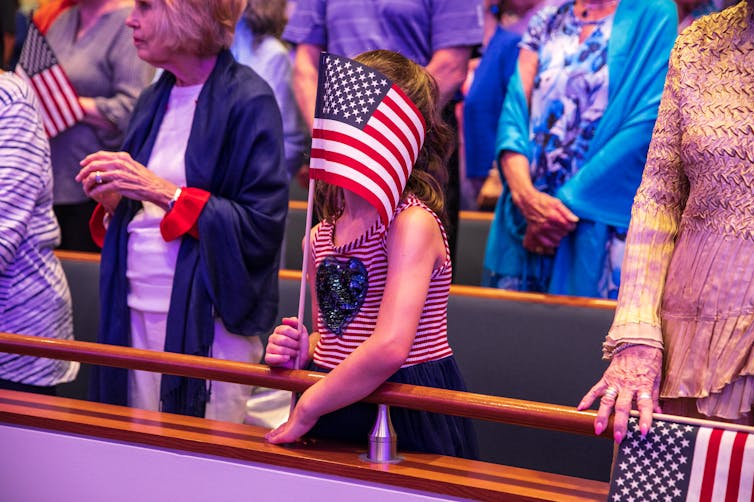
Not flagging, merely changing stripes.
The Washington Post via Getty Images
By Ryan Burge of Eastern Illinois University
The death spiral of evangelicalism has long been written about in both the religious and mainstream press.
The assumption is that evangelicalism has weathered the storms of secularization and politicization poorly. Journalist Eliza Griswold, writing for The New Yorker, chalks this up to the theological rigidity of evangelicals: that they have been structurally incapable of changing course quickly enough to stem the tide.
Others have suggested that the alliance between white evangelicalism and Republicanism is largely to blame for the decline of evangelicals. They believe that becoming so intertwined with the polarizing figure of former President Donald Trump has marginalized evangelicals in the public arena, making it even less likely for them to win over new converts.
While the share of Americans who identify as evangelical by religious tradition does seem to be falling – from 19% to 16% for white evangelicals, according to a recent Pew survey – that does, I believe, obscure a bigger and possibly more important story.
Looking at the data from a slightly different angle suggests that the share of Americans who self-identify as evangelicals has not changed in any meaningful way over the past decade. In fact, larger shares of Americans have said that they have had a born-again experience in 2018 than at any point since 1972, according to the General Social Survey. Moreover, as someone who analyzes religious data, I believe the link with politics may in fact be a central reason evangelicals are not declining significantly as a share of the U.S. population.
Evangelicalism is not toxic
In both the General Social Survey, which has been asking questions about religion since 1972, and the Cooperative Congressional Election Study, which interviews tens of thousands of Americans every year, respondents are asked if they consider themselves “born-again” or “evangelical.” In 2008, 1 in 3 people who responded to the CCES said that they do see themselves as evangelical. In 2019, that number was 34.6%. In the GSS, the share who said that they had experienced a “born-again experience” has risen four percentage points during the same period.
These self-identification measures are so important because they allow researchers a window into the mind of the average person. If the term “evangelical” has become as radioactive as many people suggest, then it would seem reasonable that smaller percentages of the public would willingly take on the label – but they are not. Just the opposite, in fact.
But just because the share of Americans who identify as an evangelical has not changed in a statistically meaningful way doesn’t mean that the composition of that group has not. A crucial part of this story is that the term “evangelical” has, I believe, become somewhat detached from its theological roots and morphed into a term that seems to capture political sensibilities as well.
As political scientist John Green notes, “[evangelicals have] become very strongly associated with Republican and conservative politics, because since the days of Ronald Reagan up until today, that group of believers have moved in that direction politically.”
There’s evidence of this move from the theological to the political. In 2008, 59% of evangelicals said that they attended church at least once a week. Just 16% said that they attended services “seldom” or “never.”
By 2019, those percentages had shifted significantly. The share who were weekly attenders declined a full seven percentage points, to 52%. On the bottom end of the spectrum, nearly a quarter of self-identified evangelicals said that they attended church “seldom” or “never” (24.2%). The share who never attended nearly tripled from 2.7% in 2008 to 7.3% in 2019.
The implication is that for many of those who self-identified as “evangelical,” it is not just about devotion to a local church, but to a general orientation to the world. As Republicanism and the religious right have become more enmeshed, it seems logical to assume that these less religiously devout people may consider their evangelicalism to be a question of political identity, rather than religious beliefs and customs.
And this is apparent from another angle, as well. Respondents were asked to describe how important religion is in their daily lives. In 2008, over 80% of evangelicals said that religion was “very important” to them. But, as each year passed, that share began to decline. By 2019, 73.7% of evangelicals said that religion is “very important” – a decline of over seven percentage points in just 11 years.
Religious evangelicals may look at these numbers and think, “This is not what the term evangelical means.” The assumption is that the term describes those who place high value on the teachings of the Bible and strive to evangelize other people into their faith. However, that understanding of the term seems to be fading, replaced with a more amorphous concept that melds together religious doctrine and an affinity for conservative politics that experts are only beginning to understand now. For instance, in her book “From Politics to Pews,” scholar Michele Margolis argues that people are choosing their religious affiliation based on their political partisanship with greater frequency now than in prior decades.
No one gets to claim ownership over a word – especially one that is so fraught as the term “evangelical.” The data offer some insight into how the definition might be evolving, not how it is defined in theological texts and social science manuscripts.
This article is republished from The Conversation, a nonprofit news organization dedicated to unlocking ideas from academia, under a Creative Commons license.
[Deep knowledge, daily. Sign up for The Conversation’s newsletter.]

About Ryan Burge
Ryan Burge is an Assistant Professor of Political Science at Eastern Illinois University. You can read more about the author here.
Previous Post

January 23, 2021
5 strategies for cultivating hope this year
Next Post
January 28, 2021 The problem with India's 'love jihad' laws
Browse Our Archives
Select a Category Buddhism Christianity Hinduism Islam Judaism Religion and society Uncategorized
Select a Month July 2024 March 2024 February 2024 January 2024 December 2023 November 2023 October 2023 September 2023 August 2023 July 2023 January 2023 August 2022 July 2022 April 2022 February 2022 January 2022 October 2021 July 2021 June 2021 May 2021 April 2021 March 2021 February 2021 January 2021 December 2020 November 2020 October 2020 September 2020 August 2020 July 2020 June 2020 May 2020
Follow Us!
TAKE THE
Religious Wisdom Quiz
I cleansed the temple in sixteen days and celebrated Passover so joyfully that we extended it another seven days. Who am I?
Select your answer to see how you score.
Asa Hezekiah Jehoshaphat Josiah
Related posts from The Conversation


Electing A Virtuous President Would Make Immunity Irrelevant

Why The Olympic Games Are A ‘Civil Religious’...

The Catholic Church Is Using The Olympics To...
TRENDING AT PATHEOS Religion News

Catholic Integralists believe that religious values – specifically Christian ones – should...

Electing A Virtuous President Would Make Immunity Irrelevant
Presidential immunity can bring with it many risks. So how can we...

Why The Olympic Games Are A ‘Civil Religious’...
Sporting events form a vital space where Americans display their 'civil religious...

After more than a decade of news, research updates, and insights on...

Q: Why do Southern Baptists and like-minded Protestants...
THE RELIGION GUY’S ANSWER: Why? Simple. Because they believe that’s what the...

THE QUESTION: Is gambling evil? THE RELIGION GUY’S ANSWER: Analysts anticipate a...
view all Religion News blogs
Ad-Free & Subscriber Log-In Subscription Support
- About Us
- 2026 Calendar
- Videos
- Podcasts
- Library of World Religions
- Faith In Media Tracker
- Advertise With Us
- Write for Us
- Privacy Policy
- Terms of Service
- Do Not Sell My Data
- Contact Us
- Radiant Digital
- Manage Newsletter Subscriptions
- Unsubscribe From Notifications
- Sitemap
Copyright 2008-2026, Patheos. All rights reserved.
Subscription Support Ad-Free & Subscriber Log-In
Follow Patheos