
BuddhistCatholicContemplativeEvangelicalGeneral ChristianHinduJewishLatter-day SaintMuslimNew VisionsProgressive Christian
Beliefs
- Buddhist
- Catholic
- Contemplative
- Evangelical
- General Christian
- Hindu
- Jewish
- Latter-day Saint
- More Voices
- Muslim
- New Visions
- Pagan
- Progressive Christian
Topics
- Religion News
- Food and Religion
- Sports and Religion
- Religious Art
- Religious Music and Entertainment
- Religious Events
- History and Religion
- Style and Religion
- Politics and Religion
- Women in Religion
- Recreation Outdoors and Religion
- Business Finance and Religion
- Careers Workplace and Religion
- Education and Religion
- Family Parenting and Religion
- Health Fitness and Religion
- Home and Religion
- Relationships and Religion
- Technology and Religion
- Travel and Religion
Columnists
- Buddhist Columnists
- Business Finance and Religion Columnists
- Careers Workplace and Religion Columnists
- Catholic Columnists
- Contemplative Columnists
- Education and Religion Columnists
- Evangelists Columnists
- Family Parenting and Religion Columnists
- General Christian Columnists
- Health Fitness and Religion Columnists
- Hindu Columnists
- History and Religion Columnists
- Home and Religion Columnists
- Jewish Columnists
- More Voices Columnists
- Latter Day Columnists
- Muslim Columnists
- New Visions Columnists
- Nonreligious Columnists
- Pagan Columnists
- Politics and Religion Columnists
- Progressive Columnists
- Recreation Outdoors and Religion Columnists
- Relationships and Religion Columnists
- Religion News Columnists
- Religious Art Columnists
- Religious Events Columnists
- Religious Music and Entertainment Columnists
- Sports and Religion Columnists
- Style and Religion Columnists
- Technology and Religion Columnists
- Travel and Religion Columnists
- Women in Religion Columnists
Resource Library
- 2026 Calendar
- Library of World Religions
- The 100 Most Holy Places on Earth
- Patheos Answers
- Podcasts
- Videos
- Faith Leaders Database
- Anglican Episcopalian
- Bahai
- Baptist
- Buddhism
- Christianity
- Confucianism
- Eastern Orthodoxy
- Hinduism
- Holiness and Pentecostal
- ISKCON
- Islam
- Judaism
- Lutheran
- Methodist
- The Church of Jesus Christ of Latter-day Saints
- New Age
- Paganism
- Presbytarian and Reformed
- Protestantism
- Religion Behind the Scenes
- Roman Catholic
- Scientology
- Shia Islam
- Sikhism
- Sufism
- Sunni Islam
- Taoism
- Zen
- See all religions
Research Tools
 Ad-Free & Subscriber Log-In Subscription Support
Ad-Free & Subscriber Log-In Subscription Support
Follow Patheos 

- Trending:
- Forgiveness
- |
- Marriage
- |
- Consciousness
- |
- Death Penalty
- |
- Election
- |
- Halloween

- Home
- Religion News
- The psychology of fairness: Why some Americans don’t believe the election results
The psychology of fairness: Why some Americans don’t believe the election results
Last updated on: January 4, 2021 at 2:18 pm by The Conversation
The psychology of fairness: Why some Americans don’t believe the election results 2021-01-04T14:18:23-04:00 The Conversation
Patheos Explore the world's faith through different perspectives on religion and spirituality! Patheos has the views of the prevalent religions and spiritualities of the world.
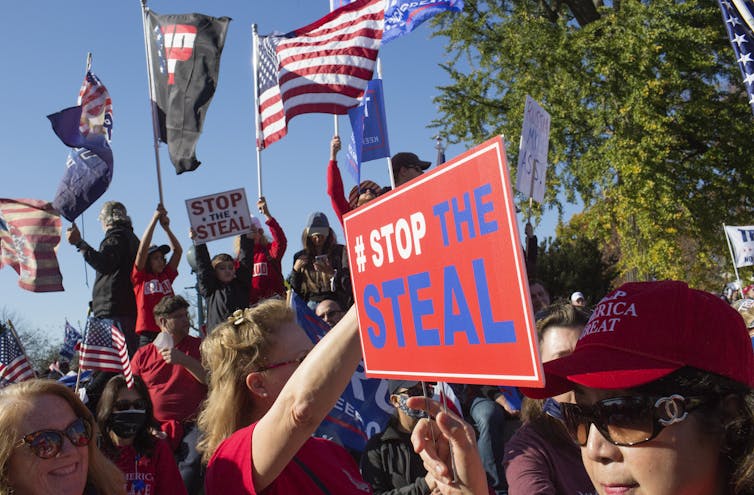
Polls show that some three-quarters of Republicans claim the election was rigged.
Andrew Lichtenstein/Corbis News via Getty Images
By David M. Mayer of University of Michigan
The electoral votes have confirmed Joe Biden won the 2020 United States presidential election. The presidential electors gave Biden 306 electoral votes to President Donald Trump’s 232 votes. Biden also recorded a solid lead of over 7 million in the popular vote.
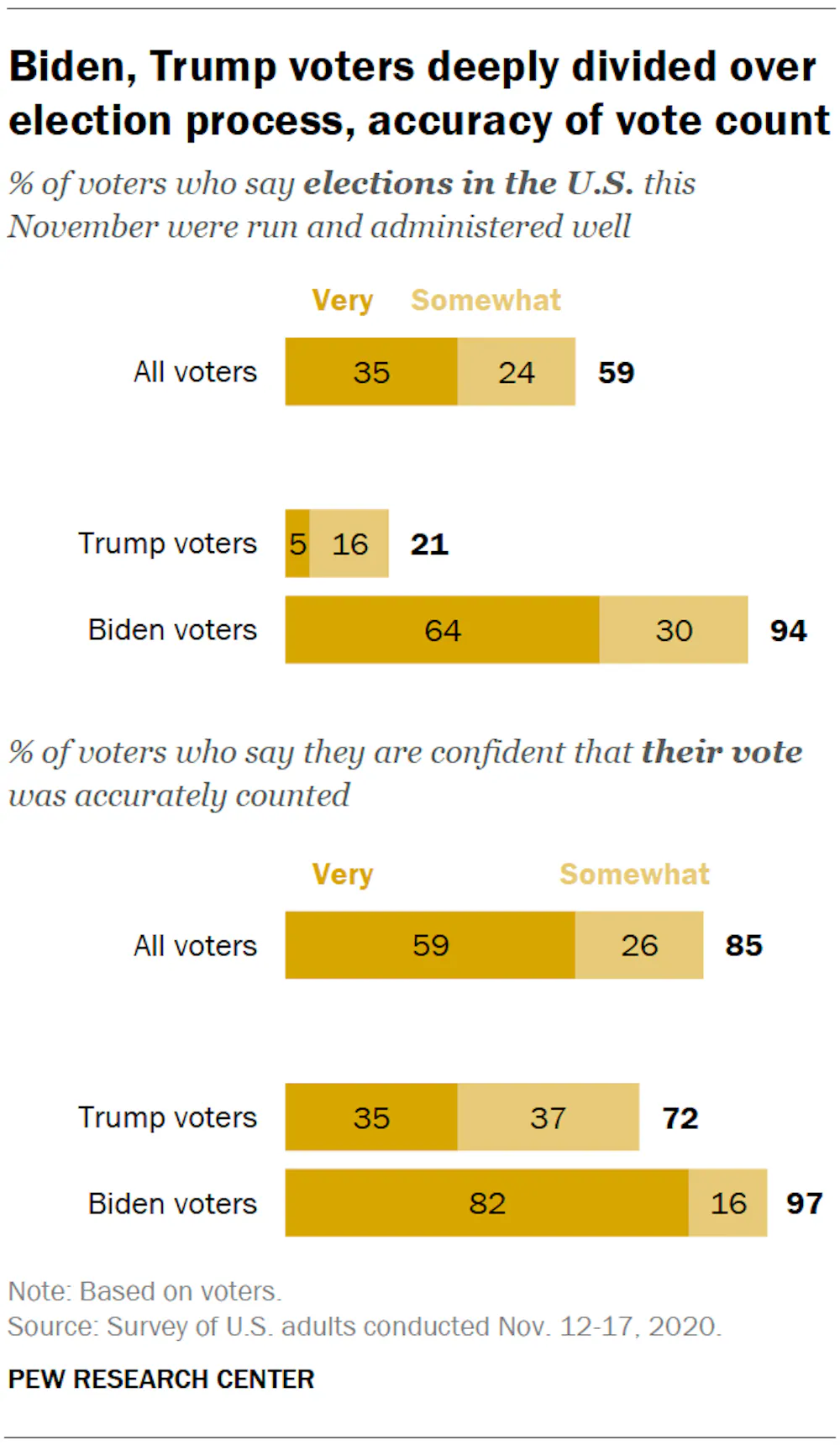
Voters deeply divided over election process and accuracy of vote count.
Based on voter survey of U.S. adults conducted Nov. 12-17, 2020. Pew Research Center, Washington, D.C., CC BY
Nonetheless, results from a new NPR/PBS NewsHour/Marist survey found that approximately three-quarters of Republicans did not trust the election results. Corroborating this finding, a separate study of 24,000 Americans found that nearly two-thirds of Republicans lacked confidence in the fairness of the election and over 80% feared fraud, inaccuracy, bias and illegality. In addition, nearly 60 lawsuits filed by Trump claiming various forms of election fraud have been dismissed, including two evaluated by the U.S. Supreme Court.
Of course, doubting the fairness of a disappointing decision is not a Republican phenomenon – it’s a human one.
When a decision is made and people get the outcome they want, they often tend to see the outcome as fair. For example, when people apply for a promotion and get it, they are more than likely to believe they deserved it. But if they didn’t get the promotion, it is likely to drive a different reaction. At that point, the process used to make the decision becomes of utmost importance. Some might ask whether the process was free of bias, consistent and ethical.
To investigate this perplexing phenomenon, it’s important to understand the psychology of fairness.
Fair procedures usually matter
Research consistently finds that when people get an unfavorable outcome but believe the process used to make the decision was fair, they react more positively.
They may be disappointed, but they tend to accept the decision and stay loyal to the institution that made the decision. This is known as the “fair process effect”: the tendency for fair procedures to mitigate negative reactions to an unfavorable decision.
However, research my colleagues and I conducted in 2009 identifies an important caveat to this effect. We found that when an unfavorable decision is very important to someone – that it is central to their identity as part of a group or their personal values – they tend to look for flaws demonstrating that the process used to make the decision was unfair.
In the first study, we asked 180 university students about a decision that the administration would soon make about limiting the free speech of students. We manipulated whether the outcome was favorable such that half of the students were told the administration planned to restrict free speech and the other half were told there would be no restrictions. We also manipulated the process by telling students they had an opportunity to express their concerns in a public forum or did not have that opportunity.
We then assessed whether the decision made by the administration violated students’ identity as a member of the university and their personal values.
We found that when students felt the decision violated their social or personal identity, they perceived the process and outcome were unfair even when they had the opportunity to express their views at a public forum. In other words, there was a weak or no relationship between providing an opportunity for voice and fairness perceptions for people whose identity was violated.
In the second study we asked 277 adults with work experience about a time a decision was made at work when the outcome was favorable (or not) and the process was fair (or not).
As in the prior study, we found that an objectively fair process did not improve fairness perceptions when an outcome violated one’s identity. Instead, these participants were more likely to say that there was a procedural flaw – they doubted the opinions they provided to the decision-maker were ever considered.
The fact that they did not get the outcome they wanted on something that was central to their identity led participants to seek out reasons that an objectively fair process was somehow flawed in a meaningful way. They felt the need to discredit the process.
These findings are consistent with other research showing that for those who have a strong moral stance on an issue,judgments about whether the process and outcome are fair are determined more by whether the outcome was favorable than whether the procedure was objectively fair.
For example, when participants supported abortion rights, and a defendant in a trial was not convicted of bombing a clinic that performed abortions, these participants believed the trial process was less fair than those who held anti-abortion rights beliefs.
Similarly, when participants held anti-abortion rights beliefs and a physician on trial for providing illegal late-term abortions was acquitted, participants believed the trial was less fair than did those with abortion-rights beliefs. When we care deeply about an issue and get an unfavorable outcome, we question the process used to make the decision.
What can you do?
In an environment in which partisan and identity politics rule, perhaps it is not surprising that a decision that hurts one’s in-group – in this case, Republican supporters – is dismissed on the basis of perceived procedural flaws that render the election unfair despite objective reality.
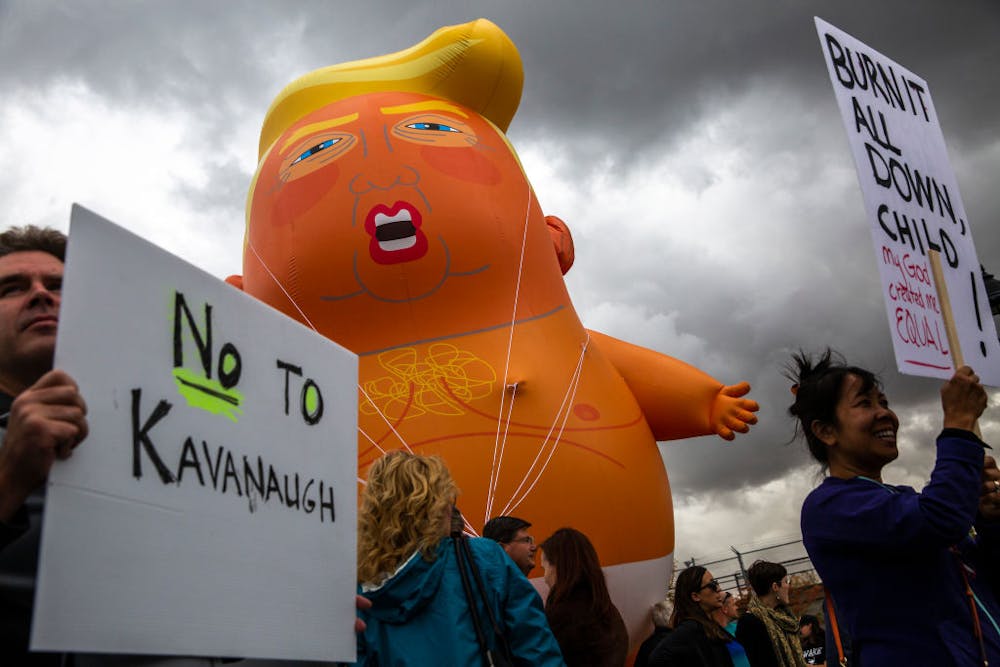
After Brett Kavanaugh’s confirmation as a Supreme Court justice, there were those who claimed that the hearings were unjust.
VW Pics/Universal Images Group via Getty Images
Of course, the act of discounting the fairness of a decision process when a decision violates one’s identity is not limited to one political party. For example, after Brett Kavanaugh was confirmed as a Supreme Court justice, Democrats tended to believe that his confirmation hearings were unjust, including the withholding of important evidence.
Given that anyone can fall victim to this bias, several things can be done. First, it is important for leaders to legitimize the decision process. For example, when an organization makes a policy change to extend or reduce the number of remote days of work per week, it is important for leadership at all levels to clarify there was reasonable and fair process used to make the decision.
Second, it is critical to ask someone who is impartial. When wrestling with an ethical conundrum, people often come to a conclusion that is aligned with their self-interest – what psychologists call “motivated moral reasoning.” Thus, a neutral person can more accurately assess the decision.
Third, reducing how much a person feels distinct and isolated from members of another group by not dehumanizing members of the other group can lessen beliefs that a decision process was rigged or biased.
People often do not get the outcome they want on issues central to their identity, so it is important to actively guard against questioning the legitimacy of an objective and fair process.
This article is republished from The Conversation, a nonprofit news organization dedicated to unlocking ideas from academia, under a Creative Commons license.
[Deep knowledge, daily. Sign up for The Conversation’s newsletter.]

About David M. Mayer
David M. Mayer is a Professor of Management & Organizations at the University of Michigan. You can read more about the author here.


Browse Our Archives
Select a Category Buddhism Christianity Hinduism Islam Judaism Religion and society Uncategorized
Select a Month July 2024 March 2024 February 2024 January 2024 December 2023 November 2023 October 2023 September 2023 August 2023 July 2023 January 2023 August 2022 July 2022 April 2022 February 2022 January 2022 October 2021 July 2021 June 2021 May 2021 April 2021 March 2021 February 2021 January 2021 December 2020 November 2020 October 2020 September 2020 August 2020 July 2020 June 2020 May 2020
Follow Us!
TAKE THE
Religious Wisdom Quiz
"______ is the same yesterday and today and forever."
Select your answer to see how you score.
The Universe Jesus Christ God's Plan Our Calling
Related posts from The Conversation


Electing A Virtuous President Would Make Immunity Irrelevant

Why The Olympic Games Are A ‘Civil Religious’...

The Catholic Church Is Using The Olympics To...
TRENDING AT PATHEOS Religion News

Catholic Integralists believe that religious values – specifically Christian ones – should...

Electing A Virtuous President Would Make Immunity Irrelevant
Presidential immunity can bring with it many risks. So how can we...

Why The Olympic Games Are A ‘Civil Religious’...
Sporting events form a vital space where Americans display their 'civil religious...

After more than a decade of news, research updates, and insights on...

Q: Why do Southern Baptists and like-minded Protestants...
THE RELIGION GUY’S ANSWER: Why? Simple. Because they believe that’s what the...

THE QUESTION: Is gambling evil? THE RELIGION GUY’S ANSWER: Analysts anticipate a...
view all Religion News blogs
Ad-Free & Subscriber Log-In Subscription Support
- About Us
- 2026 Calendar
- Videos
- Podcasts
- Library of World Religions
- Faith In Media Tracker
- Advertise With Us
- Write for Us
- Privacy Policy
- Terms of Service
- Do Not Sell My Data
- Contact Us
- Radiant Digital
- Manage Newsletter Subscriptions
- Unsubscribe From Notifications
- Sitemap
Copyright 2008-2026, Patheos. All rights reserved.
Subscription Support Ad-Free & Subscriber Log-In
Follow Patheos