
BuddhistCatholicContemplativeEvangelicalGeneral ChristianHinduJewishLatter-day SaintMuslimNew VisionsProgressive Christian
Beliefs
- Buddhist
- Catholic
- Contemplative
- Evangelical
- General Christian
- Hindu
- Jewish
- Latter-day Saint
- More Voices
- Muslim
- New Visions
- Pagan
- Progressive Christian
Topics
- Religion News
- Food and Religion
- Sports and Religion
- Religious Art
- Religious Music and Entertainment
- Religious Events
- History and Religion
- Style and Religion
- Politics and Religion
- Women in Religion
- Recreation Outdoors and Religion
- Business Finance and Religion
- Careers Workplace and Religion
- Education and Religion
- Family Parenting and Religion
- Health Fitness and Religion
- Home and Religion
- Relationships and Religion
- Technology and Religion
- Travel and Religion
Columnists
- Buddhist Columnists
- Business Finance and Religion Columnists
- Careers Workplace and Religion Columnists
- Catholic Columnists
- Contemplative Columnists
- Education and Religion Columnists
- Evangelists Columnists
- Family Parenting and Religion Columnists
- General Christian Columnists
- Health Fitness and Religion Columnists
- Hindu Columnists
- History and Religion Columnists
- Home and Religion Columnists
- Jewish Columnists
- More Voices Columnists
- Latter Day Columnists
- Muslim Columnists
- New Visions Columnists
- Nonreligious Columnists
- Pagan Columnists
- Politics and Religion Columnists
- Progressive Columnists
- Recreation Outdoors and Religion Columnists
- Relationships and Religion Columnists
- Religion News Columnists
- Religious Art Columnists
- Religious Events Columnists
- Religious Music and Entertainment Columnists
- Sports and Religion Columnists
- Style and Religion Columnists
- Technology and Religion Columnists
- Travel and Religion Columnists
- Women in Religion Columnists
Resource Library
- 2026 Calendar
- Library of World Religions
- The 100 Most Holy Places on Earth
- Patheos Answers
- Podcasts
- Videos
- Faith Leaders Database
- Anglican Episcopalian
- Bahai
- Baptist
- Buddhism
- Christianity
- Confucianism
- Eastern Orthodoxy
- Hinduism
- Holiness and Pentecostal
- ISKCON
- Islam
- Judaism
- Lutheran
- Methodist
- The Church of Jesus Christ of Latter-day Saints
- New Age
- Paganism
- Presbytarian and Reformed
- Protestantism
- Religion Behind the Scenes
- Roman Catholic
- Scientology
- Shia Islam
- Sikhism
- Sufism
- Sunni Islam
- Taoism
- Zen
- See all religions
Research Tools
 Ad-Free & Subscriber Log-In Subscription Support
Ad-Free & Subscriber Log-In Subscription Support
Follow Patheos 

- Trending:
- Forgiveness
- |
- Marriage
- |
- Consciousness
- |
- Death Penalty
- |
- Election
- |
- Halloween

- Home
- Religion News
- The problem with India’s ‘love jihad’ laws
The problem with India’s ‘love jihad’ laws
Last updated on: January 28, 2021 at 7:18 am by The Conversation
The problem with India’s ‘love jihad’ laws 2021-01-27T14:19:06-04:00 The Conversation
Patheos Explore the world's faith through different perspectives on religion and spirituality! Patheos has the views of the prevalent religions and spiritualities of the world.
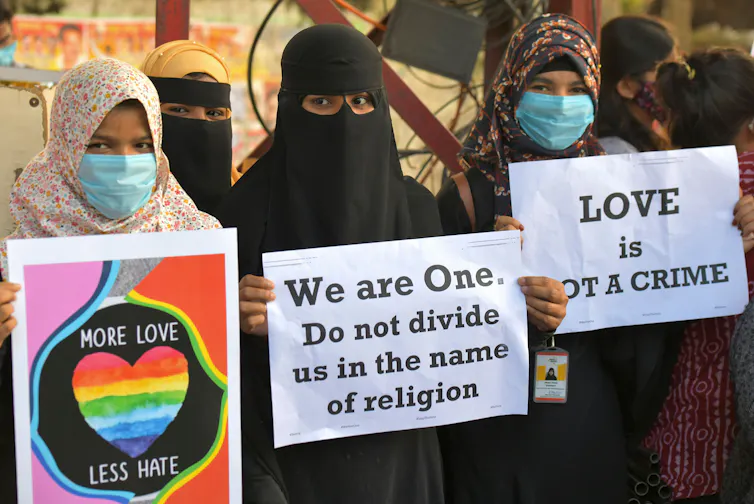
Activist protest against ‘love jihad’ laws being proposed in India.
Manjunath Kiran/AFP via Getty Images
By Sumit Ganguly of Indiana University
Under Prime Minister Narendra Modi’s leadership, the Bharatiya Janata Party government has put forward several anti-Muslim policies. The latest is a clampdown on what it sees as “love jihad,” the belief that Muslims are seeking to deceive Hindu women through marriage and convert them to Islam.
Over the course of the past year or so several BJP politicians have suggested that this is part of an Islamic conspiracy to increase India’s Muslim population.
More recently, one of India’s most populous states has assumed the right to intervene in matters of marriage – particularly between a Hindu woman and a Muslim man. Other states are planning to follow suit.
A new law on marriage
As a political scientist, I see the rapid growth of religious tensions/conflicts in India as a continuation of BJP’s anti-Muslim policies.
Despite being a Hindu-majority country, India is home to nearly 200 million Muslims.
Since the BJP came to power with a clear majority in parliament in August 2019, it stripped the special provisions in the Indian Constitution that had granted a substantial degree of autonomy to India’s only Muslim-majority state, Jammu and Kashmir – now a Union Territory, an arrangement in India’s federal dispensation under the direct rule of the national government.
In 2019, the Indian government also passed the Citizenship Amendment Act, which eases the pathway to citizenship for a range of religious groups from India’s neighboring countries but excludes Muslims.
Now, in its latest move, India’s most populous state, Uttar Pradesh, where about a fifth of the population is Muslim and the state government is led by the BJP, has taken to policing the private lives of its citizens. In November, the state passed the first “love jihad” law in the country.
Known as the Prohibition of Unlawful Religious Conversion Ordinance, it requires couples from different religious communities to provide two months’ notice to a district magistrate before getting married. A district magistrate is an official belonging to India’s administrative services – a vestige of the British colonial rule – who is in charge of the district, the basic unit of administration, and has legal as well as significant executive powers.
Under the terms of the ordinance, the presiding judicial official would have the discretion to decide whether the conversion was through compulsion; the offending person could then be denied bail and sentenced to 10 years in prison. The irony of this issue is that few individuals routinely choose to marry outside their religious affiliation.
Notionally, this law applies with equal force to all interfaith marriages. However, for all practical purposes this would affect Muslims, as Islamic personal law requires a non-Muslim to convert to sanctify the marriage. So far, enforcement has targeted only Hindu-Muslim marriages. Since its passage last year, as many as 30 Muslim men arrested in Uttar Pradesh are facing possible prosecution. It remains unclear at this stage what sanctions Muslim women marrying Hindu men might confront.
Following the lead of Uttar Pradesh, four other BJP-ruled states introducing similar legislation. In late December, the central state of Madhya Pradesh passed the Freedom of Religion Bill, which would also place similar restrictions on interreligious marriage. This law also holds the possibility of 10 years’ imprisonment.
Since the BJP holds a majority in the state legislature, there is a strong possibility of this becoming a law. Thus far there has not been any effort to enact a national law. Currently, the BJP rules in 16 out of India’s 29 states, and several other states are said to be considering enacting such a law.
Anti-conversion fervor
The strong opposition to any kind of conversion goes back to British India. In the 1920s, a Hindu revivalist movement known as “shuddhi” emerged. It sought to reconvert those who had chosen to embrace other faiths, most notably Islam. At the time interfaith marriages were a rarity.
The movement had a strongly patriarchal tenor and portrayed Hindu women as hapless victims of the ruses of Muslim men. This movement, while it initially acquired a degree of support, faded out as other more compelling social and political issues, such as anti-colonial nationalism, came to the fore.
A somewhat similar fervor, I argue, has now returned in independent India. Apart from this legislative onslaught, two other recent incidents in particular bear particular mention.
The first involved a television advertisement for a high-end jewelry chain that was launched on Indian television in October. The advertisement was from Tanishq, an affiliate of one of India’s largest conglomerates, the Tata Group, and was titled “Ekatvam,” or “unity” in Hindi.
The advertisement depicted a Hindu woman and a Muslim man preparing for a wedding. As soon as the advertisements were aired, some Hindu activists protested vigorously on social media. The company, fearing violence, withdrew the advertisement altogether.
The other episode took place in November when Netflix aired BBC’s adaptation of the novel “A Suitable Boy” by the acclaimed Indian writer Vikram Seth.
Once again, some Hindu activists protested because it depicted a Hindu-Muslim couple’s passionate kiss. The activists claimed that the film was “encouraging love jihad” and had “hurt religious sentiments.”
Accordingly, they demanded that it be forthrightly withdrawn. A minister in the state of Madhya Pradesh lodged a formal police complaint against the showing of the film, and further investigations are on.
The perils of modernity
Urban couples in India are increasingly stepping out from the tradition of arranged marriages and choosing their own life partners, sometimes across religious lines. No previous government has sought to regulate such choices. However, under the Modi government, right-wing Hindu groups are harassing such couples.
Activists have spoken out vigorously against this tide of vigilantism, and some regional courts have questioned the very basis of a law that encroaches on individual freedoms.
However, at a time when personal choices are under attack, Prime Minister Narendra Modi has maintained a studious silence.
This article is republished from The Conversation, a nonprofit news organization dedicated to unlocking ideas from academia, under a Creative Commons license.
[Deep knowledge, daily. Sign up for The Conversation’s newsletter.]

About Sumit Ganguly
Sumit Ganguly is a Distinguished Professor of Political Science and the Tagore Chair in Indian Cultures and Civilizations at Indiana University. You can read more about the author here.
Previous Post

January 27, 2021
Think US evangelicals are dying out? Well, define evangelicalism ...

Browse Our Archives
Select a Category Buddhism Christianity Hinduism Islam Judaism Religion and society Uncategorized
Select a Month July 2024 March 2024 February 2024 January 2024 December 2023 November 2023 October 2023 September 2023 August 2023 July 2023 January 2023 August 2022 July 2022 April 2022 February 2022 January 2022 October 2021 July 2021 June 2021 May 2021 April 2021 March 2021 February 2021 January 2021 December 2020 November 2020 October 2020 September 2020 August 2020 July 2020 June 2020 May 2020
Follow Us!
TAKE THE
Religious Wisdom Quiz
I asked, 'What must I do to be saved?' after an earthquake freed my prisoners. Who am I?
Select your answer to see how you score.
A Roman centurion Cornelius The Ethiopian eunuch The Philippian jailer
Related posts from The Conversation


Electing A Virtuous President Would Make Immunity Irrelevant

Why The Olympic Games Are A ‘Civil Religious’...

The Catholic Church Is Using The Olympics To...
TRENDING AT PATHEOS Religion News

Catholic Integralists believe that religious values – specifically Christian ones – should...

Electing A Virtuous President Would Make Immunity Irrelevant
Presidential immunity can bring with it many risks. So how can we...

Why The Olympic Games Are A ‘Civil Religious’...
Sporting events form a vital space where Americans display their 'civil religious...

After more than a decade of news, research updates, and insights on...

Q: Why do Southern Baptists and like-minded Protestants...
THE RELIGION GUY’S ANSWER: Why? Simple. Because they believe that’s what the...

THE QUESTION: Is gambling evil? THE RELIGION GUY’S ANSWER: Analysts anticipate a...
view all Religion News blogs
Ad-Free & Subscriber Log-In Subscription Support
- About Us
- 2026 Calendar
- Videos
- Podcasts
- Library of World Religions
- Faith In Media Tracker
- Advertise With Us
- Write for Us
- Privacy Policy
- Terms of Service
- Do Not Sell My Data
- Contact Us
- Radiant Digital
- Manage Newsletter Subscriptions
- Unsubscribe From Notifications
- Sitemap
Copyright 2008-2026, Patheos. All rights reserved.
Subscription Support Ad-Free & Subscriber Log-In
Follow Patheos