
BuddhistCatholicContemplativeEvangelicalGeneral ChristianHinduJewishLatter-day SaintMuslimNew VisionsProgressive Christian
Beliefs
- Buddhist
- Catholic
- Contemplative
- Evangelical
- General Christian
- Hindu
- Jewish
- Latter-day Saint
- More Voices
- Muslim
- New Visions
- Pagan
- Progressive Christian
Topics
- Religion News
- Food and Religion
- Sports and Religion
- Religious Art
- Religious Music and Entertainment
- Religious Events
- History and Religion
- Style and Religion
- Politics and Religion
- Women in Religion
- Recreation Outdoors and Religion
- Business Finance and Religion
- Careers Workplace and Religion
- Education and Religion
- Family Parenting and Religion
- Health Fitness and Religion
- Home and Religion
- Relationships and Religion
- Technology and Religion
- Travel and Religion
Columnists
- Buddhist Columnists
- Business Finance and Religion Columnists
- Careers Workplace and Religion Columnists
- Catholic Columnists
- Contemplative Columnists
- Education and Religion Columnists
- Evangelists Columnists
- Family Parenting and Religion Columnists
- General Christian Columnists
- Health Fitness and Religion Columnists
- Hindu Columnists
- History and Religion Columnists
- Home and Religion Columnists
- Jewish Columnists
- More Voices Columnists
- Latter Day Columnists
- Muslim Columnists
- New Visions Columnists
- Nonreligious Columnists
- Pagan Columnists
- Politics and Religion Columnists
- Progressive Columnists
- Recreation Outdoors and Religion Columnists
- Relationships and Religion Columnists
- Religion News Columnists
- Religious Art Columnists
- Religious Events Columnists
- Religious Music and Entertainment Columnists
- Sports and Religion Columnists
- Style and Religion Columnists
- Technology and Religion Columnists
- Travel and Religion Columnists
- Women in Religion Columnists
Resource Library
- 2026 Calendar
- Library of World Religions
- The 100 Most Holy Places on Earth
- Patheos Answers
- Podcasts
- Videos
- Faith Leaders Database
- Anglican Episcopalian
- Bahai
- Baptist
- Buddhism
- Christianity
- Confucianism
- Eastern Orthodoxy
- Hinduism
- Holiness and Pentecostal
- ISKCON
- Islam
- Judaism
- Lutheran
- Methodist
- The Church of Jesus Christ of Latter-day Saints
- New Age
- Paganism
- Presbytarian and Reformed
- Protestantism
- Religion Behind the Scenes
- Roman Catholic
- Scientology
- Shia Islam
- Sikhism
- Sufism
- Sunni Islam
- Taoism
- Zen
- See all religions
Research Tools
 Ad-Free & Subscriber Log-In Subscription Support
Ad-Free & Subscriber Log-In Subscription Support
Follow Patheos 

- Trending:
- Forgiveness
- |
- Marriage
- |
- Consciousness
- |
- Death Penalty
- |
- Election
- |
- Halloween

- Home
- Religion News
- The morality of feeling equal empathy for strangers and family alike
The morality of feeling equal empathy for strangers and family alike
Last updated on: January 6, 2021 at 5:15 pm by The Conversation
The morality of feeling equal empathy for strangers and family alike 2021-01-06T17:15:39-04:00 The Conversation
Patheos Explore the world's faith through different perspectives on religion and spirituality! Patheos has the views of the prevalent religions and spiritualities of the world.
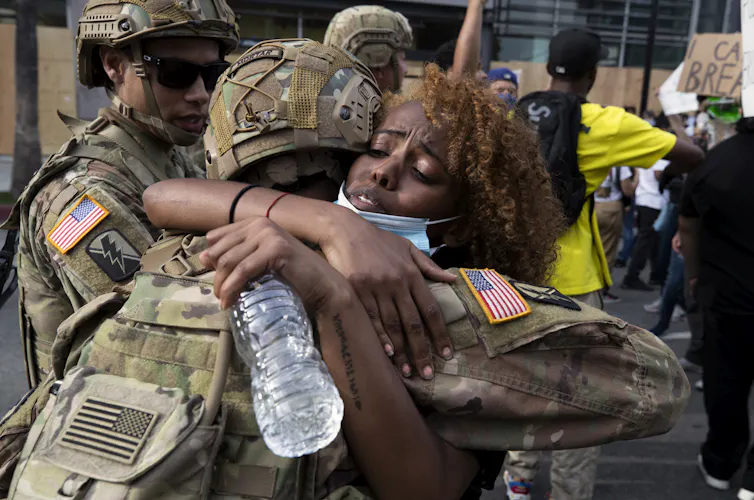
In a divided nation, a little empathy goes a long way.
Brent Stirton/Getty Images
By Brendan Gaesser and Zoë Fowler of University at Albany, State University of New York
The year 2020 was no stranger to suffering. In the midst of a global pandemic, widespread financial hardship and violence arising from systemic racism, empathy for others’ suffering has been pushed to the front and center in U.S. society.
As society grapples to find its moral compass in a time of such hardship and strife, a critical question emerges: Whose suffering should one care about?
When you ponder who is worth feeling empathy for, friends, family members and children might come to mind. But what about strangers, or people not connected to you through nationality, social status or race?
As cognitive scientists, we wanted to understand what moral beliefs people hold about empathy and how these beliefs may shift depending on whom someone is feeling empathy for.
Empathy as a force for good
Evidence suggests that empathy – broadly defined as the ability to understand and share in someone else’s experience – can be a force for good. Numerous studies have shown it often leads to altruistic helping behavior. Further, feeling empathy for a member of a stigmatized group can reduce prejudice and improve attitudes toward the entire stigmatized group.
But there has also been research suggesting empathy may contribute to bias and injustice. Studies have shown that people tend to feel more empathy for the suffering of those who are close and similar to themselves, such as someone of the same race or nationality, than for those who are more distant or dissimilar. This bias in empathy has consequences. For example, people are less likely to donate time or money to help someone of a different nationality compared with someone of their own nationality.
Neuroscientists have shown that this bias is evident in how our brains process both firsthand and secondhand pain. In one such study, participants received a painful shock and also watched another person receive a painful shock. There was greater similarity in participants’ neural activity when the person they observed rooted for the same sports team as themselves.
Whether empathy has a positive impact on society or not has been the subject of a fierce debate spanning politics, philosophy and psychology. Some scholars have suggested empathy should be denounced as too narrow in scope and inherently biased to have a place in our moral lives.
Others have argued that empathy is a particularly potent force that can motivate many people to help others and can be expanded to be more inclusive.
What is largely left unconsidered is whether it could actually be our sense of what is right and wrong that limits our empathy. Perhaps many of us believe that inequality in empathy is right – that we should care more for those who are close and similar to us. In other words, loyalty is a greater moral force than equality.
The morality of empathy
In 2020, we ran a study to better understand the morality of empathy.
Three hundred participants from across the U.S. completed a study in which they were presented with a story describing an individual who is learning about global food scarcity. The individual reads about the struggles of two people in the story, one who is socially close – a friend or a family member – and another who is socially distant: for example, from a distant country. In different versions, the person in the story is described as feeling empathy for the stranger or for the friend or family member, or for both people equally, or for neither.
After reading the story, participants then rated how morally right or wrong they thought it was for this person to feel empathy in this manner.
When presented with stories in which the person feels either empathy solely for the friend/family member or the socially distant person, participants typically respond that it is more moral to feel empathy for the friend/family member. But participants judged feeling equal empathy as the most moral. Equal empathy was rated as 32% more morally right than feeling empathy for just one person in the story.
Friend or stranger?
Although this study suggested that people believed it more moral to have equal empathy, it left certain questions unanswered: What was behind the perceived morality of equal empathy? And would this pattern hold if people were judging their own feelings on empathy?
So we ran a follow-up study with a new sample of 300 people. This time we changed the story so that it was from the participants’ own perspective, and the two people in need were people they personally knew – one being someone close to them, the other an acquaintance. We also added endings to the story, so that participants could now also feel empathy for both people but to different degrees.
The results were remarkably similar to the first study: Feeling more empathy for one’s close friend or family member was seen as more moral. But most notably, feeling equal empathy for both people was again judged as the most moral outcome.
Where to go from here?
In a moment when fostering a culture of caring for those who are different seems challenging, our research may offer some insight and perhaps hope. It suggests that most people believe we should care about everyone equally.
With the right approach, this belief in the morality of equal empathy may even translate to real changes. Recent work has shown that empathy can be increased based on one’s motivation and personal beliefs. For example, participants who wrote a letter about how empathy can be grown and developed showed improvements in their ability to recognize others’ emotions, a major part of empathy.
We are undoubtedly living through an age in which people are divided by race, nationality and political affiliation. But we are all human beings, and we all deserve to be cared for on some level. Our research provides evidence that this principle of equality in empathy is not some obscure ideal. Rather, it is a tenet of our moral beliefs.

This article is republished from The Conversation, a nonprofit news organization dedicated to unlocking ideas from academia, under a Creative Commons license.
[Deep knowledge, daily. Sign up for The Conversation’s newsletter.]

About Brendan Gaesser
Brendan Gaesser is an Assistant Professor of Psychology at University at Albany, State University of New York. You can read more about the author here.


Browse Our Archives
Select a Category Buddhism Christianity Hinduism Islam Judaism Religion and society Uncategorized
Select a Month July 2024 March 2024 February 2024 January 2024 December 2023 November 2023 October 2023 September 2023 August 2023 July 2023 January 2023 August 2022 July 2022 April 2022 February 2022 January 2022 October 2021 July 2021 June 2021 May 2021 April 2021 March 2021 February 2021 January 2021 December 2020 November 2020 October 2020 September 2020 August 2020 July 2020 June 2020 May 2020
Follow Us!
TAKE THE
Religious Wisdom Quiz
Which Christian denomination practices the sacrament of Confirmation?
Select your answer to see how you score.
Baptist Catholic Jehovah’s Witnesses Methodist
Related posts from The Conversation


Electing A Virtuous President Would Make Immunity Irrelevant

Why The Olympic Games Are A ‘Civil Religious’...

The Catholic Church Is Using The Olympics To...
TRENDING AT PATHEOS Religion News

Catholic Integralists believe that religious values – specifically Christian ones – should...

Electing A Virtuous President Would Make Immunity Irrelevant
Presidential immunity can bring with it many risks. So how can we...

Why The Olympic Games Are A ‘Civil Religious’...
Sporting events form a vital space where Americans display their 'civil religious...

After more than a decade of news, research updates, and insights on...

Q: Why do Southern Baptists and like-minded Protestants...
THE RELIGION GUY’S ANSWER: Why? Simple. Because they believe that’s what the...

THE QUESTION: Is gambling evil? THE RELIGION GUY’S ANSWER: Analysts anticipate a...
view all Religion News blogs
Ad-Free & Subscriber Log-In Subscription Support
- About Us
- 2026 Calendar
- Videos
- Podcasts
- Library of World Religions
- Faith In Media Tracker
- Advertise With Us
- Write for Us
- Privacy Policy
- Terms of Service
- Do Not Sell My Data
- Contact Us
- Radiant Digital
- Manage Newsletter Subscriptions
- Unsubscribe From Notifications
- Sitemap
Copyright 2008-2026, Patheos. All rights reserved.
Subscription Support Ad-Free & Subscriber Log-In
Follow Patheos