
BuddhistCatholicContemplativeEvangelicalGeneral ChristianHinduJewishLatter-day SaintMuslimNew VisionsProgressive Christian
Beliefs
- Buddhist
- Catholic
- Contemplative
- Evangelical
- General Christian
- Hindu
- Jewish
- Latter-day Saint
- More Voices
- Muslim
- New Visions
- Pagan
- Progressive Christian
Topics
- Religion News
- Food and Religion
- Sports and Religion
- Religious Art
- Religious Music and Entertainment
- Religious Events
- History and Religion
- Style and Religion
- Politics and Religion
- Women in Religion
- Recreation Outdoors and Religion
- Business Finance and Religion
- Careers Workplace and Religion
- Education and Religion
- Family Parenting and Religion
- Health Fitness and Religion
- Home and Religion
- Relationships and Religion
- Technology and Religion
- Travel and Religion
Columnists
- Buddhist Columnists
- Business Finance and Religion Columnists
- Careers Workplace and Religion Columnists
- Catholic Columnists
- Contemplative Columnists
- Education and Religion Columnists
- Evangelists Columnists
- Family Parenting and Religion Columnists
- General Christian Columnists
- Health Fitness and Religion Columnists
- Hindu Columnists
- History and Religion Columnists
- Home and Religion Columnists
- Jewish Columnists
- More Voices Columnists
- Latter Day Columnists
- Muslim Columnists
- New Visions Columnists
- Nonreligious Columnists
- Pagan Columnists
- Politics and Religion Columnists
- Progressive Columnists
- Recreation Outdoors and Religion Columnists
- Relationships and Religion Columnists
- Religion News Columnists
- Religious Art Columnists
- Religious Events Columnists
- Religious Music and Entertainment Columnists
- Sports and Religion Columnists
- Style and Religion Columnists
- Technology and Religion Columnists
- Travel and Religion Columnists
- Women in Religion Columnists
Resource Library
- 2026 Calendar
- Library of World Religions
- The 100 Most Holy Places on Earth
- Patheos Answers
- Podcasts
- Videos
- Faith Leaders Database
- Anglican Episcopalian
- Bahai
- Baptist
- Buddhism
- Christianity
- Confucianism
- Eastern Orthodoxy
- Hinduism
- Holiness and Pentecostal
- ISKCON
- Islam
- Judaism
- Lutheran
- Methodist
- The Church of Jesus Christ of Latter-day Saints
- New Age
- Paganism
- Presbytarian and Reformed
- Protestantism
- Religion Behind the Scenes
- Roman Catholic
- Scientology
- Shia Islam
- Sikhism
- Sufism
- Sunni Islam
- Taoism
- Zen
- See all religions
Research Tools
 Ad-Free & Subscriber Log-In Subscription Support
Ad-Free & Subscriber Log-In Subscription Support
Follow Patheos 

- Trending:
- Forgiveness
- |
- Marriage
- |
- Consciousness
- |
- Death Penalty
- |
- Election
- |
- Halloween

- Home
- Religion News
- Ready to try an old approach to a New Year’s resolution? The story of Saint Ignatius may provide some guidance
Ready to try an old approach to a New Year’s resolution? The story of Saint Ignatius may provide some guidance
Last updated on: January 6, 2021 at 5:17 pm by The Conversation
Ready to try an old approach to a New Year’s resolution? The story of Saint Ignatius may provide some guidance 2021-01-06T17:17:48-04:00 The Conversation
Patheos Explore the world's faith through different perspectives on religion and spirituality! Patheos has the views of the prevalent religions and spiritualities of the world.
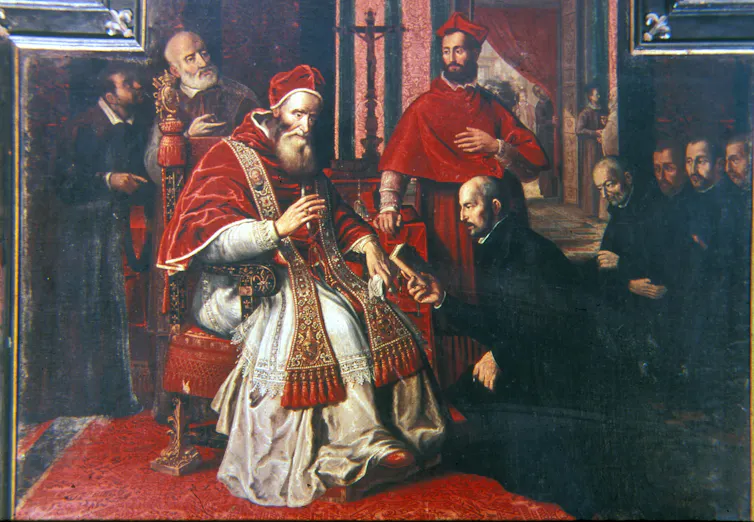
Saint Ignatius of Loyola with Pope Paul III.
Roger Viollet Collection/Getty Images
By Gordon Rixon, S.J. of Regis College at the University of Toronto
Making and breaking New Year’s resolutions is a familiar and discouraging annual ritual for many people.
Almost inevitably, in a few short weeks, many find they are unable to meet their goals of self-improvement, be it keeping a positive attitude, improving one’s health or looking for the best in people. Some might even feel diminished as a result of this failure.
The problem, as I see it, is that most people set out with their resolutions often without identifying a practical path for the journey.
As a scholar of systematic theology, I believe that Saint Ignatius of Loyola, a 16th-century Spanish courtier, provides insightful guidance. He managed to reverse his life’s direction to pursue a spiritual path.
Who was Ignatius?
Born in 1491, Iñigo, later known as Ignatius, was the youngest son of a minor noble family in the Basque region of Spain who left home at the age of 18 to win his place at the royal court.
Over a decade later, as he lay confined to bed recuperating from injuries suffered in the Battle of Pamplona against the French, he daydreamed about potential future exploits at court or service to God and humanity.
It was at that time that he started to notice the subtle development of his feelings. When he dreamed about courtly heroism he later felt depleted, but when he reflected about serving God he felt a deep, lasting and energizing peace.
Reflection about his growing self-awareness led him to make a radical change in the direction of his life. He chose to put aside his quest for glory to serve God and creation, especially his fellow humans, whether friends or strangers.
He met a group of university students who became his companions. In 1540, they together founded the Society of Jesus, commonly known as the Jesuits, a community of priests and brothers that became known throughout the world for spiritual development, preparatory and university education and justice advocacy.
Challenges before Ignatius
This path was not smooth for Ignatius. In the course of his work, he suffered many setbacks, such as suspicion and rejection by church authorities, but he came to a better understanding of himself and his path through those challenges.
As Ignatius narrates in an account of his life, which he related just before his death to a fellow Jesuit, the key is not to become suddenly perfect but to learn how to walk patiently and deliberately to grow in love and service despite imperfection.
Ignatius relates his self-driven determination to preach to pilgrims in Jerusalem. His intention, however, was not well received by church authorities, who thought he was poorly prepared. This rejection led him to further his education and become more flexible about how he understood his role in serving God.
He writes about how he was easily provoked to self-righteous anger. Once he took offense when a fellow traveler made an insulting comment about the Virgin Mary. Only the stubborn donkey he was riding saved him from pursuing the other traveler and acting on a murderous rage.
In the sharing of his story, Ignatius does not want his biography to become the center of attention. He provides an example of moving beyond the isolated facts of his life journey to reflect about their interconnected meaning and a way of looking beyond.
As the scholar of renaissance rhetoric Marjorie O’Rourke Boyle suggests, Ignatius is using the story about himself to redirect his readers’ attention to God and a higher purpose. Unflinching about relating his own faults, Ignatius encourages individuals to reflect on their desires, resources and vulnerabilities as a way to grow.
Practical guidance from Ignatius
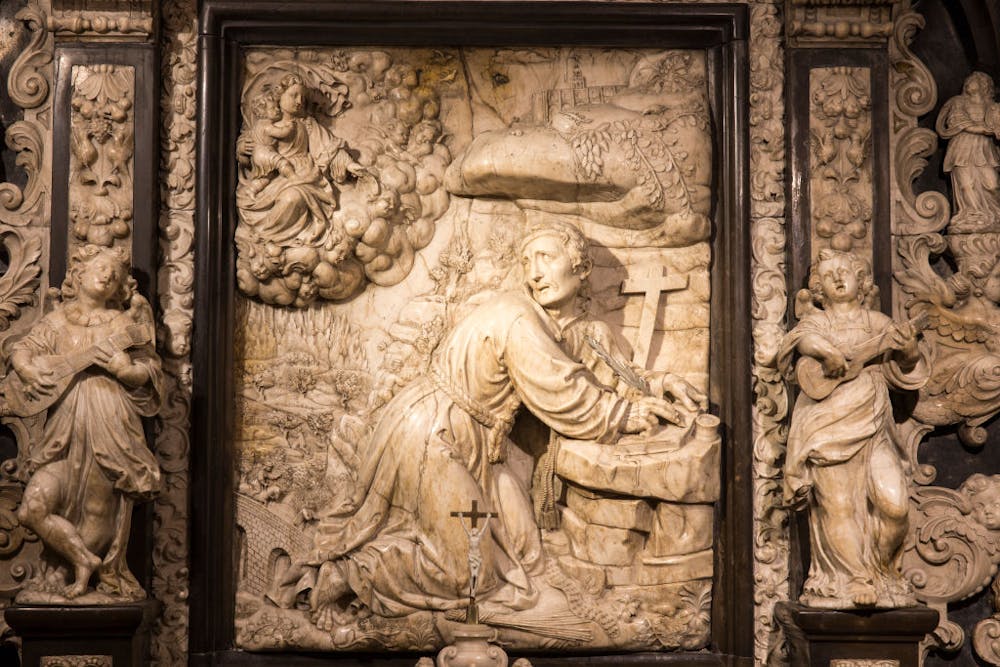
The cave in Manresa, Spain where Saint Ignatius is said to have prayed from March 1522 to February 1523 and wrote his spiritual exercises.
Christian Ender / Contributor/Getty Images News
In the “Spiritual Exercises,” his manual for prayer guides, Ignatius suggests a five-step daily process, known as the “Examen,” as a way to tell and retell life-transforming stories. These, I believe, are practical recommendations that could help people realize their resolutions in the New Year.
- Start with a realistic, accurate and encouraging assessment of your current situation. Ignatius would always begin his moments of reflective self-assessment by reaffirming his gratitude for life and opportunities to serve in a project larger than himself. Acknowledge strengths, vulnerabilities, positive and negative feelings, and areas of encouragement and discouragement as gifts.
- Be open to the light of a larger perspective. Call upon the assistance of a higher power to reveal the big picture that holds together the pieces of the journey through the day. Expect to be surprised by new insights.
- Focus on the events of today. Create a story that links the episodes of the day and your goals together. Ignatius would move beyond just listing strengths, weakness and feelings to discover how they advanced or impeded his goal to serve God and others.
- Identify the moments of darkness and discouragement that resist being drawn into your story. Ask what episodes disrupt your understanding of yourself and the world. Find new perspective by deepening your commitment to a higher purpose.
Much like the beliefs in other religions, Ignatius turns to his faith to find a new perspective during difficult moments. Christianity and other religious traditions such as Buddhism, Confucianism, Hinduism, Islam and Judaism help find purpose in a compassionate and merciful love that inspires and guides day-to-day actions, each in their own way.
As a Christian, Ignatius looked especially to the example of compassionate self-sacrifice in Jesus’ death on the Cross to hold difficult moments in a higher faith perspective. By committing to accept the cost of positive action in the face of his own failings or opposition by others, Ignatius was able to move through obstacles and find encouragement and strength to advance his story.
Finally, reflect on how your story offers direction and energy to move forward to the next day. By incorporating discouraging moments into the flow of a larger story, Ignatius learned how to move beyond the shame and confusion caused by failure and misdeeds to a healthy sense of sorrow. It helped Ignatius find a higher purpose.
Like Ignatius, many of us may need to revise our resolutions and reflect on how we may proceed, even when we feel discouraged.

This article is republished from The Conversation, a nonprofit news organization dedicated to unlocking ideas from academia, under a Creative Commons license.
[Deep knowledge, daily. Sign up for The Conversation’s newsletter.]

About Gordon Rixon, S.J.
Gordon Rixon is an Associate Professor of Systematic Theology the University of Toronto. You can read more about the author here.
Previous Post

January 6, 2021
The morality of feeling equal empathy for strangers and family alike

Browse Our Archives
Select a Category Buddhism Christianity Hinduism Islam Judaism Religion and society Uncategorized
Select a Month July 2024 March 2024 February 2024 January 2024 December 2023 November 2023 October 2023 September 2023 August 2023 July 2023 January 2023 August 2022 July 2022 April 2022 February 2022 January 2022 October 2021 July 2021 June 2021 May 2021 April 2021 March 2021 February 2021 January 2021 December 2020 November 2020 October 2020 September 2020 August 2020 July 2020 June 2020 May 2020
Follow Us!
TAKE THE
Religious Wisdom Quiz
How long did it take to rebuild Jerusalem's walls under Nehemiah?
Select your answer to see how you score.
40 days 52 days 7 years 12 months
Related posts from The Conversation


How Christians Hold Differing Views On The Resurrection
Latin America’s colonial period was less Catholic

Pope Francis called surrogacy ‘deplorable’
TRENDING AT PATHEOS Religion News

Catholic Integralists believe that religious values – specifically Christian ones – should...

Electing A Virtuous President Would Make Immunity Irrelevant
Presidential immunity can bring with it many risks. So how can we...

Why The Olympic Games Are A ‘Civil Religious’...
Sporting events form a vital space where Americans display their 'civil religious...

After more than a decade of news, research updates, and insights on...

Q: Why do Southern Baptists and like-minded Protestants...
THE RELIGION GUY’S ANSWER: Why? Simple. Because they believe that’s what the...

THE QUESTION: Is gambling evil? THE RELIGION GUY’S ANSWER: Analysts anticipate a...
view all Religion News blogs
Ad-Free & Subscriber Log-In Subscription Support
- About Us
- 2026 Calendar
- Videos
- Podcasts
- Library of World Religions
- Faith In Media Tracker
- Advertise With Us
- Write for Us
- Privacy Policy
- Terms of Service
- Do Not Sell My Data
- Contact Us
- Radiant Digital
- Manage Newsletter Subscriptions
- Unsubscribe From Notifications
- Sitemap
Copyright 2008-2026, Patheos. All rights reserved.
Subscription Support Ad-Free & Subscriber Log-In
Follow Patheos